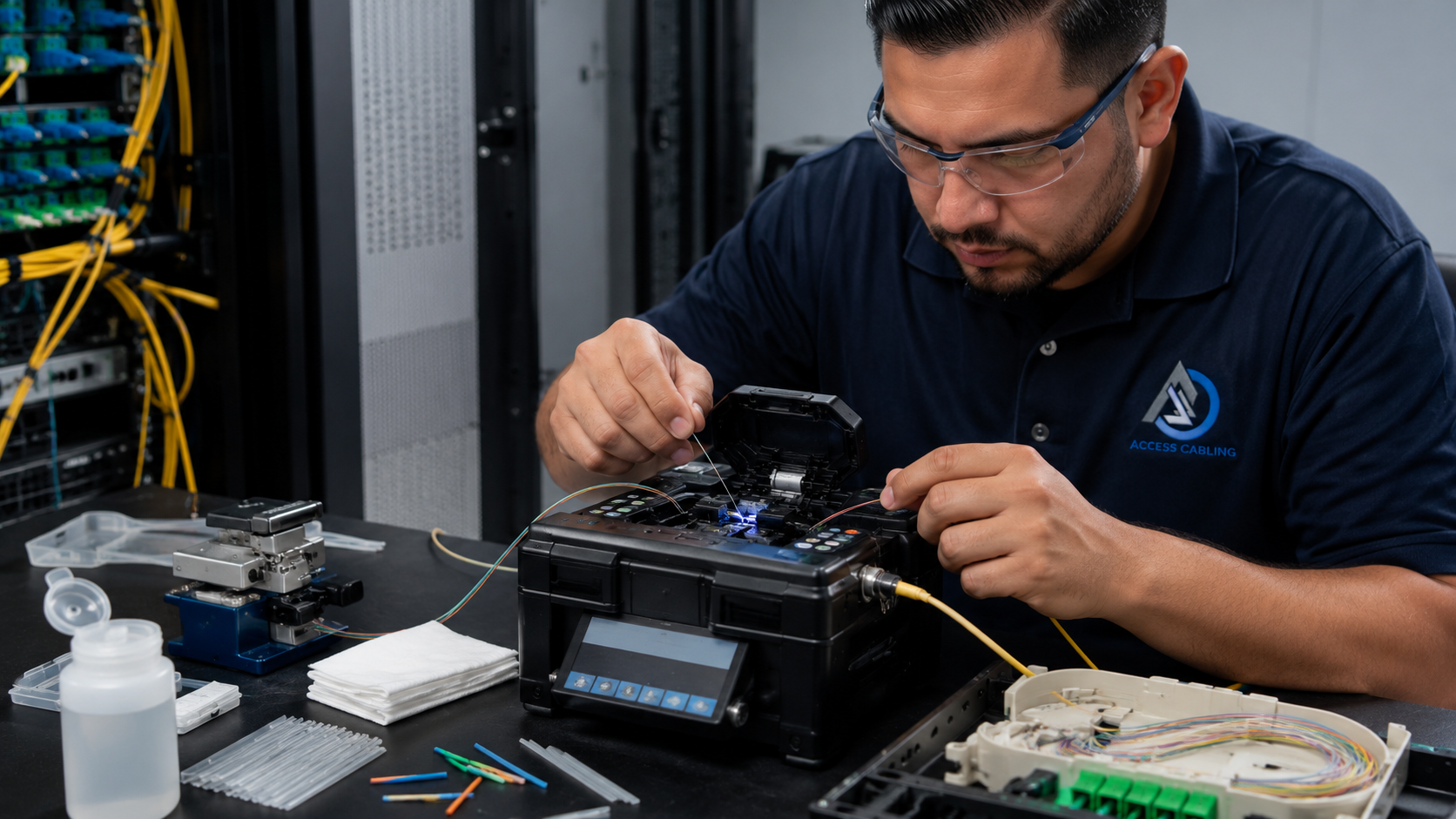
Access Cabling technician in safety glasses splicing fiber optic strands with a precision fusion splicer in a network room.
Commercial · Fiber

Fiber Optic Installation Services

Single-mode and multimode fiber installation, termination and testing.

28+ Years Experience
C-10 / C-7 Contractor
CSLB: 992009
Licensed Commercial Contractor
5 California Offices
California & Nationwide Service

Request a Fiber Optic Installation site survey

Free, no-obligation walkthrough. Licensed C-10 / C-7 (CSLB #992009). 28+ years, California & nationwide.

Request a site survey
Commercial Service Overview

Enterprise-grade fiber optic installation engineered for commercial buildings.

Fiber Optic Installation from Access Cabling delivers enterprise-grade fiber optic installation engineered by a licensed low-voltage contractor with 28+ years serving California and nationwide clients. Our BICSI-trained technicians design, install, terminate, test and certify every run to TIA/EIA standards so your infrastructure supports current bandwidth demands and future growth.

Access Cabling technician in safety glasses splicing fiber optic strands with a precision fusion splicer.
Key Benefits

Why fiber optic installation from Access Cabling

Commercial-grade installation, certified performance, and infrastructure built to last 25+ years.

Certified installation by BICSI-trained technicians
Manufacturer warranties up to 25 years on structured cabling
Fluke DSX certification reports on every project
Licensed C-10 / C-7 low-voltage contractor
24/7 emergency response and MAC services
Nationwide coverage with California headquarters
Installation Process

Our proven commercial cabling process

A repeatable, engineered process — refined over 28 years and thousands of sites.

  1. Step 1

    Free on-site survey and needs assessment

  2. Step 2

    Engineered design with rack elevations and pathway plans

  3. Step 3

    Scheduled installation with minimal business disruption

  4. Step 4

    Termination, testing, labeling and documentation

  5. Step 5

    Fluke certification and as-built drawings delivered

Fiber Optic Tray Installation

Engineered fiber pathways that protect every strand.

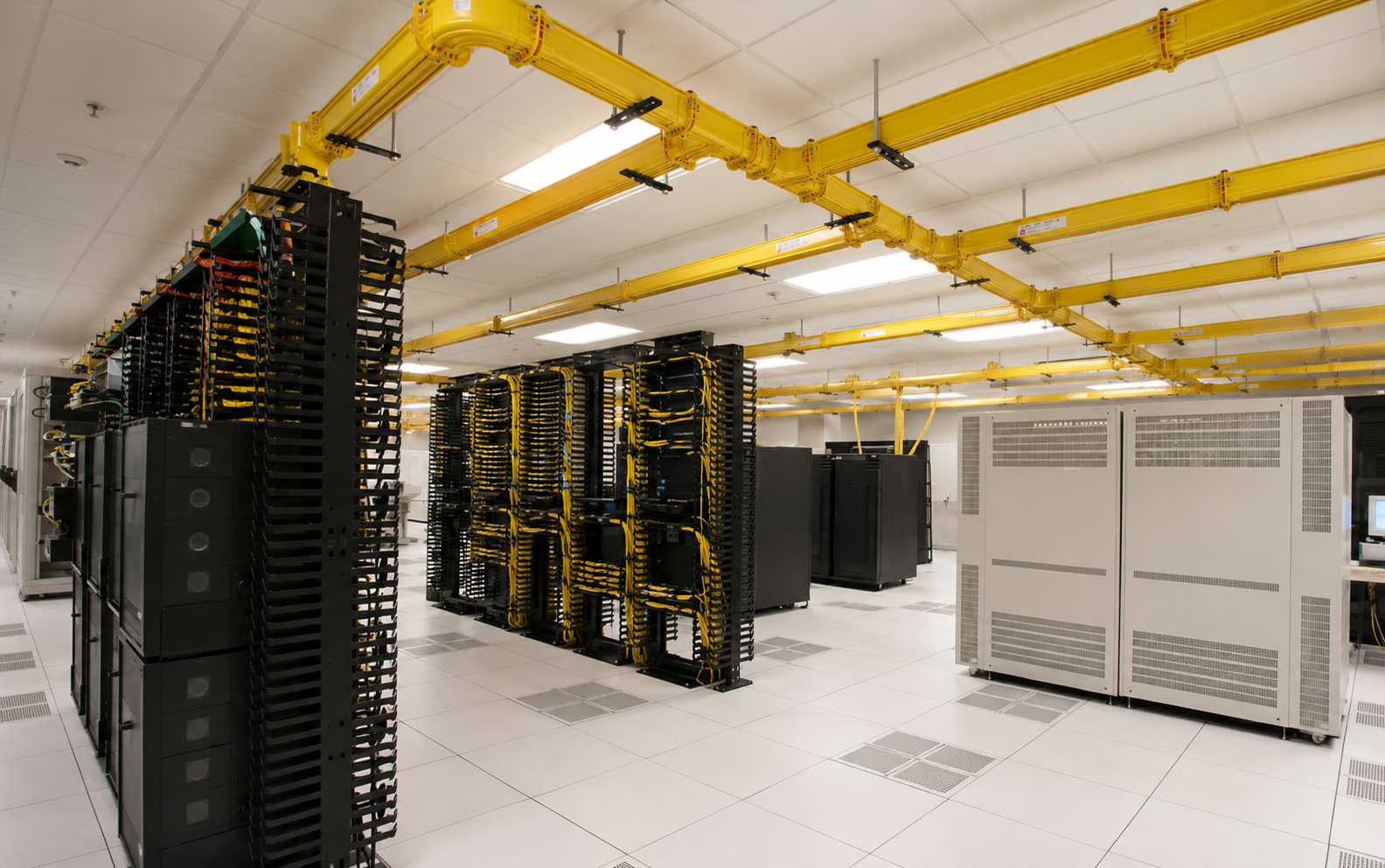
The yellow trays you see in a live data center are not decoration — they are a structured fiber raceway system that keeps single-mode and multimode fiber organized, accessible, and safe from crush, bend-radius, and thermal damage. Access Cabling designs and installs ladder rack, basket tray, and enclosed fiber raceways sized for current strand count plus future growth.

  • Overhead ladder rack and basket-tray routing above cabinets
  • Bend-radius management and strain relief at every transition
  • Separation from copper and power to avoid signal degradation
  • OS2 single-mode and OM3/OM4 multimode fiber tray layouts
  • Labeled tray segments and slack loops for fast MAC work
Enterprise data center with yellow fiber optic tray and ladder-rack pathways protecting single-mode and multimode fiber runs.
Industries Served

Fiber Optic Installation for every commercial environment

28+
Years
5
CA Offices
50
States
12M+
Feet Installed
Local Service Area

Fiber Optic Installation across California & nationwide

Local crews dispatched daily from five California offices. Multi-site rollouts across all 50 states.

In the LA / Orange County corridor, projects are dispatched from our Santa Fe Springs office at 10572 Norwalk Blvd, covering Whittier, Norwalk, Downey, Cerritos, La Mirada, and the surrounding industrial corridor.

In Depth

A closer look at fiber optic installation

Commercial fiber optic installation across California and nationwide — single-mode and multimode backbones, riser and plenum runs, campus and outside-plant, MDF/IDF interconnects, and data-center cross-connects. Access Cabling designs the topology, pulls and terminates the cable, fusion-splices where required, and delivers Tier 1 and Tier 2 Fluke/EXFO OTDR certification with a bound test report. Licensed C-10/C-7 (CSLB #992009), 28+ years, BICSI-trained crews.

When you actually need fiber (vs. copper)

Fiber is the right call for runs beyond 100m, any building-to-building or floor-to-floor backbone, 10/25/40/100G uplinks between switches, storage/HPC/AI fabrics, and environments with electrical noise, lightning exposure, or ground-loop risk. For workstation drops inside 100m, copper still wins on cost. Most commercial buildings end up with fiber backbones between MDF and each IDF, and copper (CAT6/6A) horizontal to the outlet — the classic hierarchical star topology called out in TIA-568.

Single-mode vs. multimode: pick once, live with it 20 years

OS2 single-mode (9µm core, yellow jacket) is the default for new commercial and campus backbones — it supports 10G to 100km, 100G to 40km, and every future speed roadmap without recabling. OM4 or OM5 multimode (50µm core, aqua or lime jacket) is cost-effective for short data-center reaches (10G to 400m, 40/100G to 150m) using less-expensive VCSEL optics. When budget allows we pull both to give IT a choice per link. OM1 (orange) and OM3 in legacy plants are supported but not specified new.

Cable construction we specify

Indoor riser (OFNR) or plenum (OFNP) tight-buffered distribution cable for inside-plant, indoor/outdoor loose-tube gel-filled or dry-block for building-to-building, armored for direct-bury or rodent-prone routes, and ADSS or figure-8 for aerial spans. Standard fiber counts: 12 or 24 for IDF backbones, 48-144 for MDF/campus backbones, 288+ for data-center rows. All cable is Corning, OFS, Prysmian, or Belden with matching connectors and panels.

Termination: fusion splice vs. field-polish vs. pre-term

For any single-mode span or any run that will be certified with an OTDR, we fusion-splice pigtails onto the field cable — this yields sub-0.1 dB splice loss and factory-quality connector geometry. For short multimode runs we sometimes use mechanical (Unicam-style) or fusion-splice-on connectors. For data-center rows and MDF core we prefer factory pre-terminated MTP/MPO trunks — faster deployment, guaranteed loss budget, no field polish variability. Every termination is LC, SC, or MTP with green (APC single-mode) or blue (UPC) boots as spec'd.

Testing: Tier 1 loss + Tier 2 OTDR trace

Every fiber link is tested with Fluke CertiFiber Pro or EXFO for Tier 1 insertion loss (dual-wavelength: 850/1300 for MM, 1310/1550 for SM) against the calculated loss budget, plus Tier 2 OTDR bidirectional trace showing every splice, connector, and event along the fiber. You receive .flw and .sor files plus a bound PDF report with pass/fail per link, loss headroom, and event map. Failed links are re-spliced or repulled at no cost. Certified installs qualify for 25-year Corning, CommScope, or Panduit system warranties.

Outside plant, aerial, and underground work

For campus and building-to-building runs we design pathway (conduit, innerduct, direct-bury, or aerial), pull permits, coordinate with utility locates (USA 811), and install to Corning/OFS OSP standards with proper slack loops, splice enclosures (Corning FOSC or 3M), pedestal or handhole terminations, and cable-in-conduit records. Aerial spans use Kevlar messenger or ADSS with proper sag/tension calcs. Every OSP run is documented with GPS points at pull-boxes and splice cases.

Documentation and warranty

Closeout package: as-built pathway drawings, fiber schematic showing every strand and splice, patch-panel port assignments, OTDR traces and loss reports, connector inspection photos (per IEC 61300-3-35), materials list, warranty registration, and firestop records. Delivered as a single PDF plus native OTDR files. Workmanship warranty is one year; manufacturer system warranty is 25 years when installed with certified end-to-end Corning or CommScope components.

Fiber optic cable installation cost: what commercial projects budget in 2026

Commercial fiber optic cable installation cost breaks into four line items: cable and pathway materials, terminations, fusion splicing, and Tier 1/Tier 2 certification. For a straightforward inside-plant backbone — 12 to 24 strands, MDF to a single IDF one floor apart, accessible pathway — budget roughly $6-$15 per foot installed and certified, plus $75-$150 per fusion splice and $150-$300 per LC/SC terminated pigtail. A typical 24-strand riser between two IDFs at 200 feet, fully spliced, terminated, and OTDR-tested, lands in the $6,000-$12,000 range all-in.

Outside-plant fiber installation cost varies far more because pathway drives the number: direct-burial in soft dirt with existing conduit adds $10-$25 per foot; directional bore under a road or parking lot adds $30-$75 per foot; aerial on existing pole plant with permitted attachments adds $8-$20 per foot. A 500-foot campus link between two buildings — trench, conduit, 12-strand OS2 armored cable, splice cases at both ends, and full certification — typically runs $18,000-$35,000 depending on ground conditions and permit scope. Data-center MTP/MPO pre-terminated trunks are quoted per assembly ($400-$1,200 each depending on length and fiber count) plus mobilization; they usually beat field termination on total cost above 24 strands.

The biggest cost lever on any fiber optic installation is single-mode vs. multimode and the strand count you pull. Pulling 48 strands instead of 12 adds maybe 15% to the material cost and almost nothing to labor — but re-pulling in year seven when you need more capacity costs 100% of the original job. For most commercial projects we recommend installing 4x the strands you need today, all OS2 single-mode, and terminating only what is needed at cutover. Every quote we send is fixed, line-itemized, and delivered within 48 hours of a site walk — no per-foot guessing.

Related Topics
  • Single-Mode Fiber (OS2)
  • Multimode Fiber (OM4/OM5)
  • Fusion Splicing
  • OTDR Certification
  • Campus Backbones
  • Outside Plant Fiber
  • Data Center Fiber
  • MTP/MPO Trunks
  • Fiber Loss Budgets
  • TIA-568 Standards
Ready To Build?

Request a quote for your fiber optic installation project

Share your scope — square footage, drop or device count, and timeline — and a senior estimator returns a written, itemized proposal within 48 hours. Free site survey, no obligation.

  • Licensed C-7 / C-10 (CSLB #992009)
  • Fluke-certified, 25-yr warranty
  • California & nationwide crews
  • Written proposal in 48 hours
Manufacturers

Products & manufacturers we install

Vendor-agnostic. We specify best-in-class components for each project — copper, fiber, racks, power, wireless and access control from the industry's leading manufacturers.

  • Panduit
    Copper & Fiber · Certified installer
  • CommScope
    Copper & Fiber
  • Belden
    Copper & Fiber · Belden Certified System Vendor
  • Corning
    Copper & Fiber · Fiber optic systems
  • Leviton
    Copper & Fiber
  • Siemon
    Copper & Fiber
  • Superior Essex
    Copper & Fiber
  • Chatsworth (CPI)
    Racks & Enclosures
  • Middle Atlantic
    Racks & Enclosures
  • APC by Schneider
    Power & UPS
  • Fluke Networks
    Test & Certification · DSX-8000 certification
  • Ubiquiti
    Wireless
  • PDK (ProdataKey)
    Access Control · Cloud access control

Brand references reflect products Access Cabling has installed on commercial projects. Trademarks are the property of their respective owners.

FAQ

Frequently asked questions

How much does commercial fiber installation cost?+

For a typical inside-plant backbone (12-24 strand, MDF to IDF, one floor apart, accessible pathway), plan on roughly $6-$15 per foot installed and certified, plus $75-$150 per fusion splice and $150-$300 per LC/SC termination. Building-to-building outside-plant runs with trenching, conduit, or aerial add materially — we quote OSP jobs after a site walk and utility locate. Data-center MTP trunks and pre-term assemblies are quoted by assembly.

Single-mode or multimode for my building?+

Single-mode (OS2) for any new backbone, campus link, or anything that might carry 40G+ in the future. Multimode (OM4/OM5) only for short data-center reaches where VCSEL-based transceivers save enough on optics to justify the shorter distance limit. When in doubt, single-mode — it's the last fiber you'll ever pull for that run.

How many strands should I pull?+

Rule of thumb: install 4x the strands you need today. For a small IDF uplink pull 12 strands minimum (2 in use, 10 spare). For a campus backbone pull 24-48. For a data-center row pull 144-288 or standardize on MTP-24 trunks. Fiber is cheap; pulling it a second time is not.

What's the difference between fusion splicing and mechanical splicing?+

Fusion splicing uses an arc to fuse two fibers into one continuous strand — loss is typically 0.02-0.05 dB and the joint is permanent and reflection-free. Mechanical splices (Corelink, Fibrlok) align fibers in a v-groove with index-matching gel — loss is 0.1-0.3 dB and the joint is field-serviceable. We fusion-splice every single-mode link and any run that will be OTDR-certified; mechanical splices are only used for emergency repairs where a fusion splicer isn't on-site.

Do you certify fiber, or just test light?+

We certify. Every strand gets a Tier 1 dual-wavelength insertion-loss test with a calibrated Fluke CertiFiber Pro or EXFO OLTS against a calculated loss budget, plus a Tier 2 bidirectional OTDR trace with a Fluke OptiFiber Pro or EXFO MaxTester. You get the raw .flw/.sor files, PDF report, and connector-inspection photos — everything needed to qualify for a 25-year manufacturer system warranty.

Can you install fiber in an occupied building?+

Yes — most of our inside-plant fiber work happens in live buildings. We pull during business hours on abandoned pathway or after hours on active routes, splice in the IDF/MDF at off-peak windows, and cut over uplinks in 15-30 minute maintenance windows coordinated with your NOC or IT team. Downtime per link is typically measured in minutes.

Can you run fiber between buildings on my campus?+

Yes. We handle underground (direct-bury or in conduit), aerial (messenger or ADSS), and inter-building riser. Scope includes trenching or directional bore, conduit and pull-boxes, USA 811 locates, permits with the local AHJ, splice enclosures at building entries, and grounding per NEC 770. For long or complex OSP jobs we partner with licensed underground contractors on the excavation.

What about existing fiber — can you test and document it?+

Yes. We perform Tier 1/Tier 2 audits on existing plant, produce loss reports and OTDR traces, identify failing splices or damaged strands, and rebuild termination panels and labeling to current TIA-606-B standards. Common on M&A and TI projects where inherited documentation is missing or wrong.

Do you handle MTP/MPO pre-terminated trunks?+

Yes — for data-center rows, MDF cross-connects, and any high-count deployment we specify factory-terminated MTP-12 or MTP-24 trunks with cassettes at both ends. Faster to install, guaranteed loss budget, and easier to reconfigure than field-terminated equivalents. We stock common lengths and can order custom on 2-4 week lead time.

What warranty comes with fiber installation?+

One-year workmanship warranty from Access Cabling on every job. When we install a certified end-to-end system using Corning, CommScope, Panduit, or Belden components, you also receive that manufacturer's 25-year system and application-assurance warranty. Warranty registration is included in the closeout package.

How much does fiber optic installation cost?+

Fiber Optic Installation pricing depends on drop count, cable type, pathway complexity, and building conditions. Most commercial projects range from $150 to $350 per drop installed. Request a free site survey for an itemized quote.

Do you provide fiber optic installation nationwide?+

Yes. Access Cabling is headquartered in California with a nationwide technician network for multi-site rollouts across all 50 states.

Is fiber optic installation certified and warrantied?+

Every installation is Fluke-tested and certified. Structured cabling installs carry manufacturer warranties of up to 25 years through our Panduit, CommScope, Leviton and Belden partner relationships.

Related Services

Related commercial cabling services

Get Started

Build the commercial network your business actually deserves.

28 years, thousands of sites, one accountable contractor. Get a free site survey and an itemized quote in 48 hours.

Call Us