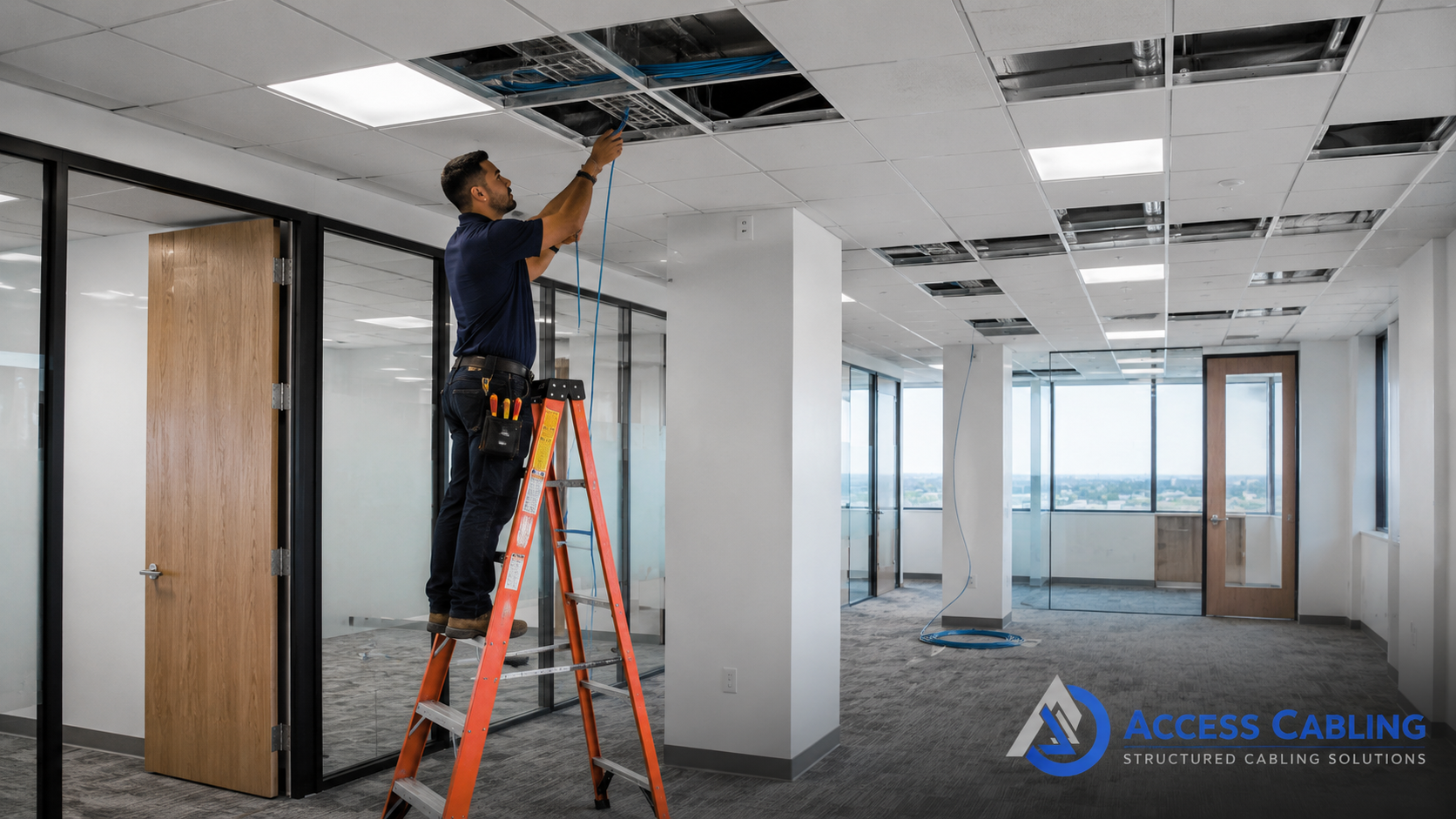
Optimizing network performance for critical business functions begins with a robust voice and data cabling infrastructure. As enterprises increasingly rely on converged networks for VoIP, Power over Ethernet (PoE) devices, and data-intensive applications, the foundational cabling system must be meticulously designed and installed to support current and future demands. Access Cabling specializes in delivering high-performance, standards-compliant voice and data cabling solutions, serving IT directors, facilities managers, and general contractors who require predictable network reliability and scalability. Unlike general installers, our approach integrates TIA/EIA, BICSI, and NEC guidelines from concept to certification, ensuring your infrastructure is engineered for resilience, manageability, and longevity, mitigating costly downtime and performance bottlenecks associated with sub-optimal cabling.
Foundational Voice and Data Cabling: Standards and Components
Voice and data cabling refers to the structured wiring system that underpins an organization's communication and information technology network. This encompasses both copper (e.g., Category 6A, Category 7A) and fiber optic (e.g., OS2, OM3, OM4, OM5) mediums, deployed to support a diverse range of applications from traditional telephony and Ethernet to high-speed data transfer, video conferencing, and IoT device connectivity. Key industry standards dictating the proper design, installation, and performance of these systems include TIA-568-D (Commercial Building Telecommunications Cabling Standard), TIA-569-C (Telecommunications Pathways and Spaces), and TIA-606-C (Administration Standard for Telecommunications Infrastructure). Adherence to these standards is not optional; it ensures interoperability, future-proofing, and maintainability. Components like plenum-rated cables, patch panels, keystone jacks, horizontal and backbone cabling, and telecommunications room build-outs are selected based on bandwidth requirements, environmental conditions, and budget, with a focus on delivering a unified, high-performance infrastructure rather than disparate systems. For example, a Category 6A F/UTP cable from Panduit or Belden might be specified to minimize alien crosstalk in a high-density environment, while Corning OM4 fiber optic cabling would be employed for inter-building backbone links requiring 10GbE or 40GbE support.
Comprehensive Design and Engineering for Converged Networks
Effective voice and data cabling infrastructure begins with a meticulous design and engineering phase, particularly critical for supporting converged networks and advanced technologies like PoE++. Our C-10/C-7 licensed specialists analyze current and projected bandwidth demands, device density, and physical layout to develop a bespoke cabling blueprint. This involves determining optimal cable types (e.g., Cat6A for 10 Gigabit Ethernet over copper, OS2 single-mode fiber for campus-wide backbones), routing pathways, telecommunications room (TR) placement, and power considerations for PoE devices. We leverage tools like AutoCAD and BICSI-compliant practices to map out cable runs, identify potential bottlenecks, and ensure proper cable management, bend radius, and slack provisions. Addressing thermal management within cable bundles, especially with higher wattage PoE applications, is a critical design element often overlooked by less experienced contractors, requiring consideration of cable fill ratios and pathways that dissipate heat effectively. Furthermore, the design process incorporates redundancy planning for mission-critical services, considering diverse routing and active/passive component selection from manufacturers like CommScope or Leviton to enhance network resilience.
Material Selection: Performance, Compliance, and Longevity
The selection of materials for voice and data cabling directly impacts network performance, compliance, and lifecycle costs. Access Cabling specifies only commercial-grade, standards-compliant components from leading manufacturers known for their reliability. For copper infrastructure, this includes Category 6A UTP/FTP and Category 7A S/FTP cables, keystone jacks, patch panels, and patch cords from vendors such as Panduit, CommScope, and Leviton. These are chosen based on specific application needs – for instance, shielded cables for environments with high electromagnetic interference (EMI) or unshielded for general office use. For fiber optic deployments, we utilize OS2 single-mode and OM3/OM4/OM5 multi-mode fiber optic cables, connectors (LC, SC, MPO), and patch panels from Corning, Belden, or AFL, ensuring compatibility with current and future high-speed optical transceivers. All materials are selected to meet NEC (National Electrical Code) fire safety classifications, such as plenum (CMP) or riser (CMR) ratings, depending on the building's fire safety requirements and air handling systems. Furthermore, we consider the mechanical characteristics of the cable, such as tensile strength and crush resistance, to ensure durability during installation and throughout its operational life, minimizing future service calls attributable to component failure.
Precision Installation for Optimal Voice and Data Performance
The integrity of a voice and data cabling system hinges on precise, standards-compliant installation. Our certified technicians adhere strictly to TIA-568-D cable termination practices, including proper pair untwist, jacket termination, and bend radius maintenance, critical for preventing insertion loss, return loss, and crosstalk that degrade signal quality. We employ industry best practices for cable pathway management, utilizing cable trays, conduits, and J-hooks to support cable bundles, prevent kinking, and maintain separation from EMI sources as required by TIA-569 and BICSI guidelines. For fiber optic installations, fusion splicing is performed with precision equipment to minimize optical loss, and fiber optic cables are dressed meticulously within cabinets to ensure protection and simplify future maintenance. Each telecommunications room (TR) and equipment room (ER) build-out is executed to TIA-942-B standards, ensuring proper grounding, bonding, labeling, and airflow management. Our installation methodology prioritizes neatness, accessibility, and adherence to specific manufacturer warranty requirements, ensuring that every drop performs to its rated specification and supports high-bandwidth applications reliably. The use of specialized tools, such as Fluke Networks cable pullers and tensioning devices, prevents cable damage during installation, safeguarding performance characteristics.
Rigorous Testing, Certification, and Documentation
Post-installation, Access Cabling conducts comprehensive testing and certification to validate the performance of every voice and data cable run. This critical step ensures that the installed infrastructure meets or exceeds TIA/EIA specifications and manufacturer warranty requirements. We utilize advanced test equipment, specifically Fluke Networks DSX-5000 or DSX-8000 CableAnalyzers, to perform Level 2G/IIIe/VI accuracy tests on copper cabling for parameters such as wire map, length, propagation delay, delay skew, insertion loss, return loss, Near-End Crosstalk (NEXT), Power Sum NEXT (PSNEXT), Alien Crosstalk (AXT) for Cat6A, and Far-End Crosstalk (FEXT). For fiber optic systems, we conduct Tier 1 and Tier 2 testing using Optical Loss Test Sets (OLTS) and Optical Time Domain Reflectometers (OTDRs) to measure end-to-end attenuation, overall link length, polarity, and identify any anomalies or splices. Each completed project includes detailed test results, a as-built documentation package, and comprehensive labeling (e.g., TIA-606-C compliant) that maps each cable drop from the user outlet to the patch panel. This meticulous documentation is essential for efficient troubleshooting, adds, moves, and changes, and maintaining the system's administration over its lifespan, providing an immutable record of performance.
Critical Applications and Use Cases for Robust Cabling
A meticulously installed voice and data cabling infrastructure is indispensable across a diverse range of critical business applications. For VoIP (Voice over Internet Protocol) systems, clean signal transmission is paramount to prevent jitter, latency, and packet loss that degrade call quality. PoE (Power over Ethernet) devices, such as IP cameras, wireless access points, LED lighting, and access control systems, rely on consistent power delivery over the same data cable, emphasizing the need for high-quality, heat-dissipating cable and robust power sourcing equipment. High-speed data center interconnections, backbone networks, and horizontal distribution to workstations demanding 1GbE, 10GbE, or even 40GbE, mandate Category 6A or fiber optic cabling to support data-intensive applications like virtualization, cloud computing, and large file transfers without performance degradation. For specialized environments, such as manufacturing floors or healthcare facilities, robust and often shielded cabling (e.g., F/UTP or S/FTP) is specified to withstand specific environmental challenges and electromagnetic interference. From multi-story office buildings to expansive industrial campuses, the underlying voice and data cabling facilitates business continuity and operational efficiency, acting as the nervous system of modern enterprise IT.
Regulatory Compliance and Safety in Cabling Projects
Adherence to regulatory compliance and safety standards is non-negotiable in voice and data cabling projects. Access Cabling operates under CSLB license 992009 (C-10/C-7), underscoring our commitment to stringent state and federal regulations. The National Electrical Code (NEC) is a primary governing document, specifically Articles 770 (Optical Fiber Cables), 800 (Communications Circuits) and 820 (Community Antenna Television and Radio Distribution Systems), which dictate cable types, grounding, bonding, and fire safety requirements for various building zones (e.g., plenum, riser, general purpose). BICSI installation methods guide safe and efficient practices, including proper handling of tools, ladder safety, and confined space protocols. Our technicians are trained in OSHA safety standards, ensuring safe work environments and preventing incidents. Furthermore, for specific industries like healthcare or government, additional compliance layers such as HIPAA or NERC CIP may influence security and physical separation requirements for network infrastructure. Our deep understanding and proactive implementation of these codes and standards protect clients from liability, ensure project approval during inspections, and guarantee the long-term safety and operational integrity of the installed cabling system.
Access Cabling's Unwavering Commitment to Cabling Excellence
What distinguishes Access Cabling in the realm of voice and data cabling is our unwavering commitment to technical excellence and client partnership. With 28+ years of dedicated experience and a CSLB 992009 license, we bring unparalleled expertise that goes beyond simply pulling cable. We function as an extension of your IT and facilities teams, providing transparent communication, meticulous project management, and adherence to aggressive timelines without compromising quality. Our confidence stems from our deep understanding of TIA/EIA, BICSI, and NEC standards, coupled with field-proven execution using only commercial-grade products from trusted manufacturers like Panduit, CommScope, Leviton, Belden, and Corning. We don't offer generalized solutions; instead, we engineer bespoke, high-performance infrastructures specifically tailored to your organization's unique operational demands and future growth projections. From the initial site survey and needs assessment to the final Fluke DSX certification and as-built documentation, our process is designed for predictability, superior performance, and long-term return on investment, mitigating future technical debt and ensuring your network backbone is a strategic asset, not a liability.
Advanced Network Segmentation and Infrastructure Security
Implementing voice and data cabling today extends far beyond simple connectivity; it is intrinsically linked to network segmentation and physical security, particularly in environments handling sensitive information or requiring high availability. A critical aspect involves the judicious use of physically separate cabling infrastructure where logical separation through VLANs or firewall rules is deemed insufficient or introduces unacceptable latency/complexities for specific applications. For instance, in industrial control systems (ICS) or SCADA environments, completely isolated Category 6A F/FTP or even fiber optic runs (e.g., OM4 multimode or OS2 singlemode, depending on distances and bandwidth) might be deployed for operational technology (OT) networks, ensuring no physical cross-contamination with enterprise IT networks. This isolation mitigates common attack vectors and simplifies compliance with regulations like NIS 2 or NERC CIP. Furthermore, physical access control to communication closets and cable pathways is paramount. This includes specifying robust, lockable server cabinets (e.g., APC NetShelter SX series) and secure conduit or cable tray systems (e.g., Cablofil Fasclic GR) to prevent unauthorized tapping or tampering. Our design methodology integrates these physical security layers from the outset, considering choke points, entry/exit strategies, and the use of tamper-evident cabling solutions or intelligent patch panels (e.g., Siemon MapIT G2) that can detect and report unauthorized connection changes. We also address electromagnetic interference (EMI) and radio frequency interference (RFI) vulnerabilities by specifying shielded cabling (e.g., Category 6A F/UTP or S/FTP) in environments prone to such disturbances, such as those near heavy machinery, power lines, or medical imaging equipment, ensuring signal integrity and preventing data exfiltration via unintended emissions. The choice between shielded and unshielded, and the specific shielding type, is a complex technical decision influenced by plenum requirements, grounding strategies, and equipment compatibility, all of which are meticulously assessed during the design phase to avoid common pitfalls like ground loops or inadequate bonding that can degrade performance rather than enhance it.
Seamless Integration with Converged Building Systems
Modern building infrastructure demands a high degree of convergence, where voice and data cabling serves as the backbone for not just IT and telephony, but also building automation systems (BAS), security cameras (IP CCTV), access control, fire alarms, and even advanced lighting control (PoE lighting). A key challenge lies in designing a structured cabling system that can reliably support the diverse power and data requirements of these disparate systems while maintaining scalability and fault tolerance. For example, Power over Ethernet (PoE) applications, particularly PoE++ (802.3bt Type 3 and Type 4) standards delivering up to 60W or 90W respectively, necessitate careful cable selection to manage heat generation within bundles. Utilizing larger gauge conductors (e.g., 22 AWG instead of 24 AWG) in Category 6A cables helps minimize resistive losses and temperature rise, preventing performance degradation and potential damage to cable jackets, especially in densely packed cable trays or conduits. Our engineering considers cable fill ratios and proposes appropriate ventilation strategies for pathways. Furthermore, integration with BAS often involves specific protocols (e.g., BACnet/IP, LonWorks/IP) that communicate over standard IP networks. The cabling design must ensure dedicated bandwidth or quality of service (QoS) mechanisms are supported upstream, while the physical layer provides the necessary throughput and reliability. This frequently involves extending fiber optic distribution (e.g., 10 Gigabit Ethernet over OM3/OM4) to aggregation points, such as BAS controllers or PoE switches, which then distribute copper connectivity to end devices. Coordinating with MEP (Mechanical, Electrical, and Plumbing) contractors is crucial here to ensure pathways are properly sized, routed away from high-voltage conduit, and firestopping measures are implemented correctly (e.g., Hilti CP 606 firestop sealant). Pitfalls include inadequate planning for future PoE device density, leading to thermal issues, or insufficient separation from electrical noise sources, both of which can lead to intermittent connectivity or system failures. Our approach includes predictive modeling of power budgets and thermal dissipation within cable bundles to preemptively mitigate these issues.
Lifecycle Management and Future-Proofing for TCO Reduction
Optimizing the Total Cost of Ownership (TCO) for voice and data cabling infrastructure requires a holistic lifecycle management approach, looking beyond initial installation costs to encompass maintenance, upgrades, and potential re-cabling expenses over a 15-20 year operational lifespan. A significant component of TCO is the cost of MACs (Moves, Adds, Changes) which can be drastically reduced through intelligent design choices. Key strategies include utilizing modular connectivity solutions, such as pre-terminated fiber optic trunks (e.g., MPO/MTP connectors) for rapid deployment and re-configuration in data centers, or high-density keystone patch panels (e.g., CommScope SYSTIMAX panels) that allow for straightforward port assignment and cable management. Over-provisioning of conduit pathways and telecommunications room (TR) space during initial build-out, typically by 25-30% beyond current requirements, avoids costly and disruptive retrofits later. While this increases upfront material cost slightly, it offers substantial long-term savings by accommodating future bandwidth upgrades (e.g., migrating from 10G to 40G or 100G) or the expansion of networked devices without needing to penetrate walls or ceilings again. Documentation plays a critical role in TCO; comprehensive, ‘as-built’ drawings, labeling schematics (e.g., TIA/EIA 606-B standard), and detailed port assignments reduce troubleshooting time and ensure efficient MACs. We utilize software tools for cable management system (CMS) documentation to maintain an accurate digital twin of the physical infrastructure. Furthermore, adopting energy-efficient cabling components, such as low-loss fiber optics or copper cables designed for optimal PoE performance, indirectly contributes to TCO reduction by minimizing energy consumption in active network equipment and cooling systems. Failure to consider these lifecycle aspects often leads to premature infrastructure obsolescence, high operational expenses due to chaotic cabling, and significant business disruption during inevitable network transformations.
Mitigating Common Failure Modes: Design and Remediation
Understanding and proactively mitigating common failure modes is paramount in designing resilient voice and data cabling infrastructure. A frequent culprit for network issues lies in improper termination and installation practices. This includes issues like incorrect pair twists in UTP (Unshielded Twisted Pair) copper cabling leading to increased crosstalk and reduced bandwidth, or excessive untwisting at the termination point which can degrade Category 5e/6/6A performance below specified standards. In fiber optic systems, common failures include dirty end-faces, exceeding bend radius limits (causing micro-bends and macro-bends leading to signal loss), or improper fusion splicing technique resulting in high insertion loss and reflectance. Our certified technicians (e.g., BICSI RCDDs, FTTx OSP certifications) adhere to strict manufacturer guidelines and industry best practices outlined in TIA-568 series standards, utilizing precision tooling such as Fluke Networks Versiv DSX CableAnalyzers for copper certification and OptiFiber Pro for fiber. Another significant failure mode involves environmental factors that are not adequately accounted for during the design phase. This includes temperature extremes in outdoor plant environments (e.g., aerial or direct-buried cables requiring UV-resistant jackets or gel-filled loose tubes), or electromagnetic interference (EMI) from heavy machinery, fluorescent lighting ballasts, or power lines which can necessitate the deployment of shielded or even armored cables (e.g., S/FTP or OSP fiber with steel tape armor). Furthermore, inadequate grounding and bonding can introduce electrical noise, creating ground loops that degrade signal quality and pose safety risks. Our designs meticulously specify bonding and grounding infrastructure in accordance with TIA-607-D standards, ensuring the telecommunications grounding busbar (TGB) and main grounding busbar (MGB) are properly integrated into the building’s electrical grounding system. A critical yet often overlooked failure point is the lack of proper cable management, leading to tangled pathways, pinched cables, and difficult fault isolation, increasing Mean Time To Repair (MTTR). We integrate structured cable management solutions, including horizontal and vertical cable managers (e.g., Panduit Wyr-Grid), distinct color-coding for different service types, and clear labeling, not merely for aesthetics but as a critical component of system reliability and swift remediation.