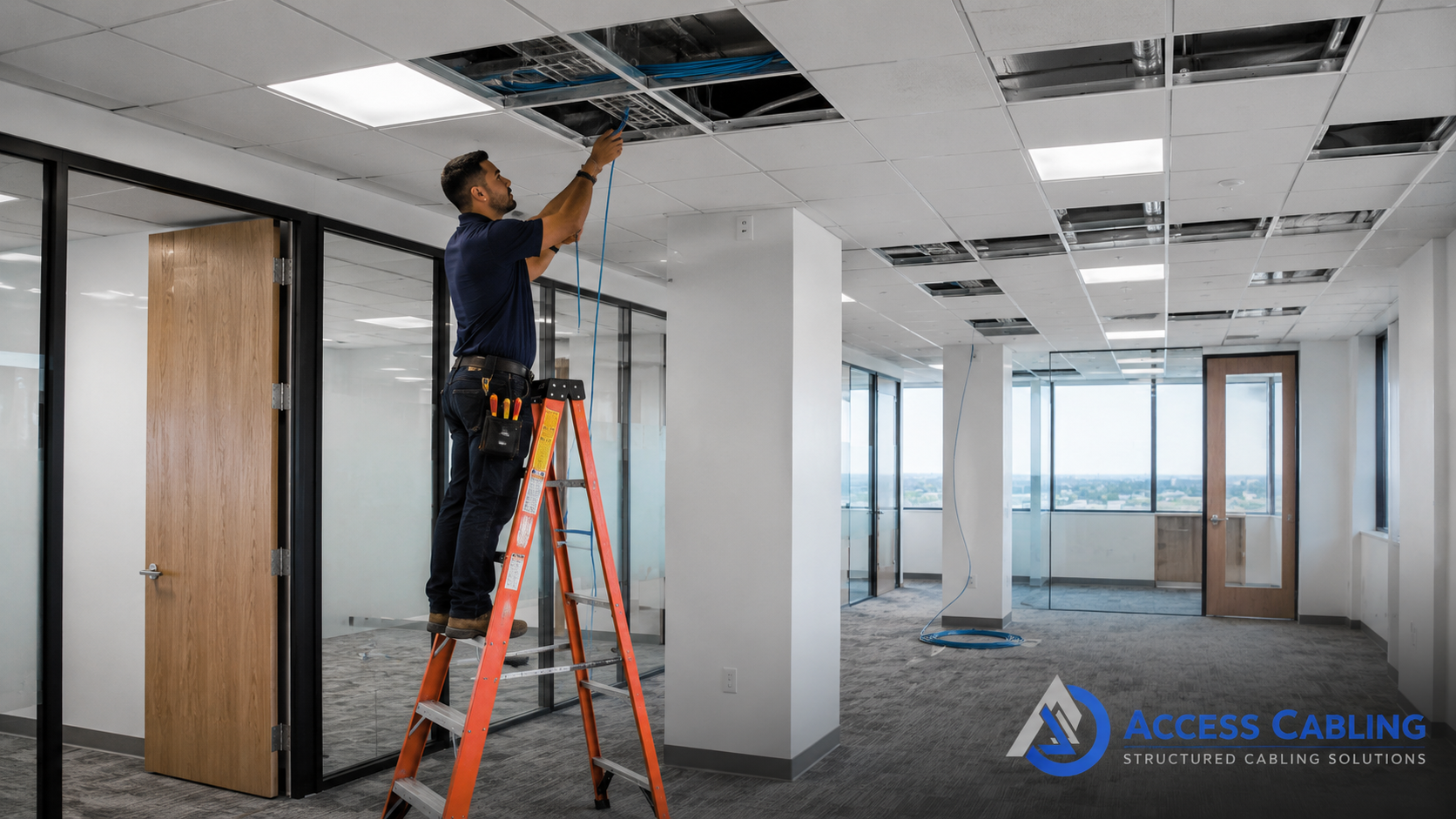
For IT directors, facilities managers, and general contractors overseeing new commercial builds, expansions, or infrastructure upgrades, navigating the complexities of modern network cabling is paramount. Access Cabling provides turnkey commercial cabling solutions that ensure your enterprise-grade network infrastructure is not only robust and scalable but also engineered to TIA/EIA, BICSI, and NEC standards. We specialize in designing, installing, and certifying advanced structured cabling systems for diverse commercial environments, from high-density office spaces and logistics warehouses to multi-tenant buildings and data centers. Unlike many providers, our 28+ years of C-10/C-7 licensure and deep expertise with top-tier manufacturers like Panduit, CommScope, and Corning, afford us the ability to deliver meticulously planned and executed commercial cabling projects that mitigate risk and maximize long-term performance, ensuring your investment supports current and future technological demands.
Foundational Commercial Cabling Architectures and Standards
Effective commercial cabling begins with a foundational understanding of structured cabling principles as defined by TIA-568.x standards, which establish uniform methods for telecommunications infrastructure in commercial buildings. This encompasses everything from the main cross-connect (MC) in the equipment room (ER) to horizontal cabling trays and outlet/connector configurations in the work areas (WA). Our designs meticulously adhere to these specifications, including TIA-569 for pathways and spaces, TIA-606 for administration, and TIA-607 for grounding and bonding. Whether deploying Category 6A for 10 Gigabit Ethernet (10GbE) over copper or OS2 single-mode fiber for high-bandwidth backbone applications, our engineers consider current throughput requirements and future scalability. We prioritize open architectures that allow for seamless integration of diverse network devices and easy expansion, avoiding proprietary systems that can lead to vendor lock-in and increased operational costs over the lifecycle of the building. This rigorous adherence ensures a compliant, high-performance, and manageable cabling plant, which is critical for business continuity in any commercial enterprise.
Strategic Design and Engineering for Evolving Commercial Needs
The strategic design phase for commercial cabling projects transcends mere wire pulling; it's about engineering a resilient, high-performance physical layer that supports a business's operational objectives. Our process begins with a comprehensive site assessment, understanding the specific environmental factors, occupancy rates, and planned technological deployments. This informs decisions regarding cable types (e.g., plenum-rated for air handling spaces, outdoor plant for campus environments), pathway configurations (conduit systems, cable trays, basket trays), and termination hardware. For instance, in a pharmaceutical facility, electromagnetic compatibility (EMC) is critical, necessitating shielded Category 6A F/UTP or S/FTP cable to prevent interference with sensitive equipment, whereas a financial institution might prioritize diverse routing and redundant pathways for maximum uptime. We leverage BICSI TDMM guidelines and manufacturer-specific design tools from partners like Panduit’s Physical Infrastructure Manager or CommScope’s System Design Tools to optimize layouts, ensure proper bend radii, and calculate precise cable lengths, thereby minimizing material waste and guaranteeing signal integrity. This detailed engineering approach proactively addresses potential bottlenecks and ensures the network can effortlessly support VoIP, Wi-Fi 6/7, PoE++ devices, and building automation systems.
Premium Components for Durability and Performance
The longevity and reliability of a commercial cabling system are directly tied to the quality of its components. Access Cabling exclusively sources structured cabling products from industry leaders like Belden, Corning, Leviton, Panduit, and CommScope, ensuring every strand and connector meets stringent performance criteria. For copper infrastructure, we specify Category 6A UTP or F/UTP cable for horizontal runs, coupled with matching patch panels, keystone jacks, and patch cords, all rated for 10GbE. For fiber optic backbones, we deploy OS2 single-mode or OM3/OM4 multimode fiber optic cable, chosen based on distance and bandwidth requirements, terminated with LC, SC, or MPO connectors. Our component selection extends to critical supporting infrastructure, including robust rack and cabinet enclosures from Chatsworth Products (CPI), cable management systems that prevent kinks and maintain proper airflow, and integrated grounding and bonding solutions that adhere to NEC Article 250. This commitment to premium, interoperable components, often backed by extended manufacturer warranties, ensures consistent network performance, simplifies future upgrades, and drastically reduces the total cost of ownership over the infrastructure's 15-20 year projected lifespan.
Precision Installation and Cable Routing Methodologies
Our installation methodology for commercial cabling projects emphasizes precision, meticulous cable management, and adherence to industry best practices. Cable pathway design is critical, whether utilizing overhead ladder rack, enclosed conduit systems, or underfloor raceways, ensuring proper separation from power wiring as dictated by NEC Article 800. We implement BICSI-compliant cable dressing techniques, labeling each cable at both ends with detailed identification adhering to TIA-606-C standards, facilitating easier troubleshooting and future maintenance. For fiber optic deployments, specialized fusion splicing or precision field termination techniques are employed to minimize insertion loss, often utilizing Corning UniCam or Panduit OptiCam termination tools. Our technicians are meticulously trained to maintain proper cable bend radii for both copper and fiber, prevent overtightening of cable ties, and ensure correct pathway fill ratios to mitigate signal degradation and provide room for future expansion. Every installation phase is executed with a focus on delivering a neat, easy-to-manage, and high-performance physical layer, avoiding the 'spaghetti' wiring common in lesser-quality installations.
Rigorous Testing and Certification for Assured Performance
Upon completion of the physical installation, Access Cabling performs comprehensive testing and certification of the entire commercial cabling plant to guarantee compliance with TIA-568.x performance specifications. For copper cabling, this involves deploying Fluke Networks DSX-8000 CableAnalyzers to measure critical parameters such as Near-End Crosstalk (NEXT), Return Loss, Attenuation, Propagation Delay, and DC Resistance, confirming channel and permanent link performance against Category 6A or higher standards. Fiber optic links are tested for insertion loss, optical return loss (ORL), and length using OTDRs (Optical Time-Domain Reflectometers) and power meters, ensuring conformity with TIA-568.3 standards. Every certified link receives a comprehensive test report generated by the Fluke DSX, which serves as a crucial documentation package for the client. This rigorous certification process not only validates performance but also future-proofs the investment, providing irrefutable proof that the installed infrastructure meets or exceeds industry benchmarks and manufacturer warranties, offering peace of mind for mission-critical applications.
Diverse Commercial Applications and Integration
Commercial cabling infrastructure is the unseen backbone enabling a vast array of business-critical applications across various sectors. For corporate offices, our systems support high-speed data networks, VoIP telephony, video conferencing, and robust Wi-Fi access points leveraging PoE. In industrial or warehouse environments, our resilient cabling facilitates networked security cameras, access control systems, building management systems (BMS), and industrial automation, often requiring specialized ruggedized or plenum-rated cables. Multi-tenant buildings benefit from neatly organized and demarcated horizontal cabling that supports multiple distinct tenants from a single riser or distribution frame, ensuring privacy and performance for each entity. Furthermore, we design and integrate cabling for specialized needs such as audio-visual distribution systems in conference rooms, digital signage networks, and distributed antenna systems (DAS) for enhanced cellular coverage. Each application demands tailored design considerations, from bandwidth requirements to environmental resilience, all meticulously addressed by Access Cabling's experienced engineering team.
Compliance, Safety, and Long-Term Maintainability
Adherence to industry regulations and safety protocols is non-negotiable in commercial cabling projects. As a C-10/C-7 licensed contractor, Access Cabling meticulously complies with all applicable NEC (National Electrical Code) articles, including Article 800 (Communications Circuits) and Article 770 (Optical Fiber Cables), ensuring proper grounding, bonding, and firestopping measures are implemented. All pathways, from conduit to cable trays, are correctly installed and grounded to prevent signal interference and ensure personnel safety. Furthermore, our installations are designed with long-term maintainability in mind. Clear and concise TIA-606-C compliant labeling, detailed as-built documentation, and organized cable management systems drastically simplify future troubleshooting, moves, adds, and changes (MACs). This proactive approach to compliance, safety, and documentation not only protects your investment and ensures operational continuity but also reduces the likelihood of costly rework or compliance violations during building inspections or future upgrades.
Access Cabling's Unmatched Commercial Cabling Expertise
What truly sets Access Cabling apart in the commercial cabling landscape is our integrated approach, combining deep technical expertise with executive-level project management. Our 28+ years of dedicated service, coupled with a C-10/C-7 license (CSLB 992009), mean we possess the requisite experience and regulatory compliance to execute projects of any scale and complexity, nationwide. We don't just pull cable; we partner with IT directors and facilities managers to understand their strategic objectives, translating business needs into meticulously engineered, standards-compliant, and future-ready network infrastructures. Our commitment to using Tier 1 components from manufacturers like Panduit and CommScope, combined with rigorous Fluke DSX certification, guarantees a robust and reliable physical layer. Moreover, our emphasis on transparent communication, detailed documentation, and a clean, organized installation ensures maximum uptime and simplifies the ongoing management of your network assets. Choosing Access Cabling means investing in a verifiable, high-performance structured cabling system that will reliably serve your commercial operations for decades.
Lifecycle Management and Future-Proofing Commercial Cabling Infrastructure
Effective commercial cabling extends far beyond initial installation; it encompasses a robust lifecycle management strategy designed to ensure sustained performance, adaptability, and cost-efficiency. This involves meticulously planning for scalability, anticipating technological advancements like 100GbE and beyond, and integrating upgrade paths for fiber optic systems (e.g., migration from OM3/OM4 to OM5 Multimode Fiber or OS2 Single-Mode Fiber for increased bandwidth density). A critical component is the establishment of comprehensive documentation, including detailed as-built drawings outlining cable runs, patch panel configurations, outlet mapping, and termination schematics, often leveraging Computer-Aided Design (CAD) files and GIS integration for large campuses. Furthermore, a proactive maintenance schedule, incorporating periodic inspection of pathways, active equipment cooling, and re-certification of critical links using TIA-568-D.3 and ISO/IEC 11801 standards with Level IIIe/IV field testers, mitigates common failure modes such as micro-bending in fiber, attenuation due to improper bend radii, or impedance mismatches in copper. We also consider the Total Cost of Ownership (TCO) by evaluating the long-term energy consumption of active components, the heat dissipation requirements, and the embodied energy of the materials themselves, recommending solutions that offer an optimal balance of performance, longevity, and environmental responsibility, thereby contributing to LEED certification objectives where applicable. This foresight prevents costly, disruptive overhauls and ensures the infrastructure remains a strategic asset, not a perpetual liability.
Inter-Trade Coordination and Project Management for Seamless Integration
Successful commercial cabling deployments necessitate intricate coordination with multiple trades and stakeholders, a multifaceted challenge managed through rigorous project management methodologies. Our approach integrates with the client's construction schedule, providing detailed Gantt charts that delineate cabling activities alongside Mechanical, Electrical, and Plumbing (MEP) contractors, as well as general construction timelines. This includes precise scheduling for raceway installation (conduit, cable trays, J-hooks) to prevent conflicts with other overhead or in-wall utilities, ensuring adequate fill ratios (e.g., NEC 300.17 for conduit) and proper grounding/bonding per TIA-607-B. Early engagement in the design phase allows for collaborative resolution of potential clashes, such as insufficient ceiling plenums for cable trays or power outlet proximity to data drops, minimizing change orders and delays. We utilize project management software like Procore or Asta Powerproject to track progress, manage resources, and facilitate real-time communication among all parties, including architects, facilities managers, and IT personnel. Deliverables include detailed work breakdown structures (WBS), risk registers identifying potential challenges like accessibility issues or material lead times, and communication plans ensuring regular updates and issue resolution. Special attention is paid to staging and logistics, particularly in occupied buildings, to minimize disruption to business operations and adhere to security protocols, often involving off-hours work for critical cutovers and migrations, orchestrated with surgical precision and comprehensive back-out plans.
Advanced Security and Resiliency in Commercial Network Cabling
The physical layer of commercial cabling represents a foundational element of an organization's overall security posture and operational resiliency. Our designs incorporate best practices for media security, addressing unauthorized access and physical tampering. This includes the deployment of keyed, color-coded patch panel systems and fiber optic enclosures that restrict unauthorized access to critical network segments, along with the strategic use of plenum-rated cables to inhibit fire propagation in air-handling spaces as per NFPA 262. For high-security environments, we implement secured conduits and pathways, often employing electromechanical locks or tamper-evident seals on telecommunications closets and equipment racks. Redundancy is paramount for resiliency; our solutions frequently involve diverse path fiber optic routes to eliminate single points of failure, designing for A-B power feeds to network equipment, and implementing distributed antenna systems (DAS) for robust wireless coverage, including public safety radio frequencies. Environmental monitoring systems within telecommunications rooms (TRs) and data centers are integrated to track temperature, humidity, and water ingress, providing proactive alerts to prevent environmental damage to critical infrastructure. Furthermore, network segmentation methodologies, implemented at the physical layer through dedicated cabling runs for different security zones or operational departments (e.g., CCTV, Access Control, Wi-Fi, Office Data), bolster logical security by preventing cross-contamination of network traffic and isolating potential breaches, aligning with NIST Cybersecurity Framework guidelines for physical access control and asset protection.
Regulatory Compliance and Industry Best Practices Adherence
Adherence to a complex landscape of regulatory compliance and industry best practices is non-negotiable for commercial cabling projects to ensure safety, performance, and legal standing. Our deployments strictly conform to the National Electrical Code (NEC, NFPA 70), particularly articles pertaining to low-voltage cabling (e.g., Article 800 for Communications Circuits). This includes proper grounding and bonding techniques, ensuring appropriate cable types for specific environments (e.g., plenum, riser, general-purpose), and maintaining required firestop ratings in penetration points to preserve the integrity of fire-rated barriers as per ASTM E814. We navigate local building codes and ordinances, which often impose additional requirements beyond national standards, such as specific pathway sizing or fire suppression system integration within telecommunications rooms. Industry standards from organizations like the Telecommunications Industry Association (TIA) and International Organization for Standardization (ISO/IEC) are foundational, guiding everything from structured cabling topology (e.g., TIA-568 series for commercial building telecommunications cabling) to pathway and space design (TIA-569-D) and administration (TIA-606-C). Our documentation deliverables include certificates of compliance, test results (e.g., Fluke DTX/DSX CableAnalyzer reports for Category 6A/7A or fiber OTDR traces), and material safety data sheets (MSDS) for all components, crucial for audits and facility management. This rigorous adherence not only mitigates legal and financial risks but also ensures the infrastructure is intrinsically reliable, safe for occupants, and future-ready for various governmental and industry-specific regulations, such as those impacting healthcare (HIPAA) or financial services (PCI DSS) data handling at the physical layer.