For commercial enterprises relying on robust wireless ubiquitous connectivity, a professionally engineered and installed WiFi infrastructure is not merely a convenience, but a critical operational backbone. Access Cabling provides comprehensive commercial WiFi installation services, encompassing RF site surveys, meticulous wireless access point (WAP) deployment, Power over Ethernet (PoE) cabling, backbone integration, and network cutover. Our C-10/C-7 licensed technicians leverage 28 years of industry experience and adhere to TIA/EIA, BICSI, and IEEE 802.11 standards to deliver high-performance, secure, and scalable wireless networks. We eliminate the guesswork, designing solutions explicitly tailored to a facility's unique architectural nuances, user density, and application requirements, ensuring optimal coverage, capacity, and minimal interference across challenging environments from multi-story office complexes to expansive industrial warehouses and outdoor areas. Our approach prioritizes longevity and seamless integration with existing IT infrastructure, backed by rigorous testing and documentation.
Engineered WiFi: Beyond Basic Connectivity
Commercial WiFi installation extends far beyond simply mounting wireless access points (WAPs) to a ceiling. A robust wireless network demands a detailed understanding of RF physics, building materials, and intended applications. Our initial phase involves a comprehensive predictive and, subsequently, a physical RF site survey utilizing tools like Ekahau Pro or NetAlly AirMagnet Survey PRO. This crucial step identifies potential sources of interference (e.g., microwaves, cordless phones, adjacent networks), optimal WAP placement for desired signal strength (RSSI), channel planning to minimize co-channel interference, and establishes the required density of WAPs to meet coverage and capacity demands outlined in IEEE 802.11ax standards, ensuring performance for high-density client environments or specific bandwidth-intensive applications such as VoIP, video conferencing, or IoT device integration. This foundational engineering prevents common issues like dead zones, dropped connections, and throughput limitations, which directly impact operational efficiency.
Structured Cabling Foundation for Wireless APs
The performance of any wireless network is inherently tied to the quality of its wired backbone. Each WAP requires a dedicated structured cabling drop meeting or exceeding Category 5e (Cat5e), Category 6 (Cat6), or Category 6A (Cat6A) specifications, depending on the required bandwidth and Power over Ethernet (PoE) budget. For Wi-Fi 6 (802.11ax) deployments, Cat6A cabling is often specified to support Multi-Gigabit Ethernet (2.5GBASE-T, 5GBASE-T, 10GBASE-T) and higher PoE requirements (PoE+, UPoE, PoH) as defined by IEEE 802.3bt. Our installations utilize TIA/EIA-568-D standards for horizontal cabling, ensuring proper termination with T568A or T568B pinouts at both the work area outlet (WAP location) and the telecommunications room (TR). We specify manufacturer components from trusted brands like Panduit, CommScope, Belden, or Leviton, ensuring interoperability, performance, and compliance with the 25-year system warranties offered by these manufacturers for properly installed and tested systems. This robust cabling infrastructure prevents bottlenecking at the physical layer, allowing WAPs to operate at their full potential.
Precision Wireless Access Point Deployment & Mounting
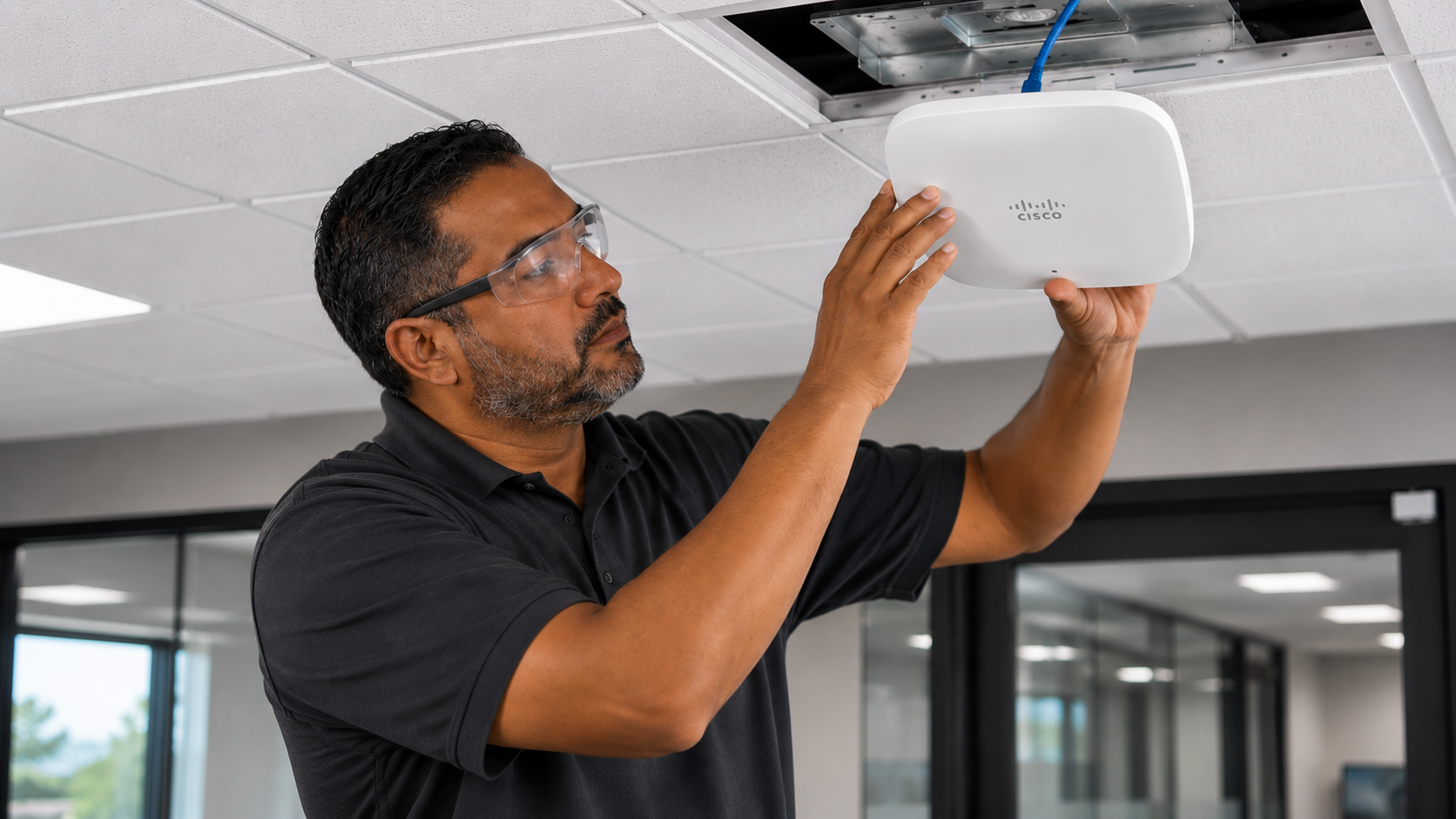
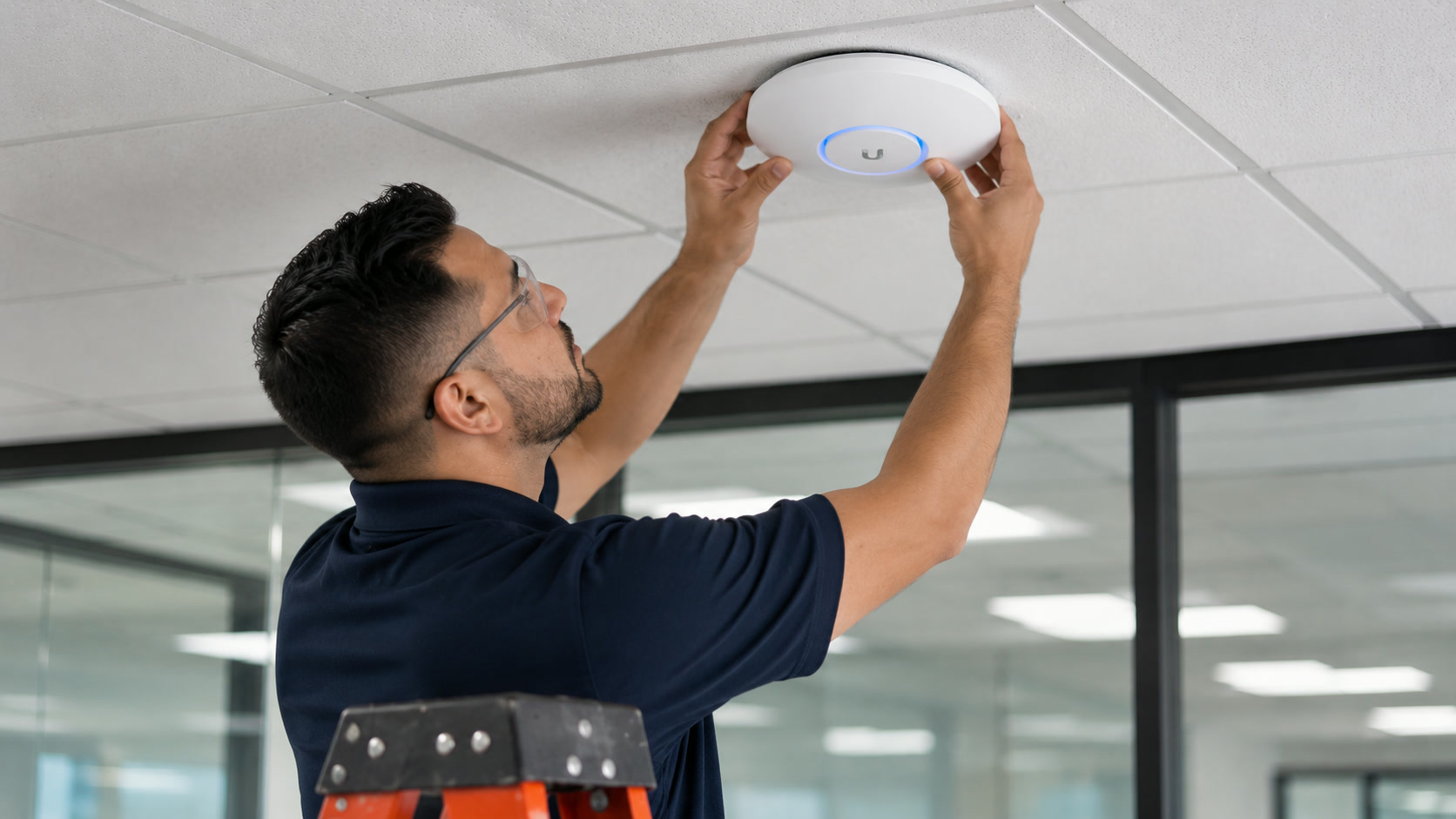
WAP deployment involves meticulous planning and execution to ensure aesthetic integration and optimal RF performance. Following the site survey, each WAP is precisely mounted according to the manufacturer's specifications (e.g., Cisco Meraki, Aruba Networks, Ubiquiti) and facility requirements. This includes strategic placement to maximize coverage and capacity while minimizing line-of-sight obstructions and adhering to ceiling grid aesthetics. Mounting methods vary from standard T-bar clips to plenum-rated junction boxes for ceiling tiles, pole mounts for open-ceiling environments, or outdoor-rated enclosures for exterior deployments. For secure installations, we often utilize anti-theft enclosures or specialized mounting brackets. All electrical work, where applicable, adheres to National Electrical Code (NEC) articles and local ordinances. Power is typically supplied via Power over Ethernet (PoE) from a network switch, eliminating the need for dedicated AC outlets at each WAP location, simplifying installation and reducing power infrastructure costs. Proper cable dress, strain relief, and labeling at both ends of each drop are standard practice to facilitate future maintenance and troubleshooting.
Advanced Testing, Certification, and Documentation
Post-installation, rigorous testing and certification are performed to validate network performance against design specifications and industry standards. This includes channelized RF validation scans using tools like Fluke Networks Aircheck G3 Pro or WLAN Sniffer to confirm signal strength (RSSI), signal-to-noise ratio (SNR), channel utilization, and identify any unforeseen interference. For the underlying structured cabling, each copper drop connecting a WAP to the network switch is tested and certified using a Fluke DSX CableAnalyzer to TIA/EIA Cat5e/6/6A Permanent Link or Channel requirements, measuring parameters such as Near-End Crosstalk (NEXT), Return Loss, Insertion Loss, and length. Fiber optic backbone links, if utilized for WAP aggregation or interconnects, are tested for Insertion Loss (Tier 1) and potentially OTDR (Tier 2) using Fluke OptiFiber Pro. Comprehensive documentation, including as-built drawings, WAP placement maps with coverage heatmaps, test results, MAC addresses, and IP assignments, is provided to the client for ongoing network management and troubleshooting. This documentation is crucial for facility managers and IT staff.
Security Integration and Guest Network Implementation
Commercial WiFi networks necessitate robust security measures to protect corporate data and ensure regulatory compliance. Our installations incorporate best practices for WLAN security, including secure authentication methods such as WPA3 Enterprise utilizing 802.1X for RADIUS server integration, MAC address filtering, and network segmentation via VLANs. Guest network implementation is a common requirement, providing isolated internet access for visitors without compromising the security of the internal corporate network. This often involves creating separate SSIDs, implementing captive portals for guest authentication, and enforcing bandwidth limits. We ensure the WAP firmware is up to date and configured for optimal security settings, preventing known vulnerabilities. Our expertise extends to configuring Wireless Intrusion Prevention Systems (WIPS) or Wireless Intrusion Detection Systems (WIDS) functionalities inherent in many enterprise-grade WAPs to detect and mitigate rogue access points or other wireless threats, safeguarding network integrity and data confidentiality.
Scalability and Future-Proofing for Evolving Demands
A well-designed commercial WiFi infrastructure must inherently be scalable to accommodate future growth in user density, emerging wireless standards (e.g., Wi-Fi 7), and increased bandwidth demands from new applications. Our design process considers not only current requirements but also anticipated expansion over a 5-10 year horizon. This includes specifying adequate conduit pathways, planning for additional structured cabling drops, and selecting WAP platforms with upgrade paths or modular designs. We advise on network switch port density, PoE budget, and backbone capacity to support projected WAP additions and throughput increases. By implementing a standards-compliant, modular architecture from the outset, businesses can expand their wireless coverage or upgrade technologies with minimal disruption and capital expenditure, avoiding costly complete overhauls. This foresight ensures the wireless network remains a valuable asset as technological landscapes evolve.
Access Cabling: Expert Wireless Infrastructure Partner
Choosing Access Cabling for your commercial WiFi installation means partnering with a C-10/C-7 licensed contractor with a 28-year track record of delivering reliable, high-performance low-voltage systems. Our specific differentiator lies in our meticulous engineering approach, which combines deep RF planning expertise with structured cabling proficiency. We don't just 'install' WAPs; we integrate a complete end-to-end wireless solution, from the demarcation point to the air interface. Our technicians are factory-trained and hold relevant certifications, ensuring adherence to the strictest industry standards (BICSI, TIA/EIA, NEC) and manufacturer best practices from leading vendors like Panduit, CommScope, and Corning. We provide turnkey services, managing all aspects of the deployment, including project management, material procurement, installation, comprehensive testing using Fluke Networks equipment, and thorough documentation, guaranteeing a seamless transition and long-term network stability for your facility.
Strategic RF Planning & Interference Mitigation
Effective WiFi deployment begins with exhaustive Radio Frequency (RF) planning, a critical phase that dictates network performance and reliability. Our methodology employs sophisticated site survey tools, such as Ekahau Pro or NetAlly AirMagnet, to conduct both passive and active surveys across the intended coverage areas. This process meticulously identifies existing RF noise floors, sources of co-channel interference (CCI) from neighboring networks, adjacent-channel interference (ACI), and potential non-WiFi interferers (e.g., microwave ovens, cordless phones operating on 2.4 GHz, or industrial machinery emissions). We analyze spectrum utilization across the 2.4 GHz, 5 GHz, and increasingly, 6 GHz bands, mapping channel saturation and identifying optimal channel assignments to maximize throughput and minimize contention. Our design incorporates cellular array principles, carefully calculating Access Point (AP) transmit power levels and antenna downtilt to achieve controlled cell sizes, ensuring seamless roaming for clients while preventing excessive cell overlap that can lead to CCI and degraded performance. For high-density environments, we factor in client density estimations (e.g., 25-50 users per AP in typical enterprise scenarios; 50-100 in auditoriums) and application requirements (e.g., VoIP and streaming video demand lower latency and higher bandwidth guarantees) to determine precise AP placement and quantity. Furthermore, we evaluate structural elements like concrete walls, metallic shielding, and water pipes using predictive modeling tools during the design phase to quantify signal attenuation (dB loss) and adjust AP placement or antenna type accordingly, thereby preempting areas of poor coverage or 'dead zones.' This detailed RF analysis and interference mitigation strategy is fundamental to delivering a robust, high-performing wireless network that can adapt to dynamic environmental conditions and evolving user demands.
Multi-Vendor Integration & Network Orchestration
Modern enterprise WiFi environments rarely consist of a monoculture of network equipment; instead, they often integrate components from multiple vendors, each selected for specific functionalities or existing infrastructure compatibility. Our WiFi installation expertise extends to seamless integration across diverse ecosystems, including Cisco Meraki, Aruba Networks, Ubiquiti UniFi, Ruckus Wireless, and Extreme Networks, among others. This involves not only physical AP deployment but also intricate network orchestration at the controller level. We configure Wireless LAN Controllers (WLCs), whether hardware-based appliances or virtualized instances, to manage APs, enforce policies, and provide centralized visibility. Our engineers are proficient in configuring essential network services such as DHCP (Dynamic Host Configuration Protocol) for IP address assignment, DNS (Domain Name System) for name resolution, and VLAN (Virtual Local Area Network) tagging (e.g., IEEE 802.1Q) to segregate traffic for different user groups (e.g., corporate vs. guest) or applications, enhancing security and manageability. We implement QoS (Quality of Service) policies to prioritize mission-critical traffic like Voice over IP (VoIP) or video conferencing, ensuring a superior user experience by allocating sufficient bandwidth and minimizing latency. This integrated approach demands a deep understanding of each vendor's proprietary protocols and management interfaces, ensuring interoperability while leveraging the strengths of each component. Our process includes thorough cross-platform testing to validate connectivity, throughput, and policy enforcement, guaranteeing that all network segments communicate effectively and that the entire wireless infrastructure operates as a cohesive, high-performance system.
Post-Implementation Optimization & Lifecycle Management
The successful deployment of a WiFi network is not a static event but rather the initiation of a continuous optimization and lifecycle management process. Following initial installation and testing, we conduct a comprehensive post-implementation validation survey, akin to the initial site survey, to verify that the deployed network meets or exceeds the design specifications for coverage, capacity, and performance. This involves measuring actual signal strength (RSSI), signal-to-noise ratio (SNR), and throughput metrics across the coverage area, identifying any discrepancies that require fine-tuning of AP power levels, channel adjustments, or minor repositioning. Our service includes detailed performance baselining, establishing key performance indicators (KPIs) such as average data rates, packet loss, and latency, which serve as benchmarks for future performance monitoring. We provide guidance on implementing proactive monitoring solutions (e.g., SNMP-based network management systems or vendor-specific dashboards) to track network health, identify potential bottlenecks, and anticipate emerging issues. Additionally, we consult on a comprehensive lifecycle management strategy, outlining recommendations for firmware updates, security patch management, cyclical performance reviews (e.g., annual RF re-surveys), and hardware refresh cycles. This forward-looking approach ensures the WiFi network remains secure, performs optimally as business needs evolve, and leverages emerging wireless technologies (e.g., WiFi 6E, WiFi 7) through planned upgrade paths, thereby extending the utility and return on investment of the initial infrastructure deployment.
Compliance, Regulatory Adherence & Critical Infrastructure
Wireless network deployments, especially within regulated industries or critical infrastructure sectors, necessitate stringent adherence to a myriad of compliance standards and regulatory mandates. Our WiFi installation services meticulously account for these requirements, encompassing local building codes, national electrical codes (e.g., NFPA 70 / NEC), and industry-specific regulations. For healthcare facilities, this includes compliance with HIPAA (Health Insurance Portability and Accountability Act) for protected health information (PHI) over wireless, mandating robust encryption (e.g., WPA3 Enterprise), secure authentication (e.g., 802.1X with RADIUS), and strict guest access policies. In financial services, PCI DSS (Payment Card Industry Data Security Standard) dictates specific network segmentation, vulnerability management, and audit logging for wireless transactions involving cardholder data. For educational institutions (K-12, higher ed), CIPA (Children's Internet Protection Act) mandates content filtering and monitoring, influencing SSID design and firewall integration. Furthermore, RF emission regulations from bodies like the FCC (Federal Communications Commission) in the US or ETSI (European Telecommunications Standards Institute) in Europe are fundamental, particularly concerning permissible transmit power levels and frequency usage to prevent harmful interference. We also consider specific requirements for critical operational technology (OT) networks in manufacturing, utilities, or smart buildings, where wireless must coexist with industrial control systems (ICS) and SCADA networks, demanding ultra-low latency, high reliability, and redundant pathways. Our documentation deliverables include comprehensive reports detailing adherence to these standards, specifying encryption protocols, authentication mechanisms, access control lists (ACLs), and audit trails, providing a clear evidentiary record for compliance audits and ensuring the deployed wireless network meets the highest standards for security, reliability, and regulatory conformance in its specific operational context.