Optimizing operational efficiency and connectivity in commercial environments necessitates a robust, secure, and high-performance WiFi network. For IT directors, facilities managers, and general contractors overseeing new constructions or infrastructure upgrades, a proficient WіFі network deployment is not merely about installing access points; it's about engineering an invisible utility that underpins all digital operations. Access Cabling, a C-10/C-7 low-voltage contractor with 28+ years of experience, specializes in designing and deploying enterprise-grade WіFі infrastructures tailored to the unique demands of offices, warehouses, manufacturing facilities, and hospitality venues. Our approach integrates meticulous site surveying, predictive modeling, best-in-class hardware, and rigorous post-deployment validation to deliver seamless, pervasive connectivity that supports mission-critical applications, IoT devices, and an expanding mobile workforce. We ensure adherence to TIA, BICSI, and manufacturer-specific deployment guidelines, guaranteeing a future-ready WіFі ecosystem.
Foundational Design Principles and Industry Standards
Effective WіFі network deployment begins with a comprehensive understanding of foundational design principles, meticulously adhering to industry standards to ensure interoperability, performance, and scalability. Access Cabling designs WіFі networks in strict accordance with IEEE 802.11 standards, encompassing 802.11ac (Wi-Fi 5), 802.11ax (Wi-Fi 6/6E), and forthcoming amendments. Our methodology integrates TIA-568 series standards for structured cabling pathways and spaces, ensuring that the physical layer supporting the wireless infrastructure is robust and compliant. We also reference BICSI's Wireless Design and Implementation Best Practices, which guide everything from access point (AP) placement and channel planning to power over Ethernet (PoE) requirements and environmental considerations. For voice-over-WіFі (VoWіFі) or real-time application support, we prioritize latency, jitter, and packet loss metrics during the design phase. This rigorous adherence to established best practices and evolving standards is critical for delivering a WіFі network that performs reliably under diverse operational loads and supports emerging technologies.
Advanced Site Surveying and Predictive Wi-Fi Modeling
Prior to any physical installation, Access Cabling conducts advanced site surveys utilizing tools like Ekahau Pro and AirMagnet Survey Pro. This crucial phase involves both passive and active surveys to identify existing RF interference, structural attenuators, and optimal AP locations. For new builds or areas without existing infrastructure, predictive modeling leverages building blueprints and material specifications to simulate RF propagation patterns and predict coverage, capacity, and channel overlap. This process generates detailed heatmaps showing signal strength (RSSI), signal-to-noise ratio (SNR), and data rates across the entire coverage area. We account for client density, application types (e.g., streaming video, voice, IoT sensors), and required throughput per square footage. Without this meticulous engineering, WіFі networks often suffer from dead zones, contention, and suboptimal performance, leading to frustrating end-user experiences and increased IT overhead. Our predictive models reduce the need for costly post-installation remediation by identifying potential issues proactively.
Hardware Selection and Robust Infrastructure Integration
The performance and longevity of a WіFі network are directly tied to the quality of its components. Access Cabling partners with industry-leading manufacturers such as Cisco Meraki, Aruba, Ruckus, Ubiquiti, and Extreme Networks for enterprise-grade access points. Our equipment selection is driven by client requirements, environmental factors (e.g., industrial-grade APs for warehouses), and budget considerations, always prioritizing reliability and scalability. We integrate WіFі solutions with robust structured cabling infrastructure, utilizing products from CommScope SYSTIMAX, Panduit, Leviton, or Belden for Category 6A and higher rated copper cabling, essential for supporting 802.11ax and future wireless standards that demand higher backhaul speeds. Power over Ethernet (PoE/PoE+) switches, often from Cisco or HP Enterprise, are selected to adequately power APs and provide network connectivity while centralizing power management. This holistic approach ensures the entire network, from the core switch to the wireless edge, operates as a cohesive, high-performing system.
Installation Methodology and Best Practices
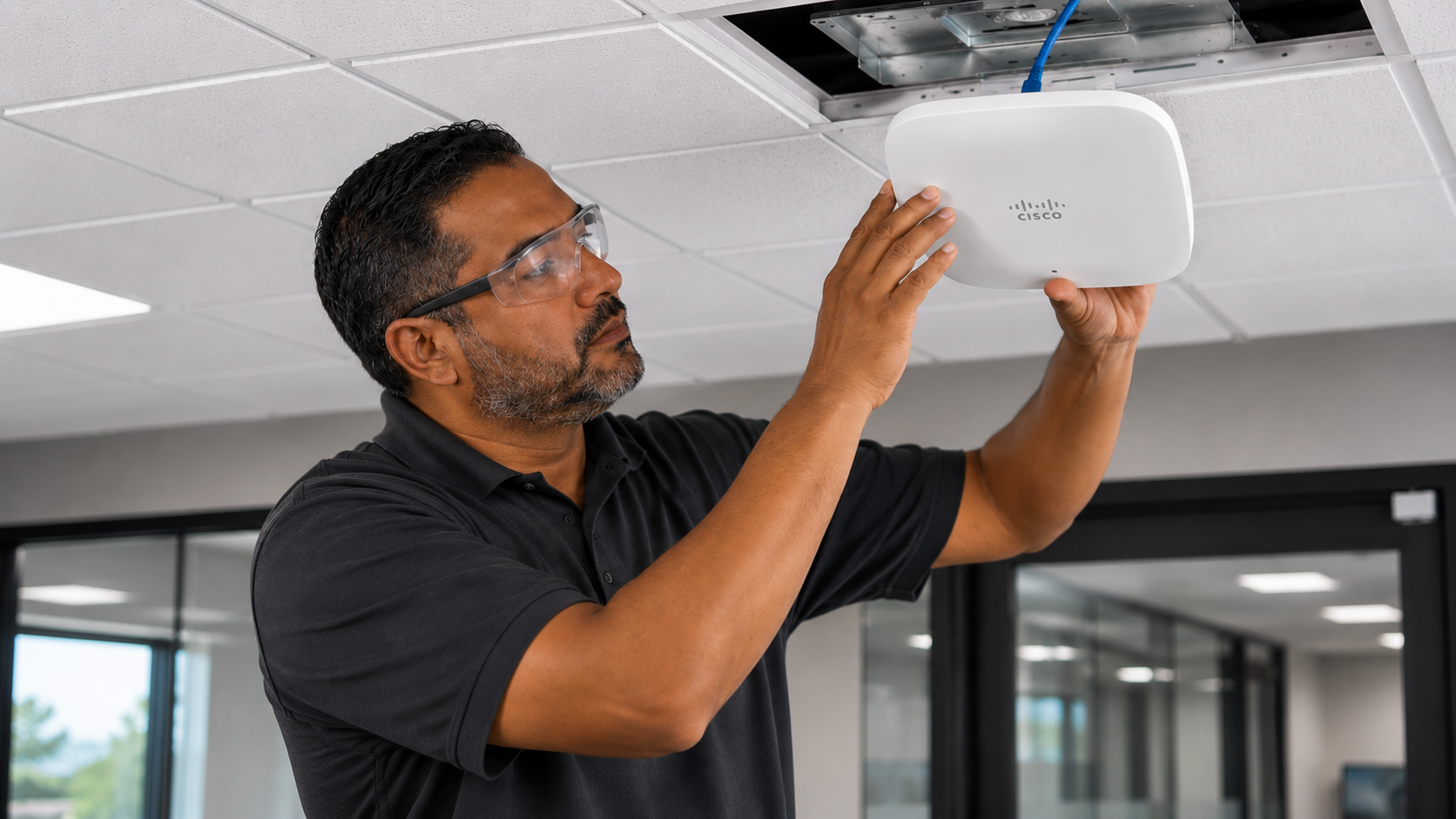
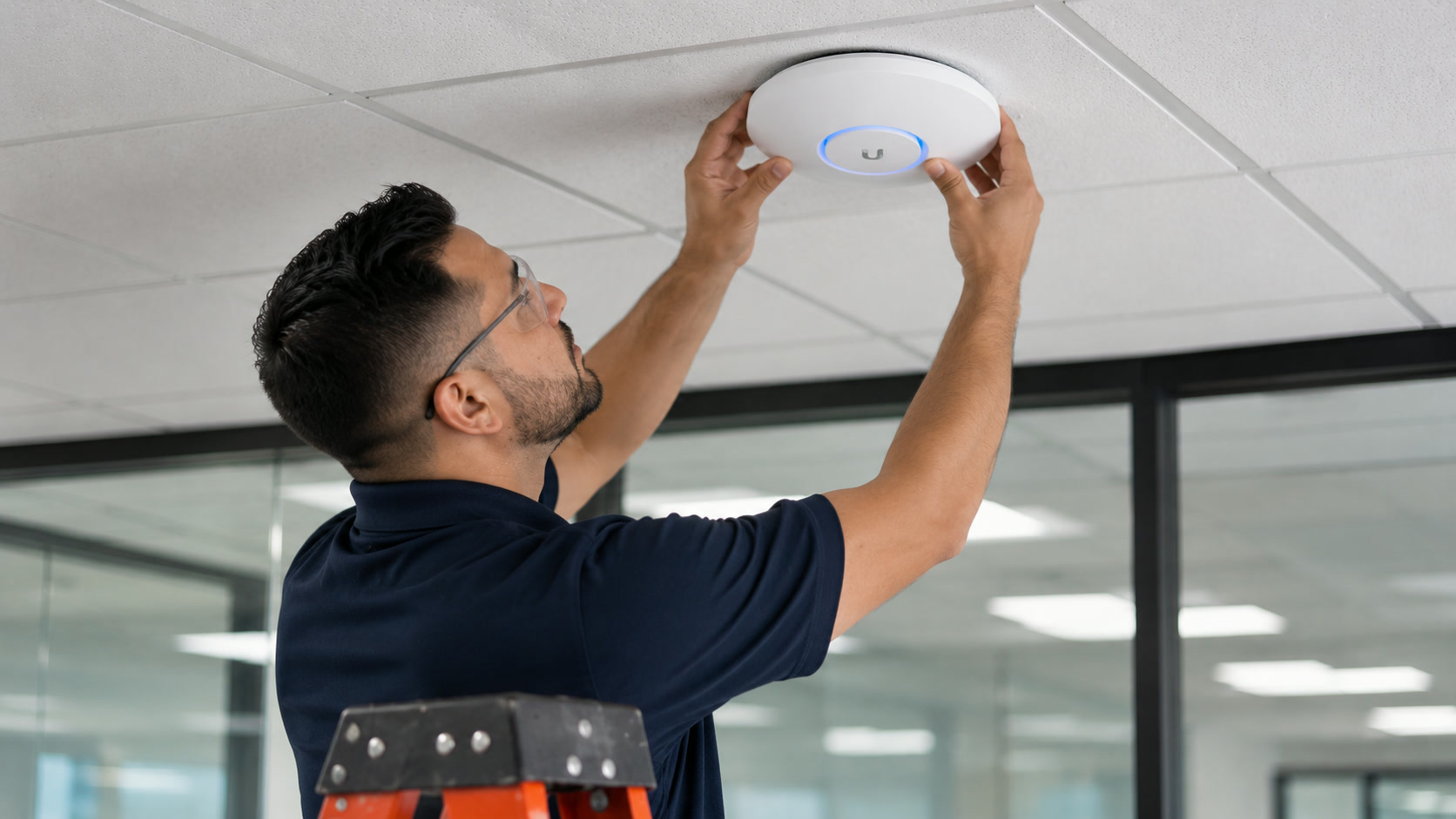
Our WіFі network deployment methodology adheres to stringent installation best practices to ensure optimal performance and aesthetic integration. APs are mounted precisely according to the validated design, utilizing appropriate mounting hardware for various ceiling types (e.g., suspended, hard-lid, unenclosed structures in warehouses). Cabling runs for each AP are meticulously managed, following NEC and TIA standards for bend radius, cable support, and fire ratings. We ensure proper grounding and bonding where required to protect equipment from electrical surges. For outdoor or harsh environment deployments, we specify and install IP67-rated enclosures, shielded cabling, and surge protection. Our technicians are factory-trained on various vendor-specific mounting and connectivity requirements, ensuring that each AP is installed to manufacturer specifications, preserving warranty and guaranteeing expected performance. The focus is on a clean, organized, and reliable physical installation that allows the wireless network to perform at its peak and simplifies future maintenance.
Rigorous Post-Installation Validation and Optimization
Upon completion of the physical installation, Access Cabling performs comprehensive post-installation validation to ensure the WіFі network meets or exceeds performance specifications. This involves a "validation survey" using tools like Fluke Networks AirCheck G2 or Ekahau Sidekick, which re-maps RF coverage, confirms signal strength, measures data rates, and identifies any unexpected interference or coverage gaps that may have surfaced during the physical deployment. We verify proper channel allocation, power settings, and roam optimization. For enterprise environments, we test client device connectivity, throughput under load, and application performance to ensure a seamless user experience. Any discrepancies between the predictive design and actual performance are identified and rectified through optimization adjustments, such as fine-tuning AP power levels, adjusting channel assignments, or addressing minor installation variations. This validation step is critical to confirm the network's readiness for operation and provides a baseline for ongoing network health monitoring.
Enhanced Security and Network Segmentation
Implementing robust security measures is paramount for any enterprise WіFі network. Access Cabling deploys solutions that incorporate industry-standard encryption protocols such as WPA2-Enterprise or WPA3, often integrated with RADIUS servers for centralized authentication (e.g., using Microsoft NPS or Cisco ISE). We implement network segmentation through VLANs (Virtual Local Area Networks) to isolate different user groups (e.g., corporate staff, guest users, IoT devices) and critical systems, minimizing the attack surface and containing potential breaches. Guest WіFі networks are typically isolated on dedicated VLANs with captive portal authentication, ensuring guest traffic does not traverse the internal corporate network. Wireless intrusion detection systems (WIDS) and wireless intrusion prevention systems (WIPS) capabilities, often embedded within enterprise APs or WіFі controllers, are configured to detect and mitigate unauthorized access points, rogue clients, and other wireless security threats. Our designs prioritize a least-privilege access model to bolster overall network integrity.
Scalability, BYOD Support, and Future-Proofing
The modern commercial environment necessitates a WіFі network capable of scaling to accommodate increasing device counts, bandwidth demands, and emerging wireless technologies. Our designs inherently prioritize scalability, utilizing enterprise-grade hardware that supports higher client densities and future Wi-Fi standards like Wi-Fi 6E (802.11ax in 6GHz). We plan for Bring Your Own Device (BYOD) strategies by estimating potential user concurrency and device types, ensuring the network can handle the diverse requirements of personal smartphones, tablets, and laptops. Future-proofing involves deploying Category 6A or even fiber optic cabling to AP locations where appropriate, providing sufficient backhaul capacity for next-generation wireless speeds. Our solutions are designed with a modular approach, allowing for seamless expansion by adding more APs or upgrading existing hardware without requiring a complete network overhaul, safeguarding your initial investment and ensuring your wireless infrastructure evolves with your business needs.
Specific Applications: Offices, Warehouses, and Industrial Spaces
The requirements for WіFі networks vary significantly across commercial environments. In office settings, design focuses on high-density user support, seamless roaming for VoIP and video conferencing, and aesthetic integration of APs. We account for open office layouts, meeting rooms, and executive spaces, ensuring consistent coverage and capacity. For warehouses and industrial spaces, the challenges include overcoming RF interference from machinery, racking obstructions, and extreme temperatures. Here, we deploy ruggedized, perhaps IP67-rated, access points, often leveraging directional antennas for focused coverage in aisles, and ensuring robust backhaul connections over longer distances or with greater noise immunity. We understand the critical need for seamless connectivity for inventory scanners, automated guided vehicles (AGVs), and other IoT devices in these environments. Our specialized expertise ensures the WіFі network is precisely engineered for the operational demands and environmental characteristics of your specific facility, whether it's a multi-story office building or a sprawling distribution center.
Spectrum Analysis and Interference Mitigation Strategies
Effective Wi-Fi network deployment hinges critically on a thorough understanding and management of the radio frequency (RF) spectrum. Our approach begins with detailed, multi-channel spectrum analysis using tools like MetaGeek Chanalyzer with an Oscium WiPry or Ekahau Spectrum Analyzer. This identifies both co-channel and adjacent-channel interference from non-Wi-Fi sources such as microwave ovens, cordless phones, Bluetooth devices, and industrial wireless sensors operating in the 2.4 GHz, 5 GHz, and increasingly, 6 GHz bands. We analyze frequency occupancy, duty cycle, and signal-to-noise ratio (SNR) to pinpoint specific interferers and their impact on Wi-Fi performance. Mitigation strategies are then precisely engineered, often involving channel planning optimization, adjustment of transmit power levels, or the strategic deployment of directional antennas to minimize unintended signal propagation. In complex industrial environments, this can extend to advising on source suppression techniques or implementing RF shielding to create 'clean' RF zones. A common pitfall is overlooking intermittent interferers; our deep-dive analysis includes capturing data over extended periods to identify these elusive issues. The chosen channels conform strictly to IEEE 802.11 standards and local regulatory body guidelines (e.g., FCC in the US, ETSI in Europe) to ensure lawful and efficient spectrum usage, maximizing throughput and minimizing latency for critical business applications.
Advanced QoS and Traffic Prioritization for Critical Applications
Implementing robust Quality of Service (QoS) within a Wi-Fi network is paramount for ensuring consistent performance of latency-sensitive applications like VoIP, video conferencing (e.g., Teams, Zoom), and real-time operational systems. Our deployments incorporate industry-standard mechanisms such as Differentiated Services Code Point (DSCP) tagging at the application layer, mapping these to 802.1p CoS values at the Ethernet frame level, and subsequently to Wi-Fi Multimedia (WMM) Access Categories (ACs_VO, AC_VI, AC_BE, AC_BK) as defined by IEEE 802.11e. This end-to-end prioritization ensures that critical traffic receives preferential treatment, reducing jitter, packet loss, and latency through congestion avoidance techniques like weighted fair queuing (WFQ) and policing. We design for specific application requirements; for instance, VoIP often demands less than 150ms round-trip delay and less than 1% packet loss, dictating specific WMM settings and wireless Medium Access Control (MAC) access parameters like Arbitration Interframe Space (AIFS) numbers and Contention Window (CW) sizes. A common mistake is a blanket QoS policy; our tailored approach involves deep analysis of an organization's specific application profiles and their bandwidth/latency needs, implementing granular QoS policies at both the wireless access point and wired network infrastructure layers to prevent critical application degradation even during peak network utilization. This proactive management of network resources ensures that business-critical communication and operations remain uninterrupted and highly performant.
Comprehensive Documentation and Knowledge Transfer Protocols
A critical, often underestimated, facet of world-class Wi-Fi network deployment is the generation of comprehensive, accurate documentation and the execution of robust knowledge transfer protocols. Our deliverables include 'as-built' network diagrams developed in Visio or AutoCAD, detailing access point (AP) locations, antenna types and orientations, cable runs (including plenum ratings and labelling conventions according to TIA/EIA standards), switch port assignments, and power over Ethernet (PoE) injector details. We provide detailed configuration files for all deployed hardware (APs, controllers, switches, firewalls) and a complete inventory list, including MAC addresses, serial numbers, and firmware versions. A crucial element is the Wi-Fi design report, which summarizes empirical site survey findings, RF heatmaps, channel plans, signal-to-noise ratios (SNR), and anticipated coverage/capacity metrics, validated against initial design parameters. For long-term operational efficiency, we conduct in-depth, hands-on training sessions with the client's IT staff. This knowledge transfer covers controller management, basic troubleshooting, AP health monitoring, and an understanding of the implemented security policies and QoS configurations. We delineate common failure modes and provide clear escalation paths, ensuring the client's team possesses the necessary acumen to maintain and troubleshoot the network post-deployment. This meticulous documentation serves not only as an operational guide but also as a foundational asset for future network expansions, upgrades, and compliance audits, mitigating reliance on external consultants for routine tasks.
Post-Deployment Monitoring, Analytics, and Predictive Maintenance
Beyond initial validation, sustaining optimal Wi-Fi network performance necessitates continuous monitoring, detailed analytics, and proactive predictive maintenance strategies. Our engagements extend to configuring and integrating network monitoring systems (NMS) such as Cisco DNA Center, Aruba Central, or Ruckus SmartZone with client infrastructure. These platforms provide real-time visibility into key performance indicators (KPIs) like client count, throughput, channel utilization, rogue AP detection, and individual AP health. We establish custom dashboards and alerts for critical thresholds (e.g., high retransmission rates, excessive channel interference, low SNR below 25dB for enterprise voice). Advanced analytics frameworks are employed to identify trends, predict potential capacity bottlenecks based on historical usage patterns, and pinpoint areas requiring proactive optimization. For instance, consistent high channel utilization on a specific AP combined with increasing client contention could signal a need for additional AP placement or channel re-planning in that micro-cell. Furthermore, we leverage these analytics for predictive maintenance: monitoring firmware versions across the AP fleet to schedule timely, non-disruptive upgrades that address security vulnerabilities or introduce feature enhancements, well before they lead to service degradation. This proactive, data-driven approach shifts network management from reactive troubleshooting to strategic planning, maximizing network uptime, extending hardware lifespan, and significantly reducing the total cost of ownership by preventing costly outages and performance impediments.