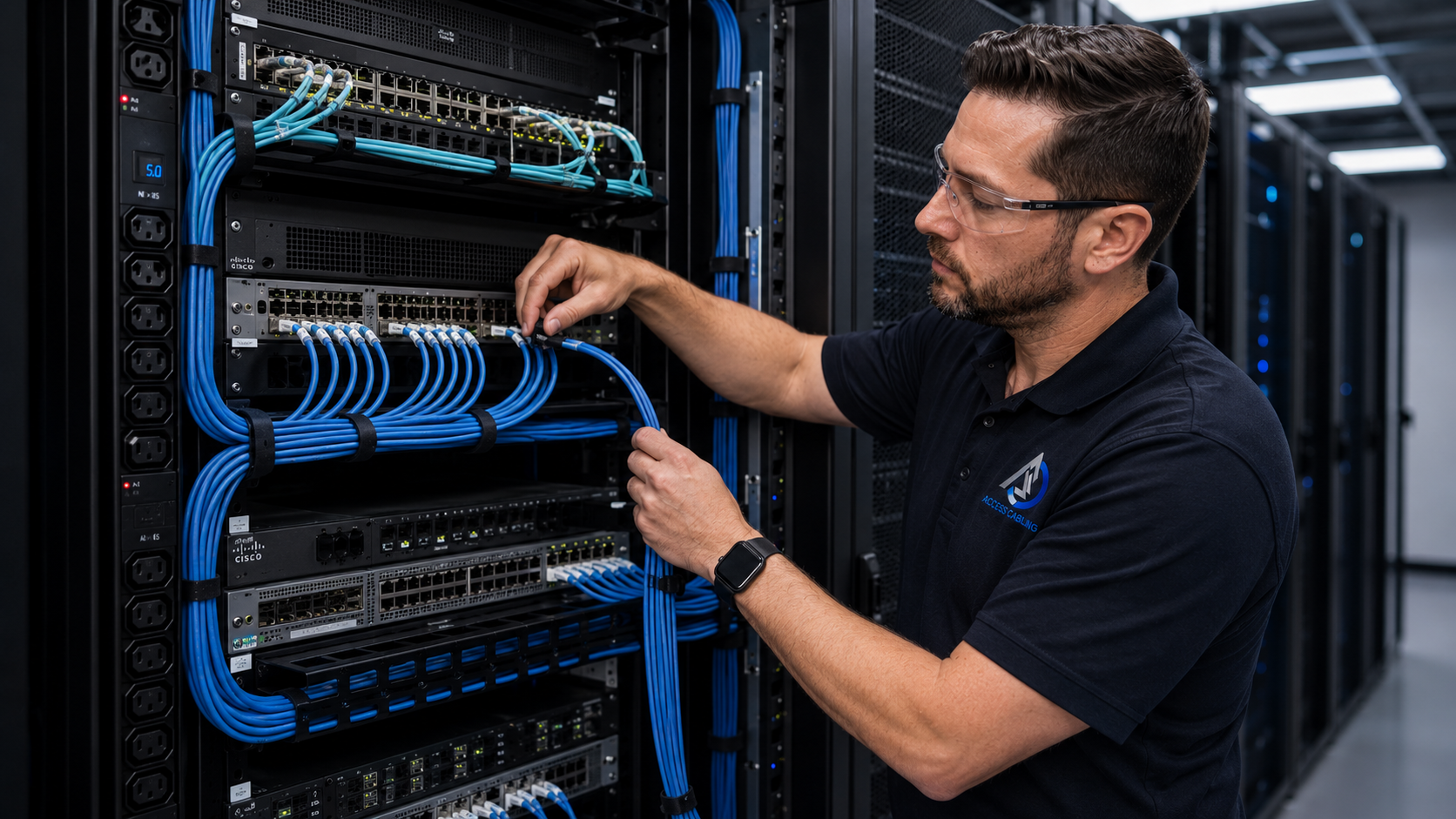
Optimizing a high-density, high-performance data center infrastructure demands precision engineering and meticulous execution, a specialty of Access Cabling's low-voltage operations. Our comprehensive data center cabling services address the critical demands of hyperscale, colocation, enterprise, and edge facilities, ensuring robust connectivity, scalability, and operational efficiency whether transitioning to 400GbE or upgrading existing fiber plants. Unlike general cabling contractors, our 28 years of nationwide experience as a C-10/C-7 licensed firm (CSLB 992009) ensures adherence to TIA-942, BICSI, and NEC standards from the initial design phase through final commissioning. We solve for the intricate challenges of power provisioning, cooling, physical security, and future-proofing, integrating structured cabling solutions that maximize uptime and return on investment for our clients.
Upholding TIA-942 and BICSI Standards in Data Center Infrastructure
Adherence to TIA-942 and BICSI standards is non-negotiable in data center cabling. TIA-942 outlines a tiered approach to data center design, from site selection and architectural considerations to electrical, mechanical, and telecommunications infrastructure, dictating factors like environmental control, fire suppression, and physical security. BICSI's Data Center Design Reference Manual (DCDCM) provides additional guidelines for best practices in structured cabling system design, installation, and administration within these complex environments. Access Cabling designs and implements systems that meet or exceed these benchmarks, ensuring reliability, resilience, and operational continuity. This includes meticulous planning for pathway and spacing requirements, ensuring proper bend radius for fiber optics, and maintaining segregation between copper data cabling and power runs to mitigate electromagnetic interference (EMI), a critical consideration in high-density environments. Our approach integrates these foundational standards into every project phase, from initial consultation to final documentation, guaranteeing a compliant and high-performing infrastructure.
Strategic Design and Engineering for Hyperscale and Enterprise Facilities
Effective data center cabling begins with a strategic design and engineering phase that accounts for current and future data demands, power density, and cooling strategies. Access Cabling's design team collaborates with IT directors and facilities managers to develop a system architecture that minimizes latency, maximizes bandwidth, and optimizes rack space utilization. This involves power-aware cabling strategies, meticulous consideration of fiber trunking versus individual patch cord deployments, and the strategic placement of Main Distribution Areas (MDAs), Intermediate Distribution Areas (IDAs), and Zone Distribution Areas (ZDAs) in accordance with TIA-942 guidelines. We leverage sophisticated CAD tools and network mapping software to model and validate designs prior to physical deployment, addressing potential bottlenecks and ensuring seamless integration with existing network hardware and physical security systems. Our engineering considers not just connectivity, but also passive cooling implications, cable management pathways, and clear demarcation points for enhanced maintainability and future upgrades, crucial for mitigating thermal hotspots and streamlining troubleshooting.
Advanced Materials and Components for High-Density Deployments
The longevity and performance of a data center infrastructure directly correlate with the quality of its components. Access Cabling exclusively sources advanced cabling materials and connectivity solutions from industry-leading manufacturers such as Panduit, CommScope, Leviton, Belden, Corning, and Legrand. For high-density data centers, this often entails pre-terminated MPO/MTP fiber optic trunk cables for rapid deployment and reduced on-site termination, OM3/OM4/OM5 multimode fiber and OS2 single-mode fiber for varying reach and bandwidth requirements (e.g., 10GbE, 40GbE, 100GbE, 400GbE), and Category 6A shielded or unshielded twisted pair copper for server-to-switch connectivity up to 10GbE. We utilize high-performance patch panels, fiber optic enclosures, and cable management solutions designed for optimal airflow and accessibility. Our selection criteria prioritize low insertion loss, high return loss, and robust physical protection for both copper and fiber, ensuring signal integrity and maximizing mean time between failures (MTBF). This includes specialized ladder racks, perforated cable trays, and finger duct cabinets that support proper bend radius and secure cable routing, essential for maintaining network performance and simplifying future MACD (Moves, Adds, Changes, Deletions) operations.
Precision Installation Methodology and Project Execution
The installation phase of data center cabling demands an unparalleled level of precision and adherence to established protocols to avoid costly downtime and performance degradation. Access Cabling's BICSI-certified technicians follow a stringent methodology that encompasses meticulous cable routing, proper labeling using TIA-606-C standards, and disciplined cable management. For fiber optic deployments, this includes careful handling to prevent micro-bends and macro-bends, proper fusion splicing where necessary, and ensuring all connectors are free of contamination through inspection with fiber scopes. Copper installations involve precise termination to maintain pair twists and minimize crosstalk, followed by comprehensive testing. Our project management workflow integrates detailed scheduling, resource allocation, and regular progress reporting, ensuring projects are delivered on time and within budget. We implement strict change control procedures and maintain open communication with client stakeholders, minimizing disruption to ongoing operations. This rigorous approach mitigates common installation pitfalls such as inadequate slack management, incorrect patch panel loading, or insufficient segregation of power and data, all of which can severely impact network performance and lead to costly reworks.
Comprehensive Testing, Certification, and Documentation
Post-installation, Access Cabling performs exhaustive testing and certification of all data center cabling infrastructure to guarantee compliance with TIA/ISO performance specifications. For fiber optic systems, we utilize Fluke DSX CableAnalyzer series network testers to conduct Tier 1 (insertion loss, length, polarity verification) and Tier 2 (OTDR trace analysis) testing, ensuring every link meets specified attenuation and reflectance limits. For copper cabling, we certify Category 6A links for alien crosstalk, return loss, and near-end crosstalk (NEXT) performance. Each test result is meticulously documented, providing a comprehensive, auditable record of the installed system's performance, including channel and permanent link test results. This certification process is critical not only for validating current performance but also for establishing a baseline for future troubleshooting and warranty claims. We provide detailed as-built drawings, cable routing schematics, and a complete set of test reports, delivering a transparent and verifiable record of the entire cabling plant's capabilities, essential for long-term operational management and maintenance.
Scalable Connectivity for Cloud, Edge, and Colocation Environments
Data center cabling solutions must be inherently scalable to support evolving cloud strategies, expanding edge computing footprints, and dynamic colocation tenancy. Access Cabling designs and deploys infrastructure that anticipates these growth trajectories. For cloud providers, this translates to dense fiber backbones and flexible patching fields that can quickly provision new racks or expand bandwidth to support increased virtual machine instances. In edge data centers, which are typically smaller and require rapid deployment, we prioritize modular, pre-terminated solutions designed for localized processing and minimal latency. For colocation facilities, our structured cabling ensures clear demarcation, secure interconnections between tenants, and a highly available, multi-tenant capable network. Common applications include spine-leaf architectures, top-of-rack (ToR) and end-of-row (EoR) switching, SAN connectivity, and high-performance computing (HPC) clusters requiring ultra-low latency. Our expertise extends to supporting diverse network topologies and providing the physical layer foundation for Software-Defined Networking (SDN) and Network Function Virtualization (NFV) deployments, adapting to the programmable infrastructure demands of modern data center operations.
Ensuring Regulatory Compliance and Robust Physical Security
Data center cabling extends beyond mere connectivity; it encompasses critical aspects of regulatory compliance and physical security, deeply integrated into the TIA-942 standard. Access Cabling evaluates and implements solutions that address fire codes, electrical safety (NEC Article 645 for Information Technology Equipment), and environmental regulations. Our installations adhere to bonding and grounding requirements to minimize fault current risks and protect sensitive hardware. Furthermore, we consider the physical security of the cabling infrastructure itself. This includes pathways that are protected from unauthorized access, secure enclosures for patching and distribution, and robust cable management that prohibits accidental or malicious tampering. We can integrate cabling for access control systems (e.g., card readers, biometrics for cabinet access), IP surveillance cameras, and environmental monitoring sensors (temperature, humidity, leakage detection) that protect the integrity of the data center's operations. Our holistic approach minimizes vulnerability and ensures the cabling plant contributes positively to the overall security posture and compliance requirements (e.g., HIPAA, PCI DSS) of the facility.
Access Cabling's Differentiated Value in Data Center Infrastructure
Access Cabling distinguishes itself in the data center cabling sector through a combination of engineering prowess, 28 years of nationwide operational experience, and a steadfast commitment to industry best practices. Unlike general contractors, our C-10/C-7 licensing (CSLB 992009) and deep specialization in low-voltage systems mean we understand the nuances of high-density fiber and copper infrastructure within mission-critical environments. We don't just install cables; we engineer a resilient, scalable foundation designed for the next decade of data center evolution. Our approach reduces the total cost of ownership by maximizing future-proofing, minimizing downtime through robust design, and streamlining maintenance with meticulous documentation. We act as a trusted partner, providing unbiased recommendations on technology and manufacturers, and ensuring full transparency from initial needs assessment through final sign-off. This level of focused expertise, national deployment capability, and unwavering quality control offers data center owners and operators a tangible competitive advantage.
Optimizing Cooling & Power with Intelligent Cable Route Design
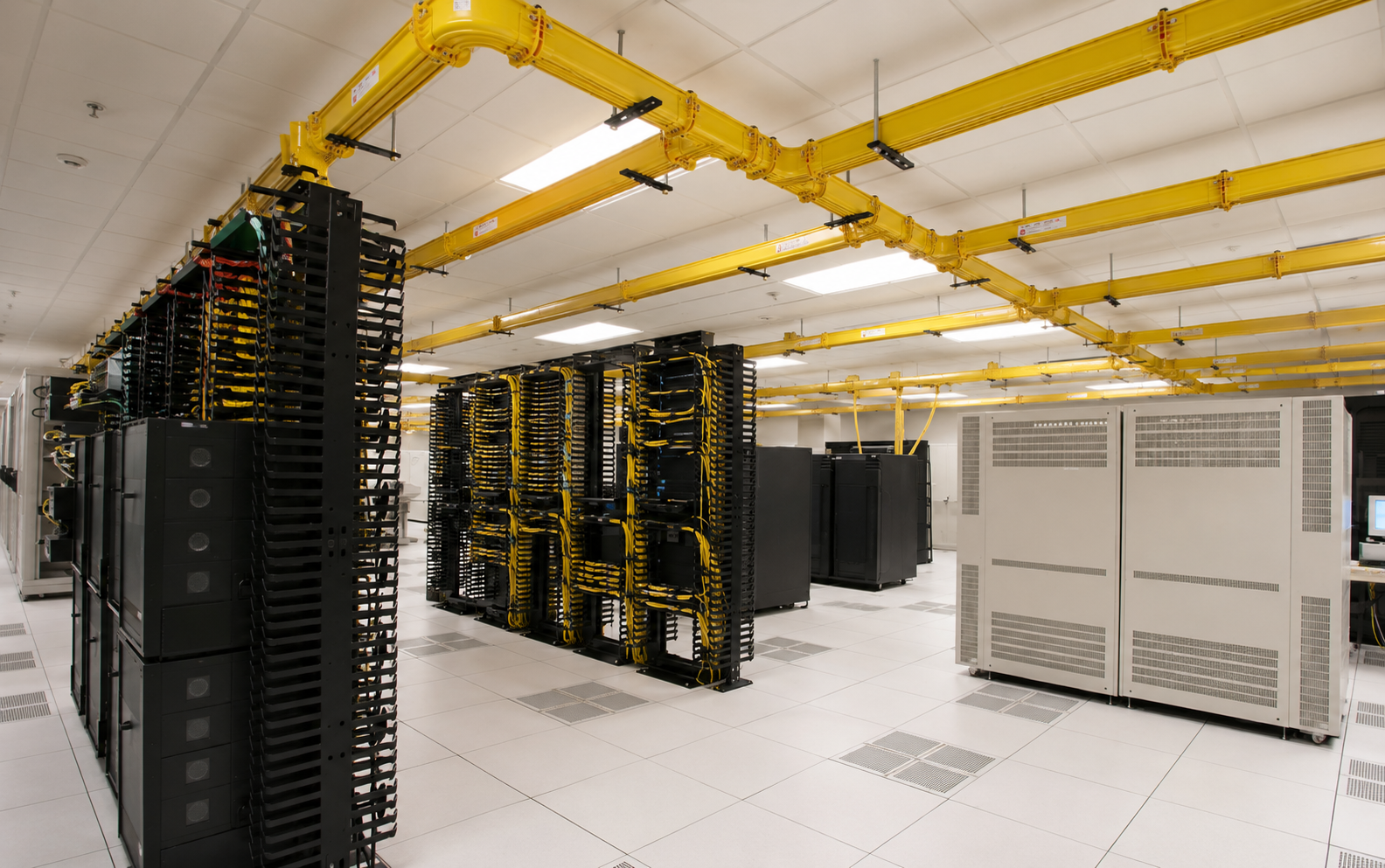
Efficient data center operation hinges significantly on prudent cable routing, directly impacting thermal management and power distribution. Our design philosophy extends beyond mere connectivity, meticulously considering airflow dynamics and heat dissipation. We employ computational fluid dynamics (CFD) analysis during the design phase to model air movement and identify potential hot spots exacerbated by cable congestion. This proactive approach ensures that overhead ladder racks, underfloor pathways, and cabinet-level cable management systems (e.g., vertical cable managers aligning with cabinet exhaust chimneys) are engineered to promote unobstructed cold aisle/hot aisle separation and minimize pressure drop across IT equipment. Furthermore, careful consideration is given to the separation of high-voltage power cables from low-voltage data cables to mitigate electromagnetic interference (EMI) and fulfill specific grounding and bonding requirements outlined in TIA-607-C and NFPA 70 (National Electrical Code) Article 645. We detail cable pathway fill ratios, utilizing tools like BICSI's pathway sizing guidelines and industry-standard calculation methods (e.g., using manufacturers' specified cable diameters and bending radii) to prevent overpopulation, which can restrict airflow, increase cable installation difficulty, and compromise future scalability. These optimizations directly correlate to reduced cooling loads, prolonged equipment lifespan, and enhanced energy efficiency, contributing to a lower Power Usage Effectiveness (PUE) and operational expenditure. Our deliverables often include detailed CAD drawings depicting cable tray elevations, conduit schedules, and floor cutouts, all coordinated with Mechanical, Electrical, and Plumbing (MEP) schematics to ensure seamless integration and avoid inter-trade clashes during construction.
De-risking Live Migrations and Phased Infrastructure Upgrades
Executing live migrations and phased infrastructure upgrades in active data centers presents unique challenges, demanding meticulous planning and execution to minimize downtime and prevent service interruptions. Our methodology includes comprehensive risk assessments, developing granular Method of Procedure (MOP) documents for every step of the migration process. These MOPs detail specific tasks, equipment identification (e.g., port mapping in IMDC/DCIM systems, asset tags), fall-back strategies, and designated communication protocols between project teams and client operations. We utilize tools such as fiber optic inspection microscopes (e.g., Fluke Networks FiberInspector) and OLTS (Optical Loss Test Sets) to pre-qualify new cabling routes and components before cutover, ensuring link integrity and performance. For copper-based systems, advanced certifiers (e.g., Viavi Certifier10G) are employed to verify compliance with TIA-568 standards for category performance. Crucially, cutover windows are strategically scheduled, often during off-peak hours, with dedicated 'go/no-go' decision points and clear escalation paths. We advocate for the implementation of 'dark fiber' or 'dark copper' pre-staging, where new infrastructure is installed and tested in parallel with existing systems, allowing for a swift, controlled transition during the cutover event. This parallel infrastructure approach, coupled with robust labeling (e.g., TIA-606-C compliant field-applied labels, machine-readable labels for DCIM integration), minimizes human error and significantly reduces the mean time to repair (MTTR) should an issue arise. Post-migration, we conduct thorough end-to-end connectivity verification and performance baselining to confirm operational stability and adherence to service level agreements (SLAs), providing clients with validated operational confidence.
Leveraging Advanced DCIM for Comprehensive Cable Lifecycle Management
Modern data center operations increasingly rely on Data Center Infrastructure Management (DCIM) platforms to provide a holistic view of resources and drive informed decision-making. Our services seamlessly integrate with leading DCIM solutions, transforming physical cabling infrastructure from a static asset into an actionable, dynamic data point. We don't just install cables; we provision them within the client's DCIM, populating databases with critical attributes such as cable type, length, pathways, connected devices (source/destination ports), circuit ID, and installation dates. This meticulous data entry facilitates accurate capacity planning, allowing operators to visualize available ports and pathways, forecast future expansion, and optimize resource utilization. Furthermore, DCIM integration supports efficient incident management by providing instant visibility into physical layer connectivity details, accelerating troubleshooting and reducing resolution times. Through auto-discovery protocols or manual input during the commissioning phase, we ensure that the DCIM accurately reflects the 'as-built' state of the cabling plant, which is crucial for maintaining data integrity throughout the infrastructure's lifecycle. This includes documenting moves, adds, and changes (MACs) directly within the DCIM, ensuring that the digital twin of the data center remains current. Beyond physical resource tracking, DCIM integration enables advanced analytics, such as identifying stranded capacity, predicting thermal hotspots (when integrated with environmental sensors), and optimizing power consumption by correlating IT loads with their underlying physical connectivity. By treating cabling as a core component of the DCIM ecosystem, we empower clients with enhanced operational control, predictive maintenance capabilities, and a quantifiable return on their infrastructure investment.
Ensuring Seismic Resiliency and Aisle Containment Compliance
In regions prone to seismic activity or in data centers where structural integrity is paramount, implementing earthquake-resistant cabling infrastructure is a non-negotiable imperative. Our design incorporates robust seismic bracing and anchoring solutions for all cable pathway systems, including overhead ladder racks, basket trays, and underfloor conduits. This involves adherence to applicable building codes and standards such as ASCE 7 (Minimum Design Loads and Associated Criteria for Buildings and Other Structures) and state-specific seismic provisions. We specify U-shaped trapeze hangers or seismic cable tray supports that are appropriately sized and anchored to the building's structural elements (e.g., concrete slabs, steel beams) using approved seismic anchors (e.g., wedge anchors, drop-in anchors rated for shear and tension loads). Cable routing is designed to accommodate building movement, utilizing flexible conduits or appropriate slack loops at connection points to prevent undue stress on cables and equipment ports during a seismic event. Complementing structural resilience, our expertise extends to optimizing aisle containment systems (hot aisle containment, cold aisle containment). We ensure that cable pathways seamlessly integrate with containment structures without compromising their sealed environment. This involves meticulous planning for cable entry/exit points through containment walls, utilizing brush grommets, specialized cable glands, or fire-rated seals that maintain the integrity of the air barrier. We also address the specific fire suppression system requirements (e.g., alignment with NFPA 75/76 for IT equipment and telecommunication rooms) to ensure that cabling does not obstruct sprinkler coverage or interfere with gaseous suppression agent distribution, while also verifying that any penetrations through fire-rated barriers are properly firestopped using UL-listed materials to maintain compartmentalization and life safety compliance.