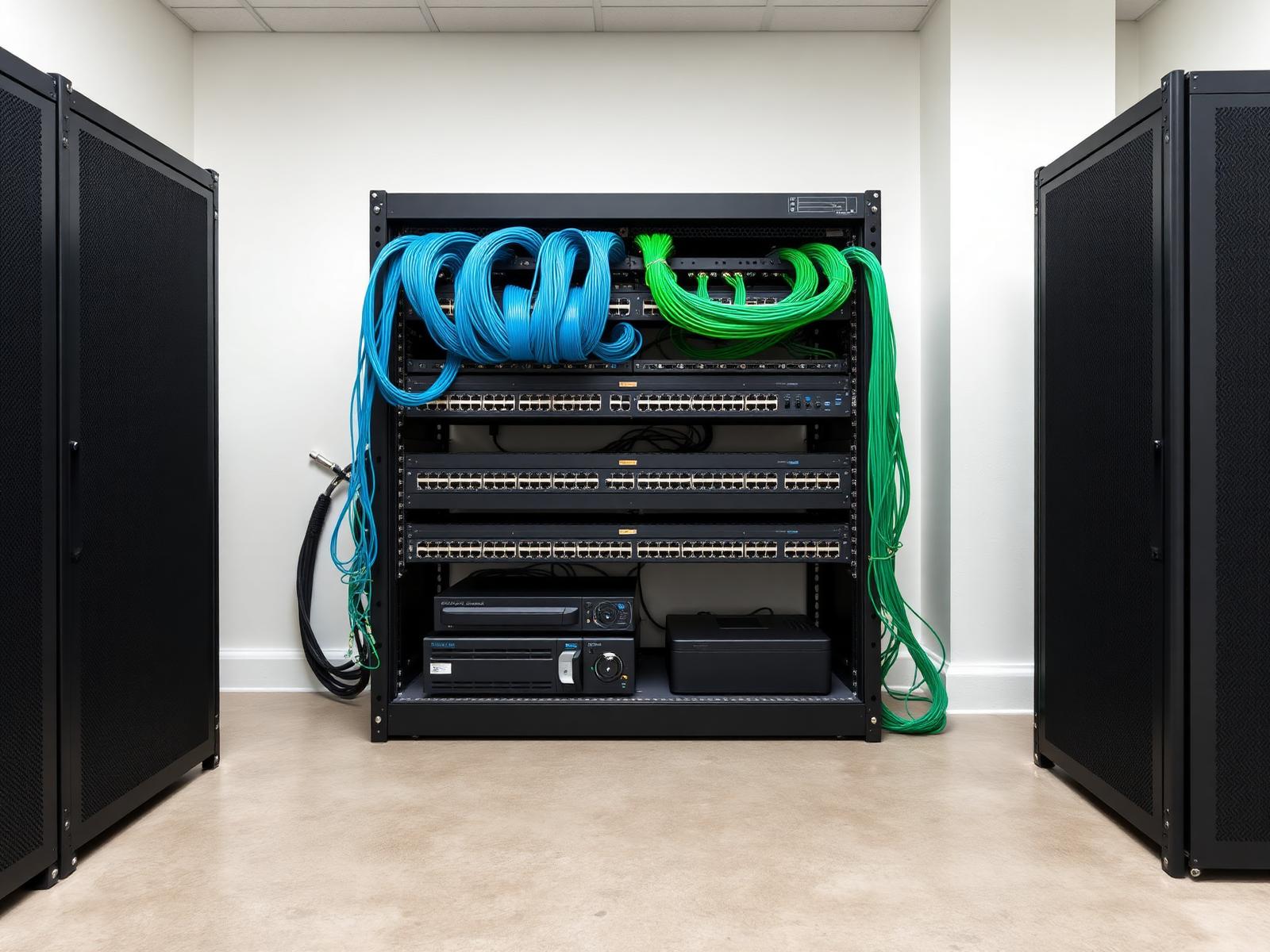
In high-density data center environments, meticulously planned and executed <b>cable management</b> is not merely an aesthetic concern; it is a critical determinant of system reliability, operational efficiency, and future scalability. Untamed cabling contributes to airflow obstruction, increased power consumption, signal degradation, and significantly complicates MACs (Moves, Adds, Changes). As a C-10/C-7 low-voltage contractor with 28+ years of expertise, Access Cabling specializes in designing and implementing robust cable management systems that optimize infrastructure performance. We go beyond basic tidying, integrating robust pathways, containment, and labeling strategies that adhere to TIA/EIA, BICSI, and manufacturer best practices, ensuring your data center infrastructure operates at peak efficiency while simplifying maintenance and mitigating downtime risks. Our approach ensures long-term viability and ease of management for even the most complex data center layouts.
Foundational Principles and Industry Standards for Cable Management
Effective cable management in data centers begins with a deep understanding of industry best practices and standards. Access Cabling adheres rigorously to ANSI/TIA-942-B (Telecommunications Infrastructure Standard for Data Centers), which outlines requirements for pathway and space, including cable routing within cabinets, racks, and overhead. We also incorporate principles from BICSI's "Telecommunications Distribution Methods Manual" (TDMM) for the design and implementation of structured cabling systems, ensuring proper bend radius, strain relief, and separation from EMI sources. This adherence prevents common issues like signal attenuation, crosstalk, and physical damage that can compromise network performance. Our engineers design solutions considering both current and future capacity, anticipating growth and technological evolution within the data center footprint, ensuring that physical layer integrity is maintained across all infrastructure layers.
Strategic Design of Vertical and Horizontal Pathways
The strategic design of cable pathways is paramount for airflow, accessibility, and segregation within data center racks and aisles. Vertical cable management units (VCMUs) are essential for routing cables between patch panels, switches, and servers within a rack, preventing obstruction of equipment vents and ensuring proper bend radius. We deploy solutions from manufacturers like Panduit (e.g., NetRunner, Wyr-Grid), CommScope (e.g., FiberGuide, SpeedFlex), and Leviton, selecting products based on cable fill capacity, density requirements, and the specific rack architecture (2-post, 4-post, server cabinets). Horizontal cable managers, integrated between patch panels and active equipment, organize patch cords within each rack unit, maintaining aesthetics and ensuring easy tracing, crucial for high-density 10GbE, 40GbE, and 100GbE fiber or copper deployments where congestion can quickly become an issue. Our designs minimize cable congestion and maximize convective cooling pathways within high-density compute and storage racks.
Overhead Containment Systems for Scalability and Airflow
Overhead cable containment, utilizing cable trays, ladder racks, or fiber raceways, is critical for routing trunk cables, backbone distribution, and inter-cabinet links while preserving underfloor airflow for cooling. Access Cabling designs and installs overhead pathways in accordance with NEC (National Electrical Code) articles concerning plenum ratings and grounding requirements. We utilize systems such as Panduit Wyr-Grid, CommScope FiberGuide, and metallic ladder rack systems (e.g., from Cooper B-Line), carefully planning for current cable loads and future expansion. Proper sizing and placement minimize sag, maintain separation between power and data circuits as per TIA-568-C, and facilitate efficient cooling by not impeding hot/cold aisle containment. Fiber optic raceways, particularly for MPO/MTP deployments, demand specialized attention to prevent macro and micro bend losses, and are selected for their smooth, enclosed pathways that protect sensitive optical fibers from physical stress and environmental contaminants, ensuring minimal insertion loss across the optical plant.
Advanced Labeling and Documentation for Maintainability
A robust cable management system is incomplete without comprehensive labeling and documentation. Access Cabling implements TIA-606-C compliant labeling schemes, ensuring every cable, patch panel port, and pathway component is uniquely identified. This includes asset tags for equipment, sequential numbering for patch cords, and origin/destination labels for backbone cabling. We utilize specialized labeling solutions such as Panduit's Self-Laminating Labels and Flag Labels, or Brady IDXPERT systems, designed for durability in data center environments. Detailed as-built documentation, including schematic diagrams, cable schedules, and an inventory of all installed components, is provided upon project completion. This meticulous approach significantly reduces Mean Time To Repair (MTTR), streamlines troubleshooting, simplifies capacity planning, and facilitates efficient MAC activities, directly translating to reduced operational costs and increased uptime for data center operators. Without accurate documentation, even the most organized physical layer can become a liability during critical events.
Component Selection and Manufacturer Synergy
The longevity and performance of a cable management system hinge on the quality and compatibility of its components. Access Cabling specifies and installs products from leading manufacturers known for their reliability and adherence to industry standards, including Panduit, CommScope, Leviton, Belden, and Corning. For instance, in fiber optic applications, we might deploy Corning's Pretium Edge solutions for high-density MPO connectivity, paired with CommScope's FiberGuide pathways to protect fiber runs. For copper, Belden's 10GX line integrated with Panduit's NetRunner vertical managers ensures end-to-end performance. Our experienced technicians are certified in the installation of these specific systems, understanding the unique features and installation requirements of each. This ensures seamless integration, validates manufacturer warranties, and guarantees that all components work synergistically to provide optimal performance and longevity for the entire physical layer infrastructure, an essential consideration when delivering enterprise-grade data center solutions.
Integration of Power and Data Cable Separation Protocols
Maintaining proper separation between power and data cabling is a critical, often overlooked, aspect of cable management that directly impacts signal integrity and safety. According to TIA-569-C and BICSI TDMM, specific separation distances must be maintained to mitigate electromagnetic interference (EMI) and prevent signal degradation, particularly for high-speed data circuits. Access Cabling engineers design pathways that ensure dedicated routes for power distribution and low-voltage data cabling, utilizing physical barriers, segregated cable trays, or shielded pathways where necessary. For instance, we may employ basket trays for data cables and separate, enclosed conduit for power feeds, or utilize specific two-compartment cable pathways. This adherence not only protects sensitive data signals from EMI but also complies with NEC safety requirements, preventing potential fire hazards and ensuring personnel safety during maintenance, especially in environments where high-power IT equipment is prevalent. Correct segregation is fundamental to achieving robust and compliant data center infrastructure.
Advanced Tools and Techniques for Professional Installation
The execution of a high-quality cable management system requires not only skilled labor but also specialized tools and techniques. Access Cabling's technicians are equipped with purpose-built tools for cutting and bending ladder rack, installing cable ties (e.g., using Panduit's GS4EH tool for consistent tension), and securely mounting vertical and horizontal managers without damaging cables. We employ techniques like 'dressing' cables neatly into trays and managers, using Velcro straps over plastic zip ties to prevent over-tightening and potential cable damage, especially for fiber optic bundles where compressive forces can induce attenuation. For overhead work, scissor lifts and proper fall protection are standard safety protocols. Furthermore, our teams use Fluke DSX CableAnalyzers for post-installation testing of copper links and оптические power meters (OPMs) and Optical Time Domain Reflectometers (OTDRs) for fiber, ensuring that the physical layer meets or exceeds performance specifications after being routed and secured within the management system. This ensures the integrity of the installation extends beyond mere aesthetics.
Access Cabling's Holistic Approach to Data Center Optimization
Access Cabling distinguishes itself through a holistic, vendor-agnostic approach to data center cable management. We don't just install; we engineer. Our process begins with a comprehensive site assessment, understanding current infrastructure, future growth projections, and specific operational challenges. We then leverage our 28+ years of experience and deep knowledge of TIA-942-B, BICSI, and manufacturer specifications to custom-design a solution that optimizes rack density, airflow, and power efficiency without compromising accessibility. Our certified technicians execute installations with meticulous attention to detail, adhering to strict quality control protocols and providing comprehensive as-built documentation. By partnering with Access Cabling, data center managers gain a resilient, high-performance physical layer foundation that supports current demands and future technological advancements, minimizing operational complexities and ensuring maximum uptime, a critical differentiator in today's high-stakes data center environment. We bridge the gap between design theory and practical, deployable solutions.
Rigorous Compliance with TIA-942 and BICSI Standards
Adherence to industry standards such as ANSI/TIA-942-B and BICSI's Data Center Design & Implementation Best Practices (DCDP) is not merely a formality but a foundational imperative for robust cable management infrastructure. We meticulously apply these guidelines, which define not only physical layer parameters like cable bend radius (e.g., TIA/EIA-568-C.0 for four times the cable diameter for horizontal copper, ten times for fiber optic trunk cables), but also environmental considerations, fire suppression integration, and fault tolerance strategies. Our design methodology incorporates these benchmarks from the initial concept phase, ensuring that pathways for structured cabling systems (e.g., Cat6A, OS2 fiber) are provisioned with adequate fill ratios (typically 40-50% for future expansion, as per TIA recommendations) and proper segregation based on electromagnetic interference (EMI) susceptibility. This prescriptive approach mitigates common pitfalls such as premature pathway congestion, signal degradation due to improper routing, and non-compliance fines. Furthermore, we leverage BICSI's comprehensive framework for risk assessment, identifying potential single points of failure within the cable plant and designing redundant pathways (e.g., A/B side routing) to enhance overall system availability. Our technical specifications include detailed schematics referencing specific TIA-568 and TIA-606-C color-coding conventions for fiber and copper, ensuring universal understanding and simplified maintenance across diverse operational teams. This commitment to rigorous standardization provides a quantifiable return on investment by extending the operational lifespan of the cable infrastructure and reducing mean time to repair (MTTR) during critical incidents.
Lifecycle Management and Future-Proofing Strategies
Effective cable management extends beyond initial deployment to encompass a comprehensive lifecycle approach, anticipating future technological evolution and minimizing total cost of ownership (TCO). Our strategy integrates modular and scalable designs that accommodate anticipated bandwidth increases and equipment refreshes without necessitating extensive overhauls. This includes specifying high-density MPO/MTP fiber optic cabling systems (e.g., 24-fiber or 72-fiber trunk cables) facilitating rapid deployment and MACs (Moves, Adds, Changes), which significantly reduces installation time and potential downtime compared to discrete fiber terminations. We design for upward compatibility, ensuring that today's OM4 or OS2 deployments can seamlessly integrate with future generations of transceivers (e.g., 100GbE, 400GbE) by carefully considering connector types (e.g., LC vs. SN/CS) and overall link loss budgets. Furthermore, our designs incorporate intelligent patching solutions and automated infrastructure management (AIM) systems, providing real-time visibility into physical layer connectivity. This proactive approach helps in capacity planning, identifying underutilized resources, and streamlining asset management. By factoring in a technology roadmap that includes potential shifts to higher fiber counts, new optical standards, or even alternative power delivery methods (e.g., DC power in the rack), we deliver a cable plant that offers sustained performance and adaptability, thereby safeguarding the client's long-term infrastructure investment against rapid obsolescence.
Interfacing with MEP Trades and Fire Suppression Systems
Successful data center cable management demands precise coordination with Mechanical, Electrical, and Plumbing (MEP) trades, particularly concerning pathways and fire suppression systems. Our project methodologies incorporate early and continuous engagement with MEP engineers to prevent conflicts in critical overhead and underfloor spaces. This detailed interdisciplinary planning ensures that HVAC ducting, plumbing lines, electrical conduits, and fire suppression pipes (e.g., pre-action or clean agent systems) do not impinge on cable pathways, maintaining prescribed clearances for both serviceability and safety. For instance, we meticulously plan cable tray and ladder rack routes to respect NFPA 75 (Standard for the Fire Protection of Information Technology Equipment) requirements, which may dictate specific separation from ignitable materials or necessitate the use of fire-rated barriers where cables penetrate rated walls. Our designs account for the impact of fire suppression system discharges, ensuring that cabling and connectors are rated for resilience in such events, and specifying pathways that permit rapid, non-damaging access for post-event inspection. Furthermore, effective cable management contributes to optimal airflow and cooling efficiency; poorly routed or bundled cables can create 'hot spots' by obstructing cold air delivery and impeding hot air exhaust, directly impacting the PUE (Power Usage Effectiveness) metric. By actively collaborating with MEP teams, we optimize thermal management, prevent physical pathway conflicts, and uphold critical safety standards, mitigating operational risks stemming from uncoordinated infrastructure deployment.
Mitigation of Environmental and Security Vulnerabilities
Cable management also plays a critical role in mitigating environmental and security vulnerabilities within the data center, extending beyond purely connectivity concerns. Our designs incorporate strategies to protect the physical cable plant from common environmental factors such as dust accumulation, humidity fluctuations, and pest ingress, particularly in raised floor or overhead plenum spaces. This includes specifying enclosed pathway systems, employing cable ties that prevent sharp edges from compromising cable jackets, and utilizing plenum-rated cables (e.g., CMP or OFNP) where required by building codes to inhibit flame spread and smoke generation. From a security perspective, physical cable infrastructure is a potential vector for unauthorized access or data exfiltration. We implement best practices such as securing cable entry points, employing robust physical locks on cabinet doors, and designing pathways that minimize visibility from public access areas. Furthermore, the systematic labeling and documentation of each connection, coupled with strict change control procedures, ensure forensic traceability in the event of a security incident. This also facilitates rapid identification of unauthorized alterations. Our designs often incorporate fiber optic surveillance elements or intelligent patching panels that can detect and report physical tampering. By integrating these environmental protection and security hardening measures directly into the cable management design, we provide a resilient foundation that safeguards both the data integrity and the availability of critical IT services against both accidental and malicious disruptions, thereby contributing to the overall compliance posture (e.g., HIPAA, PCI DSS) of the facility.