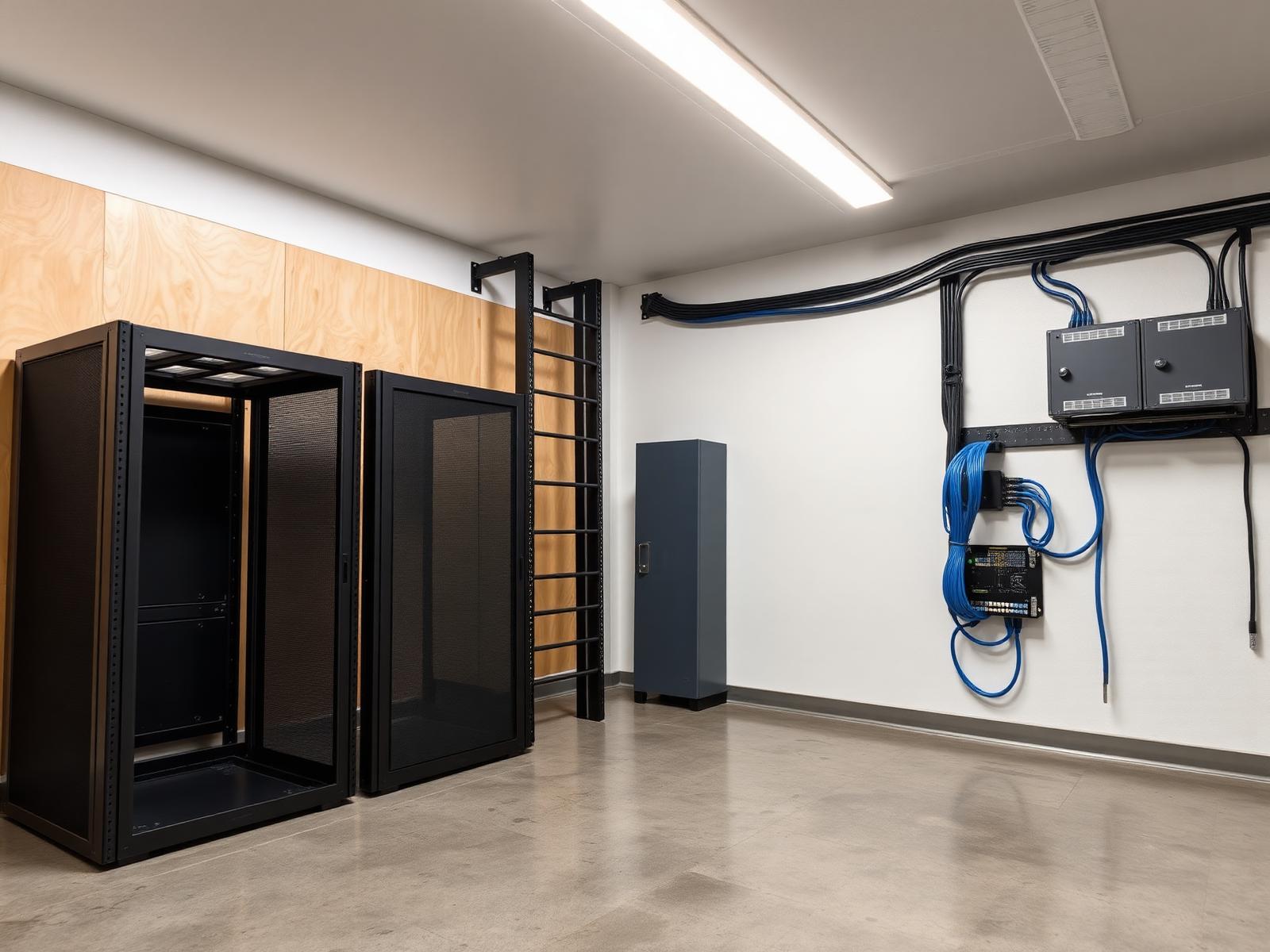
Optimizing compute density and ensuring operational continuity within data center environments hinges on meticulously planned and executed server rack installations. For IT Directors, Facilities Managers, and General Contractors responsible for mission-critical infrastructure, a robust, scalable, and compliant server rack deployment is non-negotiable. Access Cabling, leveraging 28 years of specialized low-voltage contracting experience (CSLB 992009), provides end-to-end server rack installation services designed to meet the rigorous demands of modern data centers. Our approach integrates BICSI best practices, TIA-942 standards, and manufacturer-specific guidelines from leading brands like Panduit, CommScope, and Chatsworth, ensuring each installation provides optimal airflow, power delivery, and cable management. We move beyond simple hardware assembly, focusing on an integrated infrastructure solution engineered for long-term performance and ease of maintenance within your specific data center footprint.
Comprehensive Server Rack Installation: Standards & Scope
Server rack installation by Access Cabling encompasses the precise assembly, staging, and deployment of rack enclosures, cabinets, and open-frame racks, integrated with essential power distribution units (PDUs), cable management systems, and environmental monitoring devices. Our methodologies strictly adhere to industry benchmarks such as TIA-942-B for Data Center Infrastructure, providing comprehensive guidance on rack unit (RU) allocation, aisle containment strategies (hot/cold), and structural loading. We consider factors like seismic bracing in accordance with local building codes, especially for installations in California, ensuring the physical integrity of your high-value assets. This service extends beyond just mounting equipment; it involves the strategic placement and secure fastening of racks to the data center floor, often utilizing specific anchor points and anti-tip mechanisms, ensuring stability and safety under all operational conditions and environmental stressors.
Engineering & Design for Optimal Rack Performance
The engineering phase is critical for server rack installations, demanding a detailed understanding of current and future infrastructure requirements. Access Cabling’s design team collaborates closely with your IT and facilities personnel to specify rack types (e.g., 42U, 48U, high-density 52U), cooling considerations (e.g., perforated doors for passive cooling, integrated cooling units for active), and power density needs. We utilize advanced spatial planning tools to optimize rack placement within the whitespace, accounting for conduit pathways, access flooring, and fire suppression systems. Key design decisions involve PDU selection (basic, metered, monitored, switched) with appropriate amperage and plug configurations (C13, C19, 5-20R) integrated for redundancy (A/B feeds) as per Uptime Institute Tier requirements. This meticulous planning prevents thermal hotspots, ensures uniform air distribution, and provides logical separation of power and data cabling paths, directly impacting system reliability and energy efficiency. Each design is thoroughly reviewed for compliance with NEC Articles 645 (Information Technology Equipment) and 770 (Optical Fiber Cables and Raceways).
Precision Component Selection & Procurement
Selecting the correct components for server rack installation is paramount to achieving robust, scalable, and future-proof infrastructure. Access Cabling procures high-quality rack enclosures from industry leaders such as Chatsworth Products (CPI), APC by Schneider Electric, Panduit, and CommScope SYSTIMAX. Our selection process focuses on durability, weight capacity, security features (e.g., multi-point locking doors, access control integration), and modularity for expansion. For power distribution, we specify rack PDUs from reputable manufacturers like Server Technology, Eaton, and Raritan, ensuring they meet the required power rating, outlet density, and monitoring capabilities. Cable management accessories, including vertical and horizontal cable managers (finger duct, D-rings, brush strips), patch panels (copper and fiber), and cable ties (Velcro® brand fasteners preferred over plastic zip ties for better reusability and reduced cable damage), are chosen to facilitate orderly routing and easy maintenance in accordance with TIA-568 standards for structured cabling practices inside cabinets and racks.
Advanced Deployment & Cable Management Execution
Our installation methodology for server racks emphasizes precision and adherence to established best practices. This begins with accurate leveling and securing of each rack to the data center floor, often involving epoxy-anchored bolts or specialized seismic bracing kits. Rack-mounted equipment, such as servers, switches, and storage arrays, is then systematically installed, ensuring proper weight distribution and airflow. A critical phase is the implementation of robust cable management. This involves meticulous routing of power cables along one side of the rack and data cables (copper and fiber) along the other, or designated zones, to minimize electromagnetic interference (EMI). We employ vertical cable managers for drops from overhead trays or floor openings and horizontal managers between patch panels and active equipment. Fiber optic cables are handled with extreme care, adhering to minimum bend radius requirements using appropriate slack loops and fiber spools, preventing attenuation and maintaining optical integrity as per TIA/EIA-568.3-D. This disciplined approach not only enhances aesthetics but significantly reduces troubleshooting time and improves operational efficiency.
Rigorous Testing, Documentation & Commissioning
Upon completion of physical server rack installation and cable management, Access Cabling conducts comprehensive testing and validation. For power systems, this includes verification of PDU functionality, phase balancing, and circuit breaker operation, often utilizing FLUKE electrical testers to confirm voltage and amperage. Data cabling within the racks, both copper and fiber, undergoes rigorous certification using industry-leading test equipment such as Fluke Networks DSX-8000 for copper (CAT6A, CAT7) and OptiFiber Pro for fiber (OS1/OS2, OM3/OM4/OM5). Test results confirm adherence to TIA-568.C performance parameters (e.g., Insertion Loss, Return Loss, Alien Crosstalk), ensuring full compliance and warranty eligibility. Detailed documentation, including rack elevation drawings, power schematics, port mapping, and as-built diagrams, is then compiled and provided to the client. This comprehensive package serves as an invaluable resource for ongoing operations, troubleshooting, and future expansions, aligning with BICSI OSP and ITS standards for record-keeping and data center operations best practices.
Compliance, Safety & Operational Resilience
Ensuring regulatory compliance and operational safety is fundamental to every server rack installation we undertake. Our installations strictly conform to local building codes, fire regulations, and, crucially, NEC standards pertaining to electrical safety (e.g., appropriate circuit sizing, grounding and bonding per NEC Article 250). For data centers, specific attention is paid to Article 645 for Information Technology Equipment, ensuring proper disconnection means and environmental conditions. We implement seismic bracing solutions where mandated by geographic location, protecting valuable equipment and personnel during seismic events. All work is performed by OSHA-compliant technicians, adhering to stringent safety protocols including Lockout/Tagout procedures when working with energized equipment. The careful segregation of power and data cabling within rack environments not only optimizes performance but also reduces potential fire hazards and simplifies emergency response, contributing directly to the overall resilience and business continuity of the data center infrastructure. Our approach is designed to produce an infrastructure foundation that not only performs but also protects your critical assets.
Access Cabling's Expert Data Center Rack Solutions
What distinguishes Access Cabling in server rack installation is our deep, specialized expertise in commercial data center environments, coupled with a quarter-century track record of successful deployments. Unlike general electricians or IT service providers, our C-10/C-7 licensing and BICSI-certified technicians focus solely on low-voltage infrastructure, ensuring a nuanced understanding of data center specifics. We don't just 'install' racks; we integrate them into your overall data center strategy, considering power density, cooling efficiency, logical cabling pathways, and future scalability from the outset. Our partnerships with leading infrastructure manufacturers like Corning, Belden, and Leviton ensure access to cutting-edge components that meet rigorous data center performance requirements. We provide a single point of contact and accountability, from initial consultation and design engineering through procurement, meticulous installation, rigorous Fluke DSX testing, and comprehensive documentation. This holistic approach minimizes project risk, accelerates deployment, and guarantees a high-performance, compliant, and easily manageable server rack infrastructure built for the long haul.
Integrated Project Management for Multi-Vendor Rack Deployments
Successful server rack installation, particularly in large-scale data center environments, necessitates a highly coordinated project management methodology. Access Cabling's approach integrates PRINCE2 and Agile principles, tailored specifically for infrastructure deployments involving multiple vendor ecosystems. We establish a singular point of contact project lead who orchestrates complex interdependencies between IT hardware vendors (e.g., Dell, HPE, Cisco UCS), network equipment providers (e.g., Juniper, Arista), power distribution unit (PDU) manufacturers (e.g., APC, Eaton), and environmental monitoring systems (e.g., Geist, Vertiv). Our project plans meticulously detail critical path items, employing Gantt charts with dependencies mapped to the minute level. We leverage industry-standard collaboration platforms like Microsoft Project and Jira for real-time task tracking, risk assessment, and change order management. A key differentiation is our proactive identification of potential vendor-specific integration challenges, such as disparate management interfaces, differing power requirements (e.g., C13/C14 vs. C19/C20 connectors, NEMA L5-30P vs. L6-30P), or conflicting physical space envelopes. We conduct mandatory pre-installation readiness reviews with all stakeholders, solidifying commitment on responsibilities, timelines, and escalation procedures. This integrated project management extends beyond the physical install, encompassing coordination for hypervisor deployment (e.g., VMware vSphere, Microsoft Hyper-V), operating system provisioning, and initial network configuration post-rack population. Our aim is to mitigate the common pitfalls of siloed vendor deployments, ensuring a seamless, synchronized, and on-schedule operational handover, minimizing costly delays and rework that often plague less coordinated efforts. This holistic oversight is critical for reducing total cost of ownership (TCO) by optimizing deployment cycles and avoiding post-installation troubleshooting.
Advanced Power Distribution & Thermal Management Integration
Effective server rack installation extends critically to sophisticated power distribution and thermal management, which are foundational for rack stability and longevity. Access Cabling engineers meticulously design and integrate power infrastructure from the upstream power whip connection to the individual device outlet. This involves precise selection and placement of intelligent Rack Power Distribution Units (rPDUs) from leading manufacturers such as Server Technology, Raritan, and CyberPower, supporting single-phase, three-phase, C13/C14/C19/C20, and even specialized DC power configurations. We factor in not just current load requirements but also projected growth, ensuring scalability without requiring full power infrastructure overhauls. Our designs prioritize redundancy (e.g., A+B power feeds, dual-corded devices) and load balancing to prevent single points of failure. Furthermore, integrated thermal management is paramount. While this doesn't typically involve CRAC/CRAH unit installation, our scope includes optimizing airflow within the rack itself. This encompasses strategic placement of blanking panels (e.g., Chatsworth, Middle Atlantic) to prevent hot/cold air recirculation, use of chimney-style cabinets for hot-aisle containment, and integration with intelligent rack-level monitoring systems. These systems track temperatures at multiple points (front, middle, rear, top, bottom), humidity, and even airflow pressure differentials using sensors from partners like Packet Power or ITWatchDogs. By accurately modeling heat dissipation characteristics of installed equipment (CPU, GPU, storage arrays), we can specify appropriate rack-level cooling enhancements such as active exhaust fans or in-row cooling units when main data center cooling is insufficient or requires supplemental support. This proactive thermal management prevents localized hot spots, prolongs equipment lifespan, and maintains operational efficiency, adhering to ASHRAE guidelines for data center environmental control.
Compliance Assurance: Regulatory Standards & Auditable Documentation Frameworks
Adherence to a stringent compliance framework is non-negotiable for server rack installations, particularly for regulated industries such as finance (PCI DSS), healthcare (HIPAA, HITECH), and government (NIST, FedRAMP). Access Cabling's installation methodologies are intrinsically designed to meet and exceed these regulatory mandates. Our compliance assurance begins with detailed planning that incorporates security-by-design principles, including physical access controls to the rack (e.g., biometric locks, keycard integration), secure cable routing to prevent accidental or malicious tampering, and adherence to grounding and bonding standards (e.g., TIA-607-C) for electrical safety and EMI reduction. Post-installation, we provide comprehensive, auditable documentation packages. These deliverables extend beyond basic network diagrams to include detailed asset manifests (including serial numbers, MAC addresses, and power draw for each installed device), power utilization reports, thermal mapping, logical and physical port assignments, and fiber/copper continuity test results. We also furnish detailed 'as-built' schematics that reflect the final rack elevation layouts, power connections, and network patching schedules, cross-referenced against initial design specifications. Our documentation is formatted to facilitate easy integration into a client's Configuration Management Database (CMDB) and IT Service Management (ITSM) systems, such as ServiceNow or BMC Remedy. Furthermore, our processes support specific audit trails, demonstrating adherence to change management protocols, technician certifications (e.g., BICSI RCDD, Installer 2), and quality control checklists. This meticulous documentation serves as crucial evidence during internal and external audits, significantly reducing the burden on client compliance teams and demonstrating a robust, defensible posture against regulatory scrutiny, thereby mitigating potential legal and financial penalties.
Resilient Hardware Staging & Intelligent Rack Migration Strategies
Executing a flawless server rack installation often hinges on sophisticated hardware staging and an intelligent migration strategy, particularly during data center consolidation or refresh cycles. Access Cabling provides comprehensive off-site staging facilities where new hardware (servers, switches, storage arrays, PDUs) can be pre-configured, tested, and integrated prior to on-site deployment. This includes chassis assembly, component installation (CPUs, RAM modules, expansion cards), firmware updates, and initial OS/hypervisor loading. We utilize dedicated labs with appropriate power, cooling, and network connectivity to mimic the target data center environment, drastically reducing on-site installation time and minimizing disruption. Our migration strategies are meticulously planned, whether it involves a 'cold' cutover, a 'hot' migration with virtual machine live motion, or a staged, phased approach. For critical systems, our plans incorporate detailed rollback procedures and contingency measures, including redundant data paths and temporary infrastructure to ensure business continuity. We specialize in 'rack-and-stack' services that minimize downtime by ensuring all components are perfectly aligned, labeled, and ready for power-up upon arrival at the data center floor. This includes pre-cabling within the rack, often using custom-length patch cables or fiber jumpers, to optimize cable management and reduce clutter. We leverage specialized tools and techniques for heavy equipment maneuvering, employing hydraulic lifts and server-handling equipment to ensure technician safety and prevent damage to expensive hardware. The entire migration process is documented in a runbook, detailing each step, expected outcomes, and allocated timeframes, providing complete transparency and control. This proactive staging and migration planning reduces the inherent risks associated with data center transitions, guaranteeing a swift, secure, and efficient cutover to the new rack infrastructure.