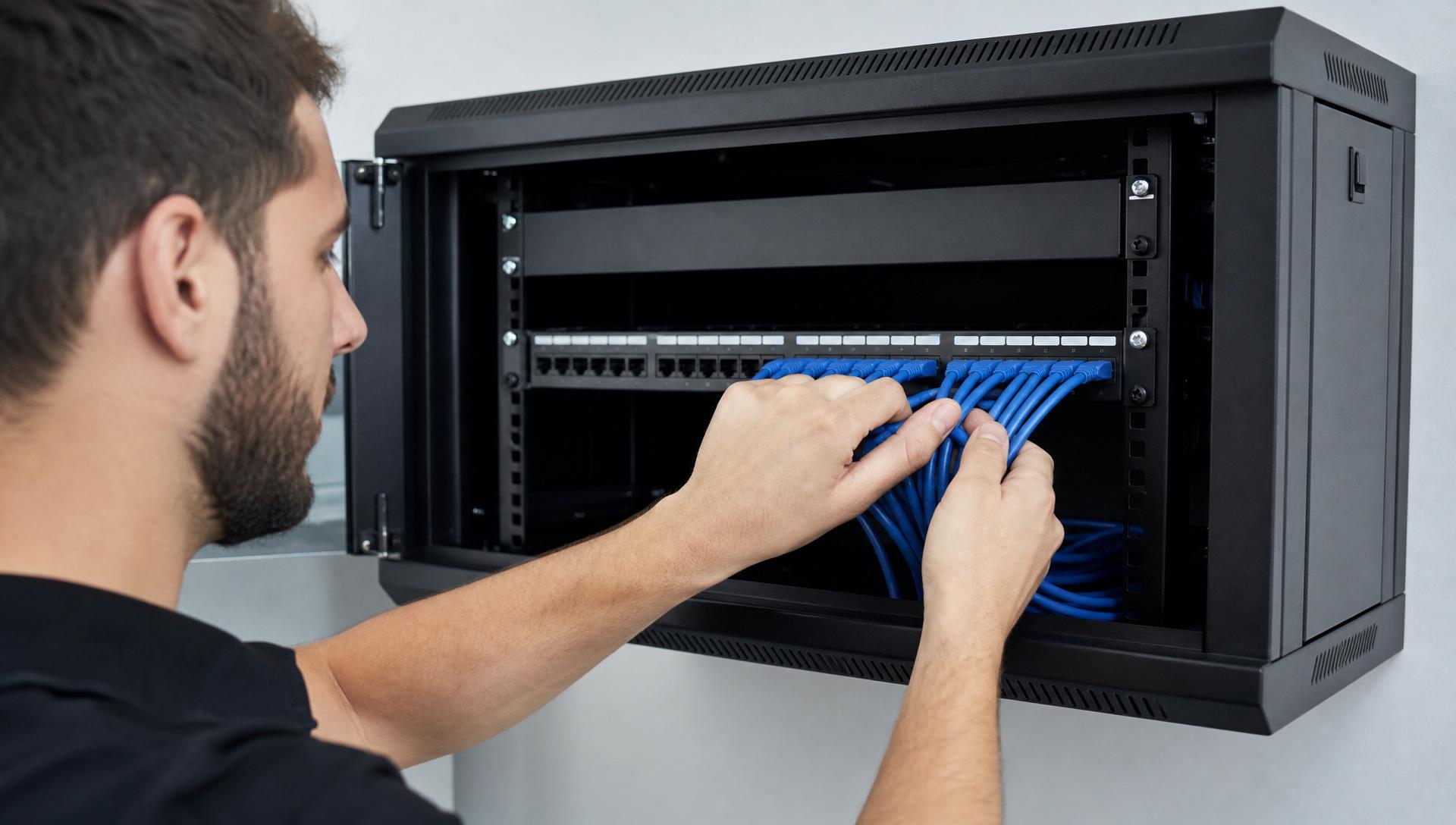
Access Cabling technician terminating Cat6 cables into a 48-port patch panel in a commercial IDF.
Commercial · Structured Cabling

Network Cabling Services

Complete network cabling design, install and certification for commercial buildings.

28+ Years Experience
C-10 / C-7 Contractor
CSLB: 992009
Licensed Commercial Contractor
5 California Offices
California & Nationwide Service

Request a Network Cabling site survey

Free, no-obligation walkthrough. Licensed C-10 / C-7 (CSLB #992009). 28+ years, California & nationwide.

Request a site survey
Commercial Service Overview

Enterprise-grade network cabling engineered for commercial buildings.

Network Cabling from Access Cabling delivers enterprise-grade network cabling engineered by a licensed low-voltage contractor with 28+ years serving California and nationwide clients. Our BICSI-trained technicians design, install, terminate, test and certify every run to TIA/EIA standards so your infrastructure supports current bandwidth demands and future growth.

Access Cabling technicians pulling large bundles of blue Cat6 through an overhead cable tray in a commercial office.
Key Benefits

Why network cabling from Access Cabling

Commercial-grade installation, certified performance, and infrastructure built to last 25+ years.

Certified installation by BICSI-trained technicians
Manufacturer warranties up to 25 years on structured cabling
Fluke DSX certification reports on every project
Licensed C-10 / C-7 low-voltage contractor
24/7 emergency response and MAC services
Nationwide coverage with California headquarters
Installation Process

Our proven commercial cabling process

A repeatable, engineered process — refined over 28 years and thousands of sites.

  1. Step 1

    Free on-site survey and needs assessment

  2. Step 2

    Engineered design with rack elevations and pathway plans

  3. Step 3

    Scheduled installation with minimal business disruption

  4. Step 4

    Termination, testing, labeling and documentation

  5. Step 5

    Fluke certification and as-built drawings delivered

Technical Standards & Testing

TIA-compliant. Fluke-certified. Fully documented.

Every network cabling installation follows TIA-568, TIA-606 labeling, NEC 800 and applicable manufacturer specifications. Fluke DSX Versiv certification and full as-built documentation are delivered at project close.

  • TIA-568 structured cabling standards
  • TIA-606 labeling and administration
  • TIA-942 data center infrastructure
  • Fluke DSX-8000 channel and link certification
  • Manufacturer certified installer for Panduit, CommScope, Leviton
Access Cabling technician terminating Cat6 cables into a 48-port patch panel in a commercial IDF.
Industries Served

Network Cabling for every commercial environment

28+
Years
5
CA Offices
50
States
12M+
Feet Installed
Local Service Area

Network Cabling across California & nationwide

Local crews dispatched daily from five California offices. Multi-site rollouts across all 50 states.

In Depth

A closer look at network cabling

Developing a robust, high-performance network foundation requires more than simply running cables. Commercial network cabling demands meticulous planning, precision installation, and rigorous testing to ensure it supports current and future data, voice, video, and IoT traffic without degradation. Access Cabling specializes in delivering turnkey network cabling solutions, from conceptual design through comprehensive certification, tailored for IT directors, facilities managers, and general contractors overseeing mission-critical infrastructure projects. Our approach integrates industry-leading standards (TIA/EIA, BICSI) with manufacturer-specific best practices from partners like Panduit and CommScope, guaranteeing a future-ready, compliant, and highly reliable physical layer. We engineer systems that minimize latency, maximize bandwidth, and provide a scalable backbone essential for today's data-intensive commercial environments, distinguishing us from less specialized installers by focusing on long-term operational efficiency and adherence to CSLB-mandated quality.

Foundational Design and Standards Compliance

Effective network cabling begins with a comprehensive foundational design that adheres to prevailing industry standards. At Access Cabling, we leverage TIA/EIA-568-D series (Commercial Building Telecommunications Cabling Standard) and BICSI Telecommunications Distribution Methods Manual (TDMM) guidelines to engineer structured cabling systems. This involves determining optimal cable pathways, telecommunications room (TR) layouts, and equipment room (ER) configurations to support specified data rates and application requirements. Considerations include horizontal cabling distances (e.g., 90 meters for twisted pair in the work area), backbone cabling topologies (star, bus, ring), and media selection (e.g., Category 6A for 10GBASE-T, OM4 or OS2 fiber for higher bandwidth requirements). We meticulously plan for growth, ensuring that the initial infrastructure can be expanded without significant disruption or reinvestment, aligning with building codes and local ordinances. Our design process also accounts for environmental factors like EMI/RFI interference, heat dissipation, and physical security, integrating these into the overall system architecture to prevent performance degradation and ensure longevity.

Our C-10/C-7 licensing underscores our commitment to delivering code-compliant installations. The National Electrical Code (NEC) Article 800 (Communications Circuits) and Article 770 (Optical Fiber Cables and Raceways) are integral to our design and implementation. This includes proper grounding and bonding (ANSI/TIA-607-C), firestopping of penetrations (ASTM E814/UL1479), and correct cable support systems (e.g., using J-hooks or cable trays to maintain bend radius and prevent crushing), which are critical for both performance and safety. We don't just run wire; we engineer a robust, compliant communication platform. This structured approach, integrating design, standards, and regulatory requirements, ensures that the installed network cabling system provides a predictable and reliable foundation for all IP-based services.

Material Selection and Infrastructure Components

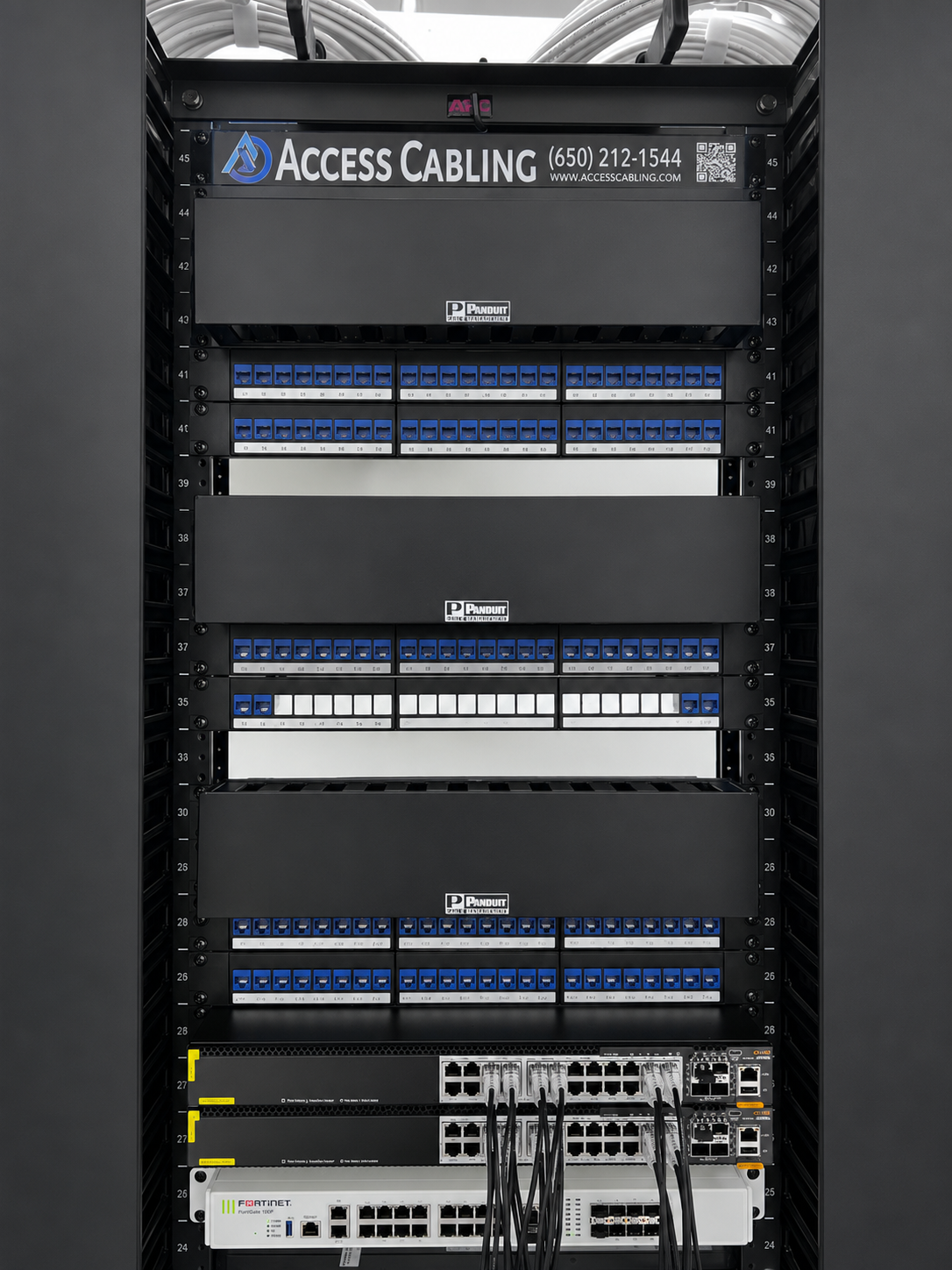
The longevity and performance of a network cabling system are directly tied to the quality of its components. Access Cabling exclusively utilizes high-grade, enterprise-class cable and connectivity solutions from industry-leading manufacturers such as Panduit, CommScope, Leviton, Belden, and Corning. For copper infrastructure, this includes Category 6, 6A, and occasionally Category 7/7A cables, chosen based on application requirements (e.g., 10 Gigabit Ethernet over Cat6A). We specify both UTP (Unshielded Twisted Pair) and STP (Shielded Twisted Pair) solutions, depending on the electromagnetic interference environment, ensuring proper shielding and grounding for STP deployments. Our connectivity components, including patch panels, jacks, and patch cords, are system-matched to the chosen cable type (e.g., Panduit TX6A™ 10Gig™ UTP copper cabling system) to maintain end-to-end performance and ensure compliance with TIA component standards.

For fiber optic infrastructure, we deploy multimode (OM3, OM4, OM5) and singlemode (OS2) fibers based on distance, bandwidth, and application. Common fiber connector types include LC, SC, and MPO, with careful consideration for insertion loss and return loss budgets. We integrate high-quality fiber optic patch panels, splice enclosures, and fiber distribution units (FDUs) to ensure robust and manageable connections. Our infrastructure solutions extend to raceways, conduits, cable trays, and racks (e.g., 19-inch racks conforming to EIA-310-E standards) that protect and organize the cabling plant. Furthermore, our designs incorporate proper cable management accessories like tie wraps (Velcro preferred for horizontal cables to avoid over-tightening), cable managers, and labeling systems (e.g., TIA-606-C compliant) that facilitate future moves, adds, and changes, minimizing downtime and operational costs. We avoid unbranded, low-quality components that can lead to intermittent performance issues and premature system failure, prioritizing certified, warrantied products.

Installation Methodologies and Best Practices

Access Cabling's installation methodologies are strictly governed by BICSI best practices and manufacturer-specific guidelines to ensure optimal performance and system integrity. Our certified technicians adhere to critical considerations such as maintaining proper cable bend radius to prevent micro-cracks in fiber and impedance mismatches in copper, especially critical for Category 6A and higher. We utilize specialized tools for cable pulling to maintain tension limits (e.g., 25 pounds for 4-pair UTP cable) and prevent jacket damage, employing rollers and lubricants where necessary. Cable pathways are carefully planned and installed, ensuring segregation of low-voltage data cables from high-voltage electrical conduits as per NEC regulations to mitigate EMI.

Termination techniques are executed with precision, particularly for RJ45 connectors on UTP/STP cables (following T568A or T568B wiring schemes consistently) and fusion splicing or specific field-terminate connectors for fiber optics. Our technicians are trained in the correct use of termination tools, ensuring consistent conductor seating and jacket strip lengths to minimize near-end crosstalk (NEXT) and return loss. Every cable run is labeled clearly and logically at both ends, conforming to TIA-606-C administration standards, facilitating efficient troubleshooting and ongoing management. This meticulous attention to installation detail, from initial cable pull to final termination and labeling, directly translates to a reliable physical layer that performs to its engineered specifications, eliminating the common pitfalls of poor installation that plague many network infrastructures.

Comprehensive Testing and Certification Protocols

Certification is the hallmark of a professionally installed network cabling system, validating its performance against industry standards. Access Cabling utilizes advanced, manufacturer-calibrated test equipment, such as Fluke Networks DSX-8000 CableAnalyzers, to perform comprehensive testing on every copper and fiber optic cable run. For copper cabling (Cat5e, Cat6, Cat6A), tests include Wire Map, Length, Propagation Delay, Delay Skew, Insertion Loss, Return Loss, Near-End Crosstalk (NEXT), Power Sum NEXT, Alien Crosstalk (for Cat6A), ELFEXT, and PS ELFEXT, all measured against TIA-568-D limits. Our Fluke DSX units are regularly updated and calibrated to ensure accurate measurements against the latest standards.

For fiber optic cabling, we perform Tier 1 testing (power meter and light source) for attenuation/insertion loss and length, often supplemented by Tier 2 testing using an Optical Time Domain Reflectometer (OTDR) to characterize splice and connector loss, and identify localized faults. All test results are compiled into detailed documentation, providing a complete performance baseline and proof of compliance. This documentation, including 'as-built' drawings and test reports, is provided to the client, serving as a critical asset for warranty claims, future troubleshooting, and network upgrades. Our rigorous testing and certification process ensures that the installed network cabling infrastructure meets or exceeds specified performance metrics, delivering the promised bandwidth and reliability for critical business operations from day one.

Integration of Smart Building and IoT Infrastructure

Modern commercial network cabling extends beyond traditional data and voice, forming the backbone for smart building technologies and the Internet of Things (IoT). Access Cabling designs and installs infrastructure capable of supporting a diverse range of IP-enabled devices, including PoE (Power over Ethernet) lighting systems (IEEE 802.3bt Type 3 and 4), security cameras (CCTV), access control systems, building management systems (BMS), wireless access points (WAPs), and environmental sensors. We strategically plan for PoE requirements, considering voltage drop, heat dissipation within cable bundles (especially for Cat6A and higher powering multiple devices), and the overall power budget for PoE switches. This includes specifying appropriate cable types, such as 23 AWG Cat6A, which excels in delivering both data and power efficiently.

The converged network approach allows for simplified management, reduced equipment costs, and enhanced operational efficiency of building systems. Our designs account for the density and distribution of these devices, ensuring adequate port density, power delivery, and network segmentation (e.g., using VLANs) to secure and optimize traffic flow. We recognize that IoT deployments generate vast amounts of data, necessitating a high-bandwidth, low-latency physical layer. By integrating these smart building requirements into the initial network cabling design, we provide a unified, future-proof infrastructure that supports seamless communication between building systems, enabling advanced automation, energy efficiency, and enhanced occupant experiences on a unified IP platform.

Scalability and Future-Proofing Strategies

In a rapidly evolving technological landscape, network cabling must be designed with scalability and future-proofing as core tenets. Access Cabling employs strategic planning to ensure the infrastructure can accommodate increasing bandwidth demands and emerging technologies without requiring a complete overhaul. This often involves deploying fiber optic cabling in the backbone, even if twisted-pair copper is currently sufficient, providing a clear upgrade path to 40GbE, 100GbE, and beyond with minimal disruption. For horizontal cabling, we often recommend Category 6A, which natively supports 10 Gigabit Ethernet up to 100 meters, future-proofing against increased desktop and Wi-Fi throughput requirements.

Our designs incorporate ample spare conduit capacity, empty rack space, and extra patch panel ports to facilitate easy additions and modifications. We plan for distributed antenna systems (DAS) for enhanced cellular coverage, and passive optical LAN (POLAN) architectures as alternatives to traditional copper-based LANs, especially in new builds or major renovations where long-term cost of ownership and energy efficiency are priorities. The 'structured' aspect of structured cabling is key here: a well-organized, systematically documented infrastructure makes future upgrades and troubleshooting vastly simpler. By building in this inherent flexibility, Access Cabling ensures that your network cabling investment will continue to serve your organization's needs for 15-20 years or more, adapting to unforeseen technological shifts and business growth, minimizing the total cost of ownership over its lifecycle.

Rigorous Project Management and Cross-Trade Coordination in Network Deployments

Successful network cabling deployments hinge on a meticulously planned and executed project management framework, often extending beyond the immediate scope of cabling to integrate seamlessly with other building trades. Our methodology incorporates the critical path method (CPM) to identify interdependencies and potential bottlenecks, particularly when coordinating with Mechanical, Electrical, and Plumbing (MEP) contractors. This involves detailed Gantt charts that map sequencing, resource allocation, and critical milestones, integrating specific hold points for joint inspections with electrical for conduit runs, HVAC for plenums and environmental controls, and even fire suppression systems for cable pathway integrity. We utilize Building Information Modeling (BIM) platforms (e.g., Revit, AutoCAD MEP) to overlay our cabling designs with architectural and engineering drawings, identifying potential clashes and optimizing cable routes for efficiency, accessibility, and compliance with local building codes such as BICSI TDMM for pathway and spaces, and NEC (NFPA 70) for electrical safety. Proactive communication channels are established through daily stand-up meetings and weekly progress reports, ensuring that all stakeholders, from general contractors to facilities managers, are fully appraised of progress, potential issues, and upcoming requirements to minimize re-work and schedule delays. This includes detailed method statements for specific installations, addressing potential disruptions, and proposing mitigation strategies before they impact project timelines or budget. Our project managers are PMP-certified, bringing a professional rigor to scope definition, risk assessment (e.g., procurement delays, site access restrictions, environmental hazards), and change management processes, ensuring that any deviations from the initial plan are formally documented, approved, and communicated to all relevant parties to maintain overall project integrity and client satisfaction. This holistic approach prevents costly rework, ensures code adherence, and guarantees a synchronized, efficient deployment that respects multi-trade schedules and delivers a fully integrated infrastructure.

Advanced Documentation and Operational Handover Protocols for Lifecycle Management

Comprehensive documentation is not merely a formality but a critical operational asset for the entire lifecycle of a network cabling infrastructure. Our deliverables extend far beyond as-built drawings, encompassing a multi-layered documentation suite designed for immediate operational utility and future expansion planning. This includes detailed cable schematic diagrams, clearly labeling each cable run from patch panel to outlet, specifying cable type (e.g., Cat6A F/UTP, OS2 Singlemode), length, and termination points. We provide comprehensive port mapping documentation, correlating physical ports to logical network addresses and associated departmental or device functions. Fluke Networks LinkWare Live reports provide granular test results for every installed link, including insertion loss, return loss, near-end crosstalk (NEXT), power sum alien crosstalk (PSANEXT), and propagation delay, offering an irrefutable proof of performance and compliance to TIA/EIA-568 standards. Furthermore, we furnish detailed rack elevation drawings for all communications cabinets and data center racks, illustrating the precise placement of patch panels, active equipment, and cable management solutions. Our handover process includes a structured training session for client IT staff, covering the physical layout, documentation access, and basic troubleshooting procedures. A digital repository, accessible through a client portal, houses all project documentation, including warranties, maintenance schedules, and equipment manuals. This rigorous documentation ensures full traceability of the infrastructure, facilitates rapid fault isolation, streamlines future upgrades or MACD (Moves, Adds, Changes, Deletions) activities, and significantly reduces the total cost of ownership (TCO) by minimizing the time dedicated to discovery and basic system management tasks. Our commitment to meticulous record-keeping provides clients with a living blueprint of their network, essential for sustained operational efficiency and strategic infrastructure planning.

Adherence to Regulatory Compliance and Environmental Sustainability in Installations

Our network cabling installations are meticulously planned and executed to exceed not only performance standards but also strict regulatory compliance and environmental sustainability benchmarks. We rigorously adhere to local, state, and federal building codes, including the National Electrical Code (NEC/NFPA 70) for safe wiring practices, and relevant fire codes (e.g., NFPA 72 for fire alarm systems, NFPA 101 for life safety) concerning plenum-rated cabling (CMP) and riser-rated cabling (CMR) in appropriate pathways to mitigate fire propagation risks. Accessibility standards, such as ADA (Americans with Disabilities Act) guidelines, are considered for equipment placement and pathway design to ensure access for all individuals. Furthermore, we prioritize the use of environmentally sustainable materials and practices wherever feasible. This includes sourcing cables with Low Smoke Zero Halogen (LSZH) jackets to minimize toxic fumes in the event of a fire, aligning with LEED (Leadership in Energy and Environmental Design) certification requirements for green buildings. We implement robust waste management programs on-site, endeavoring to recycle all scrap copper, fiber optic off-cuts, and packaging materials. Our procurement strategies favor manufacturers who demonstrate clear commitments to environmental stewardship, evidenced by certifications like ISO 14001. Energy efficiency is also factored into our designs; for instance, optimizing cable lengths to reduce signal attenuation and associated power loss, and recommending passive cooling solutions in communications closets where appropriate, thereby contributing to reduced overall facility energy consumption. The ethical disposal of obsolete equipment and materials is a core tenet, ensuring compliance with electronic waste (e-waste) regulations and promoting a circular economy approach within the lifecycle of the network infrastructure components. This integrated approach not only ensures legal compliance but also underscores our dedication to corporate social responsibility and providing clients with an infrastructure that is both high-performing and ecologically conscious.

Advanced Network Security Considerations and Physical Infrastructure Hardening

Beyond logical network security protocols, the physical infrastructure itself represents a critical attack surface that demands robust hardening measures. Our network cabling designs integrate a multi-faceted approach to physical security, addressing vulnerabilities from the telecommunications room to the individual workstation outlet. This begins with secure pathway design, employing locked server cabinets and restricted-access telecommunications rooms (TRs) with controlled biometric or badge keycard access systems. Cable pathways in public or semi-public areas are designed to be concealed or protected within robust conduits and cable trays, preventing unauthorized access or tampering. We specify and install tamper-evident cabling solutions, such as color-coded patch cords with unique serialized identifiers and security sleeves or locking mechanisms on patch panels, to deter and detect unauthorized disconnections or reconfigurations. For environments processing sensitive data (e.g., government, finance, healthcare), shielded cabling systems (e.g., Cat6A F/UTP or S/FTP) are deployed to mitigate electromagnetic interference (EMI) and radio frequency interference (RFI), which can be exploited for data eavesdropping through compromising emissions. Additionally, this shielding provides a degree of protection against external forces attempting to induce signals onto the cable. We implement strict labeling conventions that avoid disclosing sensitive network information (e.g., using generic codes instead of specific departmental or service names). The integration of video surveillance (CCTV) within TRs and along critical cable routes, coupled with environmental monitoring sensors (temperature, humidity, door contacts), provides real-time alerts for potential breaches or environmental threats. Our installation teams are trained on security protocols, including clean desk policies during installations and ensuring all active equipment and patch panels are secured at the end of each workday. This layered physical security approach complements logical cyber defenses, creating a resilient network infrastructure foundation that protects data integrity, confidentiality, and availability against both intentional and unintentional physical threats, aligning with industry best practices such as ISO/IEC 27001 Annex A controls and NIST cybersecurity framework guidelines for physical and environmental protection.

Related Topics
  • Structured Cabling Standards
  • TIA/EIA-568-D Compliance
  • Fiber Optic Backbone Installation
  • Power over Ethernet (PoE) Cabling
  • Data Center Cabling
  • Telecommunications Room Design
  • Cable Management Solutions
  • Fluke DSX Cable Testing
FAQ

Frequently asked questions

What factors most influence the selection between Category 6 and Category 6A network cabling?+

The primary factors are current and anticipated bandwidth requirements, budget, and desired infrastructure lifespan. Category 6 supports Gigabit Ethernet (1GbE) up to 100 meters and 10 Gigabit Ethernet (10GbE) up to 55 meters. Category 6A (Augmented) fully supports 10GbE up to 100 meters. If your current network operates at 1GbE but future upgrades to 10GbE are probable, or if you anticipate significant data growth, Cat6A is the more future-proof choice as it eliminates the 55-meter distance limitation for 10GbE. While Cat6A cables and components are typically more expensive and slightly larger, the long-term benefit of avoiding a premature cable plant upgrade often outweighs the initial cost difference, especially in new construction.

How does Access Cabling address potential electromagnetic interference (EMI) in network cabling installations?+

Addressing EMI is critical for network performance, especially in industrial or high-density environments. Our strategy involves multiple steps: first, careful route planning to ensure adequate separation of data cables from high-voltage power lines, as per NEC guidelines. Second, we specify shielded twisted pair (STP) cabling (e.g., F/UTP or S/FTP) when unshielded twisted pair (UTP) is insufficient, ensuring proper grounding and bonding of the shielding system to disperse interference. Third, we utilize metal conduit or cable trays as additional shielding where warranted. Proper termination and grounding of all components, including patch panels and racks (ANSI/TIA-607-C), complete the EMI mitigation strategy, preventing external noise from degrading signal integrity.

What is the typical lifecycle of a commercial network cabling system, and how does Access Cabling help extend it?+

A well-installed and properly maintained commercial network cabling system, adhering to TIA/EIA standards, typically has a performance lifecycle of 15-20 years for copper and potentially longer for fiber optic. Access Cabling extends this by: 1) Utilizing high-quality, warrantied components from reputable manufacturers. 2) Employing best practices in installation to prevent physical damage or performance degradation. 3) Designing for scalability with ample spare capacity and proper future-proofing (e.g., Cat6A, fiber backbone). 4) Providing comprehensive 'as-built' documentation and test results, crucial for efficient troubleshooting and future upgrades. This ensures infrastructure can adapt to technological shifts, maximizing ROI.

What are the common pitfalls or "gotchas" to avoid in a large-scale network cabling project?+

Common pitfalls include underestimating future bandwidth needs, leading to premature upgrades; inadequate planning for telecom room space and power, causing overheating or congestion; neglecting proper firestopping, creating code violations and safety hazards; using untested or mixed-vendor components, which can invalidate warranties and cause interoperability issues; and insufficient documentation, making future troubleshooting and MACs (Moves, Adds, Changes) extremely difficult. Access Cabling mitigates these by thorough design, strict adherence to standards, manufacturer-matched certified components, meticulous installation, and comprehensive 'as-built' records.

Can Access Cabling handle multi-site network cabling rollouts, maintaining consistent standards across all locations?+

Absolutely. Access Cabling specializes in multi-site deployments, providing centralized project management to ensure consistency across all locations, whether within California or nationwide. We establish a standardized scope of work, material BOM (Bill of Materials), installation methodologies, and testing protocols that are applied uniformly. Our teams leverage our extensive network of certified technicians and rigorously manage quality control at each site. This synchronized approach guarantees that every location receives the same high-performance, compliant network cabling infrastructure, simplifying future management, support, and scaling for organizations with distributed operations.

What documentation does Access Cabling provide upon completion of a network cabling project?+

Upon project completion, Access Cabling provides a comprehensive documentation package critical for ongoing network management and troubleshooting. This typically includes 'as-built' drawings that accurately reflect the installed infrastructure (including cable routing, TR/ER layouts, and device locations), detailed test reports for all certified cable runs (e.g., Fluke DSX reports), and a full cable schematic/labeling scheme conforming to TIA-606-C standards. We also provide a material bill of lading and manufacturer warranty information. This meticulous documentation serves as a vital resource for network administrators, facilities staff, and future contractors, ensuring efficient operations and facilitating any future modifications or expansions.

How does Access Cabling ensure proper grounding and bonding for network cabling systems?+

Proper grounding and bonding are fundamental for both safety and performance of network cabling, as stipulated by NEC Article 800 and ANSI/TIA-607-C. We ensure that all metallic components of the structured cabling system, including racks, cabinets, patch panels, cable trays, and metallic conduits, are safely bonded to the Telecommunications Main Grounding Busbar (TMGB) or Telecommunications Grounding Busbar (TGB) within each Telecommunications Room. This involves using appropriately sized grounding conductors, proper compression connectors, and exothermic welds where necessary, creating a low-impedance path to the building's electrical ground. This prevents ground loops, reduces EMI, and protects equipment and personnel from electrical surges or faults.

When is fiber optic cabling a more appropriate choice than copper for parts of a commercial network?+

Fiber optic cabling is typically chosen over copper in several key scenarios. It's preferred for backbone runs between Telecommunications Rooms (TRs) or between buildings due to its ability to support much longer distances (hundreds to thousands of meters) and significantly higher bandwidths (e.g., 40GbE, 100GbE, 400GbE) compared to copper's distance limitations (e.g., 100m for twisted pair). Fiber is also immune to electromagnetic interference (EMI) and is critical for secure environments where eavesdropping is a concern. For future-proofing, scalability, and supporting high-density server farms or critical core network links, fiber provides unmatched performance and reliability. While the initial cost of fiber components and specialized installation can be higher, the long-term benefits for high-capacity, high-speed applications often justify the investment.

How much does network cabling cost?+

Network Cabling pricing depends on drop count, cable type, pathway complexity, and building conditions. Most commercial projects range from $150 to $350 per drop installed. Request a free site survey for an itemized quote.

Do you provide network cabling nationwide?+

Yes. Access Cabling is headquartered in California with a nationwide technician network for multi-site rollouts across all 50 states.

Is network cabling certified and warrantied?+

Every installation is Fluke-tested and certified. Structured cabling installs carry manufacturer warranties of up to 25 years through our Panduit, CommScope, Leviton and Belden partner relationships.

Related Services

Related commercial cabling services

Get Started

Build the commercial network your business actually deserves.

28 years, thousands of sites, one accountable contractor. Get a free site survey and an itemized quote in 48 hours.

Call Local Office(650) 212-1544