
Every list of “top cabling companies” you find online is really a list of manufacturers — the firms that draw the glass, extrude the copper and mold the connectors that make up a data center. That is useful context when you are writing a specification, but it does not answer the question a facilities director in Los Angeles actually has: who builds this in my building, and who signs the test report at the end? This piece covers both — the ten manufacturers behind the world’s data centers, and the licensed local role that turns their products into a certified, warranted system.
- The global top ten — Corning, CommScope, Panduit, Legrand, Belden, Nexans, Siemon, Prysmian, R&M and Furukawa — are manufacturers, not installers.
- Every one of them meets or exceeds TIA-568 performance; workmanship, not brand, is what decides whether a channel certifies at 10GBASE-T.
- A 25-year channel warranty is issued only when a certified installer builds the full channel to spec and registers Fluke test data.
- Access Cabling is a licensed California C-7/C-10 contractor (CSLB #992009) and certified installer for Panduit, CommScope, Leviton and Belden.
Executive summary
Data Centre Magazine’s July 2026 ranking of the top ten cabling companies is a manufacturer ranking: Corning at number one, CommScope second, Panduit third, then Legrand, Belden, Nexans, Siemon, Prysmian, R&M and Furukawa Electric. Access Cabling does not belong on that list and does not claim to — we are the licensed Los Angeles team that designs, installs, tests and certifies structured cabling systems built from products like theirs. Below is an honest summary of each manufacturer, links to the source profiles, and what the installation side of the equation actually contributes.
Manufacturers and installers are two different categories
A cabling manufacturer engineers and produces the physical media: optical fiber, twisted-pair copper, jacks, patch panels, racks and cable management. An installation contractor engineers the pathway, pulls and terminates the media inside a specific building, tests every link to standard, documents the result and registers the warranty. Rankings of “top cabling companies” almost always mean the first group.
That distinction matters commercially. A specification that names Corning fiber and Panduit connectivity says nothing about who is allowed to install it — and manufacturer channel warranties are only issued when a certified installer performs the work and submits certification results. Choosing premium components and then hiring an uncertified crew is the most expensive way to end up with an unwarranted network.
- Data Centre Magazine — Top 10: Cabling Companies — published July 29, 2026
The top ten cabling manufacturers
10. Furukawa Electric — Tokyo, Japan (founded 1884)
Furukawa Electric draws on more than a century of engineering to produce optical fiber and cable systems built for high-capacity, low-latency transmission — a fit for hyperscale bandwidth demands.
9. Reichle & De-Massari (R&M) — Wetzikon, Switzerland (founded 1964)
R&M is known for precision-engineered structured cabling: fiber and copper systems designed for dense, reliable enterprise and data center networks, with modular components that simplify later upgrades.
8. Prysmian Group — Milan, Italy (founded 1879)
One of the largest cable manufacturers in the world, Prysmian supplies fiber optic and power cable systems at massive scale, backed by heavy R&D investment in cable design and sustainability.
7. The Siemon Company — Connecticut, US (founded 1903)
Siemon is a longtime name in structured cabling standards, producing copper and fiber systems built around high-density patching, efficient cable management and thermal performance in the rack.
6. Nexans — Paris, France (founded 2000)
Nexans builds cabling and connectivity products for both data infrastructure and electrification, with fiber systems aimed at high-speed transmission and sustainability-minded manufacturing.
5. Belden — Missouri, US (founded 1902)
Belden delivers end-to-end signal transmission products — fiber and copper cabling paired with networking hardware — built for high-bandwidth, secure, industrial-grade deployments.
- Belden company profile
- Belden video
- Access Cabling as a Belden partner — our certified-installer page
4. Legrand — Limoges, France (founded 1860)
Legrand pairs structured cabling with the broader physical infrastructure layer — power distribution and containment — giving operators an integrated approach to design and cable management.
3. Panduit — Illinois, US (founded 1955)
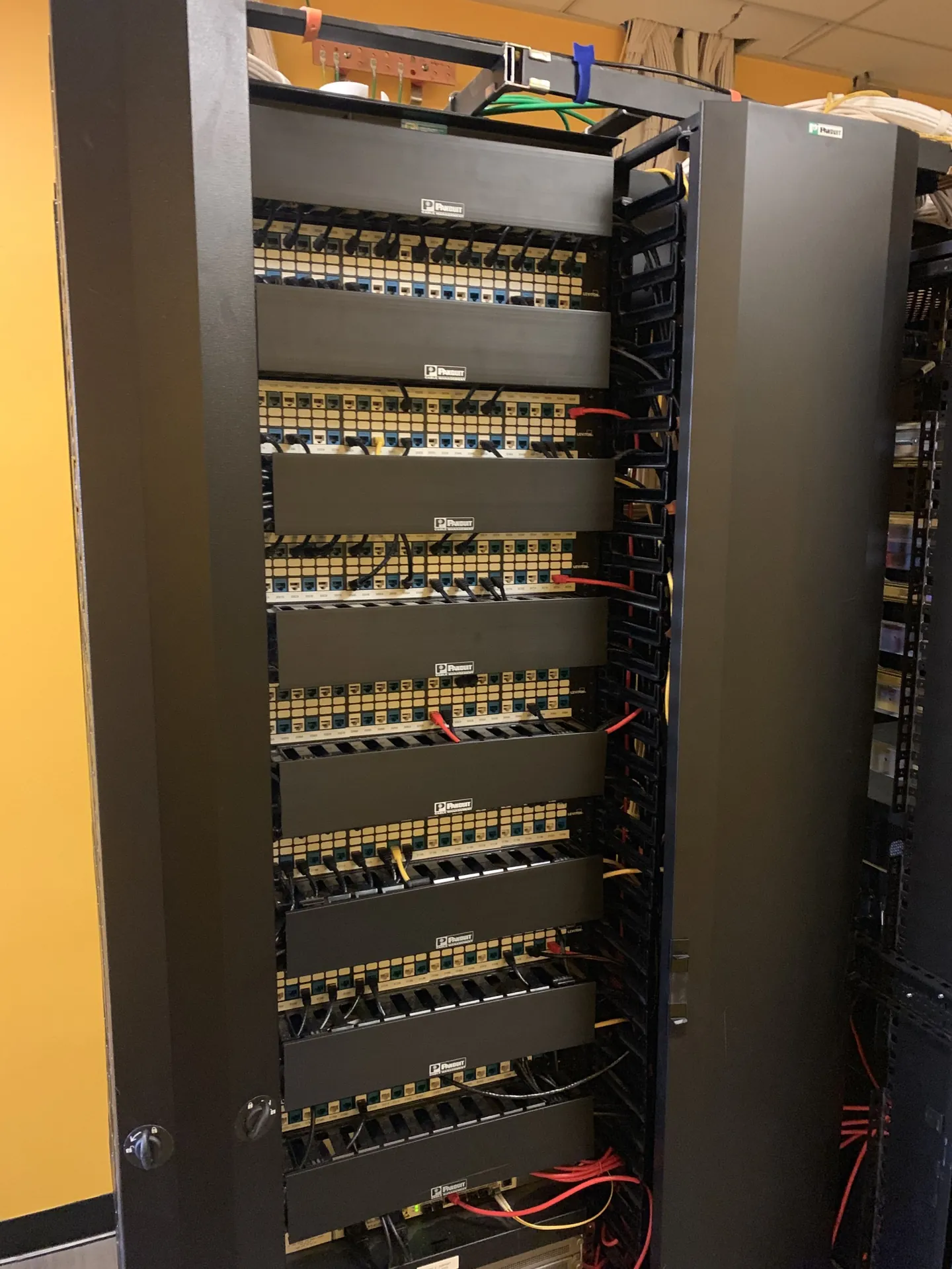
Panduit specializes in physical infrastructure: cabling, connectivity and pathway or cable management systems engineered for reliability and operational visibility. Panduit racks and patch fields appear in most of the network rooms we build.
2. CommScope — Texas, US (founded 1976, an Amphenol company)
CommScope’s SYSTIMAX platform and high-performance fiber products are widely deployed across hyperscale and colocation environments, with a strong focus on high-density fiber and automated infrastructure management.
1. Corning — New York, US (founded 1851)
Corning is the name most associated with modern optical fiber. Its innovations defined high-speed data transmission at scale, with products engineered for density, scalability and fast deployment across hyperscale and edge builds.
What the installation side actually contributes
Assume for a moment that every product on the list above performs exactly as published — a fair assumption. The remaining variables all live on the job site: pull tension, bend radius, untwist at termination, separation from electrical conduit, plenum-rated jacket selection, firestopping at penetrations, labeling discipline and whether every link is actually tested rather than sampled.
| Decided by the manufacturer | Decided by the installer |
|---|---|
| Cable category and bandwidth rating | Whether the finished channel certifies at that rating |
| Connector and panel design | Termination quality and pair geometry at each end |
| Jacket ratings (plenum, riser, OSP) | Correct rating for each pathway under Title 24 and NEC 800 |
| Warranty program terms | Certification data and warranty registration at closeout |
| Component lead times | Sequencing so cable is in before ceilings close |
The team that installs it in Los Angeles: Access Cabling
The companies above make the fiber and copper. Access Cabling is who a Los Angeles office actually calls to get it designed, installed, tested and certified correctly. We hold current California C-7 low-voltage and C-10 electrical licenses under CSLB #992009, follow California Title 24 plenum requirements and NEC Article 800, and deliver Fluke certification reports on every run we install — whether that is a new office build-out, a data center expansion, or a rip-and-replace of legacy infrastructure.
We work across Downtown LA, West LA, Santa Monica, Culver City, Burbank, Glendale, Pasadena and Long Beach, with four additional California offices and nationwide multi-site delivery. One project manager owns the scope from site survey through warranty registration.
- Network cabling services — full commercial scope
- Structured cabling contractors — GC-led and TI projects
- Fiber optic contractors near you — single-mode and multimode fiber
- Los Angeles network cabling guide — code, planning and drop counts for LA offices
- Request a free site survey — written proposal in 48 hours
Choosing components and a crew together
The practical takeaway: specify components from any manufacturer on this list with confidence, then vet the installer at least as carefully as the bill of materials. Ask for the C-7 license number, current COIs, manufacturer certifications, a sample Fluke certification report and a labeling standard. A contractor who cannot produce all five is asking you to fund premium materials and accept amateur workmanship.
If you are planning a project and want it built on the same caliber as the products these manufacturers produce, request a free site survey and a senior estimator will walk the space with you — no obligation, itemized proposal within 48 hours.