
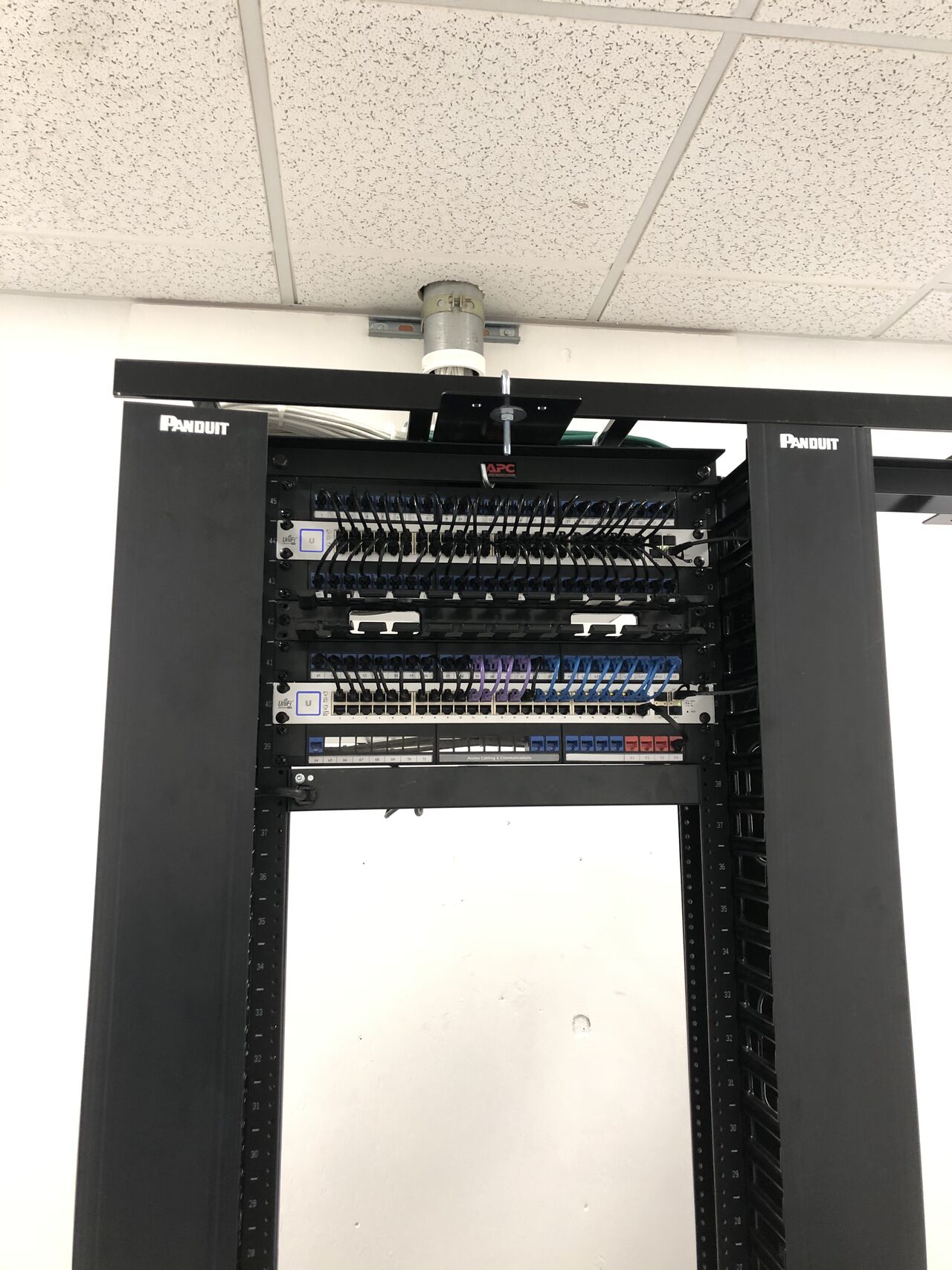
A business network is only as reliable as the cabling behind it. Slow Wi-Fi, dropped VoIP calls, and mystery outages can usually be traced to one root cause: cabling that was never designed as a system. Structured cabling is the standards-based fix — a hierarchy of subsystems, built to ANSI/TIA-568, that lets any device work at any outlet and lets any change happen without pulling new cable. This guide covers what structured cabling is, the six subsystems that make it up, the standards that govern it, the components and manufacturers behind a certified system, and when it makes sense to install or upgrade.
- Six subsystems: entrance facility, equipment room, backbone, telecom room, horizontal, work area.
- Standards live in TIA-568 (performance), TIA-569 (pathways), TIA-606 (labels), TIA-607 (bonding); ISO/IEC 11801 and EN 50173 are the international equivalents.
- Every horizontal run is star topology from a telecom room to a single outlet — never point-to-point from a switch to a device.
- The system, not the components, carries the 25-year warranty — matched Panduit, Leviton, CommScope, or Belden channels are what make that warranty registrable.
- New construction and major renovations are the two cheapest moments to install; everything after that pays a ceiling-and-wall premium.
Executive summary
A structured cabling system organizes the entire cable plant into a predictable topology: work-area outlets terminate to telecom rooms, telecom rooms terminate to an equipment room over a backbone, and every drop is labeled, tested, and documented. Following TIA-568, -569, -606, and -607 produces infrastructure that supports current and future generations of data, voice, wireless, security, and building-control systems on one physical plant. Certified components from a single manufacturer channel plus Fluke DSX test reports turn that plant into a warrantable, transferable building asset.
Why 'just run some cables' fails
Point-to-point wiring runs a separate, dedicated cable from a switch to every device. It works on day one and it fails on day one hundred. Every troubleshoot begins with a scavenger hunt, every add or move is billed by the hour, and failures cascade because nobody knows what depends on what.
Structured cabling replaces that tangle with one unified backbone that carries voice, data, video, and building-automation traffic at once. Because it is built to a published standard rather than improvised device by device, it scales cleanly as a business adds staff, equipment, or square footage.
The six subsystems
- Entrance facility — where service-provider internet, telecom, and fiber physically enter the building; the handoff between the outside world and your plant.
- Equipment room (MDF) — the main distribution frame housing core switches, servers, PBX, and the main cross-connects.
- Backbone (riser) cabling — fiber and copper trunks between the MDF and each telecom room, vertically between floors or horizontally between campus buildings. Longer distances and heavier aggregate traffic are why backbone runs are usually fiber.
- Telecom room (IDF) — floor or zone distribution frame where backbone meets horizontal cabling.
- Horizontal cabling — the copper runs from an IDF to individual outlets serving desks, wireless access points, IP cameras, VoIP phones, and printers. Cat5e, Cat6, or Cat6A depending on speed, PoE load, and distance.
- Work area — the endpoint: outlet, faceplate, patch cord, and the device itself.
Many designs add a consolidation point: an intermediate termination between the telecom room and the work area that lets open-plan furniture zones be rearranged without disturbing the rest of the system.
Governing standards
- ANSI/TIA-568 — cabling performance, distance limits, and testing.
- TIA-569 — pathways and spaces.
- TIA-606 — administration and labeling.
- TIA-607 — bonding and grounding.
- TIA-942 — data centers (extended structured cabling).
- ISO/IEC 11801 — the international equivalent of TIA-568; EN 50173 is the European profile.
Components and manufacturers behind a certified system
Structured cabling is a discipline, not a brand — but a warrantable channel does require matched, rated components end to end. Mixing a Cat6 patch cord into a Cat6A channel drops the whole run to the lowest-rated part. These are the manufacturers whose systems we routinely install and certify:
- Panduit — Copper and fiber structured cabling systems, racks, and pathway; certified installer channels with 25-year system warranties.
- Leviton Network Solutions — Atlas-X1 and eXtreme copper jacks, patch panels, and fiber cassettes.
- CommScope (SYSTIMAX / NETCONNECT) — End-to-end copper and fiber channels for enterprise and campus backbones.
- Belden — REVConnect and Berk-Tek cable; Access Cabling is a Belden Certified System Vendor.
- Corning Optical Communications — Single-mode and multimode fiber, pretermed trunks, and closet hardware.
- Siemon — Z-MAX copper systems and high-density fiber plug-and-play.
- Fluke Networks — DSX-8000 CableAnalyzer and OptiFiber — the test platforms behind the certification report you should demand.
- TIA (Telecommunications Industry Association) — Publisher of the ANSI/TIA-568 family of standards.
We are vendor-agnostic: the right channel gets specified for the building, the budget, and the warranty the client wants to hold. Trademarks are the property of their respective owners.
The business case for structured cabling
- Fewer outages and faster troubleshooting — a labeled, documented system means minutes instead of hours.
- Room to grow — a new workstation, access point, or camera usually means patching into existing infrastructure, not opening walls.
- Better performance — properly rated cable, tested and certified to spec, avoids bottlenecks from mismatched or degraded runs.
- Cleaner, safer spaces — organized tray and racks reduce clutter, heat, and fire load compared with loose bundles on ceiling tile.
- Higher lease and resale value — certified, documented cabling is a building asset the next tenant inherits.
When to install or upgrade
New construction
Installing cabling during build-out, before walls and ceilings close, is by far the most cost-effective time to do it. Low-voltage pathways can be coordinated with the electrical, mechanical, and ceiling trades from the start.
Major renovation
A significant remodel is the natural moment to remove aging or undersized cabling and replace it with a plant sized for current and near-future loads, rather than patching around old infrastructure.
Plenty of businesses upgrade outside both scenarios simply because the network has outgrown what is in the walls. Recurring connectivity issues, an office expansion, or new PoE equipment such as VoIP handsets, Wi-Fi 6E access points, or IP cameras all justify a site survey before problems escalate.
Common mistakes
- Skipping pathway design — cables land on ceiling tiles instead of basket tray.
- Missing bonding and grounding — the TGB and TBB should be installed with the frame, not retrofitted.
- Under-sizing telecom rooms — a 4×6 ft closet cannot serve a 40,000 sq ft floor.
- Point-to-point runs from switch to device — every move, add, or change becomes a wall opening.
- Mixing component ratings inside one channel, which voids the manufacturer system warranty.
- Accepting a job with no certification report, no labels, and no as-builts.
Best practices
- One MDF per building, one IDF per 10,000–15,000 sq ft or per floor.
- Cat6A horizontal, OS2 or OM4 backbone with 30% spare strands.
- Ladder rack or basket tray above every telecom room and the MDF.
- Labels installed at both ends within 24 hours of termination, per TIA-606.
- TIA-607 bonding to a TGB in each telecom room and a TMGB in the MDF.
- One manufacturer channel per zone so the system warranty stays registrable.
Choosing a contractor
Not every electrician or IT vendor is equipped to design and certify a structured cabling system. Before hiring, confirm:
- Does the contractor test and certify every run to ANSI/TIA-568?
- Is the system labeled to TIA-606?
- Will you receive a per-drop certified test report at closeout?
- Are they licensed for low-voltage work in your jurisdiction (in California, a C-7 or C-10 license)?
- Are they a certified installer for the manufacturer channel being specified?
- Do they carry general liability and workers' compensation, with COIs on request?
Access Cabling holds California license #992009 and certifies every commercial install with Fluke DSX reports delivered as part of the closeout package.
Documentation deliverable
- As-built floor plans with outlets and IDs
- Rack elevations
- Cable schedule (outlet ↔ panel port)
- Fluke DSX .flw certification file
- Fiber OLTS/OTDR reports
- Manufacturer warranty registration
Get a cabling plan built for your business
Whether you are wiring a new build, upgrading an aging plant, or trying to work out why connectivity keeps failing, a properly designed structured cabling system pays for itself in fewer headaches and more predictable performance. Access Cabling designs, installs, and certifies structured cabling for offices, warehouses, and campuses.
- Contact Access Cabling — Talk with a project manager and get your project scoped and quoted.
- Request a site survey — We walk the space, document existing pathways, and price the work.
- Structured cabling services — Design, installation, certification, and documentation.
- What Are Low Voltage Systems? — How structured cabling sits inside the broader low-voltage family.