Accurate cable certification is not merely a checkbox; it is the definitive validation of your network infrastructure's physical layer performance, ensuring it meets or exceeds industry standards. For IT Directors, facilities managers, and general contractors overseeing high-performance network deployments, robust cable certification provides incontrovertible evidence of bandwidth capabilities, signal integrity, and longevity. Access Cabling specializes in exhaustive cable certification services, primarily leveraging Fluke DSX CableAnalyzers to issue comprehensive test reports. Our approach goes beyond passing/failing; we deliver granular insights into your cabling plant's health, backed by 28 years of nationwide experience and adherence to TIA/EIA, BICSI, and NEC guidelines. This meticulous validation process is critical for maximizing network uptime, supporting high-speed applications, and maintaining manufacturer warranties, differentiating us through precision and actionable data.
Defining Cable Certification: Standards and Performance Benchmarks
Cable certification is the definitive process of verifying that installed copper or fiber optic cabling links conform to specific performance standards established by organizations like the Telecommunications Industry Association (TIA) and the International Electrotechnical Commission (IEC). For copper cabling, TIA-568 series standards (e.g., TIA-568.2-D for balanced twisted-pair) define parameters such as Near-End Crosstalk (NEXT), Far-End Crosstalk (FEXT), Return Loss (RL), Insertion Loss (IL), Propagation Delay (PD), and Delay Skew. These metrics are critical for guaranteeing the cabling can reliably support specified data rates, from 1 Gigabit Ethernet (1GbE) over Category 5e (Cat5e) to 10 Gigabit Ethernet (10GbE) over Category 6A (Cat6A), and even emerging NBASE-T (2.5G/5G) applications. For fiber optics, TIA-568.3-E and ISO/IEC 11801 standards dictate MPO/MTP polarity, optical loss budgets, and length measurements for multimode (OM1 to OM5) and singlemode (OS1, OS2) fibers, ensuring the optical signal strength is sufficient for the intended reach and speed. Access Cabling utilizes Fluke DSX CableAnalyzers, which are calibrated and regularly updated to these latest industry standards, providing irrefutable proof of compliance and performance for voice, data, and video transmission.
Fluke DSX Platforms: Precision Testing and Reporting
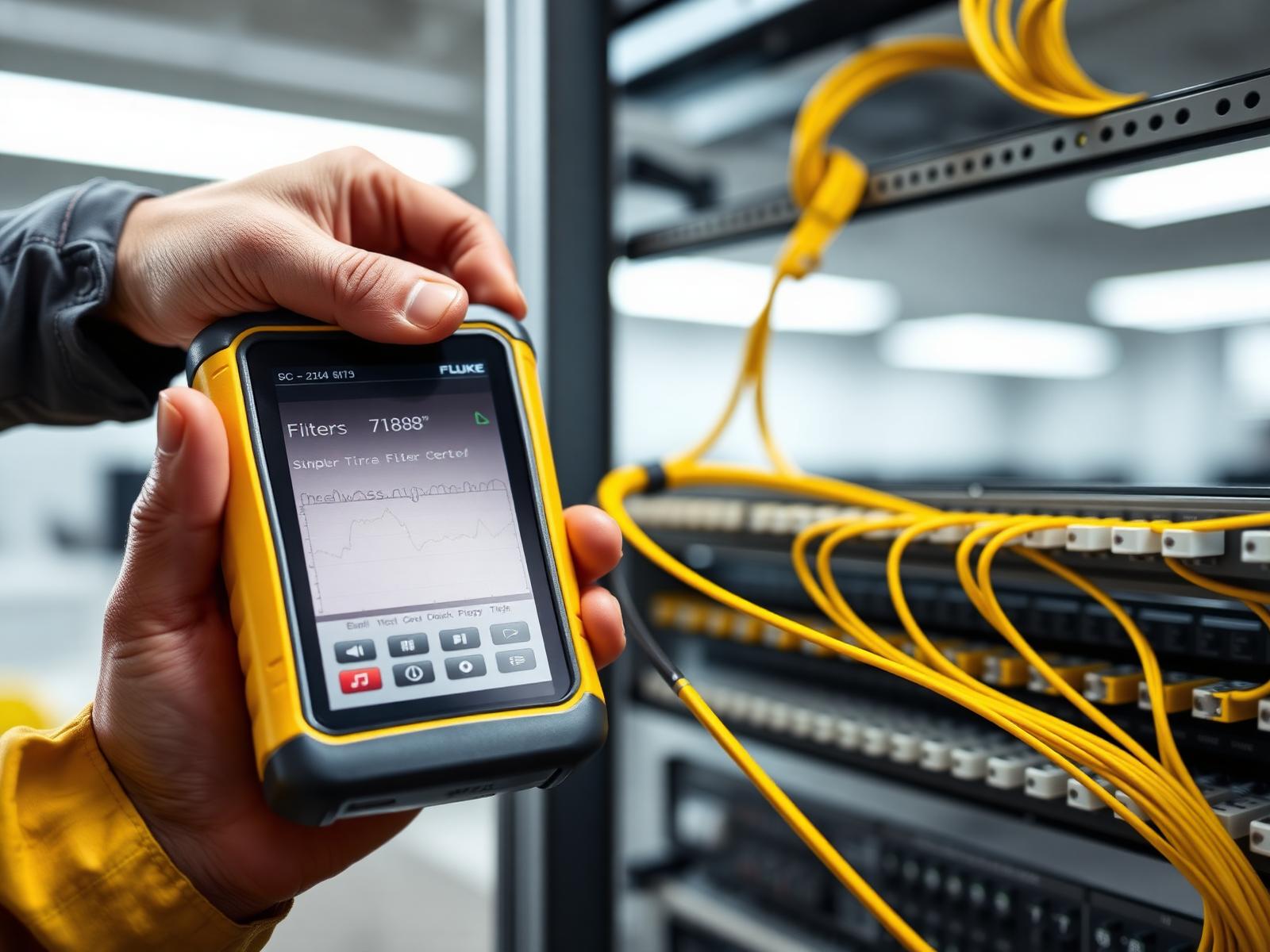
Our core methodology for cable certification revolves around the Fluke Networks Versiv DSX CableAnalyzer series, including the DSX-5000 and DSX-8000 models. These platforms are the industry benchmark for accuracy and speed in certifying both copper and fiber optic cabling. For copper, the DSX-8000 is capable of certifying up to Category 8 (Class I/II) links, measuring bandwidths up to 2 GHz, far exceeding the requirements for 10 Gigabit Ethernet and enabling future-proof infrastructure deployments. Key measurements like Alien Crosstalk (AXT) are also precisely characterized to ensure high-density installations do not suffer from external signal interference. For fiber, integrated modules perform Tier 1 (Basic) certification, measuring optical loss and length, and can be extended to Tier 2 (Extended) certification with Optical Time Domain Reflectometer (OTDR) modules for fault location and splice/connector performance analysis. The LinkWare Live software ecosystem allows for cloud-based project management, data aggregation, and standardized report generation. These detailed reports, including graphical representations of test results against specified limits, are digitally signed off by Access Cabling, providing an auditable record for warranty claims and future troubleshooting, ensuring full transparency and confidence in the certified infrastructure.
Implementation Considerations: Design Impact on Certifiability
Effective cable certification begins long before a Fluke DSX unit is ever powered on; it starts at the infrastructure design phase. Architects and engineers must specify cabling components that are designed to work synergistically to meet specific performance categories. For instance, mixing unshielded twisted pair (UTP) Cat6A cable with non-Category 6A rated patch panels or outlets can introduce impedance mismatches and increase return loss, leading to certification failures. Similarly, exceeding bend radius limits for both copper and fiber cables, particularly at termination points, significantly degrades performance parameters like insertion loss and crosstalk. Proper adherence to TIA/EIA installation guidelines, such as maintaining separation from EMI sources, correct termination practices (e.g., untwisting no more than 0.5 inches at punch-downs), and appropriate cable management, directly impacts the success of cable certification. Access Cabling’s pre-certification design review services can identify potential issues proactively, ensuring the specified components and planned pathways are conducive to achieving full standards compliance and minimizing costly rework during the testing phase. Ignoring these design principles often results in links that cannot be certified, leading to network instability and underperforming assets.
Ensuring Manufacturer Warranty Compliance through Certification
A critical, often overlooked, benefit of thorough cable certification is its role in securing and validating manufacturer warranties. Leading cabling system manufacturers such as Panduit, CommScope, Leviton, and Belden offer extended product and application warranties—sometimes up to 25 years—for end-to-end systems that are installed and certified to their specific performance standards. These warranties are not automatically granted upon purchase; they require documented proof that the entire cabling plant, from patch panel to outlet, meets or exceeds TIA/EIA performance criteria. The detailed test results produced by our Fluke DSX CableAnalyzers serve as this irrefutable proof. Without proper certification, an installation may default to a generic 1-5 year product warranty, leaving the client liable for performance failures or component defects beyond that limited period. Access Cabling meticulously documents all test results and coordinates with manufacturer warranty programs, ensuring that your investment is protected by the full manufacturer system warranty, covering both components and the supported applications. This process involves submitting the LinkWare Live generated reports directly to the manufacturer for their review and issuance of a formal warranty certificate.
Tiered Fiber Optic Certification: OLTS and OTDR Analysis
Fiber optic cable certification involves distinct tiers of testing to comprehensively validate performance. Tier 1 (Basic) certification, conducted with an Optical Loss Test Set (OLTS), measures the total insertion loss (attenuation) of the fiber link at specified wavelengths (e.g., 850/1300nm for multimode, 1310/1550nm for singlemode), verifies length, and assesses polarity. This tier confirms the link's ability to transmit light within the manufacturer's or TIA-specified loss budget. For example, a typical multimode MPO trunk might have an insertion loss limit of 0.75 dB per connector pair and 3.0 dB/km for the fiber itself. Access Cabling utilizes Fluke CertiFiber Pro modules for efficient Tier 1 testing across thousands of fiber links. Tier 2 (Extended) certification augments Tier 1 with an Optical Time Domain Reflectometer (OTDR). The OTDR provides a graphical trace of the fiber link, pinpointing the location and loss characteristics of individual connectors, splices, and any anomalies along the fiber path. This is invaluable for advanced troubleshooting, identifying macrobends, microbends, or poor splice quality that might not cause a Tier 1 failure but could degrade stability or future upgrade potential. Our technicians are proficient in interpreting OTDR traces, providing the most detailed insight into your fiber infrastructure for mission-critical deployments like data centers or campus backbones.
Troubleshooting with Certification Data: Beyond Pass/Fail
While a 'Pass' result from a cable certification test is the primary objective, understanding the underlying data is crucial for future network optimization and rapid troubleshooting. A link might 'Pass' at the margin, indicating potential issues that could worsen over time or with temperature fluctuations. For instance, a Cat6A link passing Return Loss might show a dip just within the acceptable limit at a certain frequency, suggesting a poorly terminated connector that could fail under higher load or EMI. Our Fluke DSX analyzers provide detailed graphical plots for each parameter (NEXT, FEXT, Return Loss, Insertion Loss, etc.), allowing our technicians to analyze specific frequency anomalies. If a link fails, these plots immediately highlight the problematic parameter and often localize the fault. For example, a high NEXT value at the patch panel end points to a termination error at that specific connector. This granular data, beyond a simple pass/fail indicator, empowers Access Cabling to diagnose and rectify issues efficiently, reducing mean time to repair (MTTR) and ensuring the network operates with maximum headroom for demanding applications. We leverage this diagnostic capability to not just certify, but to truly optimize your physical layer.
Access Cabling's Certification Differentiators: Experience and Documentation
Access Cabling's approach to cable certification is distinguished by our extensive experience and unwavering commitment to meticulous documentation. With over 28 years in low-voltage contracting, our teams possess a deep understanding of common installation pitfalls and the most efficient methods for rectifying them. We don't just run tests; we apply decades of institutional knowledge to interpret results, identify subtle anomalies, and provide actionable recommendations. Our project managers and field technicians are BICSI-certified, ensuring adherence to the highest industry standards for installation and testing. Every certification project culminates in a comprehensive documentation package, including all Fluke DSX reports, a summary of passed and failed links, detailed remediation efforts for any initial failures, and a formal sign-off. This documentation is crucial for audits, future network upgrades, asset management, and especially for securing those extended manufacturer warranties. We provide both digital copies through Fluke's LinkWare Live and consolidated PDFs, ensuring easily accessible and verifiable proof of your infrastructure's integrity, setting Access Cabling apart as a trusted partner for reliable network foundations.
Navigating Certification Failure Modes and Remediation Strategies
Cable certification, while critical for network performance, frequently encounters common failure modes that demand precise identification and remediation. A frequent culprit is excessive Near-End Crosstalk (NEXT), often attributable to improper termination practices such as untwisting pairs too far back from RJ45 connectors, creating an impedance mismatch. Our technicians meticulously scrutinize test reports, correlating NEXT failures with specific link segments and visually inspecting termination fields for adherence to TIA/EIA-568-C.2 or ISO/IEC 11801 standards. Another prevalent issue is Insertion Loss (attenuation), which can stem from excessively long cable runs exceeding channel limits (e.g., 90m permanent link + 10m patch cords for Category 6A) or poor quality copper with higher gauge resistance. Fiber optic links likewise encounter issues like high insertion loss due to contaminated end-faces, micro-bends, or macro-bends from tight bends, and high reflectance events indicative of poor splices or connectorization. Our Level 2 and Level 3 Fluke DSX-8000 certification tests provide granular diagnostic data, pinpointing the precise location of faults in meters from the tester. For fiber, Optical Loss Test Sets (OLTS) like the Fluke CertiFiber Pro provide end-to-end loss measurements, while an Optical Time Domain Reflectometer (OTDR) like the Fluke OptiFiber Pro detects and locates specific events (splices, connectors) within the link using backscatter analysis. Remediation involves a systematic process: confirming the test parameters, re-terminating connectors with validated tooling, replacing faulty patch cords, re-dressing cable pathways to alleviate bends, or, in severe cases, re-pulling compromised sections of cable. We document each failure, the root cause, and the successful resolution, ensuring all final test results adhere unequivocally to the specified performance criteria, safeguarding the client's infrastructure investment and operational continuity. Our teams are proficient in advanced troubleshooting techniques, such as Time Domain Reflectometry (TDR) for copper and Event Map analysis for fiber, providing definitive fault isolation even in complex, multi-segment pathways, significantly reducing Mean Time To Repair (MTTR) and project overruns.
Integrating Certification into Project Lifecycle and Vendor Coordination
Effective cable certification is not an isolated event but an integral phase within the broader project lifecycle, demanding meticulous coordination with other trades and vendor stakeholders. From the initial design phase, the selection of cabling infrastructure (e.g., screened vs. unscreened copper, multimode vs. singlemode fiber) directly impacts certifiability and must align with the intended applications and future growth. Our project managers engage early with network architects, facility managers, and even furniture vendors to understand pathways, anticipated density, and environmental factors like EMI or heat. During the installation phase, close collaboration with Mechanical, Electrical, and Plumbing (MEP) contractors is critical. For instance, ensuring proper separation of data cabling from high-voltage electrical conduits (per NFPA 70 / NEC articles 760, 770, 800) prevents inductive interference that can manifest as unexplained data errors or even certification failures like alien crosstalk. Similarly, coordinating with fire suppression contractors ensures that firestopping materials are applied correctly around cable penetrations without causing undue stress or damage to cables. Each stage, from cable pull to termination, is conducted with a forward-looking perspective on certification. During pre-certification quality assurance, our field supervisors perform visual inspections and continuity checks prior to formal testing, catching simple issues before they consume valuable certification time. Post-certification, the documentation package, comprising granular test results per link, is handed over to the client and, often, to equipment vendors themselves, who may require this data for warranty validation or advanced network diagnostics. This comprehensive, integrated approach minimizes rework, mitigates risks, and ensures that the installed infrastructure is not only robust but also fully compliant with all specified performance and regulatory standards, supporting seamless system integration and long-term TCO.
Code Compliance and Regulatory Intersections in Certification
Cable certification extends beyond merely verifying network performance; it underpins adherence to a complex web of building codes, industry regulations, and safety standards. Critical among these is the National Electrical Code (NEC, NFPA 70) in the United States, which dictates specific requirements for cabling installation, such as plenum-rated cables in air-handling spaces (e.g., 'CMP' for plenum, 'CMR' for riser), proper grounding and bonding practices for shielded cabling, and firestopping at penetrations through fire-rated walls and floors. Our certification process inherently validates that these structural requirements, which directly impact cable integrity and safety, have been met. Incorrect cable types in specific environments can lead to immediate certification failures due to excessive signal degradation or, more critically, pose significant fire hazards. International standards like ISO/IEC 11801 and CENELEC EN 50173 define structured cabling performance categories, while TIA/EIA standards (e.g., TIA-568.3-D for fiber optic cabling, TIA-606-C for administration) provide guidelines for design and documentation. Certification test instruments, such as the Fluke DSX CableAnalyzer, are regularly calibrated to NIST traceable standards, ensuring their measurements are legally defensible and align with the stringent requirements of these governing bodies. Furthermore, sector-specific regulations, such as HIPAA for healthcare facilities requiring secure data transmission, or PCI DSS for payment card industry, often implicitly rely on a certified, high-performing underlying physical network infrastructure. Our meticulous documentation not only provides performance metrics but also serves as auditable proof of compliance with these multifaceted regulatory frameworks, mitigating legal and financial risks for our clients and ensuring their infrastructure is not only fast but also safe and fully compliant.
Leveraging Advanced Analytics for Proactive Network Health Monitoring
Beyond the immediate pass/fail determination, certified cable test results offer a powerful dataset for proactive network health monitoring and strategic infrastructure management. Modern certifiers, such as the Fluke Versiv platform, store not just pass/fail indicators, but detailed graphical representations of frequency-based parameters like Return Loss, Near-End Crosstalk (NEXT), Alien Crosstalk (AXT) for Category 6A, and propagation delay. For fiber, this includes OTDR traces with event tables, and OLTS results spanning multiple wavelengths. This granular data, when systematically analyzed, forms a baseline 'fingerprint' of the physical layer's performance at the time of commissioning. Long-term, this baseline is invaluable for diagnosing intermittent network issues that may not manifest as outright cable failures but as degraded application performance. For instance, an increase in bit error rates on a specific switch port can often be correlated with subtle degradation in a certified link's Return Loss or Insertion Loss over time, potentially caused by physical stress, heat aging, or minor connector damage. Utilizing software platforms like Fluke LinkWare Live, all certification reports are centralized and time-stamped, allowing network administrators to trend performance metrics. This capability facilitates predictive maintenance by identifying links that are performing at the lower end of the 'pass' spectrum, indicating potential future issues before they become critical failures. Furthermore, the detailed documentation aids in capacity planning and technology roadmap development; knowing the precise performance characteristics of existing cabling allows for informed decisions regarding upgrades, ensuring that the physical layer can adequately support emerging technologies like 10Gbps or even 25Gbps over copper, or higher speeds over fiber, without necessitating a complete re-cabling project. This analytical approach transforms certification data from a mere compliance requirement into a potent tool for optimizing network uptime, extending infrastructure lifespan, and facilitating intelligent IT investment decisions.