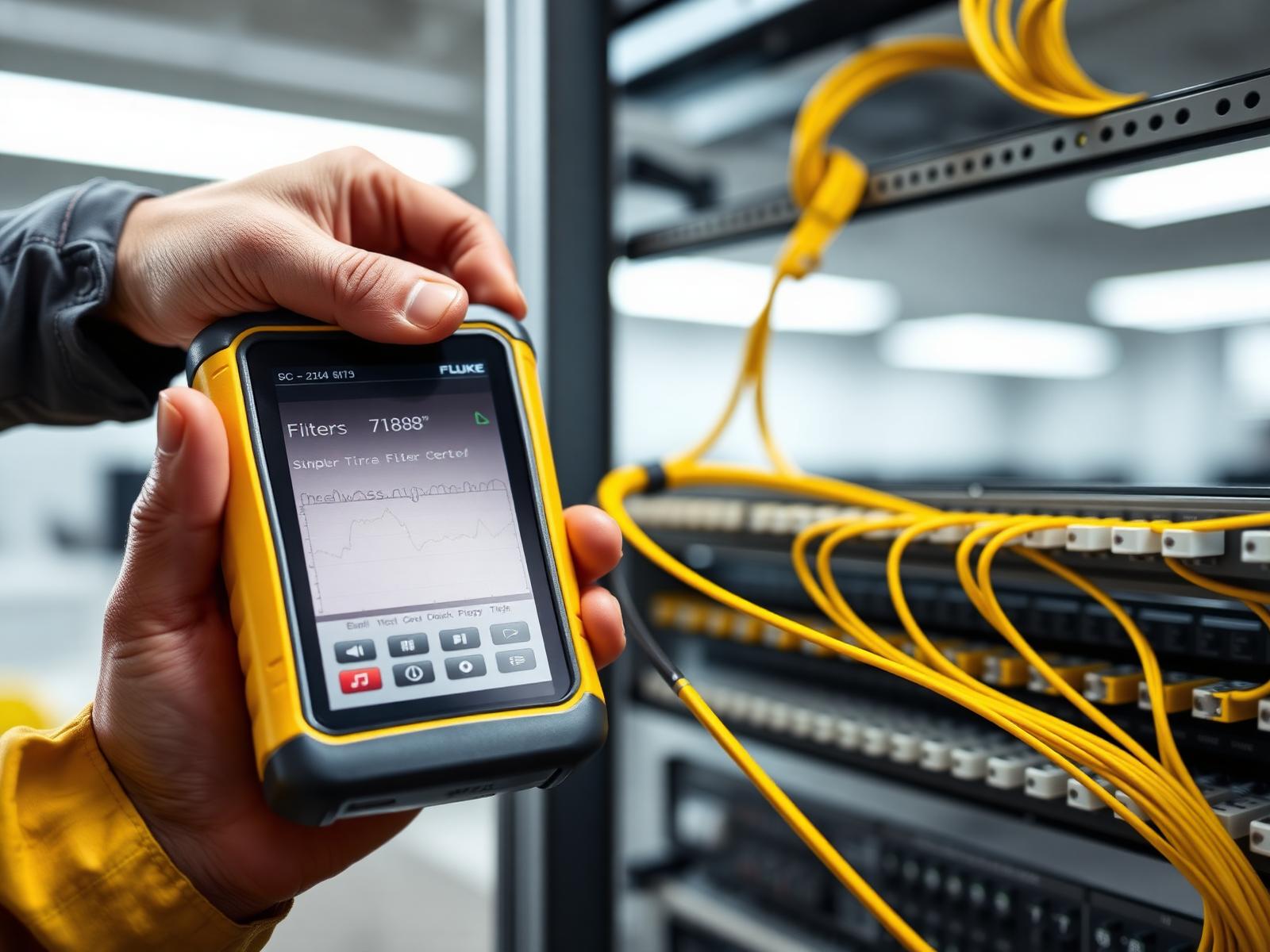
Accurate, verifiable network performance is non-negotiable for critical infrastructure. Without rigorous testing and certification, relying on newly installed or upgraded cabling systems is a significant risk that can lead to costly downtime, intermittent failures, and difficult-to-diagnose issues. Access Cabling specializes in comprehensive Fluke DSX CableAnalyzer testing and certification services, providing irrefutable proof of your cabling infrastructure's adherence to TIA/EIA, ISO/IEC, and manufacturer performance standards. We leverage the latest Fluke DSX-8000 Versiv platform for copper and fiber optic deployments, generating detailed, indelible reports that validate performance from the physical layer up. This service is essential for IT directors, facilities managers, data center operators, and general contractors who demand certainty in their network deployments, ensuring that their investment meets or exceeds the specified performance parameters before project handover. Our methodology goes beyond pass/fail; we deliver actionable insights and forensic-level documentation.
The Imperative for Fluke DSX CableAnalyzer Certification
Fluke DSX CableAnalyzer certification is not merely a 'final check' but a critical validation step mandated by industry standards like TIA-568-C/.D and ISO/IEC 11801, and often by cabling manufacturers for warranty purposes. These standards define the performance parameters for various cabling categories (e.g., Cat6A, Cat8) and fiber types (e.g., OM3, SMF-28). Without verifiable test results from calibrated, industry-recognized equipment such as the Fluke DSX series, cabling installations cannot be considered compliant, nor can they typically qualify for extended manufacturer warranties. The DSX CableAnalyzer goes beyond basic continuity or wiremap checks; it performs a full suite of tests including Near-End Crosstalk (NEXT), Far-End Crosstalk (FEXT), Attenuation, Return Loss, ACR-F (Attenuation to Crosstalk Ratio, Far-End), propagation delay, and delay skew for copper, and insertion loss, length, and optical return loss for fiber. These detailed measurements detect subtle impairments that could degrade network performance, especially for high-bandwidth applications like 10 Gigabit Ethernet and beyond. Access Cabling's technicians are Fluke Networks Certified Cabling Test Technicians (CCTT), ensuring the correct test limits, adapters, and setup procedures are applied, directly impacting the accuracy and validity of the final certification report. This adherence to protocol is fundamental to reliable network operation and serves as a crucial legal and contractual document.
Ensuring TIA/ISO Compliance and Warranty Validation
Cabling infrastructure performance benchmarks are rigorously defined by standards bodies such as TIA (Telecommunications Industry Association) and ISO/IEC (International Organization for Standardization/International Electrotechnical Commission). Specifically, TIA-568.3-D (Optical Fiber Cabling Components Standard) and TIA-568.2-D (Balanced Twisted-Pair Telecommunications Cabling and Components Standard) dictate the minimum performance requirements for all cabling systems. Fluke DSX certification ensures these parameters are met or exceeded for every permanent link and channel tested. For manufacturers like CommScope, Panduit, Leviton, and Belden, achieving their 25-year or lifetime system warranties is absolutely contingent upon providing documented test results from approved equipment, typically the Fluke DSX. Access Cabling understands these warranty requirements intimately. We utilize the precise test limits specified by the manufacturer's warranty program, such as CommScope's SYSTIMAX warranty or Panduit's PanGen, ensuring that when we certify a system, it not only performs to standard but also qualifies for the extended warranty coverage, protecting your long-term investment. Incorrect test limits, outdated firmware, or uncalibrated testers can invalidate an entire project's warranty eligibility, a risk we meticulously eliminate through our stringent quality control and technician training programs. This meticulous approach to compliance and warranty validation provides a critical layer of assurance that extends far beyond project completion.
Advanced Testing Metrics and Diagnostic Capabilities
The Fluke DSX CableAnalyzer platform offers far more than a simple pass/fail indication; it provides advanced diagnostic capabilities critical for troubleshooting and optimizing complex network infrastructures. For copper cabling, in addition to standard metrics, the DSX can pinpoint the precise location of faults, such as opens, shorts, impedance mismatches, and sources of excessive crosstalk or return loss, using its sophisticated Time-Domain Reflectometry (TDR) and Time-Domain Crosstalk (TDX) functionalities. This 'distance to fault' capability is invaluable for identifying and rectifying issues quickly, minimizing downtime. For fiber optic cabling, the OptiFiber Pro module within the Versiv platform extends capabilities beyond insertion loss testing to include Optical Time Domain Reflectometry (OTDR). OTDR measurements map the fiber link, identifying splices, connectors, and bends, and quantifying their individual loss events, all depicted graphically. This allows for detailed analysis of fiber infrastructure, ensuring not just light transmission, but signal integrity. Access Cabling utilizes these advanced features not only for certification but also for forensic analysis of existing problematic cabling, uncovering hidden issues that rudimentary testers would miss. Our detailed reports include these forensic graphs and data points, providing an unparalleled level of transparency and diagnostic depth for our clients’ records.
Precision Setup and Calibration Protocol for Accuracy
The accuracy and validity of Fluke DSX certification are directly dependent on meticulous setup and adherence to proper calibration protocols. Access Cabling's certified technicians follow a strict regimen before any testing commences. This includes verifying the tester's current calibration status – Fluke recommends annual calibration for all DSX units to maintain measurement accuracy, a service we diligently perform through authorized Fluke service centers. We ensure the correct Permanent Link Adapters (PLAs) or Channel Adapters are used, matching the cabling category being tested (e.g., Cat6A, Cat8). Crucially, the 'Test Limit' selected must precisely match the specified TIA/ISO standard and cabling manufacturer's warranty requirements (e.g., TIA Cat 6A Permanent Link). Incorrect test limits can result in false passes or failures, rendering the entire certification invalid. For fiber testing, proper cleaning of all connector end-faces, including the launch and tail cords, is paramount to avoid 'phantom' failures caused by contamination, as mandated by IEC 61300-3-35. Our process involves cleaning and inspecting using a Fluke FiberInspector during setup. This stringent protocol, from adapter selection to calibration verification and cleanliness, is fundamental to delivering legally defensible and technically accurate certification data.
Comprehensive Documentation and Deliverables
A core component of our Fluke testing service is the provision of comprehensive and easily interpretable documentation. Upon project completion, Access Cabling delivers an organized set of certification reports generated directly from the Fluke LinkWare Live cloud-based platform or LinkWare PC software. These reports are more than just a summary; they provide a granular detail for every single tested link, including cable IDs, test limits used, individual performance parameters (e.g., NEXT margin, attenuation margin, length, propagation delay), and graphical representations of frequency-dependent measurements. Each report clearly indicates a "PASS" or "FAIL" status, along with the margin by which the link passed or failed specific parameters. We provide these reports in industry-standard formats (e.g., PDF, XML), allowing for easy archiving, presentation to authorities having jurisdiction (AHJs), and submission for manufacturer warranties. This structured documentation serves as a critical audit trail, a baseline for future network upgrades, and irrefutable proof of installation quality and compliance. Unlike some providers, we ensure all test results are meticulously organized, clearly labeled, and presented in a professional, actionable format, enhancing long-term network management and troubleshooting capabilities.
Strategic Benefits of Independent Certification
Engaging Access Cabling for independent Fluke DSX certification provides strategic benefits beyond mere compliance, especially for general contractors and IT managers overseeing large-scale deployments. For GCs, third-party certification mitigates punch list items related to cabling performance, de-risks project handover, and provides a neutral, expert validation that can prevent disputes between sub-contractors and end-users. It serves as a definitive quality assurance benchmark at project closeout. For IT managers, an independently verified certification provides confidence that the physical layer is robust and capable of supporting current and future applications, preventing 'no trouble found' (NTF) issues that plague network operations teams when the cabling is assumed to be good. It establishes a trusted baseline of performance. Furthermore, in environments requiring high reliability and performance, such as data centers or industrial control networks, independent certification from a C-10/C-7 licensed contractor ensures that the entire system, not just components, meets stringent performance criteria, contributing directly to operational uptime and data integrity. Our role is to provide an unbiased, expert assessment, ensuring the client's best interests are always paramount.
Beyond Certification: Advanced Network Troubleshooting
While certification validates new installations, the Fluke DSX CableAnalyzer also serves as an indispensable tool for advanced network troubleshooting in existing infrastructures. Intermittent network issues, unexplained packet loss, or slow data transfer that cannot be resolved at the active equipment layer often point to subtle physical layer problems. Our technicians leverage the Fluke DSX's diagnostic capabilities to identify and localize these elusive faults. For instance, high bit error rates that only appear under load can be traced to marginal crosstalk performance near a patch panel, which a basic continuity tester would miss. Similarly, issues with PoE delivery can often be traced to excessive resistance unbalance in the twisted pairs, a parameter the DSX-8000 can precisely measure. We apply our expertise with the Fluke platform to diagnose legacy cabling systems for potential bottlenecks or vulnerabilities when upgrading to higher-speed networks (e.g., retrofitting for 10 Gigabit Ethernet). This goes beyond simple pass/fail testing, employing the DSX to perform 'forensic' analysis on failing or underperforming links, providing targeted, data-driven solutions to optimize existing networks and prevent future outages. Our diagnostic prowess ensures that even the most complex cabling mysteries are resolved efficiently.
Verifying Power over Ethernet (PoE) Functionality and Performance
The widespread adoption of Power over Ethernet (PoE) across modern network infrastructures introduces a critical dimension to cable certification. Fluke DSX CableAnalyzers, particularly the DSX-8000, are instrumental in verifying not just the foundational physical layer characteristics but also the nuanced electrical parameters essential for reliable PoE operation. Traditional continuity and wiremap tests are insufficient; comprehensive PoE testing involves injecting and measuring power across all four pairs (for PoE++) or relevant pairs, assessing voltage drop, maximum power delivery capabilities, and identifying potential resistive imbalances. A significant pitfall in PoE deployment is high pair-to-pair resistance unbalance, which can lead to premature degradation of powered devices (PDs), erratic performance, or even complete failure over time due to overheating and current flow discrepancies. The DSX measures these resistance imbalances with precision, flagging deviations from IEEE 802.3bt (formerly 802.3af/at) standards that specify differential resistance unbalance – typically less than 3% within a pair and 7% between pairs. Furthermore, the ability to validate 'Power Sourcing Equipment' (PSE) characteristics, such as classification and discovery protocols, ensures interoperability with connected PDs. Without rigorous PoE-specific certification, network administrators face silent failures that manifest as intermittent device connectivity, reduced lifespan of end-point devices, and significant troubleshooting complexity that is often erroneously attributed to the powered device rather than the underlying cabling infrastructure. This deep-dive testing capability provides tangible assurance that the physical layer can sustain the required power delivery for applications ranging from IP cameras and wireless access points to LED lighting systems, validating the total installed cost of the PoE-enabled network.
Addressing Electromagnetic Interference (EMI) and Alien Crosstalk Mitigation
In enterprise-grade networks, especially those deploying 10 Gigabit Ethernet (10GBASE-T) and beyond, the susceptibility to electromagnetic interference (EMI) and alien crosstalk (AXT) becomes a significant performance bottleneck. The Fluke DSX CableAnalyzer series provides sophisticated methodologies to quantify and mitigate these often-overlooked impairments. Unlike traditional near-end crosstalk (NEXT) or far-end crosstalk (FEXT), which are internal to a cable, alien crosstalk arises from the electromagnetic coupling between adjacent twisted-pair cables within a bundle or conduit. The DSX performs 'Power Sum Alien Near-End Crosstalk' (PSANEXT) and 'Power Sum Alien Far-End Cros crosstalk' (PSAFEXT) measurements, which are critical for certifying 10GBASE-T and higher-speed channels. These tests require a 'disturber' cable to induce the alien crosstalk while the 'victim' cable is measured, providing a real-world assessment of cable separation and installation practices. A common pitfall observed in field installations is insufficient separation between cable bundles or improper termination leading to elevated AXT levels, which can manifest as reduced data rates, increased error rates, and periodic network slowdowns, despite passing basic channel tests. The DSX's capability to isolate and pinpoint sources of excessive AXT, often due to poor pathway management or inadequate shielding in STP/FTP systems, empowers technicians to implement targeted remediation. This includes re-routing, improved cable management, or the strategic use of shielded cabling. Validating AXT performance is not merely about achieving 'pass' status; it’s about guaranteeing sustained, error-free operation at the specified data rates, minimizing the total cost of ownership by preempting costly post-deployment troubleshooting and infrastructure rework triggered by elusive intermittent connectivity issues.
Fiber Optic Tier 1 and Tier 2 Certification: Loss, Length, and ORL
While often associated with copper cabling, Fluke's Versiv platform (housing modules like the OptiFiber Pro and CertiFiber Pro) extends comprehensive certification to fiber optic infrastructures, crucial for modern data centers and backbone networks. Tier 1 certification (Basic) for fiber optic links primarily focuses on optical loss (attenuation), length, and polarity. The CertiFiber Pro module precisely measures end-to-end insertion loss against industry standards (e.g., TIA-568.3-D, ISO/IEC 11801) using calibrated light sources and power meters. Crucially, it calculates the 'pass/fail' threshold based on the number of connectors, splices, and the fiber length, providing an objective assessment of link quality. A critical aspect often overlooked is the 'Return Loss' (ORL) which impacts high-speed, single-mode applications, indicating reflections from connectors and splices. Poor ORL can degrade transceiver performance and reduce effective link length. Tier 2 certification (Extended) goes deeper, employing an Optical Time Domain Reflectometer (OTDR) like the OptiFiber Pro. This provides a detailed graphical trace showing loss events, reflectance, and distances to every connector, splice, and fault along the fiber path. This is invaluable for pinpointing specific points of degradation such as dirty end faces, micro-bends, or high-loss splices that Tier 1 may only show as an overall high loss. Common pitfalls include using incorrect cleaning procedures, exceeding bend radius limits during installation, or accepting components with substandard polishing, all of which are identifiable through OTDR analysis. The combined Tier 1 and Tier 2 certification strategy ensures that fiber optic links meet stringent performance criteria, providing the robust, high-bandwidth foundation necessary for mission-critical applications and future network scalability, essential for maximizing the lifecycle investment in optical infrastructure.
Strategic Project Management and Coordination for Certification Success
Achieving successful Fluke certification across large-scale cabling deployments requires more than just technical expertise at the point of testing; it necessitates meticulous project management and proactive coordination with various stakeholders. From the outset, establishing clear lines of communication with general contractors, electrical contractors (MEP trades), and IT deployment teams is paramount. The physical routing of network cabling, particularly distinguishing between horizontal runs, risers, and backbone infrastructure, often intersects with other building systems, including power, HVAC, and security. Without early coordination, common pitfalls arise, such as cable pathways being compromised by other trades, insufficient conduit fill leading to excessive heat buildup, or critical bend radius violations in congested spaces impacting performance. A well-defined project plan dictates not only the testing methodology but also the sequence of operations, identifying critical milestones for pre-testing, final certification, and remediation. This includes scheduling power disruptions for active equipment, arranging access to secured data rooms, and coordinating with fire safety officials for penetrations or pathway closures. The Fluke platform's ability to sync data to the cloud via LinkWare Live facilitates real-time progress tracking, allowing project managers to monitor certification status, identify bottlenecks, and flag potential re-tests or rework requirements promptly. This digital integration improves accountability, reduces administrative overhead, and provides an auditable trail of installation quality. Ultimately, strategic project oversight ensures that the certification process integrates seamlessly into the broader construction timeline, avoiding costly delays, mitigating risks of rework, and delivering a demonstrably compliant and high-performing network infrastructure that underpins the client's operational resilience and technology roadmap.