
Commercial cabling pricing seems opaque only because it is quoted a dozen different ways. This is what actually drives the number a facilities manager or IT director sees at the bottom of the proposal, and how to read a quote so competing bids can be compared apples-to-apples.
- Most Cat6 drops price $150–$275 installed; Cat6A drops $200–$350.
- Labor is the dominant line item — typically 55–70% of a straightforward install.
- Building conditions can move the per-drop number by 30–40% in either direction.
- Certification, warranty registration, and as-builts should be included, not add-ons.
Executive summary
A defensible commercial cabling budget in 2026 assumes $200 per drop as a national midpoint for Cat6 and $275 for Cat6A, then adjusts up or down for pathway, access windows, and drop count. Pricing that comes in significantly below those ranges usually excludes testing, patch cords, or the manufacturer warranty. Pricing significantly above usually reflects a difficult building — occupied space, hard-lid ceilings, or after-hours work.
Why quotes vary so much
A 40-drop office in an open-plenum warehouse conversion can price at $150 per drop. The same 40 drops in an occupied law-firm floor with hard-lid ceilings and after-hours access can price at $340. The cable is identical. Labor conditions, not materials, drive the difference.
What a drop includes
- One horizontal cable run from the IDF/MDF to the work-area outlet.
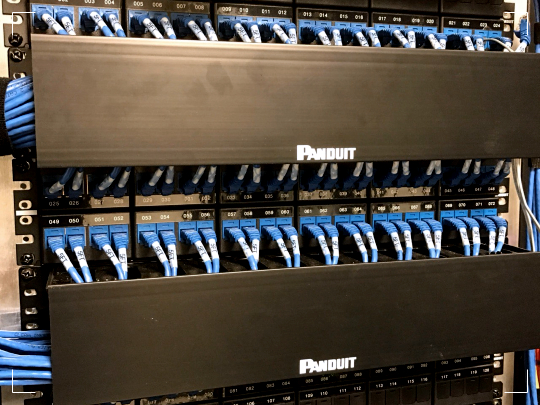
- Termination at both ends — jack, faceplate, patch panel port.
- Cable management: velcro, D-rings, service loops.
- Labeling to TIA-606 at both ends.
- Fluke DSX (or equivalent) certification report per drop.
- One matching patch cord at each end (some quotes exclude these — always ask).
Cost drivers
| Driver | Cost impact | Notes |
|---|---|---|
| Cable type (Cat6 vs Cat6A) | +$40–$80 per drop | Material + slightly larger pathway. |
| After-hours / weekend labor | +20–35% | Union rules and OT vary by market. |
| Occupied tenant space | +15–25% | Furniture protection, extra clean-up. |
| Hard-lid ceilings | +25–40% | Fishing walls and ceiling cuts. |
| Fire-rated wall penetrations | +$40–$80 each | Includes fire-stop labor and materials. |
| Long runs > 90 m | Design impact | Requires an IDF, not a per-drop premium. |
| Small project premium | +15–25% | Mobilization spread over few drops. |
Common mistakes in bid comparison
- Comparing quotes with and without certification reports.
- Missing the exclusion of patch cords — a 200-drop project needs 400 patch cords.
- Missing the exclusion of the manufacturer warranty registration.
- Assuming pathway (tray, conduit, J-hooks) is included when it is bid separately.
- Missing the exclusion of fire-stopping.
How to buy well
- Provide every bidder the same drop count, cable type, and pathway assumptions.
- Ask each bidder to itemize labor, material, certification, and warranty.
- Insist on Fluke DSX (or Wirescope) certification with per-drop reports at closeout.
- Require the low-voltage license number and evidence of manufacturer certification (Panduit CI&M, CommScope PartnerPRO, etc.).
- Ask for two client references from projects of similar scope in the last 12 months.
Budget ranges by project size
| Project size | Cat6 typical range | Cat6A typical range |
|---|---|---|
| 1–10 drops | $275–$400 / drop | $325–$475 / drop |
| 11–50 drops | $185–$275 / drop | $235–$340 / drop |
| 51–200 drops | $155–$225 / drop | $205–$285 / drop |
| 200+ drops | $140–$200 / drop | $185–$255 / drop |
When to call a professional
Before signing any low-voltage contract above $10,000, have a licensed C-7 or C-10 contractor walk the space and confirm pathway, access windows, and drop counts. A 30-minute site visit prevents the 'change order surprise' that turns a $22,000 project into a $34,000 project three weeks in.