
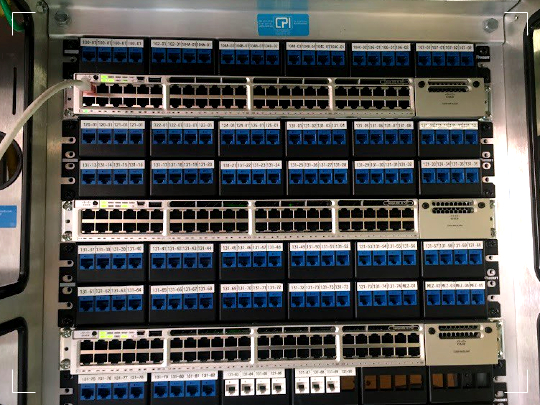
Copper still lands 90% of the workstation drops in a commercial building, and fiber still lands 90% of the traffic between buildings and between floors. The interesting decisions live in the middle: horizontal runs longer than 100 m, PoE devices that need reach, and backbone links that will carry 25 or 40 Gb/s within the cable's lifetime.
- Copper carries power; fiber does not. If the endpoint is a PoE device, copper is the default.
- Fiber wins on distance (2 km on OM4 at 10G) and immunity to electrical noise.
- Backbone and inter-building links should be fiber in almost every commercial deployment.
- Hybrid designs — fiber to the zone, copper to the desk — are the modern standard for large floors.
Executive summary
For horizontal cabling under 100 m to end-user devices, copper is the right answer. For backbone risers, building-to-building runs, high-EMI environments, and any link approaching 10G at full distance, fiber is the right answer. The realistic commercial design is a fiber backbone with copper horizontal runs, sometimes with fiber-to-the-zone architectures for very large floor plates.
The business problem
Buyers rarely ask 'copper or fiber?' — they ask 'why is our vendor quoting fiber to a run that used to be copper?' or 'why not just install fiber everywhere?' The correct answer depends on distance, powered devices, environment, and lifecycle, and it usually results in a mixed plant.
Technical explanation
| Attribute | Copper (Cat6A) | Multimode OM4 fiber | Single-mode OS2 fiber |
|---|---|---|---|
| Max distance at 10G | 100 m | 400 m | 10 km |
| Max distance at 40G | 30 m (Cat8) | 150 m | 10 km |
| Carries PoE | Yes (up to 90 W) | No | No |
| EMI immunity | Susceptible | Immune | Immune |
| Termination cost per end | $3–$8 | $25–$60 (LC/pre-term) | $25–$60 |
| Typical use | Workstations, APs, cameras | Backbone risers, MDF↔IDF | Building-to-building, OSP |
Fiber is glass. Copper is metal. That is not glib — it is why fiber is unaffected by lightning, motor noise, and grounding faults, and why copper still delivers power and short-distance economics that fiber cannot match.
Common mistakes
- Running copper between buildings on separate power services — a lightning strike will ride the shield or drain wire and destroy switch ports on both ends.
- Choosing OM3 in a new build to save a few dollars; OM4 costs marginally more and gives 4× the 40G distance.
- Terminating fiber with field connectors when pre-terminated MTP trunks would install faster and certify cleaner.
- Assuming fiber uplinks are unlimited — the SFP+ or QSFP+ modules and their DOM budgets are the real ceiling.
Best practices
- Backbone: OM4 or OS2 with at least 12 strands and 30% spare capacity.
- Horizontal: Cat6A to end devices; fiber only when copper cannot reach or environment forbids it.
- Between buildings: single-mode OS2 in innerduct, tested with both OLTS and OTDR.
- Pathway: keep fiber and copper in the same tray but different sections; never zip-tie fiber tightly.
Real-world considerations
Wireless access points, IP cameras, VoIP phones, and PoE lighting all consume copper. Any building that has these devices in ceilings or perimeters will run copper — the only question is how far. When a device is more than 90 m from the IDF (leaving margin against 100 m limits), the choice becomes copper via a new IDF, fiber-fed remote powering, or a fiber media converter at the device.
Recommended solution profiles
- Class-A office, single floor: Cat6A horizontal, 12-strand OM4 riser to MDF.
- Multi-floor building: OS2 or OM4 riser, Cat6A on each floor, 24-strand backbone.
- Campus (multiple buildings): OS2 OSP between buildings in innerduct, Cat6A inside each building.
- Manufacturing / heavy EMI: fiber to zone enclosures, short copper runs to devices.
When to call a professional
Any run over 100 m, any building-to-building link, any splice, and any fiber acceptance test with a real deliverable should be handled by a certified fiber technician with an OLTS and OTDR. Copper drops in tenant space can often be handled by a competent low-voltage crew; fiber acceptance is where warranty and future troubleshooting depend on documentation done right the first time.