For mission-critical datacenter uplinks, building backbones, and enterprise networks requiring high-bandwidth, short-to-medium distance data transmission, multimode fiber optic cabling remains a pragmatic and cost-effective solution. Access Cabling specializes in the design, installation, and certification of high-performance OM3, OM4, and OM5 multimode fiber infrastructures, providing the robust connectivity foundation modern IT environments demand. Our approach integrates deep technical expertise, adherence to TIA/EIA and BICSI standards, and meticulous project execution to ensure optical integrity and future scalability. We serve IT directors, facilities managers, and general contractors who require a dependable partner capable of deploying resilient multimode fiber systems tailored to their specific bandwidth requirements and infrastructure constraints, delivering predictable performance from edge to core.
Multimode Fiber Characteristics and Standards (OM3, OM4, OM5)
Multimode fiber, specifically OM3, OM4, and the emerging OM5, is engineered to transmit multiple light paths (modes) simultaneously within its larger core diameter, typically 50 µm. This design facilitates the use of cost-effective Vertical-Cavity Surface-Emitting Lasers (VCSELs) for light sources, making it a prevalent choice for enterprise and data center applications spanning up to several hundred meters. OM3 fiber, recognized for supporting 10 GbE up to 300 meters, utilizes a laser-optimized 50/125 µm core. OM4 extends this capability, supporting 10 GbE up to 550 meters and 40/100 GbE up to 150 meters, primarily due to its higher modal bandwidth. OM5, or Wide Band Multimode Fiber (WBMMF), is differentiated by its ability to support Short Wavelength Division Multiplexing (SWDM4) and parallel transmission over a broader spectrum (850nm to 953nm), enabling 400 GbE over two fibers (four SWDM channels of 100G each) up to 150 meters and offering a potential upgrade path for future high-density applications. All these multimode fiber types are specified under TIA/EIA-492AAAC (OM3), TIA/EIA-492AAAD (OM4), and TIA/EIA-492AAAE (OM5) standards, ensuring interoperability and defined performance metrics across the industry. Our expertise encompasses meticulous planning and precise deployment of these diverse multimode fiber types, aligning the installed plant with the specific bandwidth and distance requirements of critical network segments.
System Design for Multimode Fiber Backbones
Effective multimode fiber system design goes beyond simply selecting OM3, OM4, or OM5; it involves a comprehensive analysis of current and projected bandwidth demands, distance requirements, cable pathways, and future scalability. Key design considerations include link loss budgets, calculated using TIA-568.3-D methodology, which factor in fiber attenuation, connector loss, and splice loss to ensure signal integrity over the entire optical path. Our engineers meticulously plan cable routing to minimize bend radius violations, using appropriate conduit, cable trays, and innerducts to protect fibers, especially in plenum, riser, and outdoor plant environments. We often specify manufacturer-specific solutions like Panduit's Opti-Core, CommScope's TeraSPEED, or Leviton's Opt-X platforms, considering their respective connector options (LC, SC, MPO/MTP) and pre-terminated assemblies. For connections, MPO/MTP connectors are frequently utilized in data centers for high-density, parallel optics applications (e.g., 40GBASE-SR4, 100GBASE-SR4, 400GBASE-SR8), while LC connectors remain dominant for patching and equipment connections. The design phase critically considers equipment compatibility, power budgets, and cooling requirements within telecommunications rooms (TRs) and data halls, integrating the fiber infrastructure seamlessly into the broader network ecosystem. We prioritize designs that allow for non-disruptive upgrades, such as modular patching systems and sufficient slack management, to facilitate future technology migrations without extensive re-cabling.
Materials and Components for Optimized Performance
The longevity and performance of a multimode fiber installation depend heavily on the quality and compatibility of its components. Beyond the fiber optic cable itself, critical elements include connectors, patch panels, cable management solutions, and enclosures. We exclusively source industry-leading components from manufacturers like Corning, Belden, Panduit, CommScope, and Leviton to ensure adherence to TIA/EIA standards and guaranteed performance. For instance, pre-terminated MPO/MTP assemblies offer superior plug-and-play deployment for data centers, reducing on-site termination time and improving consistency compared to field-terminated connectors. OM3, OM4, and OM5 cables are specified with appropriate fire ratings (e.g., OFNP for plenum, OFNR for riser) according to NEC Article 770 requirements. Precision-manufactured LC and SC connectors with zirconia ferrules are used for individual connections, providing low insertion loss and high return loss characteristics essential for high-speed data. Fiber optic enclosures and patch panels are selected for robust protection, efficient fiber routing, and adequate bend radius control. Splice trays, if fusion splicing is required, are chosen to securely house and protect splices while maintaining proper fiber slack. Our procurement strategy focuses on selecting components that minimize attenuation and maximize network reliability, understanding that each part contributes to the overall link budget and system performance over its operational lifespan.
Expert Installation for Multimode Fiber Optics
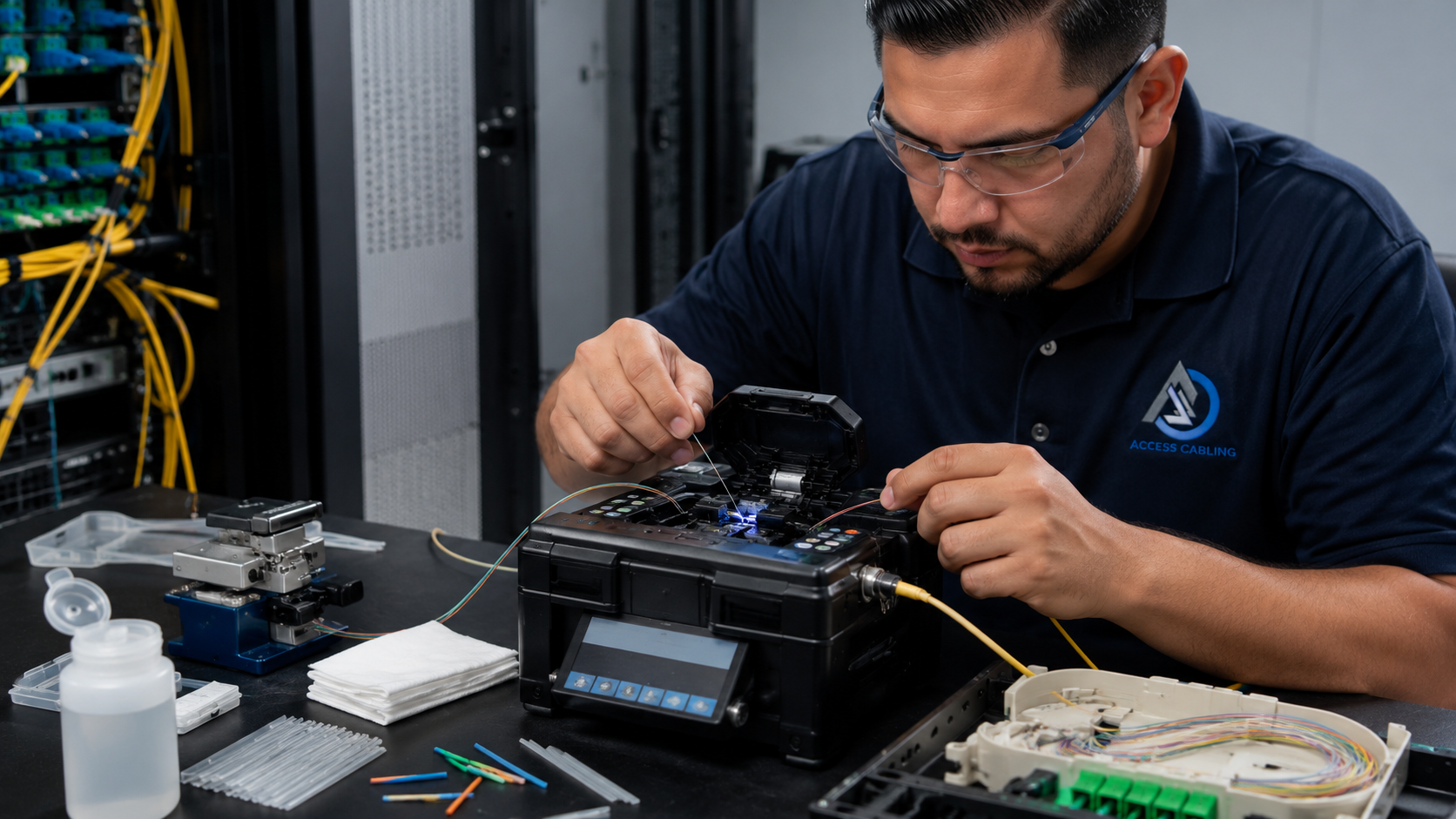
The physical installation of multimode fiber optic cabling demands specialized skills and rigorous attention to detail to preserve the optical properties of the fiber. Our certified technicians adhere strictly to BICSI installation methods, ensuring proper handling, pulling tensions, and bend radius compliance throughout the deployment process. Fiber optic cables, particularly those with smaller core diameters, are susceptible to damage from excessive pulling force, kinking, or tight bends. We utilize appropriate fiber pulling lubricants, swivels, and tension monitoring equipment to prevent micro-bends and macro-bends that can cause increased attenuation. For field terminations, our technicians are proficient in both epoxy-and-polish and fusion splicing techniques. Fusion splicing, employing state-of-the-art splicers such as those from Sumitomo or Fujikura, is preferred for its ultra-low loss (typically 0.05dB or less) and long-term stability, particularly in backbone and outdoor plant applications. For pre-terminated solutions, installation focuses on meticulous cable routing, secure mounting of patch panels and enclosures, and precise interconnection of MPO/MTP connectors. Every installation undergoes visual inspection and comprehensive documentation, including detailed labeling and creation of as-built drawings, which are crucial for future troubleshooting and infrastructure management. Our methodical approach minimizes installation-induced loss and maximizes the performance headroom for your fiber optic infrastructure.
Rigorous Testing and Certification for Assured Performance
Certification is a non-negotiable step in ensuring the installed multimode fiber infrastructure meets or exceeds TIA/EIA-568.3-D performance standards. Access Cabling employs advanced fiber optic testing equipment, including Fluke Networks DSX-8000 CableAnalyzers, for comprehensive Tier 1 (Basic) and Tier 2 (Extended) certification. Tier 1 testing involves measuring insertion loss using a Power Meter and Light Source (PMLS) or Optical Loss Test Set (OLTS) at the required wavelengths (850nm and 1300nm for OM3/OM4, potentially 950nm for OM5). This verifies that the end-to-end link loss falls within the calculated budget. Tier 2 testing incorporates an Optical Time Domain Reflectometer (OTDR), such as a Fluke OptiFiber Pro, to provide a graphical trace of the fiber link, pinpointing and characterizing individual events like connectors, splices, and any anomalies. OTDR testing is crucial for ensuring proper installation, identifying potential damage, and accurately measuring the length of each fiber segment. All test results are digitally recorded and provided to the client in a comprehensive report, validating compliance with industry standards and manufacturer specifications. This certified data provides an unassailable baseline for future network performance and diagnostics, offering peace of mind regarding the reliability and bandwidth capacity of your multimode fiber investment.
Strategic Applications of Multimode Fiber
Multimode fiber's cost-effectiveness for medium-distance, high-bandwidth applications makes it ideal for several critical network segments. In data centers, OM3 and OM4 are extensively used for server-to-switch and switch-to-switch uplinks within the same aisle or across adjacent racks, supporting 10GbE, 40GbE, and 100GbE connectivity. The migration to 400GbE often leverages OM5 in shorter data center links. For building backbones, multimode fiber connects telecommunications rooms (TRs) or intermediate distribution frames (IDFs) to the main distribution frame (MDF), aggregating traffic from workgroups across multiple floors or wings. Campus environments also utilize multimode fiber for interconnecting buildings within a short-to-medium range, providing high-speed links between core switches. Moreover, multimode fiber finds applications in storage area networks (SANs), connecting storage devices and servers with high-speed Fiber Channel links. Its robust performance over limited distances, combined with the proven reliability of VCSEL transceivers, continues to make multimode a foundational technology for enterprise networks that prioritize capacity, latency, and cost efficiency within their operational footprint. Our team advises clients on the optimal multimode fiber type and network architecture to align with their current requirements and anticipate future growth.
Access Cabling's Differentiators in Multimode Fiber Deployment
What sets Access Cabling apart in the specialized field of multimode fiber deployment is our unwavering commitment to technical excellence, rigorous adherence to standards, and a client-centric project management philosophy. With 28+ years of dedicated low-voltage experience and CSLB licenses, we possess a deep institutional knowledge that transcends theoretical understanding; it's grounded in practical, hands-on application across thousands of installations. Our C-10/C-7 licensing ensures that all work is performed by qualified professionals who understand both the intricacies of fiber optics and the broader electrical and safety implications. We aren't simply installers; we are infrastructure consultants guiding clients through complex technology choices, from OM3 to OM5, considering the nuanced impact on network topology, future upgrades, and budget. Our meticulous documentation, including comprehensive test reports and as-built drawings, provides invaluable assets for ongoing network management. This combination of deep technical expertise, certified personnel, premium materials, and a proven track record of successful, compliant deployments positions Access Cabling as the trusted partner for mission-critical multimode fiber optic infrastructures throughout California and nationwide. We deliver not just connectivity, but a reliable foundation for your enterprise's digital future.
Migration Pathways and Future-Proofing Multimode Fiber Infrastructures
Evolving network demands often necessitate strategic migration beyond initial multimode fiber deployments; understanding these pathways is critical for long-term infrastructure viability. A common scenario involves migrating from OM3 to OM4 or OM5 to support higher data rates like 400G Ethernet (e.g., 400GBASE-SR8 or 400GBASE-SR4.2 for SWDM4). This isn't merely a cable swap; it encompasses a re-evaluation of transceiver compatibility, patch panel density, and active equipment capabilities. For instance, while OM3 supports 10GBASE-SR up to 300 meters and 40GBASE-SR4/100GBASE-SR4 up to 100 meters, OM4 extends these to 400 and 150 meters respectively, and OM5 (Wide Band Multimode Fiber, WBMMF) further extends reach for SWDM wavelengths. When considering a migration, specific attention must be paid to maintaining backward compatibility where possible, leveraging existing pathways, and minimizing service disruption. This often involves careful planning of cutover windows, pre-staging of new transceivers (e.g., QSFP-DD, OSFP), and employing phased approaches where critical links are upgraded iteratively. Considerations for future-proofing also extend to the physical layer, such as ensuring sufficient conduit fill ratios for potential additional fiber runs, utilizing modular patch panels that accommodate higher port densities (e.g., MPO/MTP cassettes), and documenting precise fiber assignments to prevent misconfigurations during upgrades. Overlooking the detailed planning for these migration pathways can lead to significant cost overruns, extended downtime, and performance bottlenecks that actively impede future network scalability. We focus on providing detailed migration roadmaps that account for current and projected technological shifts, ensuring our multimode fiber installations remain robust, adaptable, and forward-compatible with emerging standards like 800G Ethernet, leveraging the benefits of technologies such as Shortwave Wavelength Division Multiplexing (SWDM).
Rigorous Documentation and Lifecycle Management for Multimode Fiber
Effective lifecycle management of multimode fiber infrastructure hinges on comprehensive, accurate, and accessible documentation, moving far beyond simple 'as-built' drawings. Our approach to documentation encompasses a multi-layered system designed to support fault isolation, capacity planning, and future upgrades. This includes detailed fiber mapping, which specifies every individual fiber strand’s termination point, color code (e.g., TIA-598-C color coding), and logical circuit assignment from the patch panel port to the active equipment interface. Beyond physical connectivity, we document attenuation test results (link loss budget measured in dB, conforming to TIA/EIA-568.3-D standards for each fiber segment), Optical Time Domain Reflectometer (OTDR) traces showing splice loss, connector reflectance, and event locations (e.g., for fusion splices, mechanical splices, and MPO fan-outs). Critical accompanying metadata includes cable manufacturer, fire rating (e.g., OFNP, OFNR), cable diameter, installation date, and technician responsible. These detailed records are maintained in an integrated database (often a DCIM or specialized fiber management software) and are updated in real-time as changes or additions occur, preventing data decay and ensuring a single source of truth. The absence of such meticulous documentation is a leading cause of prolonged troubleshooting, misallocation of resources, and increased Mean Time To Repair (MTTR) because technicians waste valuable time identifying unknown or undocumented pathways. Furthermore, accurate documentation is vital for compliance audits and capacity planning exercises, allowing precise utilization tracking and justifying future infrastructure investments based on actual data rather than estimations. Our deliverables include comprehensive close-out packages with all test results, schematics, and a documented change management process for ongoing maintenance and modifications.
Advanced Testing Methodologies and Diagnostic Tooling for Multimode Fiber
Beyond basic insertion loss testing, advanced diagnostic methodologies are imperative for ensuring peak performance and quickly resolving issues in multimode fiber networks. Our technicians are equipped with and trained on state-of-the-art testing instrumentation. This includes specialized Optical Time Domain Reflectometers (OTDRs) with multimode launch conditions (e.g., using a mode conditioner or Mandrel Wrap for 50/125µm fiber) to accurately characterize link length, attenuation per kilometer, connector reflectance, and detect micro-bends or bad splices that simple power meters might miss. We utilize launch reference cords (typically 1-meter, 900µm buffered fiber with specified connectors) and receive launch cords to minimize measurement uncertainty and accurately define the reference plane. For high-speed links, particularly those operating at 40G or 100G Ethernet, we employ an Encircled Flux (EF) compliant light source, as defined by IEC 61280-4-1, to ensure the optical power distribution within the fiber core matches the specified launch conditions for high-bandwidth transceivers. This eliminates modal-dependent bandwidth variations that can lead to bit errors and reduced reach. Additionally, we conduct polarity verification using dedicated MPO/MTP testing kits to ensure correct alignment for Method A, B, or C deployments, which is critical for interoperability. For diagnosing intermittent issues or validating link performance under load, we also utilize network protocol analyzers capable of performing BERT (Bit Error Rate Test) over the optical link, providing real-world performance metrics. This combination of advanced physical layer testing and protocol-level validation allows us to not only certify compliance with TIA/EIA-568.3-D and ISO/IEC 11801 standards but also to preemptively identify potential performance degradations that could impact applications before they become critical failures.
Energy Efficiency and Thermal Management in Multimode Fiber Deployments
While multimode fiber itself is a passive medium, its deployment significantly influences the energy efficiency and thermal management strategies within the broader data center or enterprise network. The selection of fiber cabling (e.g., tight-buffered vs. loose-tube), pathway infrastructure (e.g., cable trays, conduits, overhead raceways), and connectivity components directly impacts airflow dynamics and heat dissipation. A dense, poorly managed cabling infrastructure acts as a physical barrier to efficient airflow, particularly in hot aisle/cold aisle containment strategies. Overly packed cable trays or conduits can create localized hot spots, forcing cooling systems (CRAC/CRAH units) to work harder, consuming more energy, and increasing overall PUE (Power Usage Effectiveness). Our design principles for multimode fiber installations prioritize optimal airflow. This includes utilizing perforated cable trays and troughs, maintaining proper cable separation (e.g., segregation of power and data cables), and employing structured cabling practices that minimize cable bulk. For high-density MPO/MTP environments, careful consideration is given to fan-out cable management to prevent spaghetti cabling, which can obstruct front-to-rear airflow paths for switches and servers. We also consider the thermal properties of cable jacket materials and plenum ratings (OFNP) to ensure heat is not retained within the cabling system. The inherent advantage of fiber over copper, being immune to electromagnetic interference (EMI) and not generating heat through resistance, allows for more flexible routing and fewer thermal constraints. By optimizing the physical layout and organization of multimode fiber infrastructure, we contribute to a reduction in cooling energy consumption, extend the lifespan of active equipment by preventing thermal stress, and ultimately lower the operational overhead of the data center, aligning with sustainable IT practices and reducing Total Cost of Ownership (TCO).