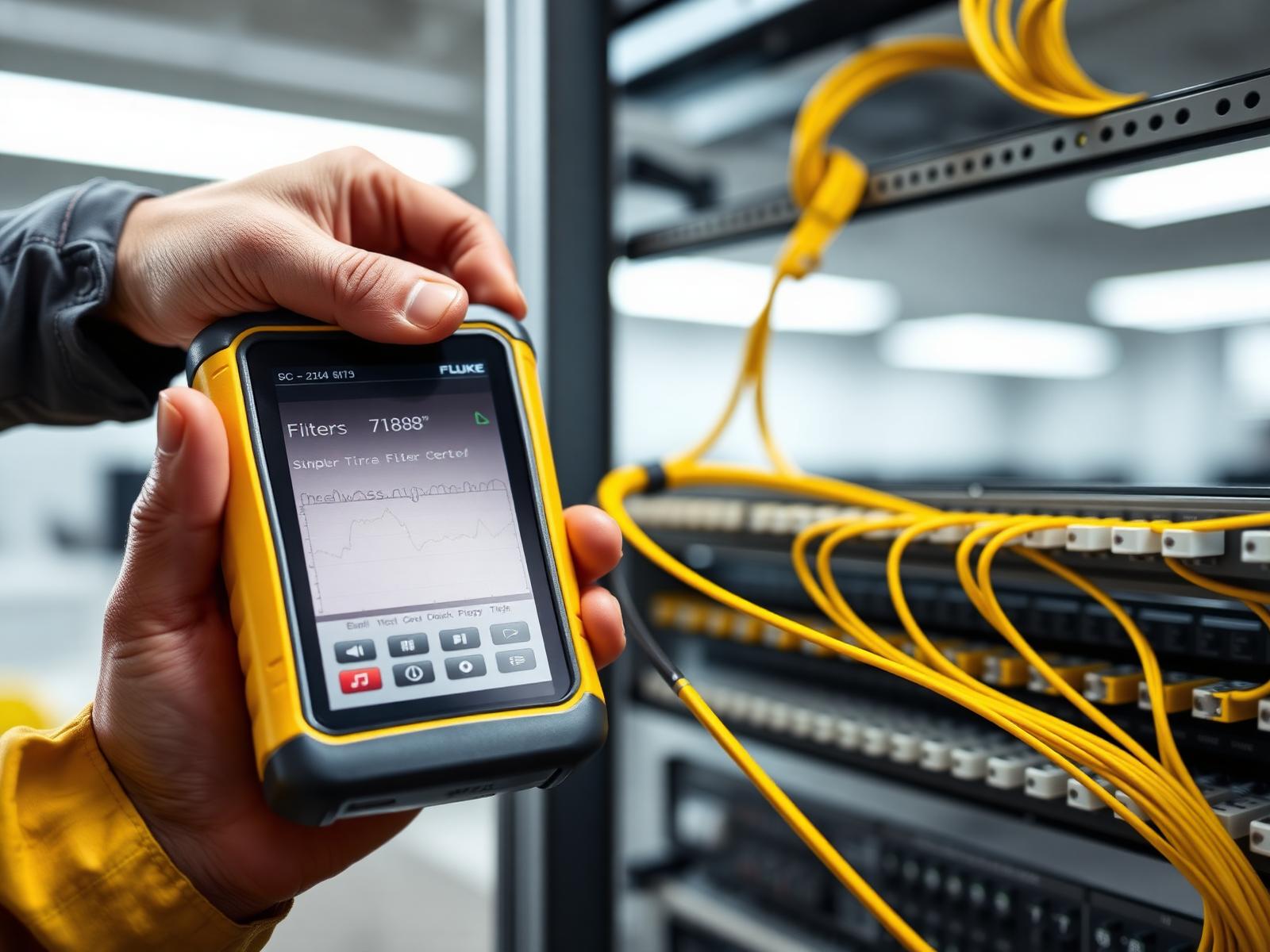
Precise and reliable fiber optic network performance is not a given; it's a verified outcome. Access Cabling specializes in comprehensive fiber certification, guaranteeing that your optical infrastructure meets or exceeds industry standards for attenuation, length, and polarity. This service is critical for IT directors, facilities managers, and general contractors who demand validated performance from their fiber backbones, whether for data centers, campus networks, or intricate industrial controls. Unlike generalized installers, our approach integrates BICSI-trained technicians, Fluke DSX-8000 Versiv testers, and adherence to specific TIA/EIA and IEEE standards from the initial design review through final documentation, mitigating future operational risks and ensuring seamless integration with high-bandwidth applications. We provide irrefutable proof of your fiber plant's readiness for next-generation demands.
Understanding Tier 1 and Tier 2 Fiber Optic Certification
Fiber optic certification is a multi-tiered validation process, distinct from basic continuity testing. Tier 1 certification, also known as Basic or Loss/Length testing, evaluates the fundamental performance characteristics of a fiber link. It measures insertion loss (attenuation) at specified wavelengths (e.g., 850nm/1300nm for multimode, 1310nm/1550nm for singlemode), optical link length, and polarity. This is performed using an Optical Loss Test Set (OLTS), such as the Fluke DSX-5000 or DSX-8000 with appropriate OLTS modules. Adherence to TIA-568.3-E and ISO/IEC 11801 standards dictates the maximum permissible loss budgets for various fiber types and link lengths. A critical component of Tier 1 is ensuring correct fiber polarity, which dictates how signals transmit and receive across a link, preventing communication errors. Tier 2 certification, or full inspection and Optical Time Domain Reflectometer (OTDR) testing, provides a deeper forensic analysis of the fiber link. While Tier 1 verifies total loss, Tier 2 pinpoints the exact location and characteristics of events contributing to that loss, such as splices, connectors, and macrobends. An OTDR sends light pulses down the fiber and measures the reflected and scattered light returning, generating a precise trace that identifies event loss, reflectance, and total link attenuation. This level of certification is essential for diagnosing issues, verifying splice quality, and ensuring long-term reliability in high-performance or mission-critical environments. It complements Tier 1 by providing granular insights into the physical integrity of the fiber path.
Precision Planning: Designing Fiber Infrastructure for Certifiable Performance
Effective fiber certification begins long before the first cable is pulled; it originates in the design phase. Access Cabling's engineering team collaborates with clients to design fiber optic systems that are inherently certifiable and optimized for specific application requirements. This involves meticulous planning of fiber types (OM3, OM4, OM5 multimode; OS2 singlemode), connector types (LC, SC, MPO), and link architecture. We meticulously apply TIA-568.3-E standards for maximum allowable attenuation budgets, considering fiber length, number of connectors, and number of splices. For example, a typical LC-terminated OS2 singlemode trunk might have a total connector loss budget of 0.75 dB per mated pair and a fiber loss of 0.35 dB/km at 1310nm. Ignoring these details during design inevitably leads to certification failures. Furthermore, physical pathway planning, including conduit sizing, aerial vs. underground routes, and appropriate bend radius considerations for various fiber cables, is vital. We also specify manufacturer-compliant components from partners like CommScope, Panduit, Leviton, and Corning, ensuring compatibility and guaranteed performance characteristics. This proactive approach minimizes unforeseen attenuation issues, reflectance excursions, or polarity mismatches that would otherwise necessitate costly reworks during the certification process.
Critical Components: Fiber Types, Connectors, and Patch Panels
The selection of fiber optic components directly impacts certifiable performance and future network scalability. We advise on selecting appropriate fiber types: multimode (OM3, OM4, OM5) for shorter distances within buildings or campuses, often for 10GbE to 100GbE applications, and singlemode (OS2) for longer distances, often exceeding 550 meters for 1GigE or for 400GbE and beyond. Multimode fiber is susceptible to modal dispersion, while singlemode fiber is limited by chromatic dispersion and polarization mode dispersion, all of which are considered during link budget calculations. Connector quality is paramount; we specify low-loss connectors from manufacturers like Corning, CommScope, or Belden, adhering to their published insertion loss and return loss specifications. For instance, an LC connector typically has an insertion loss of less than 0.25dB. MPO/MTP connectors, common in data centers, require precise cleaning and inspection due to their multi-fiber termination. Fiber optic patch panels and enclosures must provide proper cable management, strain relief, and bend radius protection to prevent microbends and macrobends, which can introduce significant attenuation and invalidate certification. We also ensure correct fiber fan-out kits, splice trays, and pigtails are utilized to maintain optical performance and facilitate future moves, adds, and changes (MACs) without compromising the certified links.
Installation Best Practices for Guaranteed Certifiable Output
Fiber optic installation is a precise discipline where meticulous adherence to best practices directly impacts certification success. Our BICSI-certified technicians execute installations according to manufacturer specifications and TIA-568.3-E guidelines. This includes proper cable handling, ensuring minimum bend radii are never violated during pulling, routing, and termination. For example, a typical 2mm singlemode patch cord often has a minimum bend radius of 10mm. Exceeding this can lead to macrobending losses visible on an OTDR trace. Fusion splicing, if required, is performed using calibrated equipment, with splice loss targets typically below 0.1dB. Connector termination, whether field-terminated or fusion-spliced pigtails, is executed with extreme precision, followed by microscopic inspection to ensure pristine end-faces free of defects, scratches, or contamination. Any contamination on a fiber end-face can cause significant insertion loss and return loss, leading to certification failure. During termination, strict adherence to polarity schemes (e.g., Method A, B, or C for MPO) is maintained throughout the link to ensure end-to-end signal integrity. Every step, from conduit fill ratios to proper labeling, is executed with the end goal of a fully certifiable and reliable fiber plant.
Advanced Testing: Fluke DSX-8000 and Comprehensive Data Analysis
Access Cabling utilizes the industry-leading Fluke DSX-8000 Versiv Cable Analyzer with appropriate fiber modules for both Tier 1 (OLTS) and Tier 2 (OTDR) fiber optic certification. For Tier 1 MPO/MTP testing, we employ specialized MPO modules that test all 12 or 24 fibers simultaneously, drastically reducing testing time while maintaining accuracy. The Fluke DSX-8000 provides automated loss/length measurements against TIA and ISO limits, ensuring compliance. For Tier 2, the OTDR functionality allows us to generate a graphical trace of the fiber link, identifying and quantifying event losses from connectors, splices, and any anomalies. This forensic capability is crucial for troubleshooting and proving installation quality. Each test result is recorded, timestamped, and stored electronically. After testing, our engineers analyze the data using Fluke LinkWare Live software to generate comprehensive certification reports. These reports include pass/fail status, measured loss and length, optical return loss (ORL), event tables, and OTDR traces for each individual fiber. This detailed documentation package provides irrefutable proof of performance and serves as a vital baseline for future troubleshooting or warranty claims.
Beyond Certification: Compliance, Documentation, and Warranty Validation
Fiber certification is not merely a pass/fail test; it's a critical component of compliance, system validation, and warranty adherence. Our detailed certification reports provide the necessary documentation for jurisdictional compliance, such as NEC Article 770 for optical fiber cables, and internal IT auditing requirements. For structured cabling systems, specific manufacturer warranties (e.g., CommScope SYSTIMAX, Panduit PanGen, Leviton Atlas) require comprehensive certification data to validate extended warranties often spanning 20 or 25 years. Access Cabling ensures that all testing is performed using calibrated equipment, with test results saved in non-editable formats, typically PDF or LinkWare Live project files, demonstrating objective evidence of compliance. This meticulous attention to documentation is especially vital for mission-critical applications like data centers, healthcare facilities, or financial institutions where every fiber link must be independently verified. Our clients receive a complete certification package, including a project summary, test parameters, individual fiber test results, and a graphical representation of the network layout where applicable, providing a complete auditable record of their fiber infrastructure's performance.
Maximizing ROI: Mitigating Risk with Certified Fiber Optics
Investing in rigorous fiber certification significantly maximizes the return on investment for your network infrastructure by mitigating operational risks and ensuring long-term reliability. Uncertified fiber links are a common source of intermittent network issues, reduced bandwidth, and costly downtime—often exceedingly difficult to diagnose without a performance baseline. By subjecting every fiber link to Tier 1 and Tier 2 certification, Access Cabling guarantees that your fiber plant is ready for high-bandwidth applications, from 10GbE to 400GbE and beyond, without performance bottlenecks. This proactive validation effort prevents 'rip and replace' scenarios and extends the useful life of your physical layer infrastructure. Certified links provide peace of mind, knowing that the cabling infrastructure will support evolving technology upgrades for years to come. In high-stakes environments like data center interconnects or industrial control networks, the cost of certification pales in comparison to the potential financial losses from network failure, making it an indispensable component of a resilient and future-proof network strategy.
Integrating Fiber Certification with Building Management Systems (BMS)
The integration of a certified fiber optic infrastructure with modern Building Management Systems (BMS) is paramount for achieving intelligent building operations, especially in data centers and smart commercial spaces. A robust fiber backbone, verified through rigorous Tier 1 and Tier 2 certification processes using equipment like the Anritsu MT1000A or VIAVI MTS-4000 OTDRs, provides the foundational communication layer for diverse BMS components such as HVAC controls, lighting systems, access control, and environmental sensors. Crucially, the certification process, by validating attenuation, optical return loss (ORL), length, and polarity, guarantees the reliability of data transport necessary for real-time analytics and automated responses within the BMS framework. For example, a certified OS2 single-mode fiber link, characterized by a loss budget verified against TIA/EIA-568.3-D standards, ensures that latency-sensitive BACnet/IP or Modbus/TCP communications are unimpeded, preventing operational delays or data corruption that could compromise building efficiency or safety systems. Without certified performance, intermittent connectivity or degraded signal quality can lead to 'phantom' alarms, erroneous sensor readings, and ultimately, a failure of the BMS to perform its intended functions, resulting in increased energy consumption, premature equipment wear, and elevated operational costs. Our integration approach involves pre-certifying specific fiber runs dedicated to BMS communication platforms, ensuring they meet the stringent performance metrics required for mission-critical environmental controls and security protocols, thereby future-proofing the building's operational intelligence.
Mitigating Electromagnetic Interference (EMI) through Fiber Optic Deployment
In industrial and medical environments, the inherent immunity of fiber optic cabling to electromagnetic interference (EMI) is a critical factor influencing network design and certification. Unlike copper-based systems, fiber optic cables transmit data via light pulses, rendering them impervious to electrical noise generated by heavy machinery, high-power electrical conduits, RF devices, and even medical imaging equipment such as MRIs. The certification process, particularly the OTDR testing inherent in Tier 2, plays a vital role in ensuring environmental resilience. For instance, in a manufacturing plant, a certified OM4 multi-mode fiber link ensures uninterrupted data flow for Supervisory Control and Data Acquisition (SCADA) systems, where EMI from variable frequency drives (VFDs) or arc welding equipment could severely degrade the performance of Category 6A copper. During the certification, detailed trace analysis from a sophisticated OTDR like the EXFO FTB-700 Series verifies the integrity of fusion splices and connector terminations, which are often points of weakness if improperly installed. This ensures that the installed fiber not only meets TIA/EIA-568 specifications for optical loss but also confirms the physical pathway's robustness against potential micro-bends or macro-bends introduced during installation near EMI sources. Moreover, proper grounding and shielding considerations, though less critical for the fiber itself, remain essential for connected active equipment, and certified fiber pathways reduce the need for expensive and often complex copper EMI mitigation strategies, simplifying compliance with standards such as IEC 61000-4-x. The certified fiber infrastructure guarantees data reliability in electrically noisy environments, minimizing operational downtime and ensuring the precision of automated industrial processes.
Life Cycle Cost Analysis: The Value of Certifiable Fiber Infrastructure
A comprehensive life cycle cost analysis (LCCA) for network infrastructure consistently demonstrates that investing in meticulously certified fiber optics significantly reduces total cost of ownership (TCO) over the system's operational lifespan. While the initial capital expenditure for high-quality fiber components and professional certification services, leveraging tools like the Jonard Tools FC-500 fiber cleaver for precise end-face preparation, may appear higher than uncertified or poorly installed alternatives, the long-term savings are substantial. The primary driver of these savings is the dramatic reduction in troubleshooting time, premature component failure, and costly network downtime. For example, a Tier 1 certified 100 Gigabit Ethernet (100GbE) link utilizing MPO connectors, verified for insertion loss, polarity, and end-face geometry using an inspection probe like the AFL FOCIS Flex, provides a guaranteed bandwidth capacity and low error rate foundational for high-performance applications. Without certification, hidden defects such as micro-fractures, air gaps in connectors, or incorrect polarity can lead to intermittent performance issues that are notoriously difficult and time-consuming to diagnose, often requiring extensive site visits and specialized equipment. Each hour of downtime in a data center or critical enterprise environment can cost thousands to millions of dollars. Furthermore, certified fiber infrastructure facilitates easier upgrades and technology refreshes; a well-documented and validated physical layer, compliant with standards such like ISO/IEC 11801, ensures compatibility and predictable performance when migrating to higher speeds, such as 400GbE or beyond. This mitigates the risk of 'rip and replace' scenarios caused by an inadequately installed or documented original build, extending the usable life of the physical plant and providing a predictable roadmap for future network evolution.
Leveraging Certified Fiber for Cybersecurity and Physical Security Initiatives
The deployment of certified fiber optic cabling forms a critical, often overlooked, layer in an organization's holistic cybersecurity and physical security strategy. Unlike copper, fiber optic cable does not emit electromagnetic signals, making it significantly more difficult to 'tap' surreptitiously without detection. Any attempt to physically intercept data from a fiber optic cable, such as by bending or cleaving the fiber, will immediately result in a measurable increase in attenuation, which can be detected by continuous optical monitoring systems or through subsequent Tier 1 or Tier 2 certification scans. For example, the precise loss measurements provided by an Optical Loss Test Set (OLTS) during Tier 1 certification establish a baseline against which future performance can be compared, alerting security personnel to unauthorized physical tampering. In perimeter security systems, certified fiber connections for IP cameras, access control points, and intrusion detection sensors guarantee uninterrupted data flow for real-time monitoring and event correlation, critical for rapid response. A rigorously certified OS2 single-mode fiber link, validated for its end-to-end optical budget and path integrity, ensures that high-resolution video streams from surveillance cameras are transmitted without packet loss or latency, preventing blind spots. Furthermore, the use of specified fiber cable types for specific security zones, e.g., armored fiber in high-risk outdoor applications, and the validation of its correct installation during certification, adds another layer of physical resilience. This comprehensive approach, underpinned by documented certification reports, integrates physical infrastructure integrity directly into the digital security framework, providing an empirically verifiable foundation for sensitive data transmission within secure facilities and beyond.