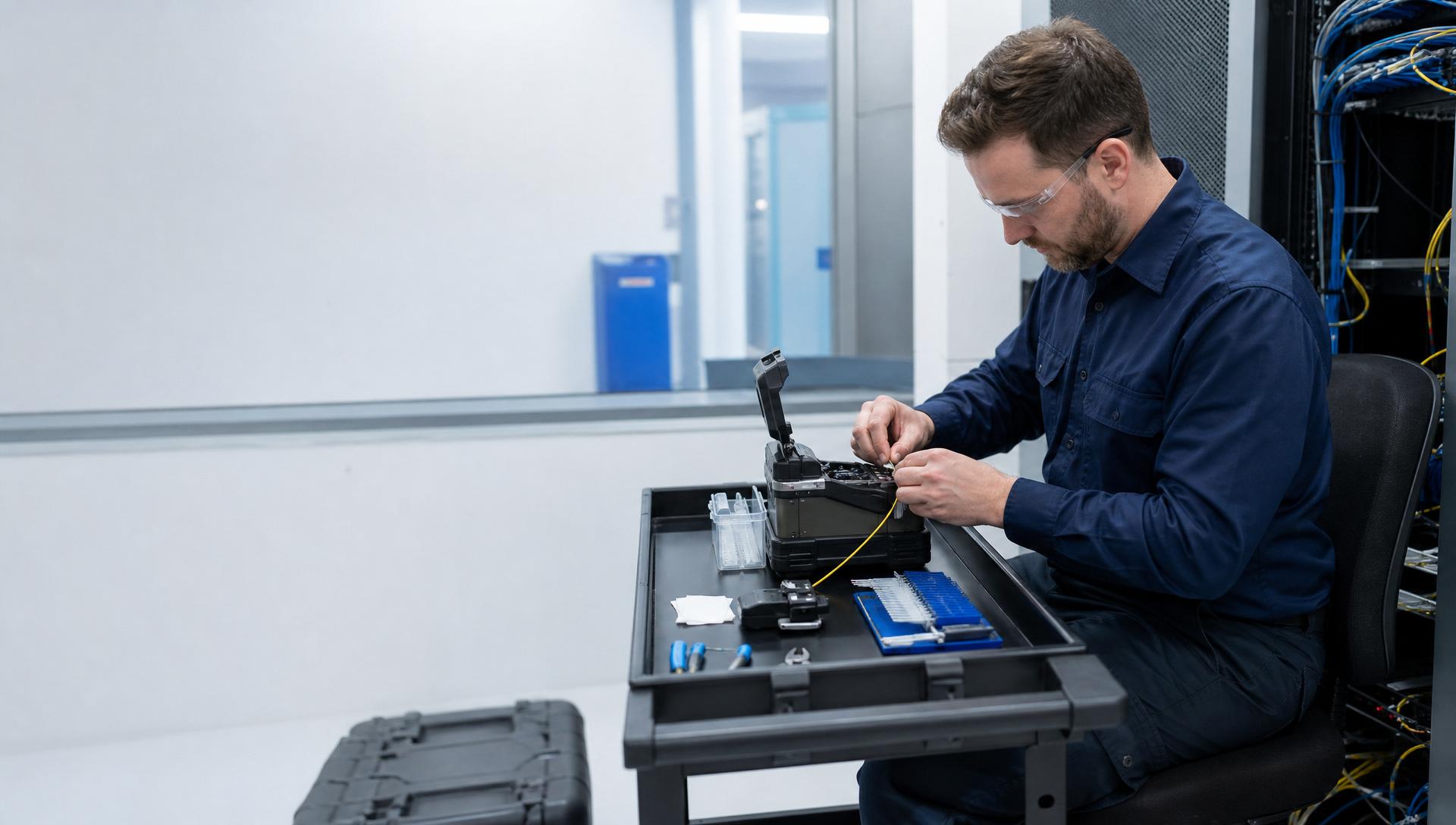
Access Cabling fiber technician performing fusion splicing in a commercial network room.
Commercial · Fiber

Fiber Splicing Services

Mechanical and fusion fiber splicing with OTDR verification.

28+ Years Experience
C-10 / C-7 Contractor
CSLB: 992009
Licensed Commercial Contractor
5 California Offices
California & Nationwide Service

Request a Fiber Splicing site survey

Free, no-obligation walkthrough. Licensed C-10 / C-7 (CSLB #992009). 28+ years, California & nationwide.

Request a site survey
Commercial Service Overview

Enterprise-grade fiber splicing engineered for commercial buildings.

Fiber Splicing from Access Cabling delivers enterprise-grade fiber splicing engineered by a licensed low-voltage contractor with 28+ years serving California and nationwide clients. Our BICSI-trained technicians design, install, terminate, test and certify every run to TIA/EIA standards so your infrastructure supports current bandwidth demands and future growth.

Macro of two glass fibers aligned in the V-grooves of a fusion splicer with a bright splicing arc between them.
Key Benefits

Why fiber splicing from Access Cabling

Commercial-grade installation, certified performance, and infrastructure built to last 25+ years.

Certified installation by BICSI-trained technicians
Manufacturer warranties up to 25 years on structured cabling
Fluke DSX certification reports on every project
Licensed C-10 / C-7 low-voltage contractor
24/7 emergency response and MAC services
Nationwide coverage with California headquarters
Installation Process

Our proven commercial cabling process

A repeatable, engineered process — refined over 28 years and thousands of sites.

  1. Step 1

    Free on-site survey and needs assessment

  2. Step 2

    Engineered design with rack elevations and pathway plans

  3. Step 3

    Scheduled installation with minimal business disruption

  4. Step 4

    Termination, testing, labeling and documentation

  5. Step 5

    Fluke certification and as-built drawings delivered

Technical Standards & Testing

TIA-compliant. Fluke-certified. Fully documented.

Every fiber splicing installation follows TIA-568, TIA-606 labeling, NEC 800 and applicable manufacturer specifications. Fluke DSX Versiv certification and full as-built documentation are delivered at project close.

  • TIA-568 structured cabling standards
  • TIA-606 labeling and administration
  • TIA-942 data center infrastructure
  • Fluke DSX-8000 channel and link certification
  • Manufacturer certified installer for Panduit, CommScope, Leviton
Access Cabling fiber technician performing fusion splicing in a commercial network room.
Industries Served

Fiber Splicing for every commercial environment

28+
Years
5
CA Offices
50
States
12M+
Feet Installed
Local Service Area

Fiber Splicing across California & nationwide

Local crews dispatched daily from five California offices. Multi-site rollouts across all 50 states.

In Depth

A closer look at fiber splicing

For enterprise networks, data centers, and critical infrastructure, maintaining signal integrity and minimizing attenuation across long-haul fiber optic links is paramount. When fiber optic cable runs require extension, repair, or rerouting, direct connectorization is often impractical or introduces unacceptable signal loss. This is where precision fiber splicing becomes indispensable. Access Cabling specializes in both mechanical and fusion fiber splicing, providing robust, low-loss connections that meet and exceed TIA/EIA-568-C.3 and ISO/IEC 11801 standards. Our certified technicians utilize advanced equipment such as Fujikura fusion splicers and Fluke DSX-8000 Versiv Cable Analyzers with MultiFiber PRO modules for post-splicing OTDR verification, ensuring optimal network performance and reliability for IT directors, facilities managers, and general contractors overseeing complex infrastructure projects. We deliver verifiable, high-performance fiber continuity.

The Imperative of Fiber Splicing: Fusion vs. Mechanical Techniques

Fiber splicing is the process of joining two fiber optic cables end-to-end to create a continuous optical path. This is a critical procedure for extending cable runs beyond factory lengths, repairing damaged cables, or terminating distribution cables into patch panels. The two primary methods are fusion splicing and mechanical splicing, each with distinct characteristics and applications. Fusion splicing, the industry gold standard, involves permanently fusing two optical fibers together using an electric arc. This method typically yields a splice loss of 0.02 dB to 0.05 dB, making it ideal for high-bandwidth, long-distance, and mission-critical applications where minimizing signal degradation is paramount. Equipment like the Fujikura 90S+ or Sumitomo Type-72C+ core alignment fusion splicers are essential for achieving these ultra-low loss connections. The process involves precisely cleaving the fiber, aligning the cores, and then applying heat to melt and fuse the glass. Post-splicing, a heat-shrinkable sleeve is applied over the splice point for protection against environmental factors and mechanical stress, adhering to NEC Article 770 requirements for fiber optic cables.

Fiber Optic Cable Types, Architectures, and Selection Criteria

The choice of fiber optic cable type directly impacts splicing requirements and network performance. Single-mode fiber (SMF), specified by ITU-T G.652.D for OS2 and G.657.A/B for bend-insensitive varieties, is characterized by a small core diameter (8-10 microns) that allows only one mode of light to propagate, resulting in significantly higher bandwidth and longer transmission distances compared to multimode fiber (MMF). Multimode fiber, defined by TIA-492AAxx specifications (OM1, OM2, OM3, OM4, OM5), has a larger core (50 or 62.5 microns) that permits multiple light modes, making it suitable for shorter distances within buildings or campuses. When splicing, it is critical to match fiber types precisely – splicing OM3 to OM4, for instance, requires careful consideration due to modal bandwidth differences, though it is technically feasible with minimal loss if cores align. Splicing an SMF to an MMF is generally not recommended due to significant mode field diameter (MFD) mismatch, leading to unacceptably high attenuation and reflectance. Understanding the network architecture, be it a point-to-point backbone or a passive optical network (PON), dictates the density of fibers and the specific splice enclosures required, such as those from CommScope or Panduit, which are designed to protect splices and manage fiber slack.

Precision Tooling and Environment Control for Optical Splice Integrity

Achieving low-loss fiber splices is highly dependent on the precision of the tools and the control of the splicing environment. A high-precision cleaver, such as the Fujikura CT50 or Sumitomo FC-8R, is paramount, ensuring a flat, perpendicular, and mirror-smooth fiber end face with minimal cleave angle (typically less than 0.5 degrees). Contamination is a primary culprit for high splice loss; therefore, meticulous fiber cleaning using lint-free wipes and isopropyl alcohol (≥99%) is performed at every stage of the splicing process. The splicing environment must be as dust-free as possible, often requiring a dedicated, enclosed workspace, especially for outdoor plant splicing. Humidity and temperature can also influence splice quality; modern fusion splicers have environmental compensation features, but extreme conditions should be avoided. Advanced fusion splicers feature core alignment technology, using cameras to precisely position the fiber cores before fusing, and post-splice attenuation estimation, providing immediate feedback on splice quality. Access Cabling's technicians are trained to utilize these advanced features to ensure every splice meets rigorous performance criteria, mitigating potential future network issues caused by poor splice quality.

Fiber Optic Enclosures and Cable Management Post-Splicing

Once fibers are spliced, they must be meticulously organized and protected within appropriate enclosures. Splice enclosures, such as Corning's OptiSheath® Series or Leviton's Black Box® units, are designed to shield splices from moisture, dust, and mechanical stress while providing proper bend radius control to prevent microbend and macrobend losses. These enclosures come in various configurations, including indoor distribution panels, outdoor aerial closures, and underground pedestals, each serving specific environmental and application needs. Effective cable management within these enclosures is crucial. This involves proper routing of fiber buffer tubes and individual fibers, slack storage to allow for future re-entry or re-splicing, and clear labeling of all fibers according to TIA-606-C standards. Failure to manage fibers properly can lead to pinching, kinking, or exceeding minimum bend radii, resulting in increased attenuation and potential fiber breakage. Our installation practices prioritize long-term maintainability and performance, ensuring that all spliced fibers are securely stored, easily identifiable, and protected against damage, facilitating future network upgrades or repairs without disruption.

OTDR Verification and Tier 2 Certification for Fiber Links

Post-splicing, rigorous testing and certification are non-negotiable for validating link integrity and performance. While fusion splicers provide an estimated splice loss, Optical Time Domain Reflectometer (OTDR) testing offers a comprehensive, 'picture' of the entire fiber link, including actual splice losses, connector losses, attentuation per kilometer, and identification of any anomalies. OTDR traces are essential for Tier 2 certification, as defined by TIA-568.3-E, providing a detailed historical record of the link's performance. Access Cabling utilizes advanced OTDRs like the Fluke Networks OptiFiber Pro or VIAVI Solutions MTS-2000, capable of testing both single-mode and multimode fibers across multiple wavelengths. We perform bi-directional OTDR testing, as specified by best practices, to accurately characterize links, especially when dealing with reflective events or different fiber types within a span. Each validated splice point, complete with its specific loss value, is documented in the final test report, providing clients with verifiable proof of compliance and superior link performance. This detailed documentation is critical for IT resource management and future troubleshooting, ensuring full accountability for every fiber strand.

Compliance, Safety Protocols, and Continuous Technician Training

Fiber optic installation and splicing demand strict adherence to safety protocols and industry compliance standards. Our technicians are trained in the safe handling of optical fibers, which can produce sharp shards during cleaving and stripping posing a laceration hazard. Eye protection is mandatory due to the invisible nature of laser light used in testing equipment. All fiber optic cable installations, including splicing, must comply with relevant sections of the National Electrical Code (NEC), specifically Article 770, which covers fiber optic cables and raceways. This includes proper firestopping for penetrations and ensuring suitable cable pathways. Furthermore, our team operates within BICSI best practices, ensuring that all installations meet or exceed industry benchmarks for quality and reliability. Continuous training is fundamental to our service delivery. Our technicians regularly receive updated instruction on new splicing equipment, fiber technologies (e.g., bend-insensitive fibers, specialty fibers), and evolving standards, ensuring that Access Cabling remains at the forefront of fiber optic infrastructure deployment and maintenance. This commitment to ongoing education translates directly into high-quality, compliant, and future-proof installations for our clients.

Advanced Applications and Strategic Advantages of Expert Fiber Splicing

Expertaneous fiber splicing is not merely a repair technique; it's a strategic enabler for advanced networking applications. In data centers, splicing facilitates the deployment of high-density fiber count cables, breaking out MPO/MTP trunk cables into individual LC or SC connectors, and extending fiber channels over vast distances. For campuses and metropolitan area networks, fusion splicing is fundamental to creating robust, redundant fiber backbones. Our capabilities extend to specialized applications like ribbon fiber splicing, where multiple fibers (e.g., 12 or 24 fibers) are spliced simultaneously, significantly reducing installation time for ultra-high-density environments. This requires specialized ribbonizing tools and multi-fiber fusion splicers, optimizing efficiency without compromising performance. For industrial and outdoor plant scenarios, we deploy ruggedized splice closures designed to withstand harsh environmental conditions, ensuring long-term network stability in challenging deployments. Access Cabling's proficiency across these varied applications provides a tangible advantage, delivering optimized fiber pathways that support the most demanding bandwidth requirements and ensure maximal uptime for our clients' critical operations.

Access Cabling's Splicing Expertise: Beyond the Connection

What distinguishes Access Cabling in the realm of fiber splicing is not just our technical proficiency, but our comprehensive, end-to-end project management and unwavering commitment to verifiable quality. We approach each splicing project with a meticulous planning phase, collaborating closely with IT directors and facilities managers to understand specific network requirements, loss budgets, and future scalability needs. Our certified C-10/C-7 low-voltage contractor status (CSLB 992009) underscores our adherence to stringent regulatory and safety standards, providing clients with peace of mind. While our technicians deploy top-tier equipment from manufacturers like AFL, Corning, and Siemens, our core strength lies in their specialized training in both single-mode and multimode splicing, encompassing full awareness of ITU-T G.652.D, G.657, and TIA-492 series standards. We provide transparent, comprehensive documentation, including detailed OTDR traces and power meter readings that establish Tier 2 compliance and validate every connection. Our 28+ years of experience translate into efficient deployment, minimal downtime, and reliable, high-performance fiber optic networks that stand the test of time, ensuring sustained operational excellence for your enterprise.

Optimizing Fiber Infrastructure TCO Through Strategic Splicing Methodologies

Total Cost of Ownership (TCO) in fiber optic infrastructure extends far beyond the initial capital expenditure of cable and active equipment; it critically encompasses long-term operational expenses, maintenance, and potential downtime associated with splice integrity. Strategic splicing methodologies, carefully selected based on network architecture, environmental conditions, and expected lifespan, play a pivotal role in minimizing this TCO. For instance, mass fusion splicing, while requiring a higher initial investment in specialized equipment and skilled labor, offers significantly lower attenuation and reflectance per splice point, directly translating to enhanced signal strength and reduced retransmissions over the network’s operational life. This not only improves data throughput and latency but also extends the reach of optical signals, potentially deferring costly repeater installations. Conversely, mechanical splicing, though offering rapid deployment and lower upfront tooling costs, typically introduces higher attenuation and reflectance, increasing long-term operational overhead, particularly in high-bandwidth, long-haul, or passive optical network (PON) applications where every dB budget is critical. Furthermore, the longevity and environmental resilience of splices contribute directly to TCO. Our approach meticulously evaluates factors such as projected network growth, potential for future fiber additions, and the specific demanding environmental conditions (e.g., extreme temperatures, vibration in industrial settings, or moisture ingress in outdoor deployments) to recommend the most suitable splicing technique and protective hardware. This considers not just the immediate project budget but the cumulative costs associated with power consumption, active equipment refresh cycles, and the significant financial impact of service interruptions resulting from splice failures. By integrating this TCO perspective into our splicing strategy, we ensure that the chosen methods provide robust, long-lasting performance, ultimately safeguarding our clients' investments and delivering optimal network reliability.

Interfacing Fiber Splicing with Critical MEP and BMS Infrastructure

Effective fiber optic splicing projects within modern facility infrastructures necessitate intricate coordination with Mechanical, Electrical, and Plumbing (MEP) and Building Management Systems (BMS) trades to prevent costly conflicts and ensure optimal system integration. Fiber optic cable pathways, particularly within data centers, smart buildings, or industrial control environments, must be carefully planned to avoid routing alongside high-voltage electrical conduits, which can induce electromagnetic interference (EMI) if not properly shielded and grounded, or within close proximity to heat-generating MEP equipment that can compromise fiber integrity or splice longevity. Equally critical is the coordination with BMS infrastructure, especially when fiber is used for sensor backhaul, security camera networks, or environmental monitoring systems. Splice enclosures and patch panels often require specific environmental controls (temperature, humidity) that fall under the purview of MEP/BMS design; failure to account for this can lead to accelerated degradation of optical components. Our project management methodology includes early and frequent inter-trade coordination meetings, utilizing BIM (Building Information Modeling) and CAD overlay techniques to identify and mitigate potential conflicts in cable tray routing, penetration points, and equipment rack placement. This proactive approach ensures that fiber pathways are optimized for both performance and physical security, avoiding pinch points, excessive bend radii, and areas susceptible to physical damage during subsequent construction or maintenance activities by other trades. Furthermore, the integration with BMS can leverage fiber’s immunity to EMI for reliable data transmission from critical plant sensors to centralized control systems, however, precise planning of splice locations and demarcation points is essential to facilitate future maintenance and troubleshooting without disrupting interconnected systems. Our detailed documentation, including as-built drawings and splice loss budgets, becomes an invaluable resource for all stakeholders, enabling seamless integration and long-term maintainability across the entire spectrum of building services.

Mitigating Common Fiber Splicing Failure Modes and Ensuring Network Resilience

Fiber optic splicing, despite its precision, is susceptible to a range of failure modes that can significantly degrade network performance and resilience if not proactively addressed. The most prevalent failure types often stem from improper fiber preparation, including inadequate cleaving angles or contaminated fiber end faces, leading to high insertion loss or unacceptable back-reflection. Another critical failure mode involves the introduction of micro-bending or macro-bending during splice protection and enclosure routing, which can cause increased attenuation and, over time, lead to catastrophic fiber breaks due to stress. Environmental factors play a substantial role; inadequate sealing of splice closures exposes splice points to moisture ingress, temperature fluctuations, and airborne contaminants, all of which accelerate fiber degradation and increase splice loss. Installer error, particularly inconsistent shrink-sleeve application or incorrect fiber alignment during fusion, also contributes significantly to poor splice quality. To mitigate these common failures, Access Cabling employs a multi-faceted approach. We utilize only automated, core-alignment fusion splicers with active cladding alignment feedback, ensuring optimal splice quality regardless of fiber geometry imperfections. Adherence to strict cleaning protocols for all tools, fibers, and equipment, coupled with environmental control measures (e.g., maintaining clean work environments in dusty or humid conditions), is non-negotiable. Post-splicing, every connection undergoes rigorous optical time-domain reflectometer (OTDR) testing to characterize insertion loss, reflectance, and event locations against industry standards like TIA/EIA-568. This comprehensive testing proactively identifies marginal splices (e.g., those approaching allowable loss limits) that, while not immediately failed, represent future points of vulnerability. Furthermore, our technicians are trained in advanced enclosure management techniques to prevent bending losses and ensure robust environmental protection for all splice trays and cable entry points, certifying the long-term reliability and resiliency of the entire optical link against both human error and environmental stressors.

Compliance Standards, Regulatory Frameworks, and Lifecycle Documentation for Fiber Splicing

Adhering to stringent compliance standards and regulatory frameworks is paramount in fiber optic splicing to ensure network performance, safety, and interoperability, particularly across diverse industries such as telecommunications, government, healthcare, and industrial automation. Key standards referenced include TIA/EIA-568 for commercial building cabling infrastructure, IEEE 802.3 related to Ethernet over fiber specifications, and industry-specific regulations that dictate installation practices, such as those from BICSI (Building Industry Consulting Service International) and relevant local electrical and building codes. For outdoor plant deployments, adherence to NESC (National Electrical Safety Code) is critical for aerial and underground installations, encompassing clearances, grounding, and bonding requirements. Furthermore, lifecycle documentation is not merely a formality but an essential component of operational efficiency and long-term network management. This includes meticulous recording of pre-installation site surveys, detailed fiber-to-fiber assignments, precise splice loss budgets calculated for each link, and comprehensive as-built drawings accurately depicting cable routes, splice closure locations, and fiber counts for every tube and strand. OTDR traces for each individual fiber, alongside power meter and light source (Tier 1) test results, form a critical part of this documentation package, serving as baseline measurements for future troubleshooting and performance validation. Regulatory compliance also extends to safety protocols, including LOTO (Lockout/Tagout) procedures for working near active equipment, proper handling of fiber shards, and stringent laser safety protocols (e.g., ANSI Z136.1 and IEC 60825-1) to protect personnel from invisible laser radiation exposures. Our commitment to these standards ensures not only the immediate functionality and safety of the installed fiber infrastructure but also provides a clear, auditable record for future expansions, system upgrades, and regulatory inspections, thereby minimizing legal and operational risks while maximizing the network's maintainability and investment protection over its entire operational lifecycle.

Related Topics
  • Fiber Optic Cable Installation
  • Data Center Fiber Cabling
  • Campus Backbone Infrastructure
  • OTDR Testing and Certification
  • Dark Fiber Solutions
  • MPO/MTP Trunk Cabling
  • Fiber Optic Repair Services
  • Structured Cabling Standards
FAQ

Frequently asked questions

What factors most significantly influence the cost of a fiber splicing project?+

The primary cost drivers for fiber splicing include the fiber type (single-mode vs. multimode), the number of fibers to be spliced, the complexity of the cable management within enclosures, and environmental conditions. Ribbon fiber splicing, while requiring specialized equipment, can be more cost-effective for high fiber counts. Site accessibility and the need for specialized enclosures (e.g., harsh environment ratings) also impact labor and material costs. Emergency repairs, especially outside standard business hours, naturally incur premium rates. Thorough upfront planning and clear project scopes typically mitigate unexpected cost escalations.

How does splicing impact the overall optical loss budget of a fiber optic link?+

Each splice introduces a small but measurable amount of attenuation, typically 0.02-0.05 dB for fusion splices and 0.2-0.75 dB for mechanical splices. While seemingly small, these losses accumulate over multiple splice points and must be factored into the overall optical loss budget, as defined by TIA-568.3-E. Exceeding the loss budget can lead to insufficient signal strength at the receiver, resulting in increased bit error rates or complete link failure. Accurate fusion splicing minimizes this impact, preserving up to 99% of the signal and extending effective transmission distances.

When is fusion splicing preferred over mechanical splicing, and vice-versa?+

Fusion splicing is almost always preferred for permanent, high-performance, and long-haul connections due to its ultra-low loss and superior reflectance characteristics, making it ideal for data centers, campus backbones, and FTTX deployments. Mechanical splicing provides a quicker, tool-less alternative for temporary repairs, emergency restorations, or scenarios where a fusion splicer is unavailable, typically in MMF applications. However, mechanical splices have higher insertion loss, higher reflectance, and less long-term stability, so they are generally not suitable for demanding enterprise or carrier-grade networks.

What specific standards and certifications does Access Cabling adhere to for fiber splicing?+

Access Cabling adheres strictly to TIA/EIA-568-C.3 and the updated TIA-568.3-E standards for fiber optic cabling and components. We also follow BICSI installation best practices, ensuring proper cable management, bend radius control, and labeling per TIA-606-C. Our testing and verification processes meet Tier 2 certification requirements, utilizing OTDRs as specified by TIA-568.3-E to provide detailed documentation of link performance. Additionally, all our work complies with relevant sections of the National Electrical Code (NEC Article 770) for fiber optic cables, ensuring electrical and fire safety.

How does Access Cabling ensure the long-term durability and protection of spliced fiber connections?+

Long-term durability is ensured through a combination of meticulous splicing technique and robust enclosure selection. Each fusion splice is protected with a heat-shrinkable splice protector sleeve, providing mechanical strength and environmental sealing. These splices are then carefully organized within industry-grade splice enclosures from manufacturers like Corning, Panduit, or CommScope. These enclosures are rated for specific environmental conditions (indoor, outdoor, aerial, underground) and are designed to protect against moisture, dust, vibration, and unauthorized access, maintaining proper fiber bend radii to prevent signal degradation over time.

Can you handle different types of fiber optic connectors (e.g., LC, SC, MPO) in your splicing projects?+

Yes, our fiber splicing services are fully compatible with all standard and many specialized fiber optic connector types. While splicing itself is performed on the bare fiber, the spliced fiber is typically pigtailed (pre-terminated with a connector) or routed to a field-installable connector. For high-density applications, we frequently splice MPO/MTP trunk cables onto breakout panels for LC or SC connectivity. Our technicians are proficient in working with various adapter types and patch panel configurations to ensure seamless integration into existing or new network infrastructures tailored to your required interface.

What is the typical timeframe for a fiber splicing project, from assessment to completion?+

The timeframe for a fiber splicing project varies significantly based on scale and complexity. A small repair involving a few splices might be completed within hours. A large-scale project, such as splicing several hundred fibers for a data center backbone or a campus-wide network, could span several days or even weeks. Our process typically involves an initial site survey and scope definition (1-3 days), dedicated splicing time (dependent on fiber count and access), and then comprehensive OTDR testing and documentation (1-2 days). We provide detailed project timelines during the proposal phase based on a thorough assessment.

How does proper fiber splicing contribute to the scalability and future-proofing of a network infrastructure?+

Proper fiber splicing is foundational to network scalability and future-proofing by creating low-loss, high-bandwidth pathways that can support evolving data rates. By executing precise, documented splices, enterprises can confidently upgrade active equipment without needing to re-cable or re-splice the passive infrastructure. The minimal inherent loss of fusion splices ensures that adequate optical power budgets remain for future speed increases (e.g., from 100G to 400G and beyond) that are highly sensitive to attenuation. This foresight, combined with well-managed and easily identifiable splice enclosures, allows for efficient future additions or modifications without disrupting existing operations.

How much does fiber splicing cost?+

Fiber Splicing pricing depends on drop count, cable type, pathway complexity, and building conditions. Most commercial projects range from $150 to $350 per drop installed. Request a free site survey for an itemized quote.

Do you provide fiber splicing nationwide?+

Yes. Access Cabling is headquartered in California with a nationwide technician network for multi-site rollouts across all 50 states.

Is fiber splicing certified and warrantied?+

Every installation is Fluke-tested and certified. Structured cabling installs carry manufacturer warranties of up to 25 years through our Panduit, CommScope, Leviton and Belden partner relationships.

Related Services

Related commercial cabling services

Get Started

Build the commercial network your business actually deserves.

28 years, thousands of sites, one accountable contractor. Get a free site survey and an itemized quote in 48 hours.

Call Local Office(650) 212-1544