
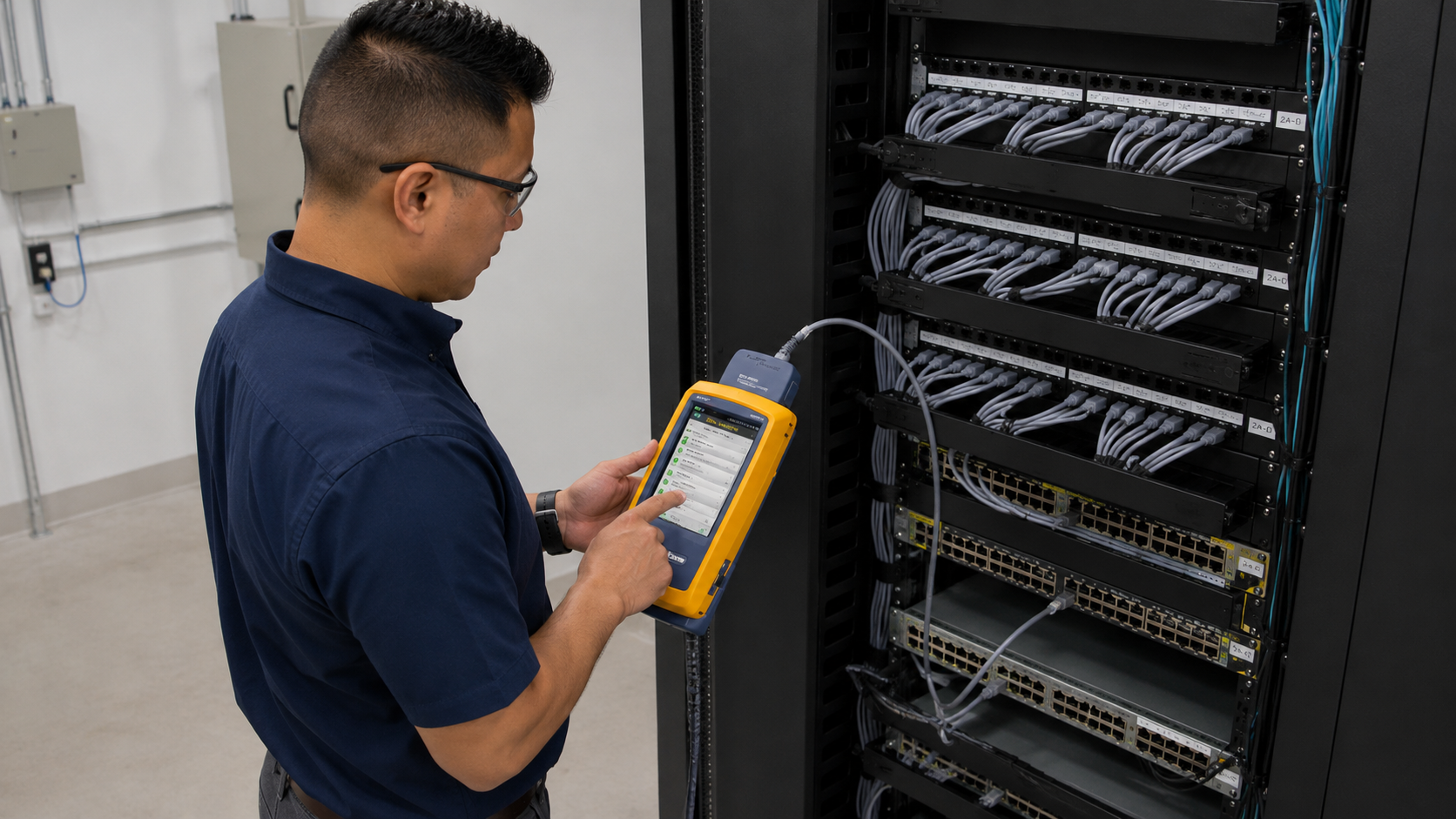
Fiber certification is where most low-voltage projects hide their weak spots. Copper has a clear PASS/FAIL against a single limit; fiber has two testing tiers, several optical budgets, and connector geometry that either was inspected under a microscope or was not. Buyers who accept 'we tested it with a light meter' get exactly what that promises.
- Tier 1 (OLTS) is required. Tier 2 (OTDR) is required for anything over 100 m or with splices.
- Every connector must be inspected under a fiber microscope before use.
- Loss budget is calculated per link; a PASS report proves the link meets its budget.
- Reference-cord method (1-jumper or 3-jumper) affects the measured loss.
Executive summary
A proper fiber certification deliverable includes an OLTS report per link at both wavelengths (850/1300 for multimode, 1310/1550 for single-mode), an OTDR trace per link for Tier 2, and endface inspection photos for every connector. The .flw and .otdr files are the artifacts; PDFs are the summary.
Why fiber failures are expensive
A fiber link that passes a light-meter but fails an OTDR trace often has a bad connector, a bend fault, or a splice that will degrade in the first year. Diagnosis after handover requires the same tools that should have been used at commissioning. Skipping certification is a bill you defer, not eliminate.
Tier 1 vs Tier 2
| Aspect | Tier 1 (OLTS) | Tier 2 (OTDR) |
|---|---|---|
| Measures | End-to-end loss + length | Loss vs. distance trace |
| Detects | Total link loss | Specific event losses (splices, connectors, bends) |
| When required | All installs | > 100 m, spliced, campus, OSP |
| Wavelengths | 850/1300 nm MM, 1310/1550 nm SM | Same, plus 1625 nm for OSP |
| Deliverable | .flw or .txt file per link | .sor or .otdr trace file per link |
Common mistakes
- Skipping endface inspection — a dirty connector on a launch cord contaminates every subsequent test.
- Missing reference-cord method in the report — 1-jumper vs 3-jumper changes measured loss by ~0.75 dB.
- Setting the wrong fiber index of refraction in the OTDR.
- One test per link direction where bidirectional is required (spliced fiber).
Best practices
- Endface inspection with a Fluke FI-3000 or equivalent, photo per connector.
- OLTS Tier 1 at both wavelengths.
- OTDR Tier 2 for any spliced link or link > 100 m.
- Bidirectional OTDR for spliced fiber.
- Native files delivered (.flw, .sor) plus PDF summary.
Sample loss budget
For an OM4 link, 100 m, 2 connectors and 0 splices: max loss ≈ 3.0 dB at 850 nm (per the reference method used). A well-installed link commonly measures 1.2–2.0 dB, giving generous margin against the limit and headroom for future connector wear.
When to call a professional
Any project with more than 12 fiber strands, any splice, and any building-to-building link should be certified by a fiber-certified technician with a calibrated OLTS and OTDR. Vendor-neutral certification protects the buyer against a manufacturer disputing a warranty claim later.