
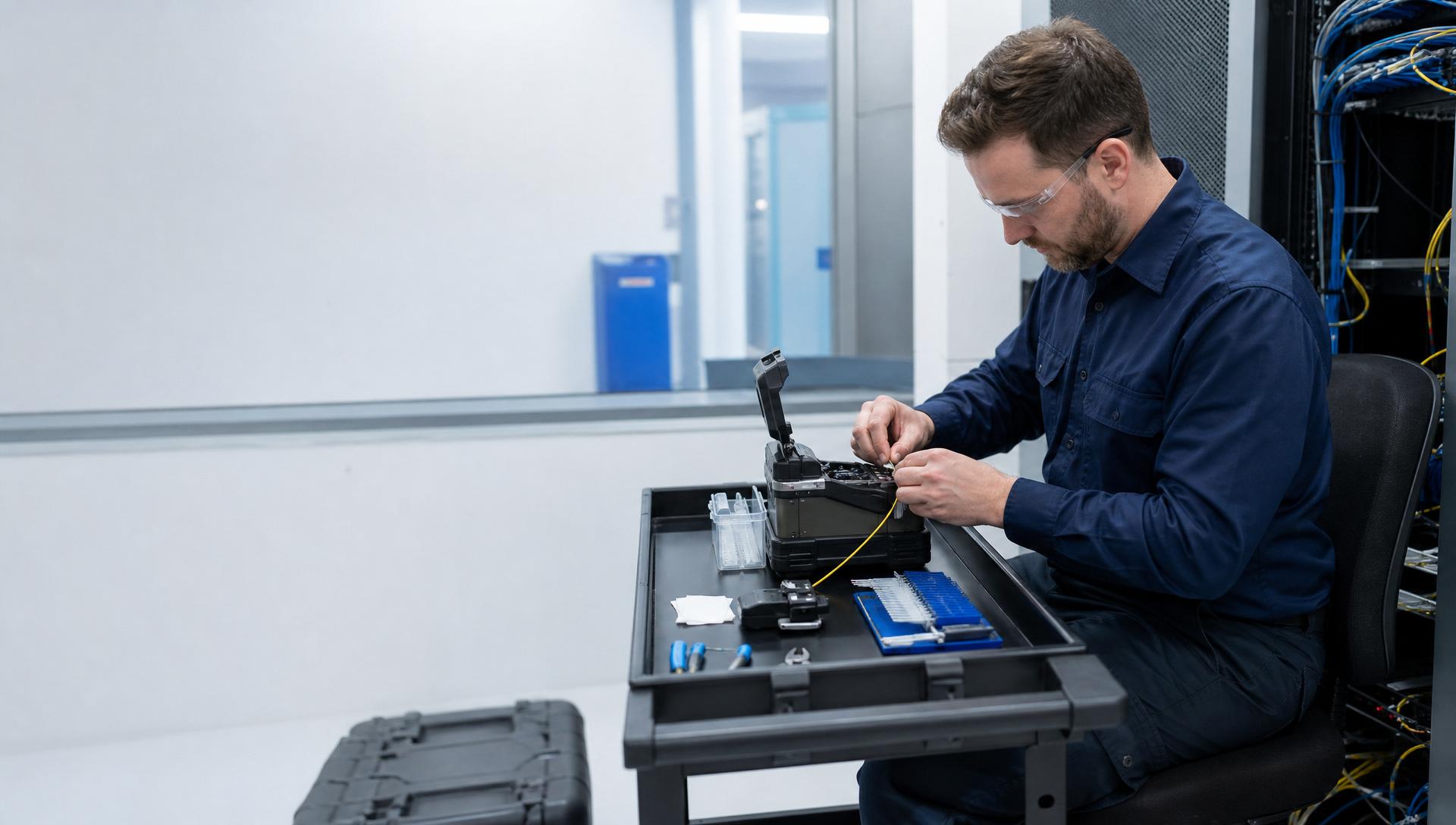
Fiber troubleshooting is a discipline: inspect, measure, compare to baseline, and repair. Without a baseline OTDR trace from commissioning, diagnosis becomes guesswork. With one, the fault usually reveals itself in the first pass.
- Always inspect the endface first; dirt is the most common fiber fault.
- OTDR trace comparison to baseline is the fastest diagnostic technique.
- Bidirectional testing is required for spliced fiber.
- Never bypass a bad connector with a jumper; fix the connector.
Executive summary
Effective fiber troubleshooting starts with visual inspection under a fiber microscope, moves to OLTS for total loss, then to OTDR for event location, and closes with a re-cleaned and re-tested link. Comparing new traces to the commissioning baseline shortens diagnosis time by 5–10×.
Common fault patterns
Contamination on the endface accounts for a majority of fiber trouble tickets. Bends and macrobends account for most of the rest. Actual glass failures — broken fibers, splice degradation, connector destruction — are less common than either of the above and usually easy to isolate once inspection is complete.
Diagnostic sequence
- Inspect both endfaces under a fiber microscope.
- Clean and re-inspect if either endface is contaminated.
- Measure end-to-end loss with an OLTS at operational wavelengths.
- If loss exceeds the calculated budget, run an OTDR trace from each end.
- Compare to the commissioning trace if available.
- Isolate and repair the identified event.
Common mistakes
- Cleaning the far end with the same cassette used on a dirty near end.
- Reading an OTDR from one direction only on a spliced link.
- Assuming the fault is the connector because it is easier than checking the splice.
- Bypassing a bad connector with a jumper — fault will follow the light path.
Best practices
- Keep a certified inspection scope, launch cords, and clean cassettes in the field kit.
- Archive commissioning .sor files with the closeout package.
- Document every repair with before/after traces.
- Replace bulk cleaning wipes on a schedule; solvent evaporates.
When to call a professional
Any live-network fiber fault should be handled by a certified fiber technician with an OTDR and inspection kit. Splicing without training routinely makes a bad link worse.