Access Cabling commercial structured cabling infrastructure
Commercial · Fiber

Single Mode Fiber Services

Long-haul OS2 single-mode fiber for campuses and carriers.

28+ Years Experience
C-10 / C-7 Contractor
CSLB: 992009
Licensed Commercial Contractor
5 California Offices
California & Nationwide Service

Request a Single Mode Fiber site survey

Free, no-obligation walkthrough. Licensed C-10 / C-7 (CSLB #992009). 28+ years, California & nationwide.

Request a site survey
Commercial Service Overview

Enterprise-grade single mode fiber engineered for commercial buildings.

Single Mode Fiber from Access Cabling delivers enterprise-grade single mode fiber engineered by a licensed low-voltage contractor with 28+ years serving California and nationwide clients. Our BICSI-trained technicians design, install, terminate, test and certify every run to TIA/EIA standards so your infrastructure supports current bandwidth demands and future growth.

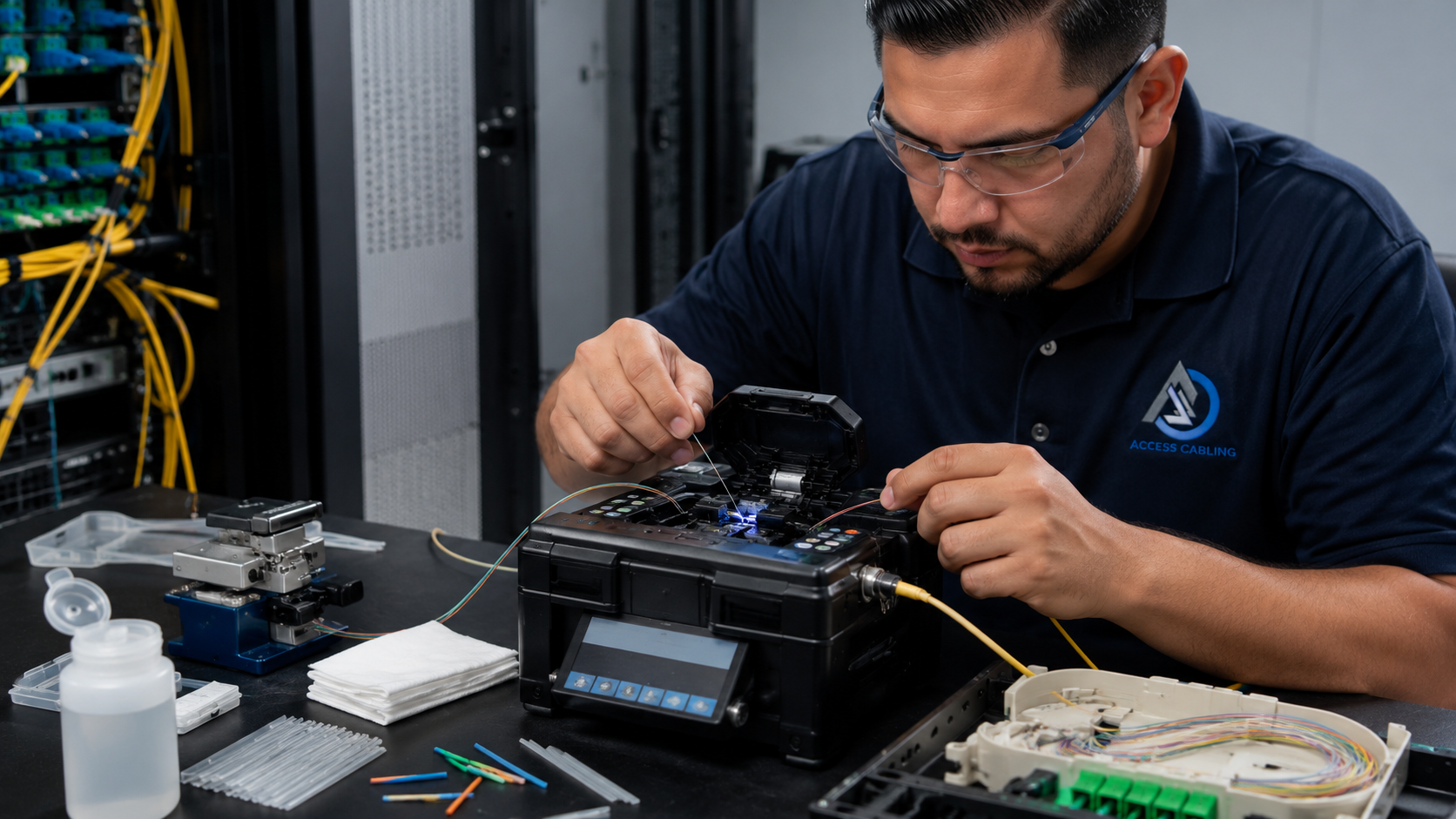
Yellow single-mode fiber pigtails coiled beside a bench fusion splicer during termination.
Key Benefits

Why single mode fiber from Access Cabling

Commercial-grade installation, certified performance, and infrastructure built to last 25+ years.

Certified installation by BICSI-trained technicians
Manufacturer warranties up to 25 years on structured cabling
Fluke DSX certification reports on every project
Licensed C-10 / C-7 low-voltage contractor
24/7 emergency response and MAC services
Nationwide coverage with California headquarters
Installation Process

Our proven commercial cabling process

A repeatable, engineered process — refined over 28 years and thousands of sites.

  1. Step 1

    Free on-site survey and needs assessment

  2. Step 2

    Engineered design with rack elevations and pathway plans

  3. Step 3

    Scheduled installation with minimal business disruption

  4. Step 4

    Termination, testing, labeling and documentation

  5. Step 5

    Fluke certification and as-built drawings delivered

Technical Standards & Testing

TIA-compliant. Fluke-certified. Fully documented.

Every single mode fiber installation follows TIA-568, TIA-606 labeling, NEC 800 and applicable manufacturer specifications. Fluke DSX Versiv certification and full as-built documentation are delivered at project close.

  • TIA-568 structured cabling standards
  • TIA-606 labeling and administration
  • TIA-942 data center infrastructure
  • Fluke DSX-8000 channel and link certification
  • Manufacturer certified installer for Panduit, CommScope, Leviton
Access Cabling commercial structured cabling infrastructure
Industries Served

Single Mode Fiber for every commercial environment

28+
Years
5
CA Offices
50
States
12M+
Feet Installed
Local Service Area

Single Mode Fiber across California & nationwide

Local crews dispatched daily from five California offices. Multi-site rollouts across all 50 states.

In Depth

A closer look at single mode fiber

Single-mode fiber installation and certification across California — OS2 9µm backbones for inside-plant, campus, and outside-plant applications. Access Cabling specifies, pulls, fusion-splices, and OTDR-certifies single-mode fiber for 10G through 400G links and every future speed roadmap. Licensed C-10/C-7 (CSLB #992009), BICSI-trained crews, Fujikura core-alignment splicers.

Why single-mode is the default for new backbones

OS2 single-mode carries 10G to 100km, 40G to 40km, 100G to 40km, and 400G to 10km on today's optics — and every new optical standard the IEEE has published maps to single-mode reach. Multimode's short reach and generation-limited optics mean any new backbone should default to single-mode unless a specific short-reach data-center case says otherwise. The fiber itself is now similar in cost to multimode; the historical cost premium was in the optics.

OS1 vs. OS2 (and why we only install OS2)

OS1 was the original loose-tube indoor-outdoor single-mode with higher water-peak attenuation at 1383 nm. OS2 is low-water-peak fiber that works efficiently across the full CWDM band — required for 40G BiDi, CWDM/DWDM multiplexing, and long-reach 100G. Every new backbone we install is OS2. If you have OS1 in the ground it still works for standard 10G, but plan OS2 for expansions.

Connectors: LC, SC, and MTP with APC or UPC polish

LC-duplex is the standard for switch and server connections. SC survives on legacy telco panels. MTP/MPO-12 or -24 is standard for high-density data-center and pre-term trunks. Polish: UPC (blue boot) for most enterprise applications; APC (green boot) for anything approaching video, RF-over-fiber, or long-reach single-mode where return loss must exceed 60 dB. APC and UPC are not compatible — mating them damages the connector.

Loss budget and testing

Loss budget = (fiber length × 0.35 dB/km at 1310 nm or 0.25 dB/km at 1550 nm) + (splices × 0.1 dB) + (connectors × 0.5 dB) + margin. Every OS2 strand is fusion-spliced to a pigtail (splice loss under 0.05 dB), OTDR-verified bidirectionally, and Tier 1 loss-tested at both 1310 and 1550 nm. Failed links are re-terminated at no charge.

Applications we install for

MDF-to-IDF backbones, campus building-to-building, data-center row-to-row, LAN uplinks 10/25/40/100G, storage fabrics, DWDM/CWDM metro links, fiber-to-the-desk in high-security environments, and RF-over-fiber for cellular DAS and CATV.

Related Topics
  • OS2 Single-Mode
  • APC vs UPC Connectors
  • 10G/40G/100G Optical Ethernet
  • DWDM/CWDM
  • OTDR Certification
  • Fusion Splicing
  • Long-Reach Fiber
  • MDF/IDF Backbones
Ready To Build?

Request a quote for your single mode fiber project

Share your scope — square footage, drop or device count, and timeline — and a senior estimator returns a written, itemized proposal within 48 hours. Free site survey, no obligation.

  • Licensed C-7 / C-10 (CSLB #992009)
  • Fluke-certified, 25-yr warranty
  • California & nationwide crews
  • Written proposal in 48 hours
Manufacturers

Products & manufacturers we install

Vendor-agnostic. We specify best-in-class components for each project — copper, fiber, racks, power, wireless and access control from the industry's leading manufacturers.

  • Panduit
    Copper & Fiber · Certified installer
  • CommScope
    Copper & Fiber
  • Belden
    Copper & Fiber · Belden Certified System Vendor
  • Corning
    Copper & Fiber · Fiber optic systems
  • Leviton
    Copper & Fiber
  • Siemon
    Copper & Fiber
  • Superior Essex
    Copper & Fiber
  • Chatsworth (CPI)
    Racks & Enclosures
  • Middle Atlantic
    Racks & Enclosures
  • APC by Schneider
    Power & UPS
  • Fluke Networks
    Test & Certification · DSX-8000 certification
  • Ubiquiti
    Wireless
  • PDK (ProdataKey)
    Access Control · Cloud access control

Brand references reflect products Access Cabling has installed on commercial projects. Trademarks are the property of their respective owners.

FAQ

Frequently asked questions

Is single-mode more expensive than multimode?+

The fiber cable itself is comparable in cost today; the historical premium was in the optics. For 10G and beyond, single-mode optics have come down enough that the total-installed-cost gap is small for anything longer than a few hundred meters — and single-mode buys 20+ years of speed roadmap.

Can I mix single-mode and multimode in the same backbone?+

Yes, and we frequently pull hybrid trunks — 12-24 strands OS2 plus 6-12 strands OM4. Panels are dedicated per fiber type since connectors and reference cables differ. Never mate SM and MM together — the core-diameter mismatch destroys signal.

APC or UPC — which do I need?+

UPC for standard enterprise Ethernet and short-reach 10G. APC for anything RF-over-fiber (DAS, CATV), video, long-reach single-mode, or where return loss must be better than 60 dB. Never mate APC to UPC — the geometry mismatch damages both connectors.

How far can single-mode reach at 10G? 100G?+

10GBASE-LR: 10km. 10GBASE-ER: 40km. 10GBASE-ZR: 80km. 100GBASE-LR4: 10km. 100GBASE-ER4: 40km. 400GBASE-LR4: 10km. Practical inside-plant and campus reaches are always well within these limits.

What's the difference between OS1 and OS2 fiber?+

OS2 is low-water-peak fiber that works across the full 1260-1625 nm CWDM band. OS1 has a water-peak attenuation spike at 1383 nm that limits CWDM applications. New installs are always OS2.

How long does an OS2 installation last?+

Physically, 40+ years properly installed and protected. Application-wise, every optical Ethernet standard from 10G to 400G runs on OS2 — the plant will outlast several generations of switch and optic upgrades.

Can you terminate single-mode in the field or only fusion-splice?+

For any single-mode termination we fusion-splice a factory pigtail — field-polished single-mode connectors are difficult to get consistently under 0.5 dB loss and are not standard practice on quality commercial jobs. Pigtail-splice is the professional method.

Do you install DWDM or CWDM multiplexers?+

We install the fiber plant to support DWDM/CWDM and can install and terminate customer-supplied passive mux/demux gear. Optic and channel-plan design is coordinated with your networking team or optical vendor.

How much does single mode fiber cost?+

Single Mode Fiber pricing depends on drop count, cable type, pathway complexity, and building conditions. Most commercial projects range from $150 to $350 per drop installed. Request a free site survey for an itemized quote.

Do you provide single mode fiber nationwide?+

Yes. Access Cabling is headquartered in California with a nationwide technician network for multi-site rollouts across all 50 states.

Is single mode fiber certified and warrantied?+

Every installation is Fluke-tested and certified. Structured cabling installs carry manufacturer warranties of up to 25 years through our Panduit, CommScope, Leviton and Belden partner relationships.


Related Services

Related commercial cabling services

Get Started

Build the commercial network your business actually deserves.

28 years, thousands of sites, one accountable contractor. Get a free site survey and an itemized quote in 48 hours.

Call Local Office(650) 212-1544