
Quick Answer
A low voltage system is any building system that runs on roughly 50 volts or less and exists to move information rather than to power the building. In commercial construction that covers network cabling, wireless access points, security cameras, access control, intercom and paging, sound masking, audio-visual, nurse call, and most building-automation wiring.
They're often lumped together as "low voltage" on a set of plans because they share the same pathways, the same telecom rooms, and — in California — the same C-7 license classification. What they don't share is line-voltage power, which is a separate scope with separate rules.
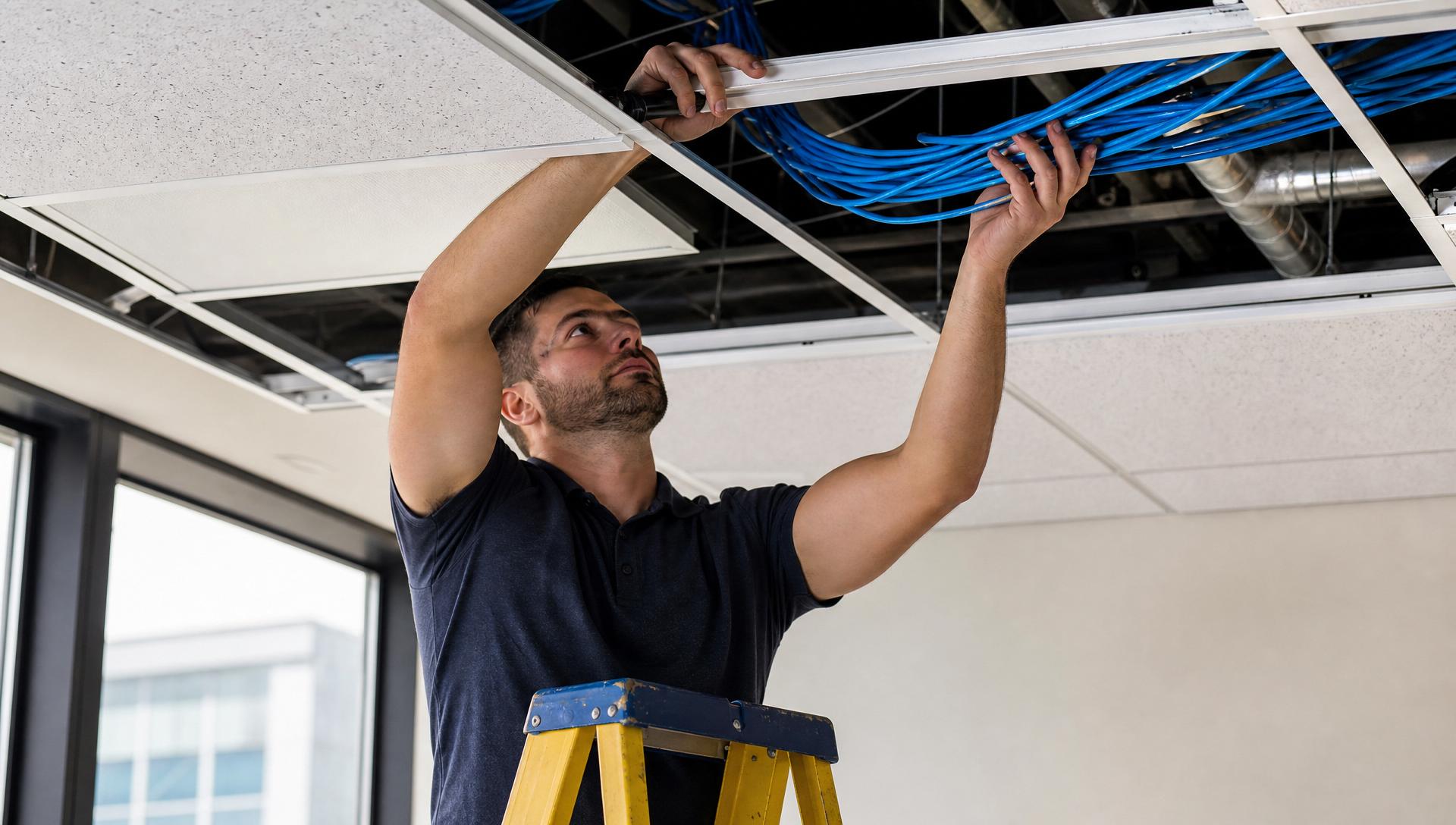
What Counts as a Low Voltage System
There's no single list every jurisdiction agrees on, but on a commercial project these are the scopes that almost always fall under low voltage:
- Structured cabling — Cat6, Cat6A, and backbone fiber
- Wireless access points and in-building wireless
- Security cameras and video surveillance
- Access control, card readers, and door hardware wiring
- Intercom, paging, and mass notification
- Sound masking and background audio
- Conference room AV, displays, and digital signage
- Video walls and LED displays
- Building automation, HVAC controls, and lighting controls
- Point-of-sale, time clocks, and industrial device connectivity
Fire alarm is the notable edge case: it's low voltage electrically, but it's a life-safety system with its own permits, inspections, and licensing path, so it's usually bid and inspected separately.

Low Voltage vs. Electrical Work
The simplest way to separate them: electrical work delivers power, low voltage work delivers information. A 120V circuit exists to run a light fixture or a receptacle. A Cat6A drop exists to get a camera or an access point onto the network — and, over Power over Ethernet, to give it just enough power to operate.
That distinction drives real differences on a jobsite. Low voltage cabling has its own pathways, its own separation requirements from power cabling, its own performance testing, and its own labeling and documentation standards. An electrician's pull is not automatically a compliant data cabling install, and a data cabling contractor is not licensed to land line voltage.
How a Low Voltage System Is Actually Built
Nearly every low voltage scope in a building rides on the same physical backbone. Service and core equipment land in a main distribution frame (MDF). Fiber runs from there to intermediate distribution frames (IDFs) on other floors or in other areas. From each IDF, horizontal copper runs out to the devices — desks, cameras, readers, access points, displays.
That's why the cabling design decides how well every other system performs. If IDF placement, pathway capacity, or drop counts are wrong, the camera system and the Wi-Fi and the AV all inherit the problem. Our guide to structured cabling walks through that backbone in more detail.
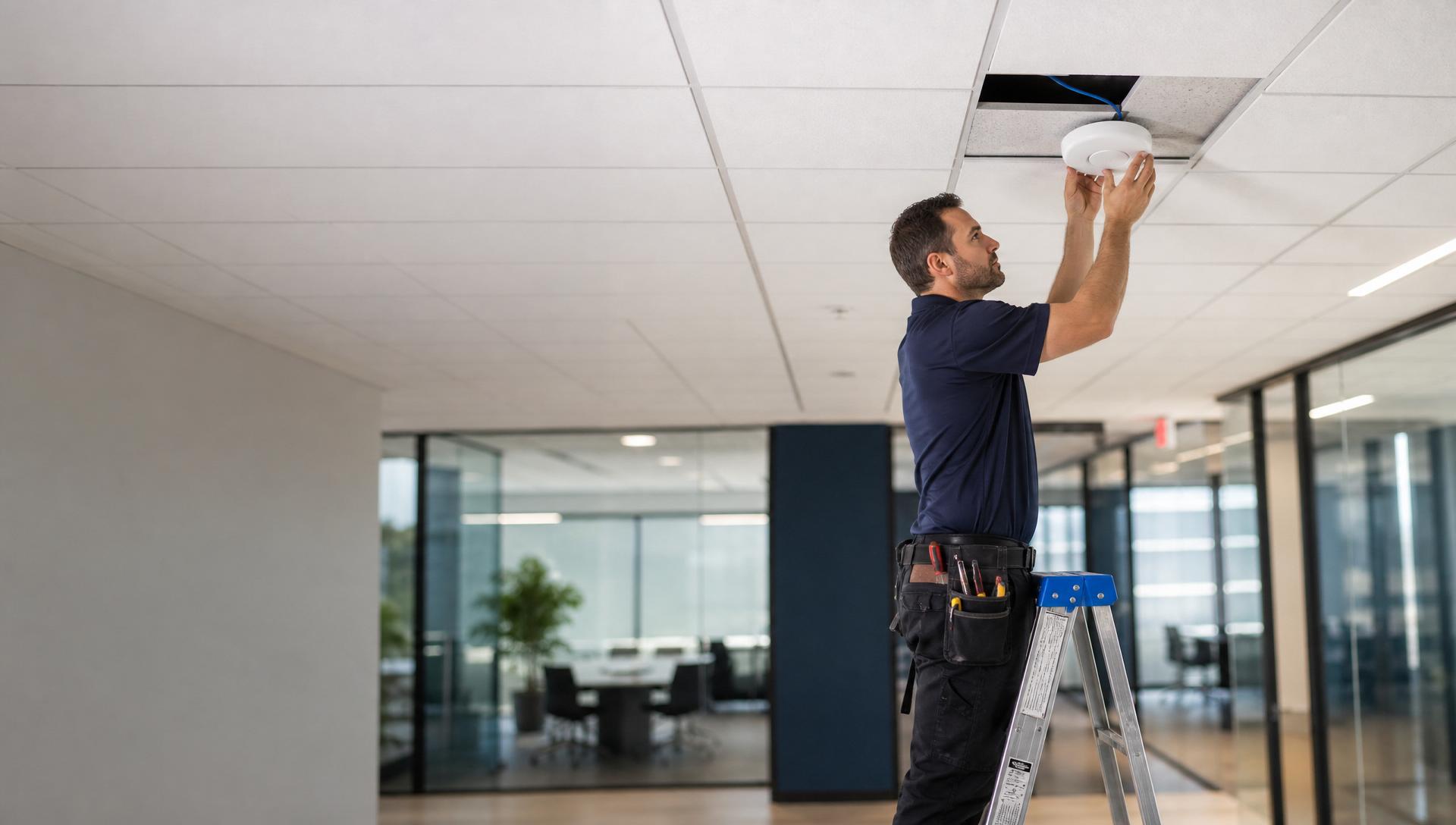
Power over Ethernet Changed the Rules
Power over Ethernet lets one cable carry both data and operating power, which is why a camera, reader, phone, or access point usually needs no electrician at the device end. Modern PoE standards deliver substantially more wattage than early versions did, and that has practical consequences: higher-wattage PoE generates heat inside a cable bundle, so cable selection, bundle size, and conduit fill all matter more than they did a decade ago.
It also concentrates risk in the telecom room. When dozens of devices draw power through a switch, switch capacity and UPS backup become part of the low voltage design conversation rather than an afterthought.
The Codes and Standards That Apply
Commercial low voltage work is not unregulated. The documents that come up on essentially every project:
- ANSI/TIA-568 — cabling performance, topology, and testing
- ANSI/TIA-569 — pathways and telecommunications spaces
- ANSI/TIA-606 — labeling, administration, and documentation
- NEC Articles 725 and 800 — cable types, plenum ratings, and separation
- Local fire and building amendments — firestopping, concealed-space rules, and inspection requirements that vary by jurisdiction
Local rules genuinely differ. San Jose, for example, has a specific fire department policy on cabling in concealed spaces — we documented it in our San Jose low-voltage requirements guide.
Licensing in California
California licenses commercial low voltage work under the C-7 Low Voltage Systems classification, and line-voltage electrical work under C-10 Electrical. Access Cabling holds both, which is why a single crew can handle cabling, devices, and the electrical work a project needs without splitting the scope across two contractors.
Common Mistakes We're Called In to Fix
- Non-plenum cable installed in an air-handling ceiling
- Cable laid directly on ceiling tile or supported from ductwork and sprinkler pipe
- Unsealed wall and floor penetrations with no firestopping
- Data cabling run parallel and tight to power conduit, inviting interference
- No labeling and no as-built documentation, so nobody can trace a drop later
- Drops installed but never certification-tested, so failures surface after move-in
- IDF placement that pushes horizontal runs past the 90-meter limit
Who Installs Low Voltage Systems
A licensed low voltage contractor designs the pathways and telecom rooms, installs and terminates the cabling, mounts and commissions the devices, certification-tests every drop, and hands over labeled as-builts. On larger projects they also coordinate with the general contractor, the electrician, and the IT team so the infrastructure is ready when equipment arrives.
Access Cabling has done this across California for 28+ years from five offices, licensed C-7 and C-10, with Fluke certification on every drop. If you're planning a build-out, a move, or a system replacement, a free site survey is the fastest way to get a real scope instead of a guess. You can also see where we work on our service areas page.
Frequently Asked Questions
- What counts as a low voltage system?
- In commercial buildings, low voltage generally means anything operating at roughly 50 volts or less — network cabling, Wi-Fi access points, security cameras, access control, intercom, paging, sound masking, AV, and most building-automation wiring. It's separate from the line-voltage electrical system that powers lights and outlets.
- Are low voltage systems safe?
- Low voltage carries far less shock risk than 120V or 277V line voltage, which is why it's handled by a different license class. It still has to be installed correctly: plenum-rated cable in air-handling spaces, proper firestopping at penetrations, and correct support and separation from power cabling are code requirements, not preferences.
- Do low voltage systems need a licensed contractor in California?
- Yes for commercial work. California licenses low voltage work under the C-7 (low voltage systems) and C-10 (electrical) classifications. Access Cabling holds both, and most commercial projects also require permits and inspection depending on the jurisdiction.
- What's the difference between low voltage and electrical work?
- Electrical work delivers line-voltage power to lights, outlets, and equipment. Low voltage work delivers data and signal — and, over Power over Ethernet, a small amount of power — to devices like phones, cameras, and access points. They run in the same building but under different standards, licenses, and pathways.
- Can low voltage cabling carry power to devices?
- Yes. Power over Ethernet lets a single cable carry both data and power to cameras, wireless access points, VoIP phones, displays, and some lighting. Higher-wattage PoE generates more heat, so cable type and bundle sizing matter more than they used to.
- What standards apply to low voltage systems?
- Commercial installs are typically governed by ANSI/TIA-568 for cabling performance and topology, TIA-569 for pathways and spaces, TIA-606 for labeling and documentation, plus the National Electrical Code (Article 725/800) and local amendments for fire and life-safety requirements.