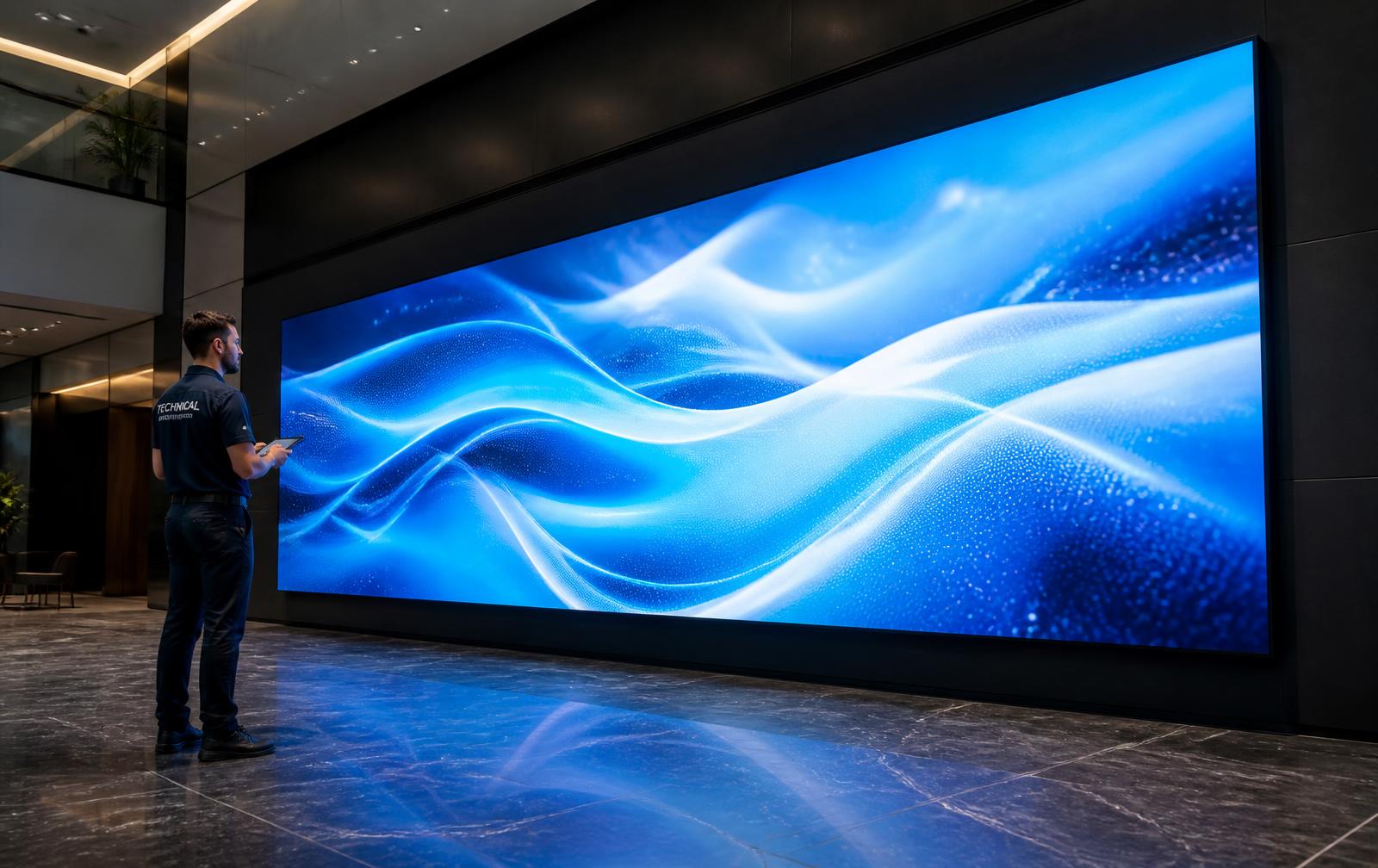
Commercial video wall installation across California and nationwide. Access Cabling designs, structurally mounts, powers, cables, calibrates and commissions direct view LED (DVLED) and LCD video walls for corporate lobbies, boardrooms, control rooms, retail, casinos, houses of worship, stadiums and large venues. We are an authorized SBC LED dealer (sbcledusa.com), so the panels, processors, spares and manufacturer warranty come from the same contractor that installs the structured cabling, power coordination and control system behind them. Licensed C-10/C-7, CSLB #992009, 28+ years.
Direct view LED vs. LCD video walls
A tiled LCD video wall (Samsung VHR, LG VSM, Planar) is the lower-cost option for control rooms and internal dashboards, but every tile carries a 0.44-1.8 mm bezel, so the image is always gridded. Direct view LED has no bezel at all — the wall is one continuous canvas at any size or aspect ratio, is brighter (600-1,500 nits indoors, 5,000-10,000 nits outdoors), holds calibration far longer, and is serviceable module-by-module from the front on most modern cabinets. For lobbies, boardrooms, broadcast backdrops, retail brand walls and anything a customer will look at, we specify DVLED. For 24/7 multi-source control rooms on a tight budget, LCD still competes.
Choosing pixel pitch and screen size
Pixel pitch is the distance in millimetres between LED centers, and it sets the minimum comfortable viewing distance — roughly one metre per millimetre of pitch. A 1.2 mm wall reads clean from about 4 ft, a 1.9 mm wall from 6 ft, a 2.5 mm wall from 8 ft, a 4 mm wall from 13 ft, and a 10 mm outdoor wall from 33 ft. We size the canvas backwards from the room: closest seat, furthest seat, content resolution (native 1080p or 4K mapping avoids scaling artifacts), and ceiling height. Undersizing pitch wastes budget; oversizing it makes text unreadable from the front row.
Structure, power and heat — the part most bids miss
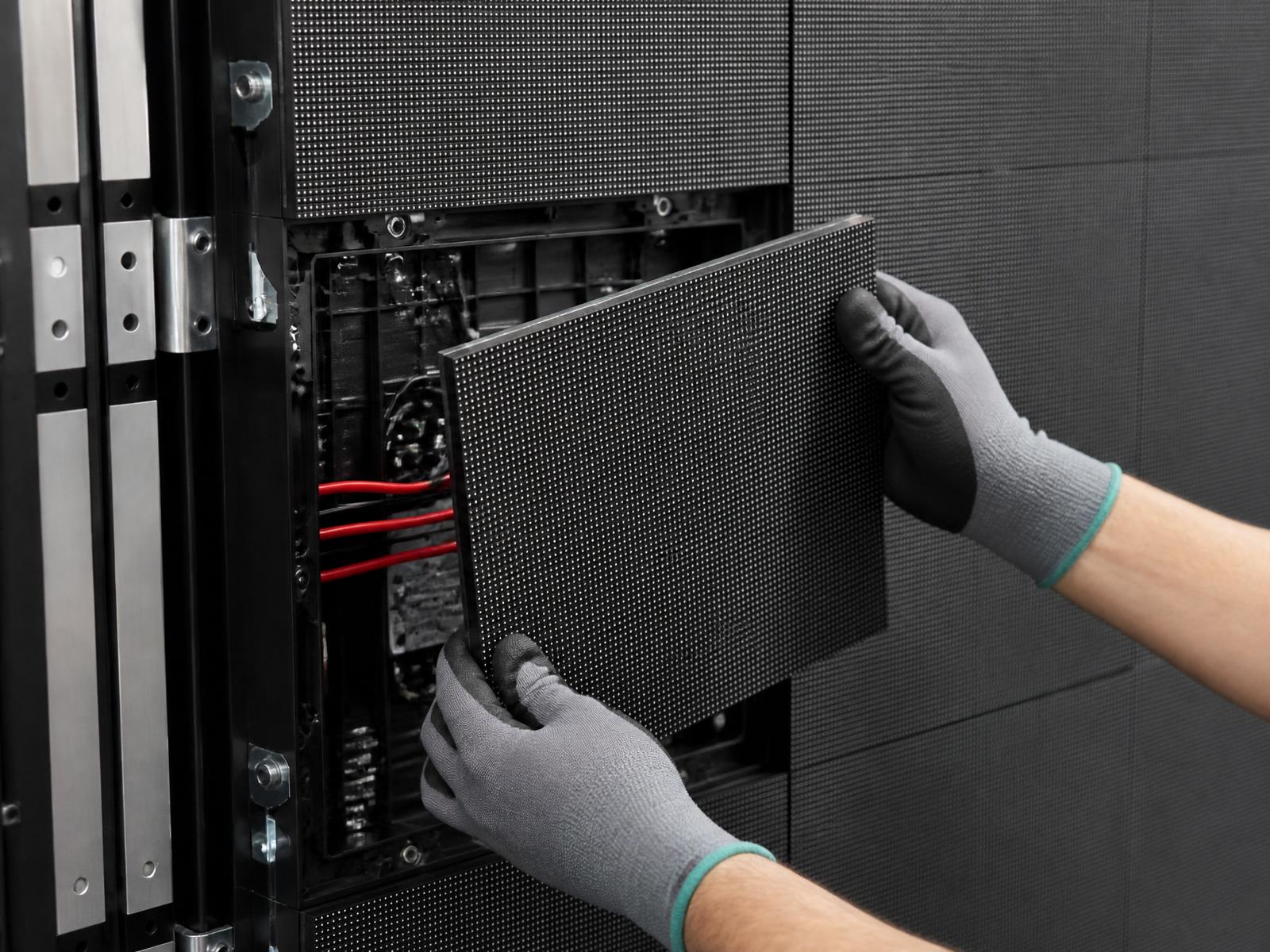
A DVLED wall is a structural, electrical and thermal load, not just a screen. We verify wall construction and add unistrut or a welded steel subframe where studs cannot carry the cabinet weight, laser-level the frame to sub-millimetre flatness (a 0.3 mm step between cabinets is visible on a fine-pitch wall), and coordinate dedicated 20A circuits sized to peak draw rather than typical draw. Receiving cards, power supplies and hot-swap module clearance are planned so the wall can be serviced without demolition. On recessed or millwork-integrated walls we specify rear ventilation or forced air so cabinets stay inside their thermal spec.
Signal, processing and control
Every wall runs through a video processor — Novastar VX/MX, Brompton, or the manufacturer's scaler — which maps sources onto the LED canvas, handles genlock, low-latency scaling, HDR and redundancy. Behind it sits the source layer: a media player (BrightSign, Xogo, ScreenCloud), a room codec for Teams/Zoom, a matrix or AV-over-IP fabric (Crestron NVX, SDVoE, Dante AV) and a control processor with a touch panel or wall keypad. We home-run shielded Cat6A to each receiving card, provision redundant sender ports on mission-critical walls, and put the head-end in a ventilated rack with a UPS.
Cabling and infrastructure — where we are different
Most AV integrators subcontract the low-voltage infrastructure. We are the low-voltage contractor: the Cat6A, fiber backbone, conduit, floor boxes, firestopping, rack build, labeling to TIA-606-B and Fluke DSX certification are all in-house on the same crew that hangs the wall. That removes the classic finger-pointing between the cabling trade and the AV trade at commissioning, and it means the video wall lands on infrastructure that is documented and tested rather than assumed.
Calibration, commissioning and handover
At commissioning we run module-level brightness and color calibration across the whole canvas, correct seams and low-grayscale uniformity, set target nits and color temperature for the room's lighting, verify frame rate and latency end-to-end, program every control preset and source, and burn in the wall before sign-off. Handover includes as-built drawings, cabinet and receiving-card maps, IP address plan, calibration files, spare-module inventory, warranty registration and on-site training for facilities and IT.
Service, spares and multi-site programs
LED walls need an owner. We stock spare modules and power supplies per install, offer preventative-maintenance visits that re-verify calibration and clean intake paths, and provide 4-hour and next-business-day response options. For retail, franchise and corporate multi-site programs we build one reference design — cabinet layout, processor config, content template, acceptance sheet — pilot a site, then roll the identical build out nationwide under one project manager.