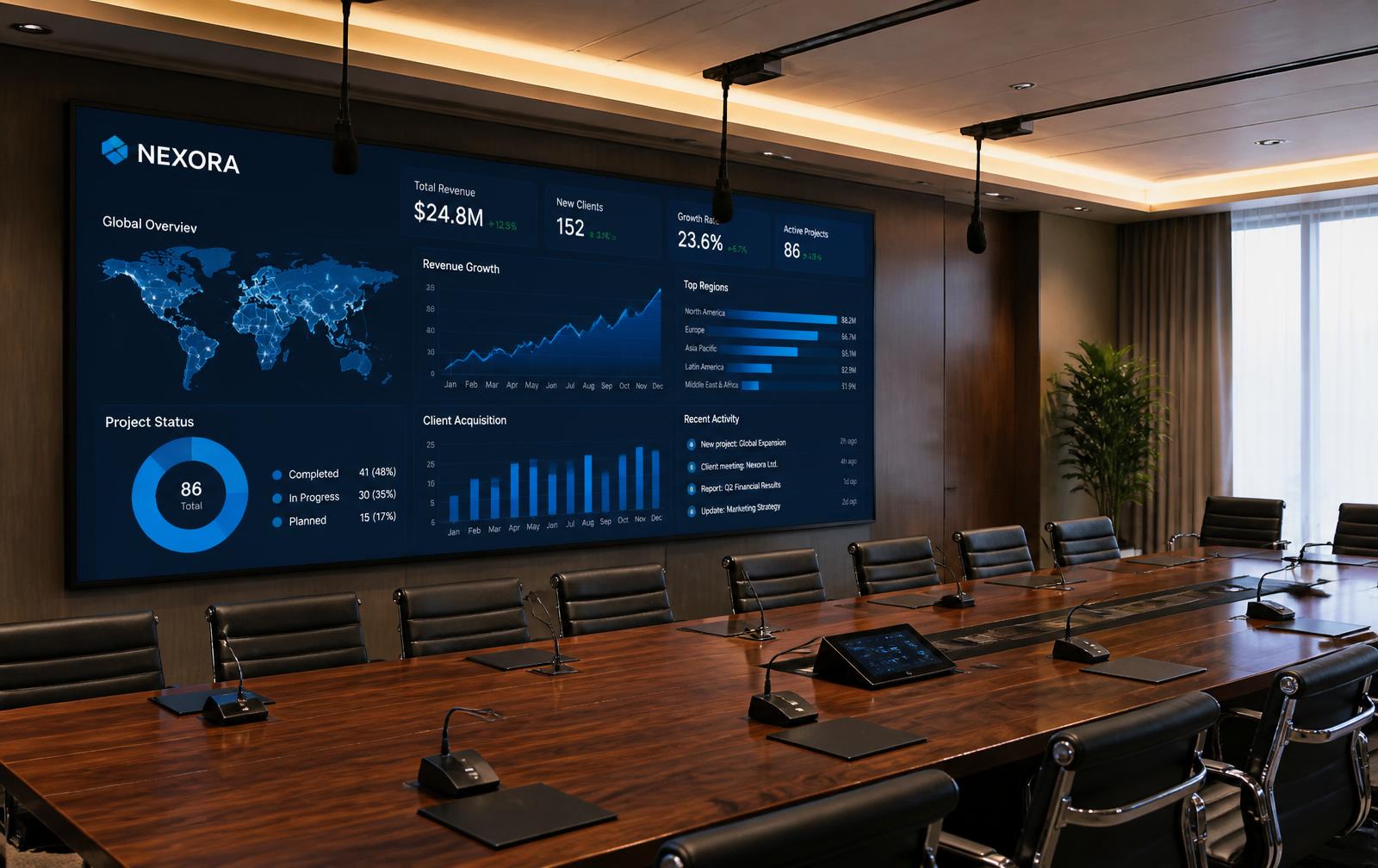
Direct view LED (DVLED) video walls designed and installed by Access Cabling — a licensed low-voltage contractor and authorized SBC LED dealer (sbcledusa.com) delivering seamless, bezel-free LED canvases for lobbies, boardrooms, casinos, houses of worship, education, retail and large venues across California and nationwide. Fine-pitch cabinets from 0.9 mm to 4 mm, front-serviceable modules, Novastar or Brompton processing, calibrated and commissioned with full as-built documentation.
What direct view LED actually is
In a DVLED display, the LEDs themselves are the pixels — there is no LCD panel, no backlight and no bezel. Individual surface-mount or chip-on-board packages are populated onto modules, modules snap into cabinets, and cabinets tile into any size or shape you want. The result is one continuous image with no grid lines, viewable off-axis at nearly 160 degrees, at brightness levels an LCD cannot reach, with a service life typically rated at 100,000 hours to half brightness.
Pixel pitch, resolution and content mapping
Pitch determines both clarity and price. Common indoor pitches are 0.9, 1.2, 1.5, 1.9, 2.5 and 3.9 mm. Rather than picking a pitch first, we work from the content: a wall that must display native 1920x1080 at 1.5 mm pitch is about 9.4 ft wide; the same 1080p canvas at 2.5 mm is about 15.7 ft wide. Mapping content to native resolution avoids scaling softness on text and logos. When a client wants a non-16:9 canvas — a long lobby ribbon, a curved reception wall — the processor handles the custom mapping and we design the source templates to match.
COB, GOB and IMD: which package to specify
Traditional SMD packages are cost-effective but vulnerable to knocks in high-traffic areas. GOB (glue-on-board) fills the module face with resin for impact and moisture resistance — the right pick for schools, gyms, retail floors and anywhere people can touch the wall. COB (chip-on-board) encapsulates the dies directly, delivering the highest contrast, best thermal behaviour and the most durable surface, and is now standard for sub-1.5 mm boardroom and broadcast walls. IMD sits between them on cost. We specify per environment rather than defaulting to the cheapest module.
Cabinet systems, flatness and serviceability
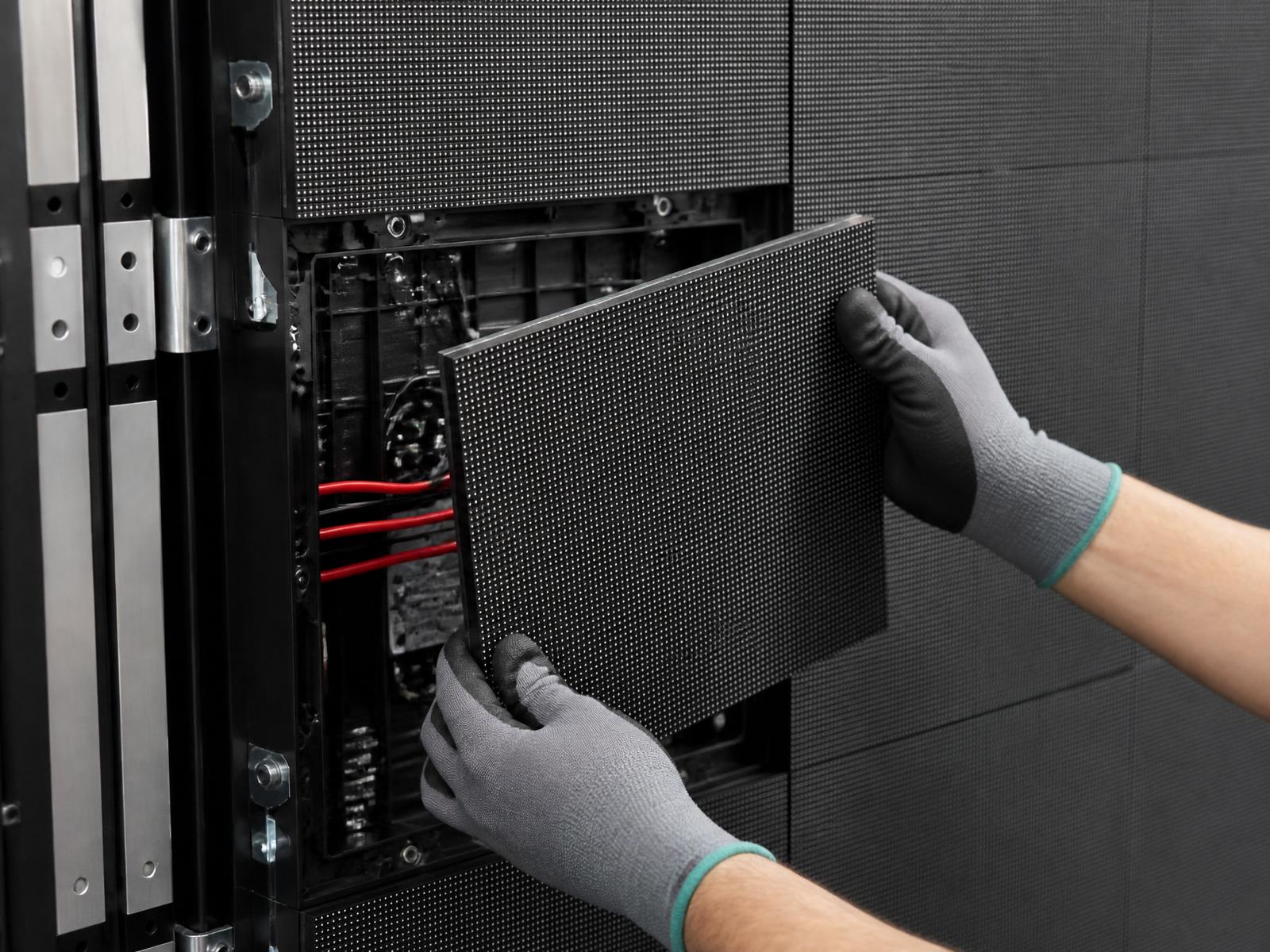
Cabinet quality is what separates a wall that still looks right in year five from one that shows seams in month three. We specify die-cast aluminium cabinets with adjustable corner locks, magnetic front-service modules, and hot-swappable receiving cards and power supplies. Installation uses a laser-levelled mounting frame with fine adjustment at every cabinet so the finished surface is flat within a fraction of a millimetre — a step or twist at a cabinet joint is the single most visible defect on a fine-pitch wall.
Processing, redundancy and HDR
A Novastar VX or MX-series, Brompton Tessera or equivalent processor handles input scaling, color management, frame-rate genlock, low-latency pass-through for live camera feeds, and HDR tone mapping. Mission-critical walls (broadcast, control rooms, casino floors, worship IMAG) get dual sender cards with hot backup and looped receiving-card cabling, so one failed cable or card does not black out a section. Every port map is documented in the as-builts.
Where DVLED wins over projection and LCD
Against projection: DVLED needs no darkened room, no lamp or laser replacement cycle, no throw distance, no keystone or shadow issues from people walking past. Against LCD: no bezels, higher brightness, better off-axis color, module-level serviceability instead of tile replacement, and a lifespan that fits a 7-10 year facility plan. The trade-off is capital cost, which is why we quote the pitch and package that actually match the room instead of the largest wall that fits.
Integrated infrastructure from one contractor
Because Access Cabling is the structured cabling contractor, the DVLED wall arrives on infrastructure we designed: shielded Cat6A to each receiving card, fiber backbone where distances exceed copper limits, a ventilated head-end rack with UPS, dedicated circuits, conduit and firestopping, TIA-606-B labeling, and Fluke DSX certification on every link. That integration is also why our walls tie cleanly into conference-room AV, sound masking, paging and access control already on your network.