Developing a robust, high-performance office cabling infrastructure is foundational for any modern enterprise, directly impacting productivity, communication, and operational efficiency. Access Cabling specializes in designing, installing, and certifying comprehensive office cabling solutions tailored for dynamic open workspaces, collaborative zones, and secure private offices. We understand that effective office environments demand more than just connectivity; they require scalable, resilient, and meticulously documented cabling systems that support current and future technological demands. As a C-10/C-7 low-voltage contractor with 28+ years of expertise and CSLB 992009, we leverage TIA/EIA standards, BICSI best practices, and manufacturer-specific guidelines from industry leaders like Panduit, CommScope, and Corning to deliver a future-proof physical layer. Our approach prioritizes minimal disruption, optimal cable management, and verifiable performance, ensuring your office infrastructure is a strategic asset, not a bottleneck.
Structured Cabling Framework for Modern Offices
Office cabling, at its core, refers to the installation of structured cabling systems within commercial office environments to support data, voice, video, and building automation needs. This encompasses the telecommunications and equipment rooms, backbone cabling, horizontal cabling, and work area outlets, all governed by industry standards like TIA-568. The specific application of TIA-568.C Series (e.g., TIA-568.C.2 for balanced twisted-pair cabling or TIA-568.C.3 for optical fiber cabling) dictating performance requirements, cable types, connector interfaces, and installation practices. For instance, in an open office layout utilizing modular furniture or movable partitions, we implement zone cabling architectures per TIA-568.C.0 and TIA-TISS-PNP. This involves placing consolidation points (CPs) or multi-user telecommunications outlet assemblies (MUTOA) at strategic locations, allowing for flexible reallocation of network drops as workspace configurations change, minimizing the need for re-pulling new horizontal runs and reducing churn costs. Backbone cabling typically consists of armored or unarmored fiber optic cables (e.g., OM3/OM4 multimode or OS2 singlemode) for high-bandwidth uplinks between telecommunications rooms and the main equipment room, complemented by larger-gauge copper bundles for voice or specific legacy systems where fiber is not feasible. The choice of Category 6A or higher-grade copper cabling for horizontal runs is determined by current and projected bandwidth requirements, particularly for supporting higher-power PoE applications (e.g., PoE++ for LED lighting or video conferencing units) that demand superior heat dissipation and reduced signal degradation over distance.
Tailored Design and Engineering for Office Layouts
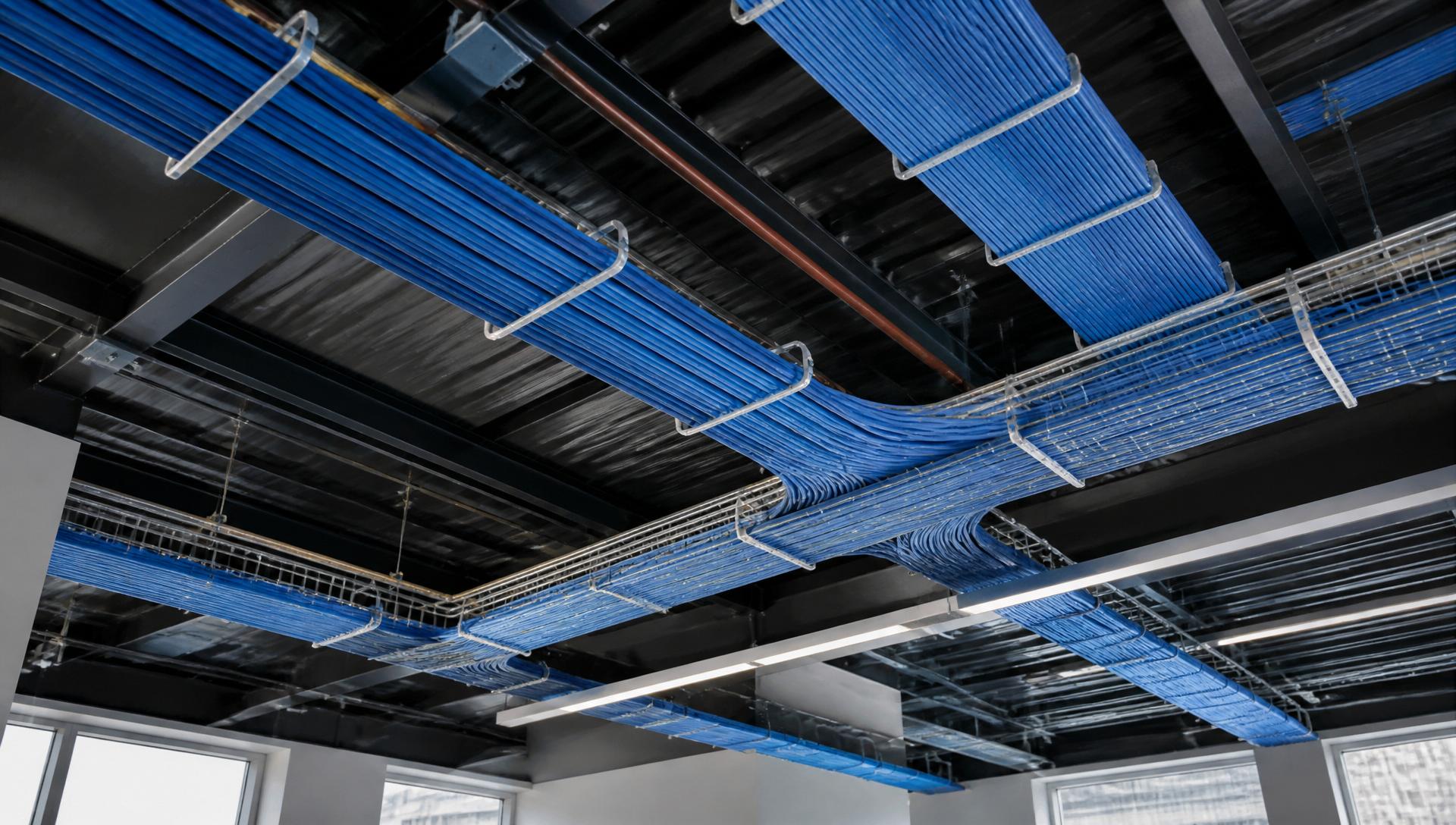
Effective office cabling starts with meticulous design and engineering, considering the unique architectural and operational requirements of each space. This includes a thorough site survey to understand pathways, fire ratings, power availability, and electromagnetic interference (EMI) sources. Our design process factors in the office's current spatial utilization, anticipated growth, and technology roadmap, mapping out work area outlet (WAO) density, telecommunications room (TR) placement, and cable routing paths to meet TIA-569 (Telecommunications Pathways and Spaces) guidelines. For open-plan offices, we often implement underfloor raceway systems (e.g., access floor, cellular floor) or overhead basket tray solutions to manage the high density of horizontal runs while maintaining accessibility and aesthetics. We consider power-over-Ethernet (PoE) demands for devices like VoIP phones, Wi-Fi 6/6E access points, IP cameras, and smart lighting, often specifying Cat 6A shielded or unshielded twisted pair (UTP) cabling, such as Belden 10GX or CommScope SYSTIMAX GigaSPEED X10D, to mitigate alien crosstalk and support 10 Gigabit Ethernet (10GBASE-T) with sufficient headroom for future PoE standards like IEEE 802.3bt (Type 3 and Type 4). Our engineering drawings detail equipment room layouts, including rack elevations, cable tray routes, labeling schemes compliant with TIA-606-C, and grounding and bonding plans conforming to TIA-607-C, ensuring a structured, manageable, and standards-compliant infrastructure that can be easily maintained and scaled.
Premium Components and Infrastructure Hardware
The longevity and performance of an office cabling system are directly tied to the quality of its components. Access Cabling exclusively utilizes enterprise-grade cabling and connectivity hardware from leading manufacturers. For copper infrastructure, this includes Category 6A UTP or shielded twisted pair (F/UTP or U/FTP) cabling from Panduit (e.g., Pan-Net TX6A™), CommScope (e.g., SYSTIMAX GigaSPEED X10D®), or Leviton (e.g., Atlas-X1™). These cables are selected for their superior NEXT/FEXT performance, return loss, and ability to support 10GBASE-T over 100 meters, essential for modern office applications. Connectivity hardware – patch panels, keystone jacks, and patch cords – are matched to the cable type and manufacturer to maintain channel performance and often come from the same vendor to simplify warranty claims and ensure system compatibility. For optical fiber backbones and fiber-to-the-desk (FTTD) applications, we deploy Corning SMF-28® Ultra optical fiber or OM3/OM4 multimode fiber, terminating with LC or MPO connectors. We specify robust cable management solutions such as Panduit Wyr-Grid® overhead cable tray systems or Legrand Cablofil® basket tray for horizontal distribution, and vertical cable managers within racks to maintain proper bend radius and reduce stress on cables, prolonging their lifespan and ensuring optimal performance. Grounding and bonding components, paramount for safety and EMI mitigation, adhere to NEC Article 250 and TIA-607-C standards, utilizing proper gauge wire and approved connection hardware.
Precise Installation and Cable Management Best Practices
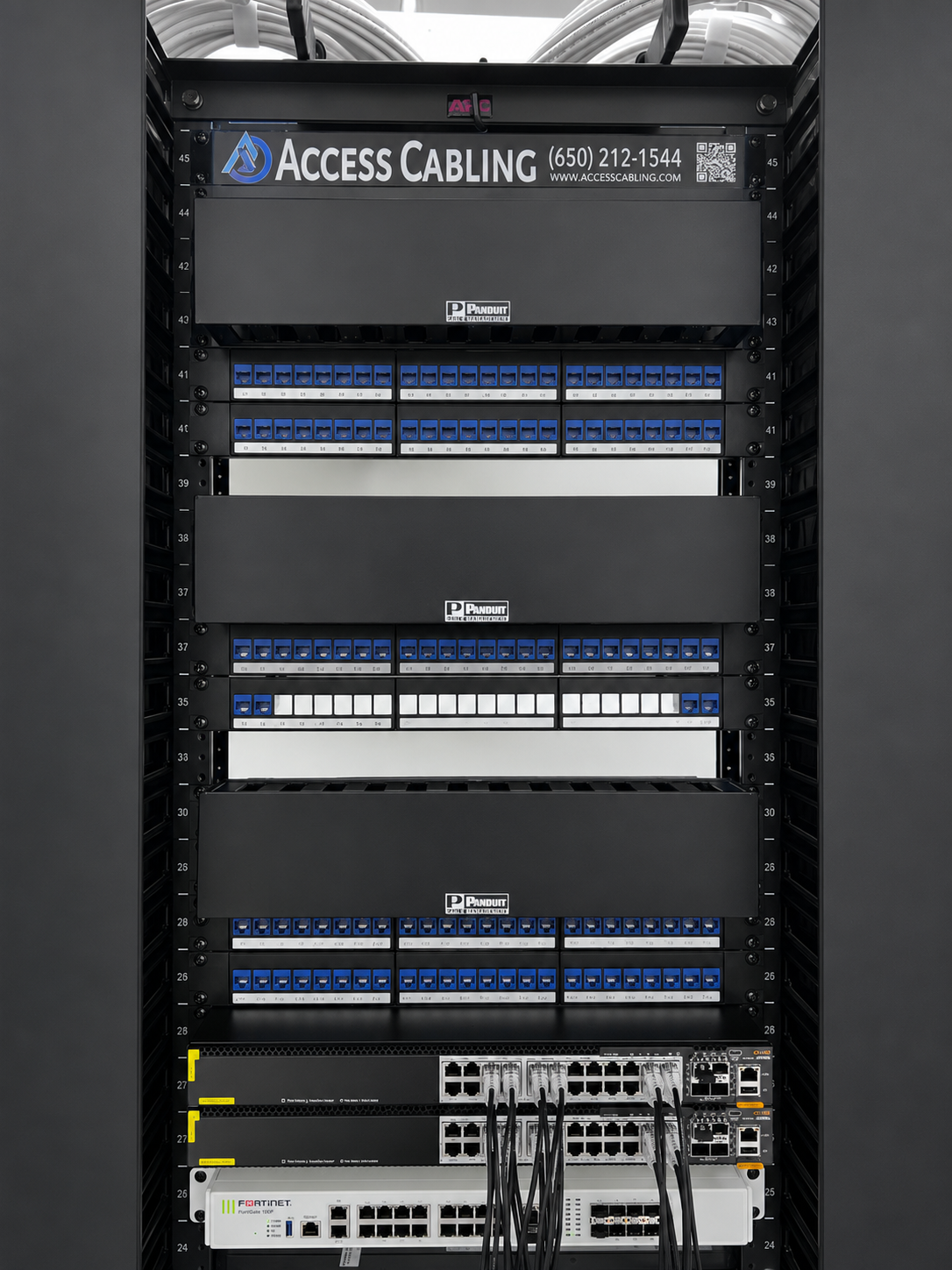
Our installation methodology for office cabling is rooted in precision, adherence to TIA/EIA standards, and minimal disruption to ongoing operations. Technicians are BICSI-trained and certified, employing best practices for cable pulling, termination, and dressing. We utilize specialized tools such as adjustable cable sheaves, cable gliders, and maximum pulling tension monitors to prevent micro-bends and over-tensioning of copper and fiber cables, which can degrade performance. Cable pathways, whether overhead trays, conduit, or underfloor systems, are meticulously planned and installed to ensure proper fill ratios (as per NEC guidelines) and separation from power cables to avoid EMI. For open office environments with frequent reconfigurations, we implement zone wiring strategies utilizing CP (Consolidation Point) enclosures or MUTOA (Multi-User Telecommunications Outlet Assembly) boxes providing flexibility at the furniture level without disturbing horizontal runs from the TR. All terminations, whether 110-style, keystone, or fiber optic (fusion splicing or mechanical), are performed with calibrated tools and inspected for proper seating, neatness, and strain relief. Cable management within racks and cabinets is paramount, utilizing vertical and horizontal managers to maintain clear pathways, proper bend radius, and ease of access for future MACs (Moves, Adds, Changes). This meticulous approach ensures not only optimal current performance but also simplified future maintenance and scalability.
Rigorous Testing and Performance Certification
Every office cabling installation by Access Cabling undergoes comprehensive testing and certification to guarantee standards compliance and performance. For copper horizontal cabling, we perform Level 2G or Level 3E (depending on project specifications) field testing with Fluke Networks DSX-8000 Versiv Cable Analyzers, certifying each permanent link or channel to TIA-568-C.2 or ISO/IEC 11801 Class EA/FA specifications, depending on the cable category (e.g., Cat 6A). Key parameters tested include Wire Map, Length, Insertion Loss, Return Loss, Near-End Crosstalk (NEXT), Far-End Crosstalk (FEXT), Power Sum Near-End Crosstalk (PSNEXT), Alien Crosstalk (for Cat 6A), Propagation Delay, and Delay Skew. Optical fiber backbone and horizontal runs are tested for insertion loss (attenuation) using an Optical Loss Test Set (OLTS, compliant with TIA-526-14A for multimode or TIA-526-7 for singlemode) and often with an Optical Time Domain Reflectometer (OTDR) to identify splice loss, connector loss, and cable length, and characterize any anomalies. All test results are compiled into a comprehensive certification report, typically provided in digital format (e.g., Fluke LinkWare™ Live), which serves as a verifiable benchmark of the system's performance and is a critical document for manufacturers' extended warranty programs, such as Panduit's Pan-Net® Warranty Plan or CommScope's SYSTIMAX® Warranty Program. This rigorous validation ensures the installed infrastructure meets or exceeds specified performance parameters, supporting all current and future network applications reliant upon it.
Compliance, Safety, and Regulatory Adherence
Adherence to electrical codes, safety regulations, and industry standards is non-negotiable for office cabling projects. Access Cabling's licensed C-10/C-7 low-voltage technicians are well-versed in the National Electrical Code (NEC), specifically Article 800 (Communications Circuits) and Article 770 (Optical Fiber Cables and Raceways), which dictate cable types, fire ratings (e.g., plenum-rated CMP, riser-rated CMR), grounding, and bonding requirements. All installations comply with local building codes, including specifications for firestopping penetrations through fire-rated barriers, using approved fire-rated caulk or intumescent collars to maintain fire resistance ratings, which is critical for occupant safety and regulatory sign-off. We implement strict safety protocols on job sites, including OSHA guidelines, arc flash awareness for work near electrical panels, proper use of PPE, and adherence to fall protection standards when working at heights. Our grounding and bonding practices strictly follow TIA-607-C requirements, ensuring proper termination of the Telecommunications Main Grounding Busbar (TMGB) and Telecommunications Grounding Busbars (TGBs) to the building's main grounding electrode system, which is vital for equipment protection, worker safety, and minimizing electrical noise. This meticulous attention to compliance and safety not only protects our clients and their employees but also ensures projects pass inspections and qualify for manufacturers' extended warranties.
Access Cabling's Differentiated Long-Term Value
Access Cabling stands apart in the office cabling sector through our commitment to transparent communication, engineering excellence, and a proactive long-term partnership approach. Unlike many installers, we don't just pull and terminate; we consult, design, and implement systems with a deep understanding of your business objectives and future technological demands. Our 28+ years of experience has instilled a disciplined methodology, leveraging advanced design tools and a deep bench of BICSI-certified RCDDs (Registered Communications Distribution Designers) to create optimized, vendor-agnostic solutions. We prioritize structured documentation, providing detailed as-built drawings, comprehensive test reports, and systematic labeling schemes (per TIA-606-C) that empower your IT staff for seamless maintenance and future upgrades, minimizing costly troubleshooting. We proactively address common office cabling challenges, such as integrating legacy systems, accommodating high-density Wi-Fi environments, or supporting specialized AV and security systems. Our meticulous quality control, from initial design review to final certification, ensures a robust physical layer that reduces downtime and provides a stable foundation for your critical networked applications. Choosing Access Cabling means investing in an infrastructure solution that delivers predictable performance, operational resilience, and verifiable return on investment for years to come.
Integrated Project Management and Inter-Trade Coordination
Successful office cabling deployments necessitate a granular, integrated project management approach that extends far beyond mere cable laying. Our methodology incorporates agile principles adapted for infrastructure projects, emphasizing iterative planning, risk mitigation, and continuous stakeholder communication. This begins with an exhaustive pre-installation survey, detailing not just existing network infrastructure but also architectural blueprints, HVAC ducting, plumbing schematics, and electrical conduit routes to identify potential conflicts and optimize cable pathways. A critical facet involves meticulous coordination with other trades, particularly Mechanical, Electrical, and Plumbing (MEP) contractors. We establish joint planning sessions to synchronize installation schedules, define shared pathways for conduit and cable trays, and resolve spatial contention proactively, preventing costly delays and reworks. For instance, ensuring adequate separation between data cables and high-voltage power lines (e.g., adhering to TIA-569-D guidelines for pathway separation) requires direct communication with electrical contractors to confirm phase arrangements and potential electromagnetic interference (EMI) sources. Furthermore, our project managers act as a central point of contact, facilitating transparent information flow between the client's IT department, general contractors, and specialized vendors for access control, audio-visual systems, and security, ensuring all low-voltage systems are optimally integrated and future-proofed. This holistic oversight minimizes project churn, ensures adherence to critical timelines, and delivers a cohesive, functionally robust office environment.
Advanced OSP & ISP Cabling for Campus Environments
For modern office complexes spanning multiple buildings or even expansive floors within a single high-rise, the distinction between Outside Plant (OSP) and Inside Plant (ISP) cabling becomes critical, each demanding specialized considerations. Our expertise encompasses the design and deployment of robust OSP fiber optic backbones (e.g., OS2 single-mode and OM4/OM5 multi-mode, often armored directly buried or run through underground conduit systems, conforming to ANSI/TIA-568.0-E standards for outside plant cabling) to link disparate buildings, ensuring ultra-low latency and high-bandwidth connectivity across the campus. This involves detailed geotechnical surveys to assess soil conditions, precise trenching and boring operations, and stringent fusion splicing techniques for fiber optic termination, often requiring specialized equipment like Furukawa S179 or Sumitomo Type-72C+ fusion splicers. For ISP applications, within each building, we implement structured cabling systems (Category 6A, 7A, or OM4/OM5 fiber) extending from telecommunications rooms (TRs) to individual workstations. Pitfalls in OSP include rodent damage, water ingress, and unauthorized excavation, which we mitigate through armored cabling, proper conduit sealing, and utility strike prevention protocols. Inside, common issues like cable congestion in risers, inadequate cooling in TRs, and unmanaged patch panels are addressed through engineered cable pathways, thermal management solutions, and detailed labeling schemes, preventing common failure modes such as crosstalk, attenuation, and overheating that can cripple network performance. Our solutions prioritize resilience, often including diverse routing for OSP fiber and redundant power feeds for active ISP equipment, ensuring business continuity even in the event of localized infrastructure failures.
Comprehensive Documentation and As-Built Deliverables
A critical, yet often overlooked, component of a professional office cabling deployment is the provision of comprehensive and accurate as-built documentation. This suite of deliverables extends far beyond simple schematic diagrams, serving as an indispensable resource for ongoing maintenance, troubleshooting, and future network expansion. Our documentation package includes detailed floor plans (e.g., CAD drawings in .dwg or .pdf format) meticulously mapping every cable run, outlet location, telecommunications room (TR) or enclosure, and pathway. Each cable is uniquely identified through a logical naming convention (e.g., incorporating building, floor, TR, and port information), with corresponding patch panel and switch port assignments explicitly documented. Fiber optic link loss budgets, OTDR traces (e.g., using EXFO FTB-1 Pro or Fluke Networks OptiFiber Pro OTDRs), and power meter readings are recorded and provided, establishing baseline performance metrics for each fiber segment. Furthermore, we furnish rack elevation diagrams, detailing the exact placement of all active and passive equipment within server cabinets and TRs, including power distribution units (PDUs) and uninterruptible power supplies (UPS). A well-structured Bill of Materials (BOM) itemizes every component used, from bulk cable to connectors, patch cords, and mounting hardware, complete with manufacturer part numbers and quantities. This comprehensive documentation package minimizes the total cost of ownership (TCO) by reducing mean time to repair (MTTR), streamlining moves, adds, and changes (MACs), and providing an auditable record for regulatory compliance and network security assessments, ultimately enhancing the long-term maintainability and value of the entire cabling infrastructure.
Security Integration and Physical Layer Resilience
The physical layer cabling infrastructure within an office environment represents a foundational element for overall organizational security, often overlooked in favor of cybersecurity software solutions. Our cabling designs incorporate robust security considerations from the ground up, recognizing that a compromised physical layer can render even the most sophisticated digital defenses ineffective. This begins with careful planning of access controls to telecommunications rooms (TRs), data centers, and critical wiring closets, employing measures such as secured cages, biometric access systems, and surveillance cameras to prevent unauthorized physical access. Cable pathways themselves are designed to be as inconspicuous and tamper-resistant as possible, utilizing concealed conduits, locked cable trays, and plenum-rated cables in secure ceiling spaces, particularly for sensitive data transmission lines. For highly secure environments, we implement fiber optic cabling (e.g., OM4/OS2) for inter-building and backbone connections, as fiber is inherently more resistant to electromagnetic eavesdropping than copper-based systems. We also consider the physical security of network endpoints, ensuring outlets are securely mounted and resistant to tampering. Furthermore, our deployment strategies include careful consideration of cable segregation, maintaining clear physical separation between different network classifications (e.g., guest WiFi, corporate LAN, critical control systems) to prevent accidental or malicious cross-contamination. Physical resilience is also a key factor; this includes utilizing fire-rated cables (e.g., LSZH – Low Smoke Zero Halogen) to mitigate fire propagation, reinforcing cable trays against seismic activity in vulnerable regions, and designing redundant pathways for critical links to ensure continuous network operation even if a primary route is compromised. By hardening the physical infrastructure, we create a more secure and resilient foundation, significantly reducing attack surface and enhancing overall data integrity and business continuity for mission-critical office operations.