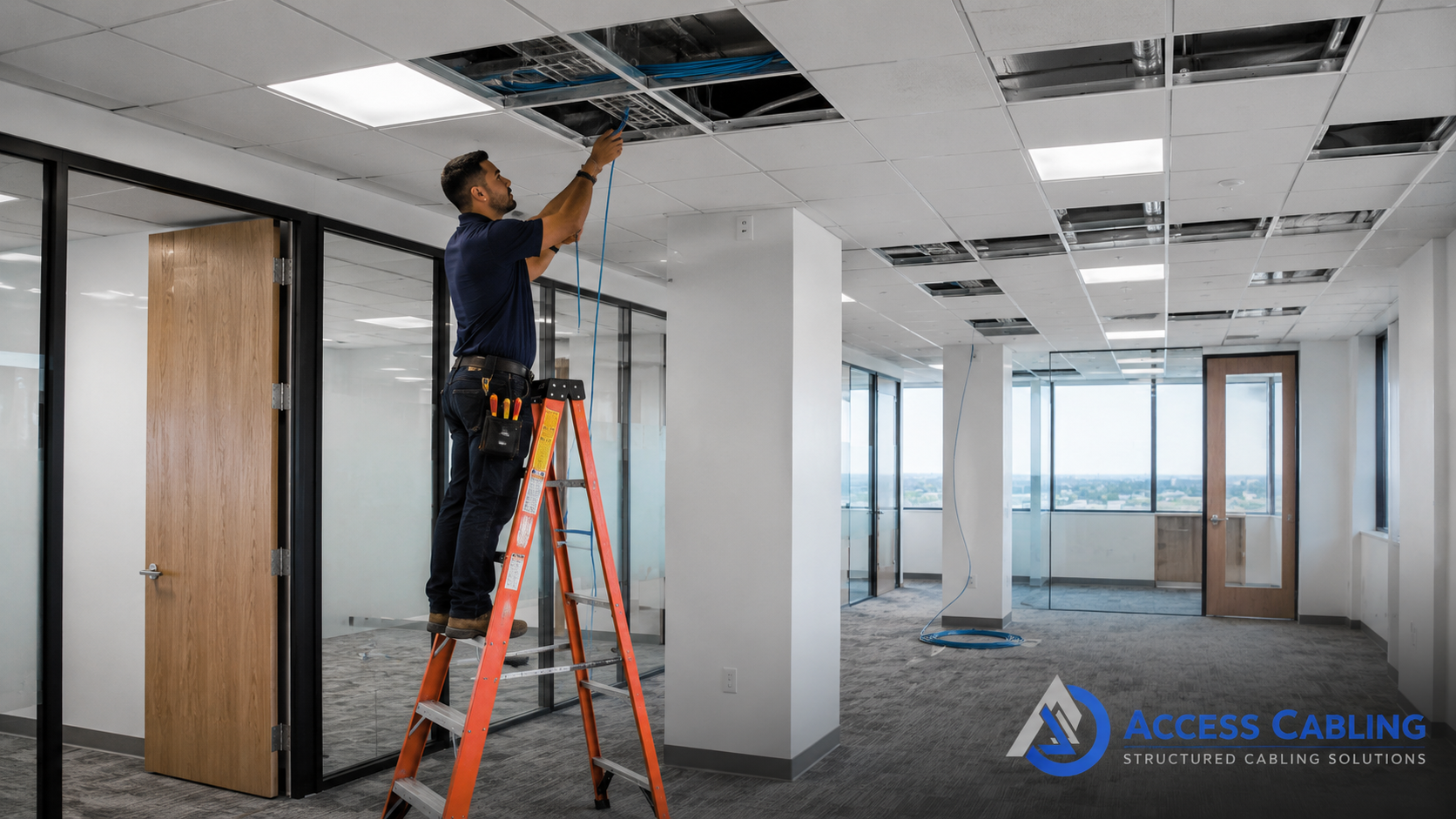
Developing and maintaining robust, reliable, and HIPAA-compliant network infrastructure within healthcare environments demands specialized expertise far beyond typical commercial cabling projects. Access Cabling provides comprehensive healthcare cabling solutions tailored precisely for hospitals, medical clinics, imaging centers, and specialized treatment facilities. Our C-10/C-7 licensed technicians understand the critical uptime requirements, stringent data privacy regulations, and unique environmental challenges inherent to medical settings. We engineer, install, and certify structured cabling systems that support everything from Electronic Health Records (EHR) and Picture Archiving and Communication Systems (PACS) to real-time patient monitoring and high-bandwidth telemedicine applications, ensuring uninterrupted operation for life-critical systems while adhering to all relevant industry standards.
Specialized Network Infrastructure for Clinical Environments
Healthcare facilities require more than just high-speed data transfer; they demand infrastructure resilience and data integrity. Our healthcare cabling deployments adhere strictly to TIA-1179 (Standard for Healthcare Facility Telecommunications Infrastructure) and BICSI ITSIMM (Information Technology Systems Installation Methods Manual) guidelines. This includes careful consideration for electromagnetic interference (EMI) given the prevalence of medical imaging equipment (MRI, X-ray) and other high-power devices, necessitating appropriate shielding and grounding practices. We frequently deploy Category 6A or higher twisted-pair cabling for backbone and horizontal runs, paired with OS2 single-mode fiber optics where extended distances, high data rates, or future proofing for 40/100G Ethernet are required, particularly for connections between data centers, main distribution frames (MDFs), and intermediate distribution frames (IDFs) within large hospital campuses. Every component, from cable pathways to connectivity hardware, is selected from reputable manufacturers like Panduit, CommScope, and Leviton to ensure system longevity and performance under the demanding continuous operation of a medical facility.
Design Considerations for HIPAA and Patient Data Security
HIPAA compliance is not solely a software or policy concern; it fundamentally extends to the physical layer of the network. Our design approach for healthcare cabling prioritizes physical security and data segregation. This involves implementing robust physical access controls for telecommunications rooms (TRs) and main cross-connects (MCs), specifying secure enclosures, and carefully planning cable routing to minimize unauthorized access points. For sensitive data, dedicated and isolated network segments can be achieved through physically separate cabling or VLAN implementations, with design recommendations integrated into the overall infrastructure plan. We ensure all components specified meet flammability ratings (e.g., plenum-rated cables for air handling spaces) and are appropriately labeled to NEC requirements for safety and ease of maintenance, critical for auditing and disaster recovery planning within a healthcare system. Our methodologies aim to create a secure, auditable, and resilient physical infrastructure that forms the foundational layer of a HIPAA-compliant IT environment.
Materials and Components for Medical-Grade Reliability
The selection of materials for healthcare cabling is paramount for performance and safety. We primarily utilize low-smoke, zero-halogen (LSZH) or plenum-rated cables from manufacturers like Belden and Corning to prevent the circulation of toxic fumes in case of fire, a crucial consideration in hospitals where patient evacuation is complex. For copper infrastructure, Category 6A F/UTP or S/FTP (foiled/screened unshielded/foiled twisted pair) is often preferred over UTP in environments with high EMI risks, providing superior alien crosstalk performance and noise immunity, essential for reliable operation of critical medical devices. Fiber optic cabling, typically OS2 single-mode or OM4 multimode, is deployed with armored jackets in high-traffic areas or underground conduit runs to protect against physical damage. We specify connectivity hardware from manufacturers known for their stringent quality control, including jacks, patch panels, and fiber optic connectors designed for high cycle counts and consistent performance, minimizing future downtime due to component failure. All infrastructure components are selected to withstand chemical cleaning agents commonly used in clinical environments.
Installation Protocols for Active Healthcare Environments
Installing new or upgrading existing cabling in active healthcare facilities requires meticulous planning and execution to minimize disruption to patient care and clinical operations. Our project management workflow includes phased deployments, off-hours work scheduling, and stringent infectious disease control protocols where necessary. All technicians are trained in hospital safety procedures, including patient privacy (HIPAA awareness) and environmental precautions. Cable pathways are carefully assessed and installed to avoid interference with medical gas lines, electrical systems, and sensitive diagnostic equipment. We use specialized tools and techniques to ensure minimal dust and noise during installation, critical for maintaining a sterile and quiet healing environment. All cable routing adheres to bend radius limitations, appropriate slack management, and physical separation requirements to optimize performance and facilitate future maintenance, a BICSI best practice that prevents attenuation and ensures long-term system integrity.
Precision Testing and Comprehensive Certification
Post-installation, rigorous testing and certification are non-negotiable for healthcare cabling. We employ Fluke Networks DSX-8000 CableAnalyzers for comprehensive certification of all copper infrastructure, testing for parameters such as insertion loss, return loss, near-end crosstalk (NEXT), far-end crosstalk (FEXT), and alien crosstalk (AXT) against TIA-568-C.2-1 and ISO/IEC 11801 standards. For fiber optic cabling, we perform Tier 1 (insertion loss/length/polarity) with an Optical Loss Test Set (OLTS) and Tier 2 (OTDR) testing where required, utilizing Fluke Networks CertiFiber Pro and OptiFiber Pro systems to ensure adherence to TIA-568.3-D. Each installed link receives a unique identifier, and detailed test reports are provided as part of the project handover documentation, offering an auditable record of compliance and performance for the facility's IT department. This meticulous certification process provides objective proof that the installed infrastructure meets or exceeds industry performance specifications.
Supporting Diverse Healthcare Applications and Systems
Modern healthcare relies on an increasingly interconnected ecosystem of applications and devices. Our cabling infrastructure is engineered to support this complexity. This includes high-bandwidth backbone connectivity for PACS servers and large medical image archives, enabling rapid access to critical diagnostic information. We regularly deploy cabling for Voice over IP (VoIP) communication systems, nurse call stations, Real-Time Location Systems (RTLS) for asset tracking and patient flow optimization, and building automation systems (BAS). Furthermore, our solutions embrace the growing adoption of IoT devices in healthcare, providing reliable network access for smart beds, infusion pumps, and wearable monitoring devices. The infrastructure can also accommodate future advancements like augmented reality for surgical training or advanced telemedicine platforms, ensuring the facility's network evolves with medical technology, avoiding costly rip-and-replace scenarios.
Ensuring Compliance, Safety, and Future Scalability
Beyond HIPAA, healthcare cabling must also adhere to numerous other regulations and best practices, including National Electrical Code (NEC) articles regarding pathways, grounding, and firestopping, as well as local building codes. Our methodologies inherently incorporate these requirements from the design phase through commissioning. We also focus on scalability, deploying modular patch panels, ensuring accessible pathways, and planning for future growth in port density and bandwidth. This proactive approach minimizes future renovation costs and operational disruptions. Access Cabling's extensive experience as a C-10/C-7 licensed contractor ensures that all work is performed by qualified professionals who understand the critical nature of their work in a healthcare setting, providing peace of mind to facility managers and IT directors that their infrastructure is not only compliant and safe but also robust enough to support clinical excellence for years to come.
Integrated Project Management for Multi-Phase Deployments
Deploying robust cabling infrastructure within active healthcare facilities necessitates a highly specialized project management methodology that extends beyond conventional IT installations. Our approach integrates with the hospital's operational rhythm, employing detailed phasing plans to minimize disruption to patient care and clinical workflows. This involves meticulous coordination with facilities management, biomed departments, and critical care units to schedule work in off-peak hours or during planned downtime for specific areas. We utilize BIM (Building Information Modeling) and CAD overlays to pre-plan cable routes, conduit pathways, and equipment rack placements, ensuring optimal utilization of existing infrastructure and avoiding conflicts with MEP (Mechanical, Electrical, and Plumbing) systems. Our project managers are adept at navigating the stringent access controls and infection control protocols (ICRA – Infection Control Risk Assessment) inherent in medical environments, coordinating credentialing, badging, and ongoing health screenings for all on-site personnel. Detailed communication plans are established from project inception, providing transparent updates on progress, potential impacts, and resolution strategies, ensuring all stakeholders are continuously informed. This proactive engagement, combined with agile problem-solving capabilities, is crucial for mitigating risks and maintaining project timelines in such dynamic and sensitive settings.
Advanced Power over Ethernet (PoE) for Medical Devices
The increasing proliferation of IP-enabled medical devices, from intelligent infusion pumps to remote patient monitoring systems and VoIP communications, places significant demands on structured cabling to deliver not only data but also reliable power. Our designs for healthcare environments prioritize robust Power over Ethernet (PoE and PoE+) deployments, specifically leveraging IEEE 802.3bt (4PPoE/PoE++) for higher power requirements (up to 90W at the PSE), ensuring sufficient wattage for critical devices like MRI touch panels, surgical displays, and advanced security cameras. This necessitates careful consideration of cable types – typically Category 6A or higher-grade shielded twisted pair (STP) solutions – to mitigate potential temperature rise effects within cable bundles, which can degrade performance and shorten cable lifespan in high-density pathways. We implement intelligent patching solutions and redundant power sourcing equipment (PSEs) to enhance resilience and prevent single points of failure. Furthermore, our designs account for the physical distances and power budget limitations inherent to PoE, often strategically placing powered switches to minimize voltage drop and maintain specified power levels at the device end point. Thermal management of telecommunications rooms (TRs) and equipment closets is also critical, as active PoE deployments can contribute to increased heat loads, requiring robust HVAC solutions to maintain optimal operating temperatures for all active network equipment.
Rigorous Documentation and Asset Management for Compliance
Comprehensive and accurate documentation is not merely a best practice; it is a critical component of regulatory compliance, operational efficiency, and disaster recovery planning within healthcare infrastructure. Our deliverables include detailed 'as-built' schematics, which meticulously map every cable run, termination point, patch panel, and active network device. This encompasses floor plans annotated with exact conduit pathways, fiber optic backbone routes, and precise locations of all telecommunications outlets (TOs) and wireless access points (WAPs). We provide extensive labeling protocols adhering to industry standards like TIA/EIA 606-B, ensuring each cable, port, and rack unit is uniquely identifiable and traceable from end to end. Beyond physical infrastructure, our documentation packages include comprehensive test results (e.g., Fluke DSX-8000 certifications for copper, OTDR traces for fiber), warranty information for all components, and a granular inventory of all installed assets. This level of detail empowers healthcare IT teams to swiftly diagnose and troubleshoot issues, facilitates seamless upgrades and expansions, and provides indisputable evidence of compliance during audits (e.g., Joint Commission, HIPAA). Proper asset management, including a digital repository of all documentation, is integral to demonstrating due diligence and ensuring long-term operational continuity and accountability.
Strategic Pathway and Space Planning for Future Expansion
Healthcare facilities are in a constant state of technological evolution, requiring cabling infrastructure that is not only robust for current needs but also inherently scalable for future demands. Our designs incorporate strategic pathway and space planning to accommodate anticipated growth and changes in medical technology over a 10-15 year horizon. This involves oversizing conduit pathways (e.g., implementing 4-inch instead of 2-inch for primary risers), deploying extra innerducts within main cable trays, and leaving unused capacity in cable management systems in telecommunications closets (TRs) and main distribution frames (MDFs). We advocate for the installation of additional empty fiber optic strands (dark fiber) in backbone infrastructure, anticipating future requirements for higher bandwidth applications such as 8K imaging, AI-assisted diagnostics, and advanced telemedicine platforms, without the disruptive and costly need for trenching or opening walls later. Furthermore, our layouts ensure adequate floor space and clear access around all racks and equipment for maintenance, upgrades, and future equipment installations, adhering to BICSI recommendations for telecommunications room sizing and environmental controls. This forward-thinking approach minimizes the Total Cost of Ownership (TCO) by reducing the frequency and complexity of future infrastructure overhauls, allowing healthcare providers to adapt to emergent technologies with agility and efficiency.