Enterprise-grade connectivity demands a robust, high-performance wireless network infrastructure. Access Cabling provides end-to-end wireless network deployment services, meticulously engineered to support the most demanding commercial environments, from high-density user areas to expansive industrial facilities. We address the unique challenges of wireless spectrum management, interference mitigation, and seamless roaming, ensuring ubiquitous coverage and reliable throughput crucial for mission-critical operations. Unlike general IT integrators, our C-10/C-7 licensing and 28+ years in low-voltage infrastructure position us to design, install, and certify WLAN systems from the ground up, integrating physical layer dependencies with advanced RF planning. Our approach prioritizes future scalability, adherence to TIA/EIA and IEEE standards, and deployment strategies that minimize operational disruption while maximizing wireless performance and security for our clients nationwide.
Strategic Wireless Site Survey and RF Planning
Every successful wireless network deployment begins with a comprehensive site survey and meticulous Radio Frequency (RF) planning. Access Cabling employs advanced RF analysis tools, such as Ekahau Pro and AirMagnet Survey Pro, to conduct both predictive and active site surveys. A predictive survey models RF propagation based on architectural plans and material compositions, identifying potential interference sources like concrete walls, metal structures, or specialized medical equipment prior to installation. An active survey validates these predictions by mapping actual signal strength (RSSI), signal-to-noise ratio (SNR), co-channel interference, and potential rogue access points (APs) using real-world measurements. This process generates detailed heatmaps, channel plans, and AP placement recommendations, optimizing coverage, capacity, and minimizing channel contention. Our planning adheres strictly to IEEE 802.11 standards, specifically focusing on the 802.11ax (Wi-Fi 6) and 802.11be (Wi-Fi 7) specifications for high-density environments and low latency applications, ensuring the physical infrastructure can support the increasing demands for bandwidth and connectivity. We consider environmental factors, existing RF landscapes, and specific client application requirements, such as voice-over-IP (VoIP) or real-time location services (RTLS), to design a wireless network that not only functions but excels.
High-Performance Access Point Selection and Installation
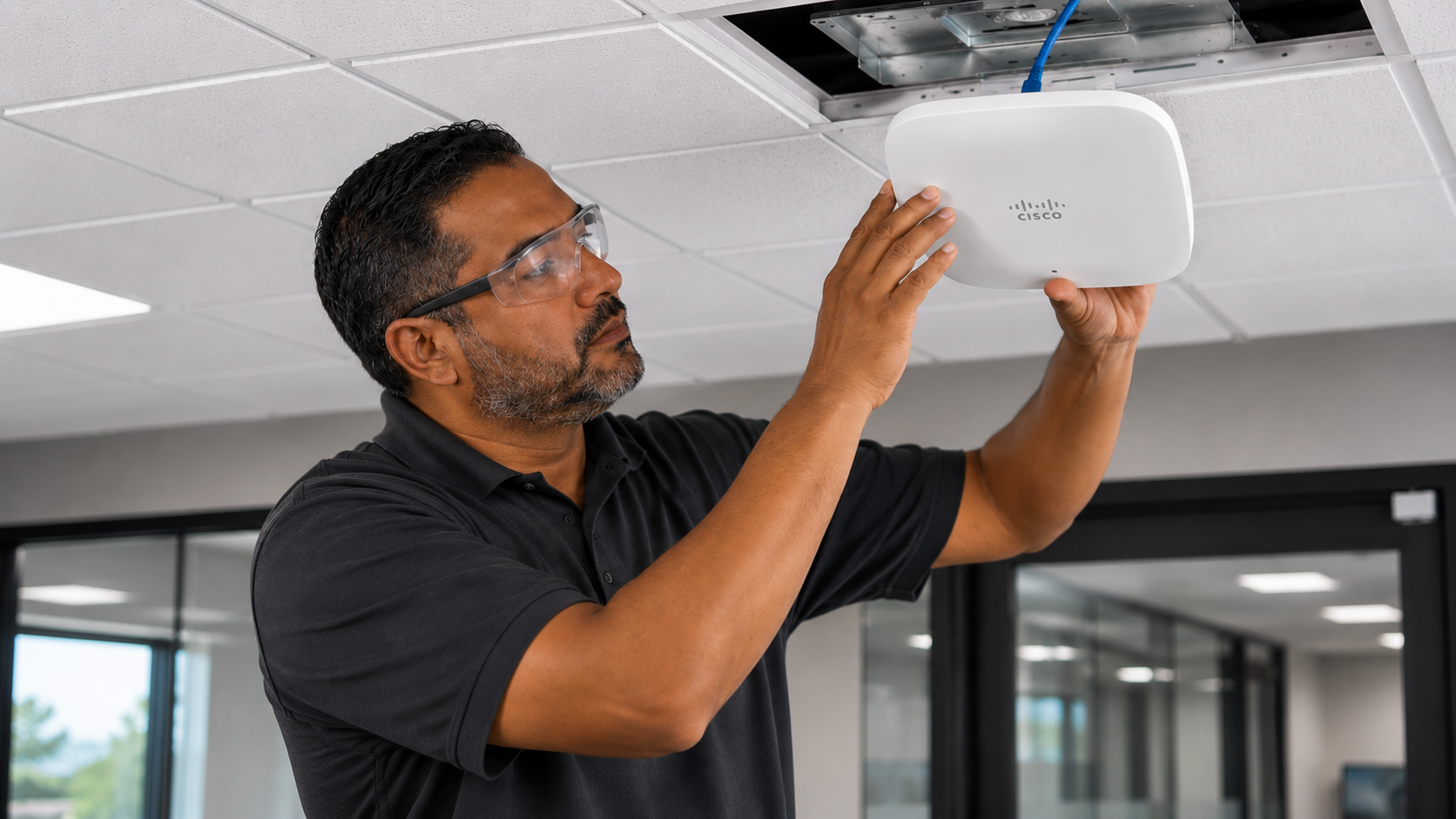
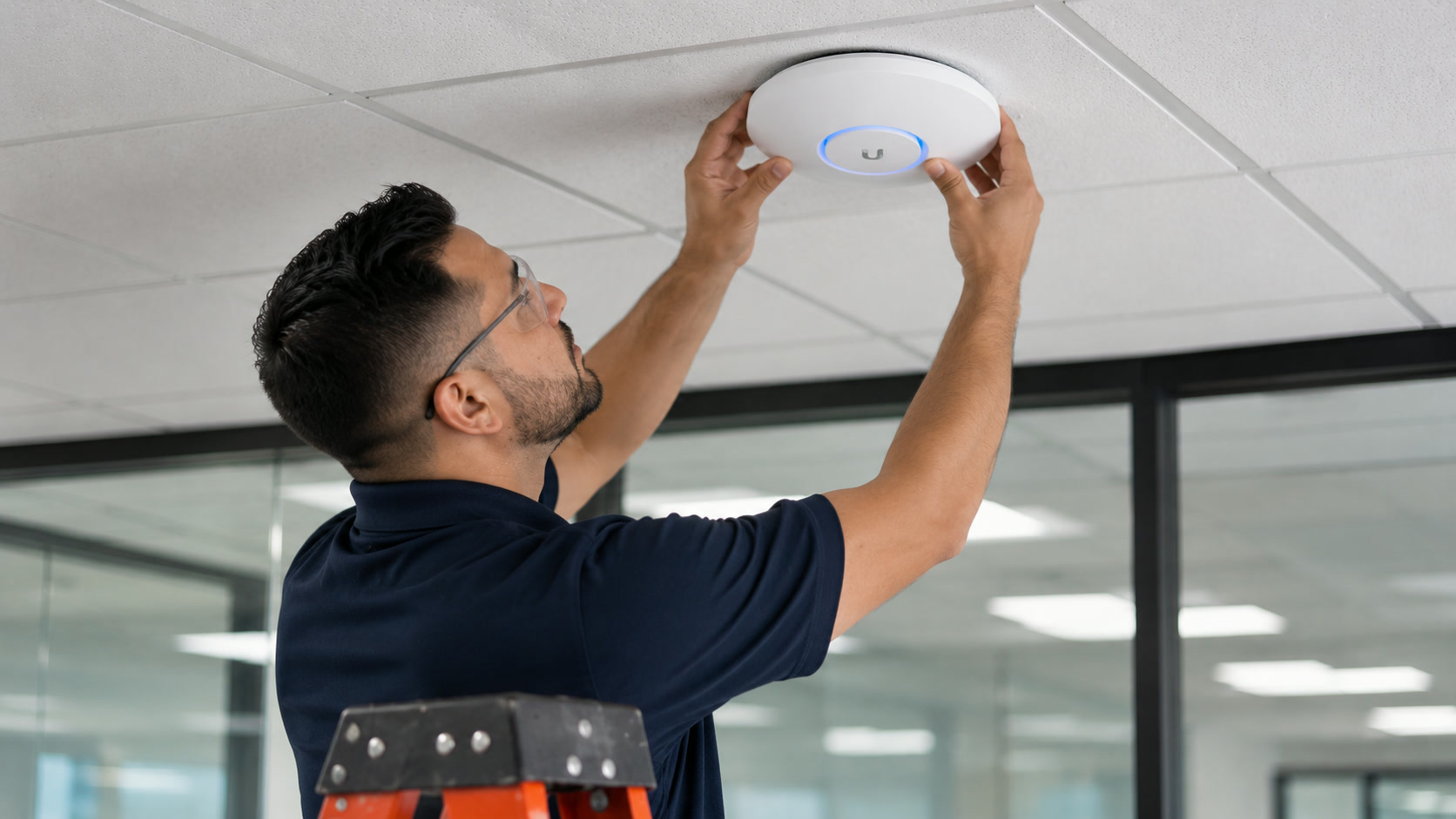
The selection and strategic placement of Access Points (APs) are critical to achieving optimal wireless performance. Access Cabling partners with industry-leading manufacturers such as Cisco Meraki, Aruba, Ubiquiti, and Ruckus Wireless, specifying APs that align with the defined coverage, capacity, and security requirements. Our technicians are factory-trained on various AP models, ensuring correct installation per manufacturer specifications and industry best practices. Proper AP installation involves precise mounting at the exact locations identified during RF planning, ensuring optimal antenna orientation and minimal obstruction. We meticulously manage power requirements, often utilizing Power over Ethernet (PoE) to deliver power and data over a single Ethernet cable, simplifying installation and reducing infrastructure costs. Our installations conform to NEC Article 725 for low-voltage cabling and TIA/EIA 568 standards for structured cabling, ensuring the cable plant supporting the APs is robust, properly terminated, and compliant. We consider aesthetic integration for office environments and ruggedization for industrial or harsh outdoor settings, selecting appropriate enclosures and mounting hardware to protect APs and maintain environmental integrity.
Secure Wireless Backhaul and Power Infrastructure
A robust wireless network relies heavily on its underlying wired backhaul and power infrastructure. Access Cabling designs and implements the complete structured cabling system to support the wireless APs, typically utilizing Category 6A or higher-grade shielded twisted-pair (STP) cabling for optimal performance and electromagnetic interference (EMI) reduction, especially in noisy industrial settings. Each AP location is provisioned with two dedicated data drops, allowing for PoE power delivery and redundancy. Our installations adhere to TIA-568-C.2 standards for balanced twisted-pair cabling systems, ensuring proper cable runs, termination procedures, and connector types (RJ45). For power, we deploy compliant PoE solutions (e.g., IEEE 802.3at Type 2 'PoE+' or 802.3bt Type 3/4 '4PPoE') capable of supplying sufficient wattage to advanced Wi-Fi 6/7 APs, which often have higher power demands than legacy models. We also account for power conditioning, grounding, and surge protection to safeguard network equipment. Our expertise extends to deploying fiber optic backbones for large campuses or buildings where distance limitations or high bandwidth demands necessitate optical connectivity from the network closet to remote data aggregation points, utilizing single-mode or multi-mode fiber in accordance with TIA-598-C standards.
Advanced Wireless Link Performance Testing and Validation
Post-installation, Access Cabling performs rigorous testing and validation to confirm the wireless network operates as designed and meets specified performance criteria. This includes a comprehensive post-deployment site survey, utilizing tools like Fluke Networks AirMagnet Wi-Fi Analyzer and Spectrum XT to verify actual coverage, identify any new sources of interference, and ensure channel utilization is balanced. We perform throughput testing to validate data rates and capacity at various locations across the coverage area, ensuring benchmark performance aligns with client expectations for applications such as streaming, large file transfers, and VoIP calls. For the underlying structured cabling, we conduct Tier 2 certification testing using Fluke DSX CableAnalyzers for copper infrastructure (e.g., Cat6A permanents links), verifying TIA-568-C compliance for attenuation, near-end crosstalk (NEXT), far-end crosstalk (FEXT), and return loss. For fiber optic runs, we perform Tier 2 testing using Optical Time Domain Reflectometer (OTDR) such as the Fluke OptiFiber Pro, validating loss, length, and connector cleanliness to TIA-568.3 standards. All test results are compiled into detailed reports, providing tangible proof of a high-performing, standards-compliant wireless and wired infrastructure.
Multi-Site Wireless Deployments and Centralized Management
For organizations with multiple locations, Access Cabling specializes in the planning and execution of multi-site wireless network deployments. Our approach ensures consistency in performance, security posture, and manageability across geographically dispersed offices, warehouses, or retail outlets. We leverage cloud-managed wireless platforms from vendors like Cisco Meraki, Aruba Central, or Ubiquiti UniFi, which provide centralized visibility, simplified configuration pushing, and remote troubleshooting capabilities. This allows for a uniform configuration template across all sites, reducing the administrative overhead and potential for configuration drift. Our design methodology considers Wide Area Network (WAN) bandwidth requirements for cloud-managed platforms, optimizing communication pathways and ensuring seamless integration with existing network security policies. Each site's RF plan is tailored, but the overarching architecture remains standardized, facilitating streamlined support and future expansion. We coordinate installations across multiple regions, ensuring a consistent deployment methodology and minimized disruption to business operations, delivering a unified wireless experience enterprise-wide.
Wireless Security Integration and Compliance Adherence
Wireless network security is paramount, particularly in commercial environments handling sensitive data or regulated operations. Access Cabling integrates robust security protocols into every wireless deployment, adhering to industry best practices and compliance frameworks such as HIPAA, PCI DSS, or NIST 800-Series. We implement enterprise-grade authentication methods like WPA3-Enterprise, leveraging 802.1X with RADIUS servers (e.g., Cisco ISE, FreeRADIUS) for strong user and device authentication, assigning specific network access policies based on user roles or device profiles. We configure guest networks with proper isolation and captive portals to protect the internal network from unauthorized access. Our solutions include Wireless Intrusion Prevention System (WIPS) capabilities within the APs or via dedicated sensors to automatically detect and mitigate rogue APs, denial-of-service attacks, and other wireless threats. We ensure compliance with corporate security policies and provide recommendations for ongoing vulnerability management and periodic security audits to maintain a resilient and secure wireless infrastructure against evolving cyber threats.
Scalability and Future-Proofing for Evolving Wireless Standards
The rapid evolution of wireless technology necessitates a forward-thinking approach to network design and deployment. Access Cabling designs wireless infrastructures with inherent scalability and future-proofing capabilities, mitigating the need for costly rip-and-replace scenarios as new standards emerge. Our designs account for future capacity demands by oversizing cable plant capacity (e.g., using Cat6A even if Cat5e is minimally sufficient for current APs) and provisioning additional conduit pathways. We implement modular architectures that allow for easy upgrades of access points as 802.11 standards advance (e.g., from Wi-Fi 6 to Wi-Fi 7 and beyond), ensuring compatibility with next-generation devices and applications. Considerations for emerging technologies like IoT, 5G integration, and potentially CBRS Private LTE are factored into the physical layer design. By specifying open-standard equipment where appropriate and ensuring proper documentation of the installed infrastructure, we empower our clients with the flexibility to adapt to future technological shifts while maintaining optimal performance and minimizing total cost of ownership.
Detailed Spectrum Analysis and Interference Mitigation Strategies
Effective wireless network deployment is predicated on a thorough understanding of the radio frequency (RF) environment. Our process begins with a comprehensive spectrum analysis using enterprise-grade tools such as Ekahau Pro or NetScout AirCheck G2. This involves active and passive scanning across relevant frequency bands (2.4 GHz, 5 GHz, 6 GHz, and potentially CBRS where applicable) to identify sources of co-channel interference (CCI), adjacent-channel interference (ACI), and non-Wi-Fi interference from devices like microwave ovens, cordless phones, or legacy industrial equipment. We don't just detect interference; we characterize it by signal strength, duration, and frequency hopping patterns to determine its impact on channel capacity and signal-to-noise ratio (SNR). Mitigation strategies are then developed, ranging from intelligent channel planning and dynamic frequency selection (DFS) adjustments to the physical isolation of interfering sources or the deployment of specialized directional antennas. For high-density environments, we analyze airtime utilization metrics to prevent retransmission overheads that degrade overall throughput, often recommending finer-grained cell planning and power adjustments to create optimally sized micro-cells, thereby maximizing spectral efficiency, especially in congested urban or industrial settings. Understanding the local regulatory domain's permissible power levels and duty cycle restrictions (e.g., ETSI EN 300 328 and EN 301 893 for Europe, FCC Part 15 for North America) is paramount to ensure compliant and high-performing deployments, avoiding potential fines or service interruptions.
Structured Cabling Integration and Backbone Infrastructure Design
While wireless, the underlying wired infrastructure is foundational. Our deployment includes a meticulously planned structured cabling system compliant with TIA/EIA-568-D standards, specifically TIA-568.3-D for optical fiber cabling and TIA-568.2-D for balanced twisted-pair copper cabling. We specify and install Category 6A or higher shielded/unshielded twisted pair (STP/UTP) cabling to support 10 Gigabit Ethernet (10GbE) to each access point, future-proofing for Wi-Fi 6E and upcoming Wi-Fi 7 demands that exceed gigabit throughput. Power over Ethernet (PoE) provisioning is critical, requiring careful calculation of power budgets and selection of IEEE 802.3at (PoE+) or IEEE 802.3bt (PoE++) compliant switches to reliably power all access points, ensuring ample wattage for peak consumption and future upgrades. For backbone infrastructure, we deploy multi-mode (OM3/OM4/OM5) or single-mode fiber optic cabling to connect distribution switches to the core network, providing high-bandwidth, low-latency links that are immune to electromagnetic interference (EMI). This fiber optic backbone is essential for aggregating traffic from numerous APs and for bridging significant distances between wiring closets. We provide detailed patching schedules, cable routing diagrams, and termination schematics, ensuring maintainability and ease of future expansion. Common pitfalls we address include improper cable dress, bend radius violations, and inadequate grounding, all of which can severely degrade network performance or introduce intermittent faults, shortening the lifespan of the physical layer infrastructure. Our documentation includes as-built drawings, test results for all cable runs (e.g., Fluke DSX-8000 certifications), and labeling standards adhering to TIA/EIA-606-C for organized network management.
Environmental Durability and Industrial Hardening for Harsh Conditions
Deploying wireless networks in non-office environments presents unique challenges related to environmental durability and protection. For industrial facilities, outdoor public spaces, or harsh manufacturing floors, we specify and install access points and associated enclosures rated for IP (Ingress Protection) and IK (Impact Protection) standards. This includes IP67-rated APs for dust and water immersion protection, or IK10-rated enclosures to withstand significant mechanical impact and vandalism. We meticulously consider operating temperature ranges, deploying industrial-grade equipment capable of functioning reliably from -40°C to +70°C, and assessing the need for specialized heating or cooling apparatus within outdoor cabinets. Material compatibility is also vital; for instance, corrosive atmospheres in certain chemical plants necessitate stainless steel enclosures or UV-stabilized polymer housings to prevent degradation. We account for transient voltage suppression (TVS) and surge protection on both data and power lines to safeguard equipment from lightning strikes or industrial power fluctuations. The choice of mounting hardware and cabling materials (e.g., UV-resistant outdoor-rated jackets, armored fiber optics) is critical to ensure long-term reliability against environmental stressors like solar radiation, extreme humidity, or airborne particulates. These considerations extend to antenna selection, where directional or omnidirectional antennas with appropriate beamwidths are chosen not only for RF performance but also for their mechanical robustness and suitability for the specific environmental stresses of the deployment site, thereby minimizing total cost of ownership (TCO) through extended equipment longevity and reduced maintenance overheads.
Post-Deployment Optimization and Ongoing Lifecycle Management
Our commitment extends beyond initial deployment through comprehensive post-deployment optimization and ongoing lifecycle management. This involves a rigorous post-installation validation survey using tools like WLAN-optimizer for automated spectrum analysis and network performance baselining, ensuring the deployed network meets or exceeds the initial design specifications for coverage, capacity, and performance. We conduct active client roaming tests, throughput assessments (e.g., iPerf3 tests), and latency measurements across various device types and operating systems to verify real-world user experience. A critical aspect is the fine-tuning of Radio Resource Management (RRM) algorithms, adjusting transmit power levels, channel assignments, and band steering parameters to optimize airtime fairness and client distribution, preventing unfair client association or sticky client issues. For ongoing management, we implement network monitoring systems (NMS) such as Cisco DNA Center, Aruba Central, or Ruckus SmartZone, providing real-time visibility into network health, device status, client counts, and performance metrics. This allows for proactive identification of anomalies, performance bottlenecks, and security threats. Our lifecycle management services include routine firmware updates (patch management), configuration backups, capacity planning based on usage trends, and security audits to ensure continued compliance and evolving threat protection. We also provide detailed documentation for handoff, covering operational procedures, troubleshooting guides, and escalation matrices, empowering internal IT teams with the knowledge and tools for day-to-day management. Regular performance reviews and health checks ensure the wireless network continues to align with evolving organizational needs and technological advancements, providing a sustained high-performance and secure wireless environment.