
Rebuilding a data center rack row without dropping a single packet.
The client's core data center had grown organically for years — mismatched cabinets, tangled patch cords across the fronts of switches, and label schedules that no longer matched reality. Every MAC (move/add/change) was a scavenger hunt, and their operations team had stopped trusting the documentation.
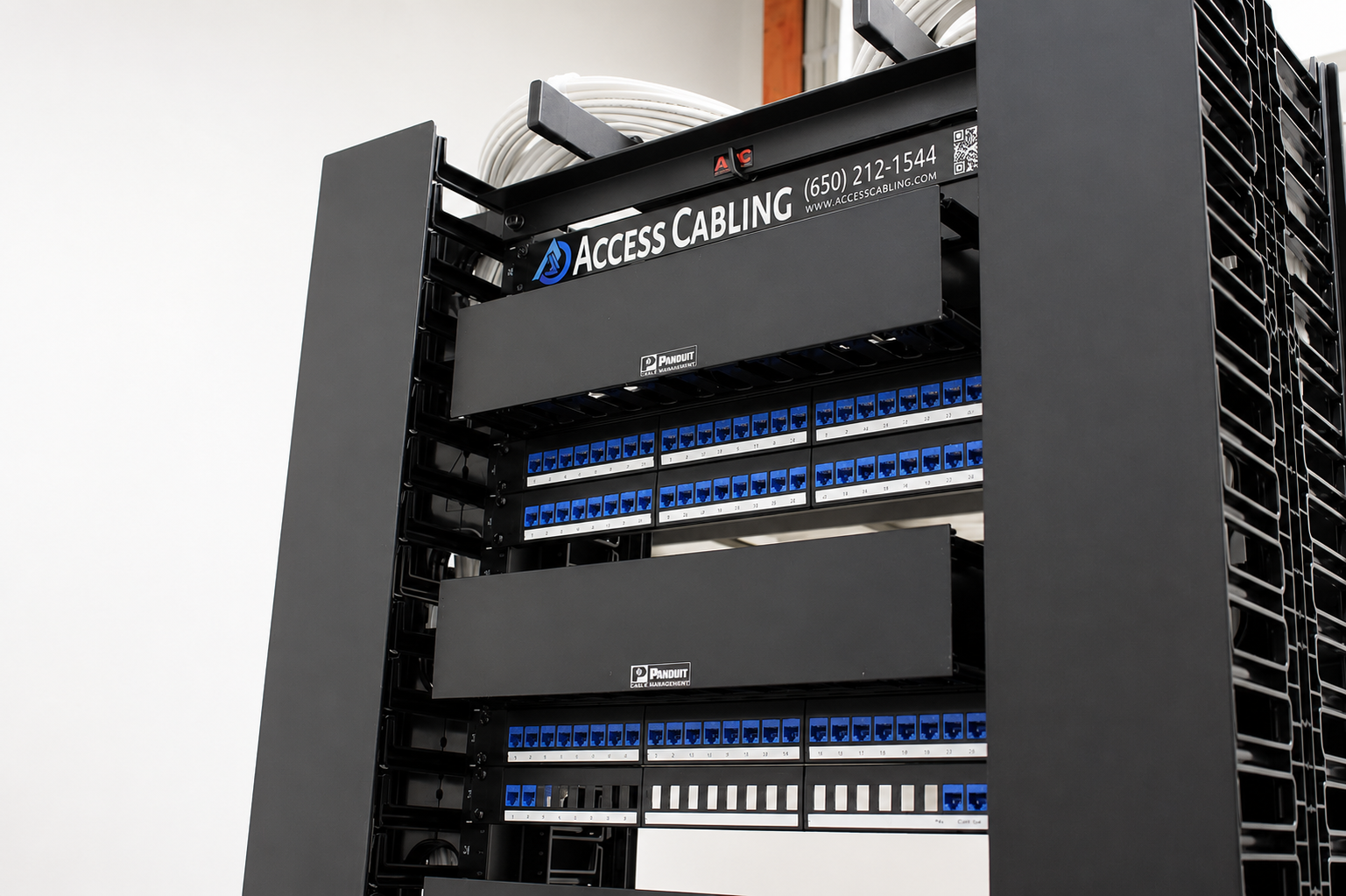
Access Cabling was brought in to rebuild the rack row from the ground up: new Panduit Net-Access cabinets, Chatsworth vertical cable management between every pair, high-density Corning fiber patching for the spine, and CommScope SYSTIMAX Cat6A copper for edge distribution — all without taking production offline.
We started with rack elevations and pathway drawings drafted against the existing MEP and power layout, then prefabricated cable assemblies to length in our shop. Cabinets were staged, dressed and labeled before they ever touched the production floor. Cutovers happened in tight after-hours windows, cabinet by cabinet, with rollback plans printed for every step.
The final walk-through delivered exactly what the client asked for: a clean rack row, vertical managers hiding every patch, color-coded fiber and copper for instant visual identification, TIA-606 labels on every port, and a documentation package their ops team could hand directly to an auditor.
What we delivered
- Engineered rack elevations and pathway drawings before install
- Panduit Net-Access cabinets installed, leveled, grounded and bonded
- Chatsworth (CPI) vertical cable management between every cabinet pair
- High-density Corning fiber patching for OM4 and single-mode uplinks
- CommScope SYSTIMAX Cat6A copper distribution to edge switches
- Prefabricated patch cord assemblies cut to length in our shop
- TIA-606 labels applied to every cable, port and cabinet
- Fluke Cat6A channel testing plus fiber OTDR and insertion-loss reports
- As-built rack elevations and port maps delivered as a PDF package
Design first, then dress every cabinet off the floor
Nothing was left to guess on install night. Rack elevations, pathway drawings and cutover runbooks were signed off in advance. Cabinets were pre-populated, patch panels pre-terminated, and vertical managers pre-loaded with slack loops so the actual production window was mostly about moving fibers from the old row to the new one — with a documented rollback for every strand.
Why this project worked
Every U accounted for before a single cabinet was ordered — power, cooling, weight and pathway all coordinated with MEP.
Patch cords, trunks and fiber assemblies cut to length in the shop. Result: dramatically less time on the production floor.
CPI vertical managers between every cabinet pair — patch cords stay out of the front of the switch and out of the airflow path.
100% Cat6A channel test results and fiber OTDR/insertion-loss reports delivered as part of the as-built package.
Every port, cable and cabinet labeled to a consistent scheme so future MACs take minutes, not hours.
Tightly scoped change windows with printed runbooks and rollback plans. Production traffic never dropped.
A rack row the ops team actually trusts
Zero unplanned outages during cutover. Documentation delivered as a searchable PDF package. Ops team reports MAC time cut significantly on the new row — every patch is where the label says it is, and the vertical managers keep the fronts of switches accessible for the first time in years.