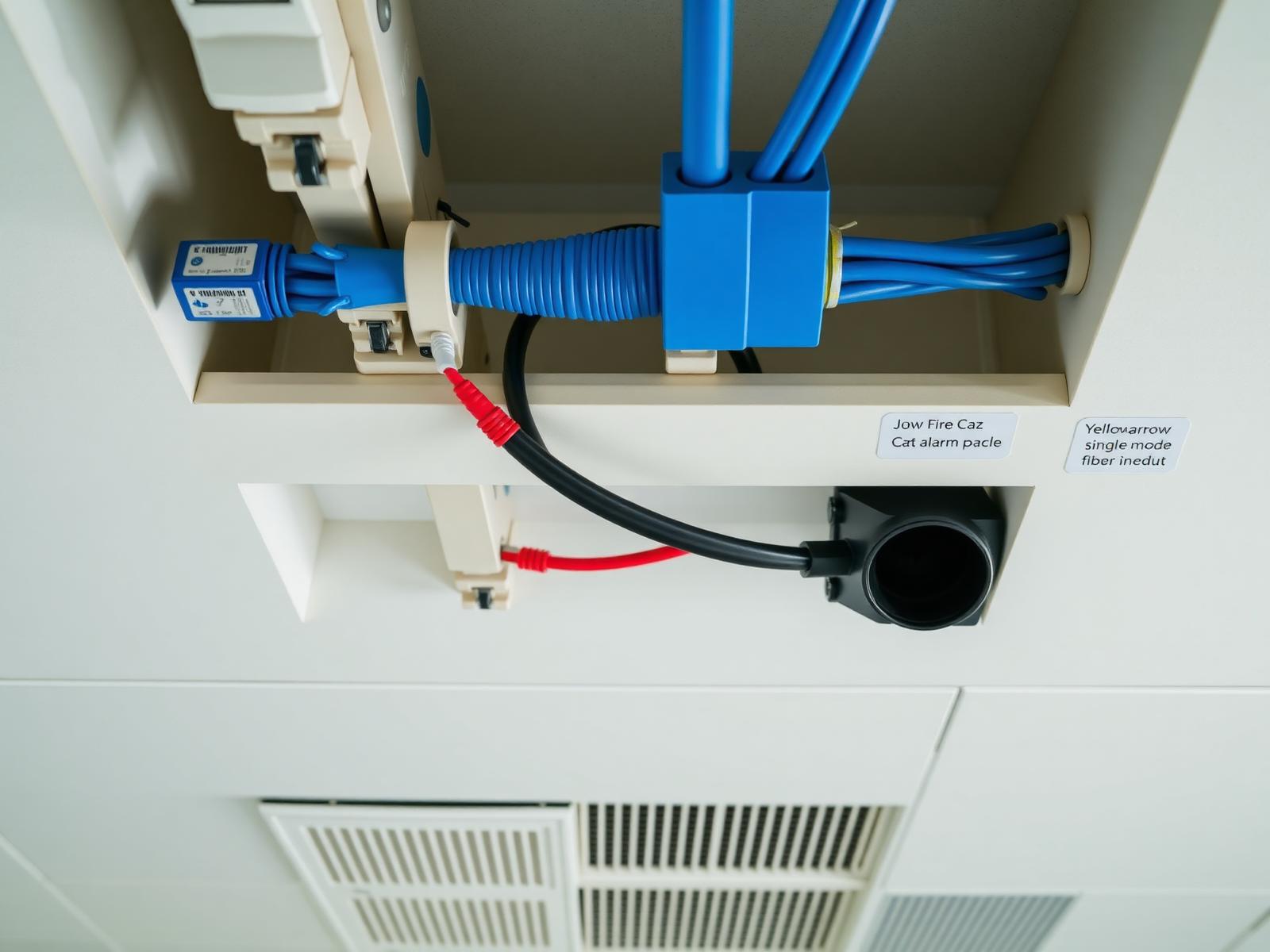
Developing a truly intelligent building requires a robust, scalable, and secure physical layer capable of supporting a converged Internet of Things (IoT) and IP infrastructure. Access Cabling specializes in designing and deploying precisely such smart building infrastructure, enabling seamless integration of diverse systems from Building Management Systems (BMS) and Power over Ethernet (PoE) lighting to advanced audiovisual (AV) and security applications. Our approach moves beyond traditional siloed cabling, consolidating multiple discrete networks onto a unified IP backbone. This strategy reduces capital expenditure, simplifies ongoing maintenance, and provides a future-proof foundation for evolving smart technologies. We engineer solutions that leverage industry-leading products from manufacturers like Panduit, CommScope, and Corning, ensuring your smart facility is equipped with a high-performance, resilient network designed to optimize operational efficiency and user experience.
Converged IP for Intelligent Building Systems
The transition to smart buildings is fundamentally driven by the convergence of operational technology (OT) and information technology (IT) onto a common IP network. This necessitates a cabling infrastructure capable of supporting a myriad of disparate systems, including lighting controls (e.g., DALI, KNX over IP), HVAC, access control, surveillance, and sophisticated AV distribution (e.g., SDVoE, Dante, AES67). Access Cabling designs and implements these converged IP infrastructures following TIA-862-B (Structured Cabling for Building Automation Systems) and BICSI ITSIMM guidelines, emphasizing zone cabling architectures and service consolidation points (SCPs) to maximize flexibility and minimize future disruption. The physical layer, often comprising Category 6A or fiber optic cabling, must handle bandwidth-intensive applications and deliver reliable power via PoE, frequently exceeding 60W per port with standards like IEEE 802.3bt (PoE++). Our engineering ensures that passive components, including patch panels, outlets, and cable pathways, are specified to meet the electromagnetic compatibility (EMC) and thermal dissipation requirements inherent in high-density PoE deployments, preventing performance degradation or premature equipment failure.
Design Considerations for Unified Communications & AV
Designing smart building infrastructure for unified communications (UC) and advanced AV distribution requires a meticulous understanding of latency, bandwidth, and signal integrity. Modern AV-over-IP protocols like SDVoE (Software Defined Video over Ethernet) demand 10 Gigabit Ethernet (or higher) to deliver uncompressed, zero-latency 4K video, necessitating Category 6A or OM3/OM4 fiber optic backbones. Audio transport protocols such as Dante and AES67 are less bandwidth-intensive but highly sensitive to latency and jitter, requiring carefully managed network segmentation (VLANs) and Quality of Service (QoS) configurations at the physical and logical layers. Access Cabling incorporates TIA-568 series standards, particularly TIA-568.0-E, and BICSI-007 (Information and Communications Technology Design for Health Care Institutions) principles where applicable, to ensure the underlying cabling infrastructure supports these real-time applications seamlessly. We factor in considerations for cable bend radius, termination practices, and appropriate shielding (UTP vs. F/UTP vs. S/FTP) to mitigate alien crosstalk and external interference, critical for maintaining the high signal-to-noise ratio required by sensitive AV equipment. Our designs account for environmental conditions, conduit fill ratios, and pathways to protect optical fiber from macrobends and excessive tensile stress, common causes of insertion loss.
Materials Specification for Resilient Smart Buildings
The selection of materials is paramount for the longevity and performance of smart building infrastructure. For horizontal cabling, we primarily specify Category 6A UTP or F/UTP from manufacturers like CommScope SYSTIMAX, Panduit PanGen, or Belden for its 10GBase-T capability and enhanced alien crosstalk performance, essential for converged IP applications and high-bandwidth AV. For backbone and riser applications, multimode fiber (OM3 or OM4, often Corning ClearCurve) or singlemode fiber (OS2) is utilized to support distances exceeding copper's reach and provide future-proof bandwidth for evolving technologies like 40GbE and 100GbE. Connectivity components, including patch panels, connectors, and outlets, are chosen for their robust construction, compliant mating performance, and tool-less or rapid termination features where appropriate, from brands like Leviton or Panduit. We prioritize plenum-rated (CMP) or riser-rated (CMR) cabling as dictated by NEC articles 770 and 800 for fire safety, and utilize specialized industrial-grade components (e.g., IP67-rated enclosures, harsh environment fiber) in extreme conditions. Power over Ethernet components, from switches to patch cords, are evaluated for their thermal dissipation characteristics to ensure consistent performance under high-power loads, adhering to manufacturers' specifications and IEEE 802.3 standards for cable and connector performance.
Installation Methodologies for Integrated Systems
Access Cabling's installation methodologies for smart building infrastructure are meticulously planned to minimize disruption and maximize long-term performance. We employ zone cabling principles, utilizing service consolidation points (SCPs) or consolidation points (CPs) to enable flexible deployment of sensors, controls, and AV endpoints, reducing the need for costly cabling modification during tenant fit-outs or system upgrades. Our technicians are trained in manufacturer-specific termination procedures (e.g., Corning UniCam, Panduit FieldTerm) and adhere strictly to TIA-568.1-E and TIA-569-D (Telecommunications Pathways and Spaces) for cable routing, support, and protection. Cable dress and pathway management are critical, especially for high-density PoE deployments, to ensure proper airflow and prevent pinch points. We utilize specialized tooling, including calibrated cable cutters, strippers, and punch-down tools, along with precise fiber cleavers and fusion splicers. All work areas are maintained according to industry best practices, ensuring a clean and safe environment compliant with OSHA regulations. The installation process integrates rigorous labeling schemes, often following TIA-606-C (Administration Standard for Telecommunications Infrastructure), for every cable and termination point, facilitating simplified troubleshooting and future system expansions.
Advanced Testing and Certification for IoT/AV Networks
Verification and certification are non-negotiable for smart building infrastructure, especially for high-performance AV-over-IP and PoE applications. Access Cabling utilizes advanced certification test equipment, primarily Fluke Networks DSX-8000 CableAnalyzers, to perform comprehensive Tier 2 certification on all installed copper cabling up to Category 8 and fiber optic cabling (Tier 1 & Tier 2 for both multimode and singlemode). For copper, this includes measuring insertion loss, return loss, near-end crosstalk (NEXT), power sum alien crosstalk (PSANEXT), and delay skew, ensuring compliance with TIA-568.2-D and ISO/IEC 11801 standards. For fiber, we certify insertion loss, optical return loss (ORL), and sometimes Optical Time Domain Reflectometer (OTDR) measurements to ensure link integrity and identify potential splices or breaks. Crucially, for PoE deployments, we test for DC resistance unbalance and power throughput capabilities, verifying that the cabling can support the specified wattage per IEEE 802.3bt. All test results are documented and provided in both summary and detailed formats, offering irrefutable proof of performance and establishing a baseline for a long-term warranty from both Access Cabling and the product manufacturer.
Compliance and Future-Proofing Smart Building Deployments
Ensuring smart building infrastructure meets current and future compliance standards is integral to our design philosophy. We meticulously adhere to the National Electrical Code (NEC), specifically articles like 770 (Optical Fiber Cables and Raceways) and 800 (Communications Circuits), for proper cable types, grounding, and bonding. Additionally, our methodologies integrate BICSI guidelines (e.g., BICSI ITSIMM, BICSI-005, BICSI-007) and TIA standards (e.g., TIA-568.0-E, TIA-942-B) to ensure structured cabling best practices, pathway and space management, and data center design principles are applied where relevant. For accessibility, particularly in AV deployments in public spaces, we consider ADA compliance for screen placement, hearing loops, and visual notification systems. Future-proofing is achieved through strategic over-provisioning of pathways and backbone capacity, considering emerging standards like 2.5G/5G Ethernet (NBASE-T), 25GBASE-T, and next-generation fiber optics. We also design for modularity, utilizing intelligent patching systems (e.g., Panduit PanView iQ, CommScope imVision) that provide real-time visibility into the physical layer, allowing for dynamic system reconfigurations and simplified upgrades without ripping and replacing core infrastructure. This foresight protects your investment and ensures your smart building can adapt to technological advancements.
Interoperability Protocols and API Integration for Building Management Systems
Achieving true 'smart' functionality within modern buildings necessitates robust interoperability between diverse Subsystems, spanning HVAC, lighting, security, and audiovisual. This often involves navigating a complex landscape of communication protocols, such as BACnet/IP for building automation, Modbus RTU/TCP for industrial control, KNX for lighting, and more recently, MQTT and CoAP for IoT devices. A critical aspect of our design philosophy at Access Cabling is a meticulous assessment of gateway requirements and API (Application Programming Interface) integration strategies. We frequently implement Linux-based gateway solutions utilizing open-source libraries like Eclipse Mosquitto or Node-RED to translate proprietary protocols into a unified data structure, often JSON or XML, readily consumable by a central Building Management System (BMS) or an Integrated Platform Management System (IPMS). This not only facilitates holistic control and monitoring but also enables sophisticated data analytics for predictive maintenance and energy optimization. A common pitfall here is underestimating the computational overhead and network bandwidth required for real-time data exchange across hundreds or thousands of sensor endpoints, especially when dealing with high-frequency telemetry from vibration sensors or environmental monitors. Careful consideration of message queuing, data compression, and edge computing capabilities at the sensor level can mitigate these challenges, ensuring data integrity and system responsiveness. Our engineers are proficient in developing custom API connectors using Python or JavaScript, allowing seamless data flow between disparate vendor-specific applications and the primary control plane, thereby avoiding vendor lock-in and promoting future-proof system evolution.
Cybersecurity Frameworks for Converged Operational Technology Networks
The convergence of Information Technology (IT) and Operational Technology (OT) within smart buildings, particularly the integration of AV systems onto the core IP network, introduces a critical new vector for cyber threats. Unlike traditional IT, OT environments often feature legacy devices with limited patching capabilities, extended lifecycles, and real-time operational imperatives that preclude regular reboots. Access Cabling addresses this by implementing a 'defense-in-depth' cybersecurity framework tailored for OT/AV networks. This includes stringent network segmentation, often achieved through VLANs (Virtual Local Area Networks) and micro-segmentation using technologies like Cisco TrustSec or VMware NSX, isolating critical building systems from less sensitive network traffic. We deploy next-generation firewalls (NGFWs) at network boundaries with deep packet inspection capabilities to identify and block anomalous traffic patterns indicative of industrial control system (ICS) specific attacks. Furthermore, endpoint protection for AV processors, digital signage players, and smart sensors involves whitelisting applications and implementing intrusion detection systems (IDS) with signatures for common OT vulnerabilities (e.g., those found in SCADA protocols). A significant constraint lies in the often-limited processing power of edge IoT devices, which may not support complex encryption algorithms or robust authentication mechanisms. To circumvent this, we rely on network-level encryption (e.g., IPsec VPNs for inter-VLAN communication) and strong access control policies, often leveraging IEEE 802.1X for device-level authentication. Regular vulnerability assessments and penetration testing, using tools like Nmap for network mapping and Metasploit for exploit validation, are integral to identifying and remediating potential weaknesses before they can be exploited, ensuring the operational continuity and data integrity of the building infrastructure.
Lifecycle Management and Future-Proofing Through Modularity
Implementing a smart building infrastructure represents a significant capital investment, underscoring the importance of lifecycle management and future-proofing strategies. Technology obsolescence, particularly in AV and IoT domains, occurs at an accelerated pace compared to traditional building systems. To counteract this, Access Cabling emphasizes modular design principles, promoting infrastructure that allows for incremental upgrades rather than wholesale replacement. This involves deploying structured cabling systems (e.g., Category 6A or fiber optic to the desk/room) with ample spare capacity and diverse pathways, allowing for future bandwidth demands and evolving connectivity standards (e.g., 5G in-building DAS integration). More crucially, our approach extends to the selection of active equipment. We prioritize devices and platforms that adhere to open standards, possess robust API interfaces, and feature hot-swappable components. For instance, using modular network switches with upgradeable line cards ensures that as network speeds increase from 1GbE to 10GbE or even 25GbE, only specific components need replacement. Similarly, AV over IP (AVoIP) encoders and decoders that support multiple compression standards (e.g., JPEG 2000, H.264, NDI) offer greater flexibility for future display technologies and content formats. A common pitfall is the adoption of single-vendor, closed ecosystems, which while sometimes simpler to deploy initially, lead to vendor lock-in and costly, disruptive rip-and-replace cycles. Our documentation deliverables explicitly include technology roadmaps, detailing projected end-of-life (EOL) dates for key components and outlining potential upgrade paths, allowing building owners to budget and plan for technology refreshes proactively, thereby maximizing the return on their initial investment and ensuring sustained operational efficiency for decades.
Environmental Controls and Human-Centric Lighting Integration
Modern smart building design extends beyond mere automation to encompass human-centric environments that optimize occupant comfort, well-being, and productivity, with integrated environmental controls and lighting playing a pivotal role. Access Cabling designs systems that go beyond basic thermostat control, incorporating dynamic HVAC adjustments based on real-time occupancy data from passive infrared (PIR) or millimeter-wave radar sensors, CO2 levels, and even volatile organic compound (VOC) detection. This granular control, managed by DDC (Direct Digital Control) systems, ensures energy efficiency while maintaining optimal air quality and thermal comfort zones. Integration with advanced lighting systems, often utilizing DALI (Digital Addressable Lighting Interface) or PoE (Power over Ethernet) lighting fixtures, allows for precisely tunable light intensity and color temperature (CCT). Human-centric lighting (HCL) strategies dynamically adjust illumination throughout the day to mimic natural daylight patterns, supporting circadian rhythms and reducing eyestrain. This involves programming complex lighting scenes that transition from cooler, brighter whites in the morning to warmer, softer tones in the evening, orchestrated by schedules and potentially influenced by external ambient light sensors. A significant design consideration is the seamless communication between these diverse environmental systems – HVAC, shading, and lighting – requiring a unified control plane or a well-defined integration layer to prevent conflicting commands. For example, ensuring that automated blinds lower to reduce solar gain, while the lighting system compensates with appropriate task lighting, requires careful scripting and testing of inter-system dependencies. Without this coordinated approach, systems can work against each other, leading to occupant dissatisfaction and wasted energy, undermining the very purpose of a 'smart' environment. Our installations prioritize open protocols and robust programming platforms that enable such intricate, cross-system automation for truly intelligent and responsive building environments.