

California Abandoned Low-Voltage Cable Removal
Leaving a Commercial Space? Don't Leave Abandoned Cabling Behind. Tenant moves, remodels and building turnovers commonly leave network and communications cabling above ceilings, in telecom rooms and throughout vacated suites.
NEC 800.25 — Abandoned Cables
The California Electrical Code incorporates National Electrical Code requirements that address abandoned communications cabling. NEC Article 800.25 — Abandoned Cables requires the accessible portion of abandoned communications cables to be removed; cabling that is properly identified for future use may be permitted to remain.
Cabling that is unused, no longer terminated to equipment and not properly identified for future use may qualify as abandoned communications cabling. How the requirement applies to your building is determined by the local Authority Having Jurisdiction, and the lease, turnover terms and construction contract determine financial responsibility.
2025 California Electrical Code — Title 24, Part 3Effective January 1, 2026
Article 800.25 — Abandoned CablesFree public access to NFPA 70
Tell us the building, square footage and move-out date. A project manager will follow up, usually within one business day.
Request a Free Site Survey
A project manager will follow up on scope, scheduling, and next steps — usually within one business day.
- Abandoned cable removal
- California
The equipment leaves. The cabling usually doesn't.
When a tenant vacates, the equipment normally goes with them — switches, servers, computers, wireless access points, phones, cameras, access control hardware, AV gear and telecom equipment. What stays behind is often thousands of feet of network, communications, security and AV cabling above ceilings, inside walls and terminated in the telecom rooms.
Once that cabling is no longer being used or designated for future use, it may become abandoned cabling subject to applicable code requirements.
Before turning your space back over to the landlord, Access Cabling can trace the existing low-voltage infrastructure, identify the cabling designated for removal, remove abandoned cabling, clean the telecommunications spaces and provide documentation showing the completed work.
Get a Tenant Move-Out Cable Removal QuoteWho Is Responsible for Removing the Cable?
The code establishes requirements concerning abandoned cable. It does not simply make every departing tenant pay for or remove every cable. The lease, surrender requirements, construction agreements and the circumstances of the space determine whether responsibility falls to the tenant or the property owner.
If your lease requires removal, Access Cabling can perform it.
Abandoned Cable Removal for Property Managers
A repeatable turnover workflow that leaves the suite and the telecom rooms ready to lease again.
Survey the vacant or vacating space
Trace the existing low-voltage cabling
Identify active, reusable and designated abandoned cabling
Coordinate infrastructure that must be retained
Remove the cabling designated for removal
Remove obsolete supports and hardware where appropriate
Clean the MDF and IDF telecommunications spaces
Remove obsolete patch panels and equipment within scope
Address penetrations and firestop restoration within the approved scope
Photograph the completed work
Provide close-out documentation
Prepare the space for the next tenant
What we remove — and what we install next
Commercial cable removal across every low-voltage discipline, from above-ceiling copper to telecom-room demolition.
Cat5, Cat5e, Cat6, Cat6A and legacy copper network cabling removed from ceilings, walls, pathways and telecom rooms during tenant turnover or remodel.
Unused horizontal and backbone fiber removed when it falls within the approved project scope — including riser and inter-floor runs no longer in service.
Legacy voice cabling, 25-pair and multi-pair bundles, cross-connect fields and abandoned analog station cabling removed and hauled off.
Unused camera, access control and intrusion cabling removed when the associated system is confirmed out of service and removal is appropriate.
Abandoned audio, video, display, speaker and conference-room cabling pulled back and removed during office decommissioning.
Above ceiling cable removal in suspended, open and hard-lid ceilings — including bundles resting on grid, tile and mechanical equipment.
MDF cleanup and IDF cleanup: designated patch cables, patch panels, racks, wall-mount cabinets and obsolete equipment removed within scope.
Low voltage demolition for tenant improvement, remodel and office decommissioning — one low voltage demolition contractor from demo through new install.
One contractor from demolition through new infrastructure installation
Most buildings need both halves of the job — the old cabling out and the new cabling in. Access Cabling performs the low-voltage demolition and then installs the new structured cabling, fiber and security infrastructure, so scheduling, documentation and accountability stay with one licensed contractor.
- Low-voltage site surveys
- Cable tracing and identification
- Abandoned cable removal
- Tenant space decommissioning
- Cable pathway and support cleanup
- Telecom room / MDF & IDF demolition
- Penetration and firestop coordination
- Disposal and copper recycling
- Photo documentation and close-out
- New structured cabling installation
- Cat6 and Cat6A installation
- Fiber optic cabling
- Security and camera cabling
- Network installation and cutover
Fire alarm and other life-safety cabling must be evaluated separately before removal. Cabling associated with an active or required life-safety system should not be removed without confirming the system status, approved scope and applicable AHJ requirements.
Why abandoned cabling gets removed
- Accumulated cable can add combustible material inside ceilings and telecom rooms
- Old bundles consume pathway, tray and support capacity needed for new cabling
- Abandoned cable obstructs access to infrastructure, devices and equipment
- Unidentified cable complicates troubleshooting for future contractors and TI work
- Cluttered MDF and IDF rooms slow every move, add and change
- Unremoved, unidentified cabling can create potential code concerns during inspection
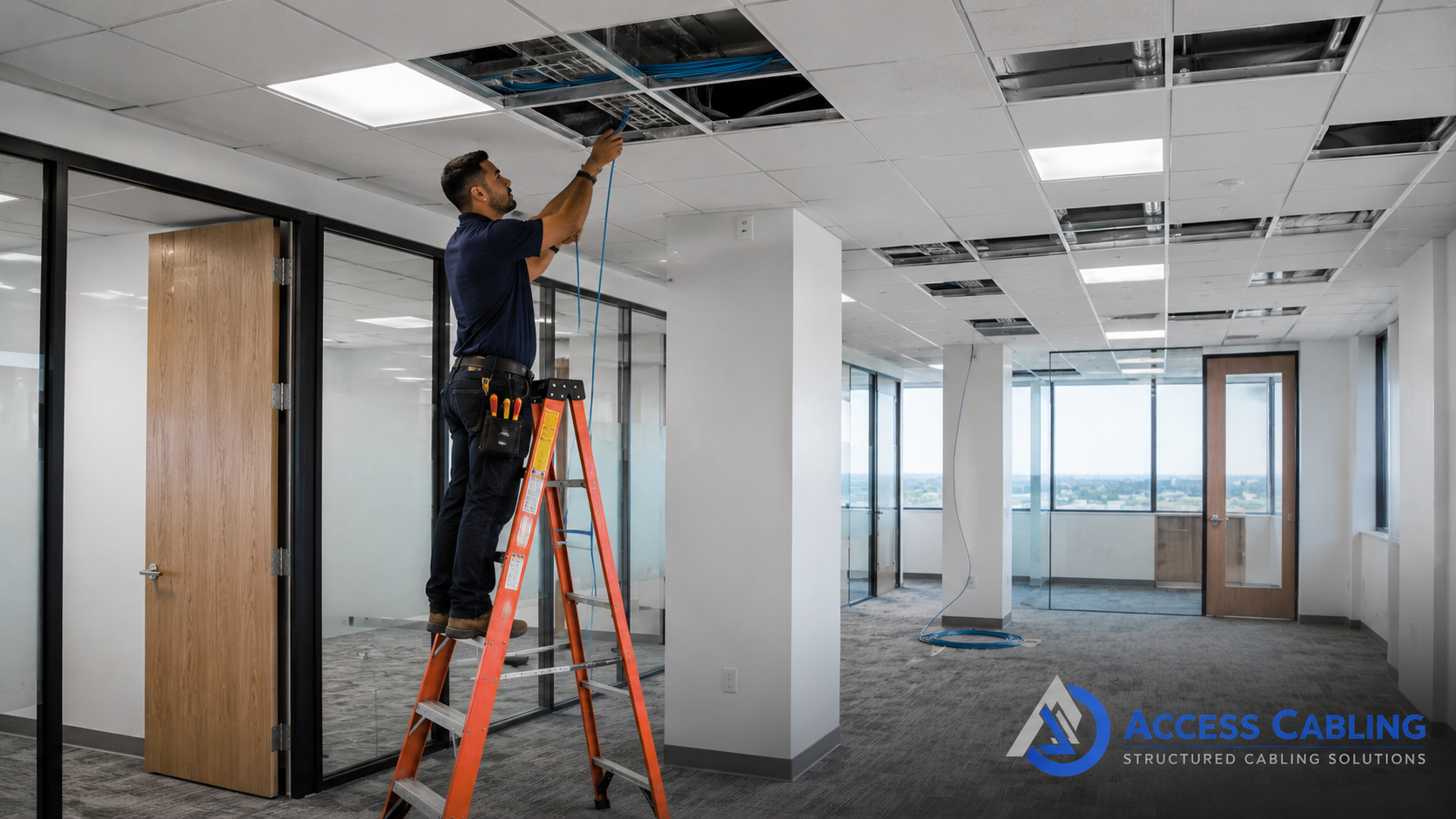
Your California Abandoned Cable Removal Contractor
Access Cabling specializes in commercial low-voltage infrastructure — design, installation, demolition and documentation.
Offices, warehouses, multi-tenant buildings, healthcare, education and government sites.
Photographs, scope confirmation and documentation showing the completed removal.
Commercial Cable Removal Throughout California
Crews dispatch from five California offices for tenant move-outs, turnovers and low-voltage demolition.
Abandoned cable removal questions
Does California require abandoned low-voltage cable to be removed?+
The California Electrical Code (Title 24, Part 3) incorporates National Electrical Code requirements that address abandoned communications cabling. NEC Article 800.25 — Abandoned Cables requires that the accessible portion of abandoned communications cables be removed, while cabling that is properly identified for future use may be permitted to remain. How the requirement applies to a specific building is determined by the local Authority Having Jurisdiction. Review the official sources directly: dgs.ca.gov/BSC/Codes for the California Electrical Code and link.nfpa.org/free-access/publications/70 for NFPA 70.
What is considered abandoned communications cabling?+
Cabling that is not in use, is no longer terminated to equipment, and is not properly identified for future use may qualify as abandoned communications cabling. Cabling that remains in service, or that is properly tagged and identified for future use, is treated differently. Field conditions and the local Authority Having Jurisdiction determine how the definition is applied on a given project.
Does a tenant have to remove network cabling when moving out?+
The code establishes requirements concerning abandoned cable; it does not simply make every departing tenant remove every cable or pay for removal. The lease, surrender requirements, construction agreements and the circumstances of the space determine whether the tenant or the property owner is responsible. If your lease or surrender obligation requires removal, Access Cabling can perform the work.
Can existing Cat6 cabling stay in place?+
Cabling that is still in use, or that is properly identified for future use, may be permitted to remain. We trace and label what is active or designated for reuse so the next tenant can keep usable infrastructure instead of paying to re-cable the suite.
Can Access Cabling remove cable above a suspended ceiling?+
Yes. Above ceiling cable removal is routine work for our crews — suspended grid, open ceilings and hard-lid areas, including cable resting on tile, grid and mechanical equipment. We work after hours or in phases when the building requires it.
Do you remove fiber optic cabling?+
Yes, when unused horizontal or backbone fiber is included in the approved scope. Fiber that supports an active circuit or a service provider hand-off is identified and retained unless the owner confirms it can be removed.
Do you provide MDF and IDF cleanup?+
Yes. MDF cleanup and IDF cleanup include removing designated patch cables, patch panels, racks and obsolete equipment within scope, dressing the cabling that remains, and photographing the finished telecommunications spaces.
Can you remove the old cabling and install the new cabling?+
Yes. Access Cabling handles low-voltage demolition and new structured cabling installation — Cat6, Cat6A, fiber, security and AV — so one contractor carries the project from demolition through new infrastructure installation.
What about old fire alarm cabling?+
Fire alarm and other life-safety cabling must be evaluated separately before removal. Cabling associated with an active or required life-safety system should not be removed without confirming the system status, the approved scope and applicable AHJ requirements.
Read the code for yourself
Both references below are official sources. Requirements and their application are determined by the adopted code and the local Authority Having Jurisdiction.
2025 California Electrical Code — Title 24, Part 3Effective January 1, 2026
https://www.dgs.ca.gov/BSC/Codes
Article 800.25 — Abandoned CablesFree public access to NFPA 70
https://link.nfpa.org/free-access/publications/70
Don't leave thousands of feet of unused low-voltage cabling behind.
Access Cabling surveys the space, traces the existing low-voltage infrastructure, identifies the cabling designated for removal, performs the low-voltage demolition and leaves the suite and telecommunications rooms ready for the next tenant — documented and photographed.
Code requirements and their application can vary based on the project, building and jurisdiction. The local Authority Having Jurisdiction (AHJ) determines application and enforcement of applicable codes. Lease obligations concerning removal of tenant-installed cabling should be reviewed separately. Access Cabling does not provide legal advice.