For organizations maintaining legacy Voice over IP (VoIP), traditional digital phone systems, and 1 Gigabit Ethernet (GbE) network infrastructure, reliable CAT5E cable installation remains a fundamental requirement. While newer cabling technologies offer higher bandwidth, properly installed and certified Category 5e (CAT5E) cabling continues to serve as an economical and robust backbone for numerous low-to-medium bandwidth applications. Access Cabling specializes in the precise design, deployment, and testing of CAT5E infrastructure, ensuring complete compliance with TIA-568-C.2 industry standards and delivering predictable performance for sustained operations. Our methodical approach, coupled with 28 years of nationwide experience as a C-10/C-7 licensed contractor, guarantees that your CAT5E deployments are engineered for longevity and operational stability, avoiding the common pitfalls associated with subpar installation practices.
CAT5E Standards and Performance Metrics
CAT5E, specified under ANSI/TIA-568-C.2, is an enhanced version of Category 5 (CAT5) cable, designed to minimize crosstalk and improve signal integrity. It supports data transmission speeds up to 1000BASE-T (1 Gigabit Ethernet) over distances up to 100 meters (328 feet), and can also handle Power over Ethernet (PoE) for devices like IP phones and wireless access points. Key performance parameters defining CAT5E include near-end crosstalk (NEXT), power sum near-end crosstalk (PSNEXT), equal-level far-end crosstalk (ELFEXT), insertion loss, and return loss, all of which must meet stringent benchmarks specified by TIA standards. Adherence to these metrics ensures that the installed system will reliably support 1 GbE operations without excessive retransmissions or packet loss. Understanding these specifications is critical for proper cable and component selection, as well as for accurate post-installation testing and certification.
System Design and Pathway Planning for CAT5E
Effective CAT5E cable installation begins with meticulous system design and pathway planning. This involves a comprehensive site survey to identify optimal cable routes, avoid electromagnetic interference (EMI) sources (e.g., fluorescent lighting, heavy machinery, power conduits), and determine appropriate conduit or cable tray requirements. We prioritize adherence to BICSI TDMM guidelines for pathway sizing, fill ratios, and bend radius management, which are critical for preserving cable integrity and performance. Proper pathway design anticipates future growth, facilitating easier upgrades or additions while minimizing disruption to existing operations. Factors such as vertical firestopping, horizontal cable management within telecommunications rooms, and appropriate slack management at termination points are integral during the design phase to ensure both current performance and long-term maintainability of the CAT5E infrastructure. Ignoring these foundational elements often leads to premature cable degradation, intermittent network issues, and costly remediation efforts down the line.
CAT5E Component Selection and Compatibility
The performance of a CAT5E system is not solely dependent on the cable itself but on the synergistic interaction of all its components. This includes the specified CAT5E rated copper cable (e.g., 24 AWG UTP), RJ45 modular connectors, patch panels, and patch cords. We exclusively utilize high-quality, TIA-standard compliant components from reputable manufacturers such as CommScope, Panduit, Leviton, and Belden. These components are designed to meet or exceed CAT5E performance specifications, ensuring channel-wide compliance. Crucially, all components within a channel (from patch panel port to outlet) must be rated for at least CAT5E to achieve certified performance. Mixing and matching lower-rated components will degrade the entire channel's capabilities, leading to performance bottlenecks, even if high-quality cable is used. Proper component selection directly impacts system headroom, POE resilience, and overall network stability, making it a non-negotiable aspect of our installation methodology.
Precision Installation Techniques for CAT5E
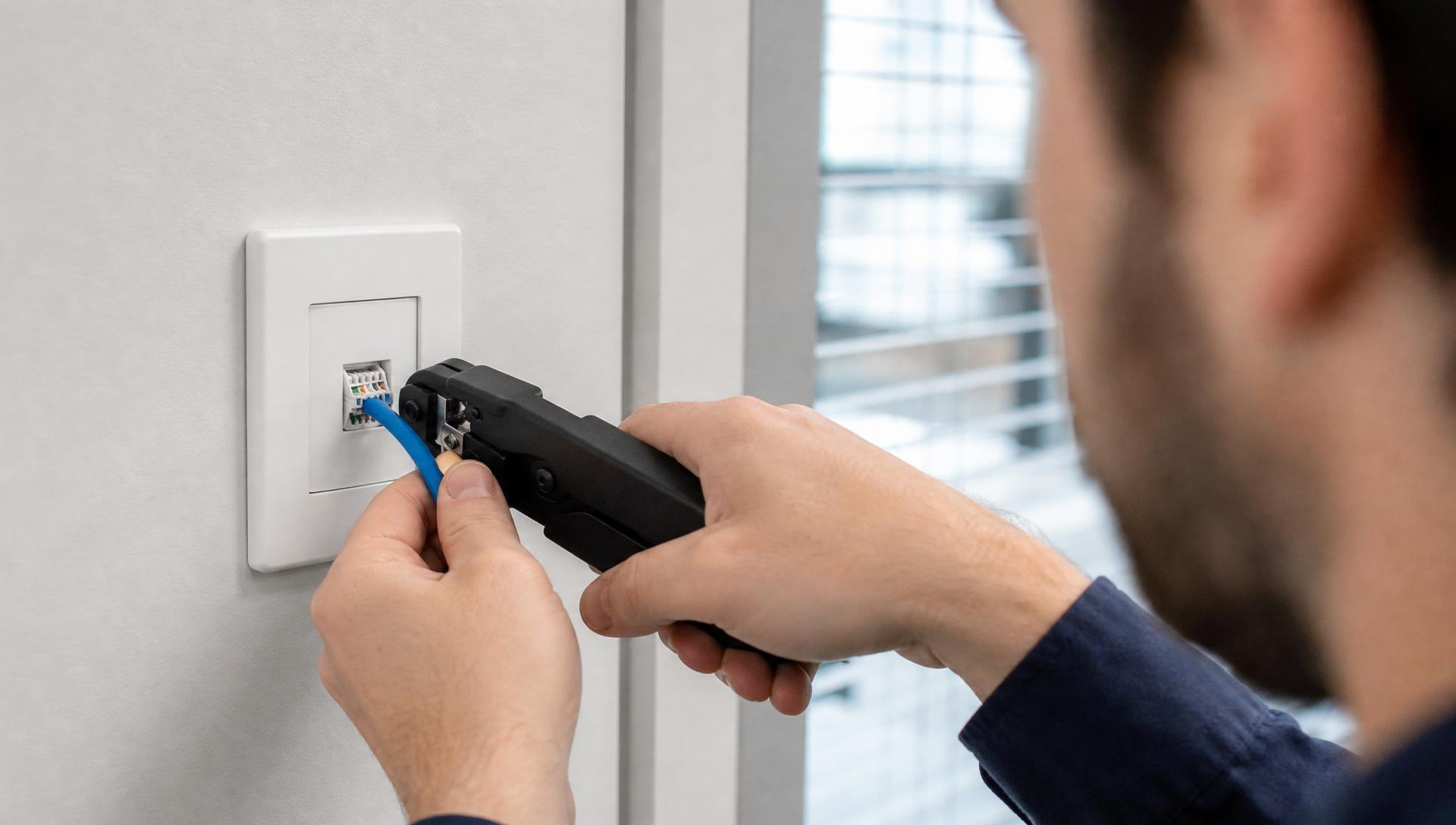
Our CAT5E cable installation methodology is rooted in precision and adherence to industry best practices. Technicians are trained in proper cable handling, including maintaining the minimum bend radius (typically 4x the cable diameter during installation and 8x after installation for permanent bends) to prevent micro-cracks and signal degradation. Labeling is executed per ANSI/TIA-606-C standards, providing clear identification for every cable run from the patch panel to the work area outlet, simplifying troubleshooting and future modifications. Termination at both ends – patch panels and outlets – uses compliant keystone jacks or modules, ensuring proper wire pair segregation and preventing crosstalk. All termination practices follow the T568B wiring scheme, unless T568A is specifically requested and consistently applied throughout the entire installation. This meticulous approach minimizes common installation errors that can otherwise compromise network reliability, such as untwisting pairs excessively or improperly seating conductors.
Rigorous Testing and Certification with Fluke DSX
Upon completion of every CAT5E installation, comprehensive testing and certification are performed to guarantee compliance with ANSI/TIA-568-C.2 standards. We utilize industry-leading Fluke DSX CableAnalyzer series test equipment for accurate, verifiable results. Each installed link is tested for critical parameters including wire map, length, propagation delay, delay skew, insertion loss, return loss, NEXT, PSNEXT, ELFEXT, and PSELFEXT. The Fluke DSX provides detailed PASS/FAIL results for each parameter, generating immutable certification reports that serve as a testament to the system's performance and long-term viability. This rigorous testing process not only confirms that the cabling meets performance specifications for 1 Gigabit Ethernet applications but also provides a baseline for future troubleshooting, identifying potential issues before they manifest as network downtime. Without certified test results, the reliability of any cabling infrastructure remains unproven speculation, making this step absolutely critical for warranty validation and operational assurance.
Common Applications and Longevity Considerations
CAT5E cabling remains highly relevant for numerous commercial applications requiring 1 GbE or less. This includes traditional VoIP phone systems, basic workstation connectivity for general office use, IP security camera systems (especially those utilizing PoE), point-of-sale (POS) systems, and certain building management systems. While higher category cabling exists, CAT5E often presents a cost-effective solution where 10 Gigabit Ethernet (10GbE) or higher speeds are not currently required nor anticipated in the near future. The longevity of a CAT5E installation is directly correlated with the quality of initial design, materials, and installation practices. A well-installed and certified CAT5E system can reliably serve its intended purpose for 10-15 years, provided it is not subjected to physical damage or environmental degradation. Strategic planning considers the expected lifespan of connected hardware, ensuring the cabling infrastructure remains a suitable foundation. It is crucial to assess both current and projected network demands to determine if CAT5E will adequately support an organization's operational trajectory, preventing premature and costly re-cabling projects.
Compliance and Safety Protocols (NEC, NFPA)
All CAT5E cable installations adhere strictly to the National Electrical Code (NEC), specifically Article 770 for Optical Fiber and Communications Cable and Article 800 for Communications Circuits. We also ensure compliance with local building codes, fire safety regulations (NFPA 70 and NFPA 72), and TIA/EIA standards. This includes proper firestopping of all penetrations through fire-rated walls and floors using UL-approved materials to maintain compartmentalization and prevent fire spread. Additionally, cable tray and conduit fill ratios are rigorously observed to prevent overheating and ensure proper airflow, which can impact cable longevity and data integrity. Grounding and bonding of communications infrastructure, as per NEC requirements, is fundamental to mitigate electrical hazards and protect sensitive equipment from electrostatic discharge (ESD) and transient voltage. Our commitment to these safety and compliance standards is unwavering, protecting both personnel and your investment in the cabling infrastructure from regulatory infractions and potential operational failures.
Access Cabling's Unwavering Commitment to Quality
What distinguishes Access Cabling in the realm of CAT5E cable installation is our unwavering commitment to engineering excellence and verified performance. As a C-10/C-7 licensed contractor (CSLB 992009) with 28 years of experience, we do not merely pull and terminate cable; we design and implement robust, standards-compliant, and future-ready infrastructure. Our technicians are factory-trained and BICSI-certified, ensuring they possess the deep technical expertise required for precision installation and troubleshooting. We provide comprehensive documentation packages, including as-built drawings and Fluke DSX certification reports, offering complete transparency and auditability for every circuit. This meticulous approach minimizes service calls, extends the lifespan of your network infrastructure, and provides a dependable foundation for your business operations. Our extensive experience across diverse commercial environments nationwide allows us to anticipate challenges and implement solutions that other integrators might overlook, making your CAT5E deployment a true asset rather than a liability.
Ensuring Electromagnetic Compatibility (EMC) in CAT5E Deployments
Electromagnetic Compatibility (EMC) is a critical, yet often overlooked, factor in successful CAT5E network installations. While CAT5E cable offers inherent noise immunity through its twisted pair design, proper installation practices are paramount to mitigating external interference and preventing signal degradation. We rigorously adhere to TIA/EIA-568-C.2 standards for Alien Crosstalk (AXT) and Near-End Crosstalk (NEXT) reduction, particularly in environments with high electromagnetic interference (EMI) such as industrial facilities, healthcare settings, or data centers adjacent to power distribution infrastructure. This involves strategic cable routing to maintain adequate separation from power lines, fluorescent lighting ballasts, electric motors, and other potential noise sources. Specific attention is given to ensuring proper bonding and grounding of all metallic components, including patch panels, racks, and conduit, to create a low-impedance path for stray currents, minimizing ground loops and common-mode noise. For installations requiring enhanced EMC performance, particularly where unshielded twisted pair (UTP) CAT5E might be susceptible, we implement best practices in cable dressing within pathways. This includes avoidance of tight bundling that can increase crosstalk, and maintaining minimum bend radii to preserve cable geometry and signal integrity. Our technicians are trained to identify potential EMI sources during site surveys and to employ appropriate mitigation strategies, which may include the use of shielded connectors or careful integration with shielded conduit systems where UTP alone is insufficient. This proactive approach ensures the long-term stability and performance of the CAT5E physical layer, providing robust data transmission even in electrically noisy environments.
Further, precise planning for conduit fill ratios and cable segregation within shared pathways is vital. Overfilling conduits can lead to excessive compression and alteration of cable twist rates, compromising impedance characteristics and increasing susceptibility to both internal (e.g., FEXT, ELFEXT) and external interference. Our designs typically adhere to a maximum 40% fill ratio for data cables in conduit, allowing for proper airflow and reducing thermal stress, which can also impact cable performance over time. When CAT5E runs must parallel power lines, we maintain the minimum separation distances specified by BICSI or TIA guidelines, which typically range from 6 to 12 inches depending on the power line voltage and current. In unavoidable cross-over scenarios, we ensure that data cables cross power lines at a 90-degree angle to minimize inductive coupling. We also consider the impact of transient voltage surges and employ appropriate surge protection devices at critical network points, particularly where outdoor runs or interfaces with external power systems are present. This comprehensive approach to EMC ensures that the installed CAT5E infrastructure delivers reliable, error-free communication, fulfilling its role as the backbone for critical enterprise operations, and proactively reducing intermittent network issues often attributed to poor EMI management.
Leveraging CAT5E for Distributed Antenna Systems (DAS) Backhaul
While often categorized for enterprise LANs, CAT5E's capabilities extend to various specialized applications, including its utility as a cost-effective backhaul for Distributed Antenna Systems (DAS) in certain scenarios. In smaller to medium-sized DAS deployments, particularly those using analog or passive DAS requiring lower data rates for remote radio heads (RRHs) or access points, CAT5E can serve as a viable and economical alternative to fiber optics or higher-category copper. The critical consideration here is the distance limitation and the specific requirements of the DAS vendor's remote units. Many modern DAS solutions, especially those supporting multi-band, multi-operator configurations, demand higher bandwidth and often proprietary signaling over dedicated fiber. However, for simpler, single-operator, or smaller footprint deployments, CAT5E can effectively carry power-over-Ethernet (PoE) to power smaller remote units, alongside the necessary data signals. Our engineers meticulously evaluate the DAS system architecture, including signal types (e.g., RF over Ethernet, baseband), required data rates, and manufacturer specifications, to determine the suitability of CAT5E. This involves calculating voltage drop over specified cable lengths when utilizing PoE/PoE+ (IEEE 802.3af/at) to ensure adequate power delivery to RRHs, particularly for runs approaching the 100-meter limit.
The primary advantage of using CAT5E in these specific DAS applications is the reduced material and installation cost compared to fiber and the inherent ease of termination and testing. However, this is balanced against potential limitations. Signal attenuation over CAT5E becomes more pronounced at higher frequencies, which impacts the maximum usable distance for RF-over-Ethernet DAS configurations. Therefore, link loss budgets are rigorously calculated to ensure sufficient signal strength at the remote antenna unit. Furthermore, while CAT5E supports gigabit Ethernet, the aggregate bandwidth requirements of a large, modern DAS often exceed its capacity, necessitating an upgrade path to CAT6A or fiber. Our project planning for such deployments includes a detailed analysis of the expected growth of wireless services and potential future technology upgrades for the DAS, providing clients with a clear roadmap for scalability. We ensure proper grounding and shielding practices are employed, as DAS often operates in close proximity to sensitive RF equipment, necessitating strict adherence to EMC guidelines to prevent interference. Our expertise allows for intelligent integration of CAT5E within the DAS infrastructure, optimizing cost without compromising performance for suitable applications.
CAT5E Project Management and Multi-Trade Coordination
Successful CAT5E installation projects, particularly in new build-outs or major renovations, rely heavily on effective project management and seamless coordination with other trades. As the communications cabling contractor, Access Cabling assumes a pivotal role in orchestrating our work with electrical, HVAC, plumbing (MEP), and even architectural finishing teams. Our project managers initiate coordination early in the planning phase through BIM (Building Information Modeling) if available, or detailed CAD overlays, to identify potential conflicts in pathway routing (e.g., conduit runs, cable trays, plenum space allocation). This proactive approach prevents costly rework and schedule delays. We participate in regular site meetings, providing precise conduit and cable tray sizing requirements, load estimations for racks and cabinets, and precise locations for telecommunications rooms (TRs) and outlets. A crucial aspect is managing penetrations through fire-rated walls and floors; we work directly with the general contractor and fire protection teams to ensure all sleeves, conduits, and cable trays are properly sealed with UL-listed firestop materials to maintain compartmentalization and comply with NFPA 70 (NEC) and local building codes. Our documentation includes detailed cut sheets for all components, shop drawings showing exact cable routes, and a schedule of values that integrates with the overall project timeline, ensuring transparency and accountability.
Furthermore, the timely delivery of materials and the sequencing of installation activities are meticulously planned to align with the overall construction schedule. For instance, rough-in of backbone and horizontal cabling often occurs concurrently with the framing and MEP rough-in, followed by termination and testing during the finishing stages. We provide clear material requirements and staging area needs to the general contractor, minimizing on-site clutter and maximizing efficiency. Our team coordinates power requirements for TRs and telecom equipment with the electrical contractor, specifying dedicated circuits and suitable receptacle types (e.g., NEMA 5-15R, 5-20R). Any changes or deviations from the original design are meticulously documented through formal RFI (Request for Information) and change order processes, ensuring all stakeholders are informed and agree on modifications. This rigorous project management methodology, coupled with our collaborative approach, ensures that the CAT5E infrastructure is installed efficiently, safely, and in full compliance with all project specifications and regulatory requirements, minimizing disruptions to other trades and facilitating a smooth project handover. We also manage the disposal of waste materials responsibly, adhering to local environmental regulations and contributing to overall site cleanliness and safety.
Lifecycle Cost Analysis and Future-Proofing with CAT5E
While CAT5E might seem a legacy option to some, a comprehensive lifecycle cost analysis often reveals it as a highly cost-effective solution for many applications, particularly when balanced against immediate and anticipated future networking demands. Investing in CAT5E can represent significant upfront savings compared to higher-category cabling like CAT6A or fiber, especially in deployments where current and foreseeable bandwidth requirements do not exceed Gigabit Ethernet. Our approach involves a detailed Total Cost of Ownership (TCO) evaluation, considering not just the material and installation costs, but also the longevity, maintenance overhead, and potential upgrade paths. For smaller offices, retail spaces, or industrial environments where IP cameras, VoIP phones, and standard workstation connectivity are the primary drivers, CAT5E provides robust 1000BASE-T performance without the premium associated with higher-bandwidth media. Key to future-proofing with CAT5E lies in careful infrastructure planning – installing sufficient conduit pathways and generous cable tray capacity to accommodate future upgrades to higher-category copper or fiber without extensive demolition or costly re-cabling.
Our recommendation often includes oversized conduits or additional empty pathways where the client’s technological roadmap indicates potential future needs for multi-gigabit speeds or specialized applications. By installing larger diameter conduits (e.g., 2-inch instead of 1-inch) during the initial CAT5E deployment, the cost difference is minimal, yet it dramatically reduces the expenditure and disruption associated with future re-runs. Furthermore, specifying high-quality, riser-rated (CMR) or plenum-rated (CMP) CAT5E cable ensures compliance with fire safety codes and provides a stable physical medium that can potentially support emerging technologies with efficient signal encoding protocols. While CAT5E does not natively support 10 Gigabit Ethernet over its full 100-meter reach, it can support 2.5GBASE-T and 5GBASE-T (IEEE 802.3bz) over shorter distances with compatible active equipment. Our consultation includes a thorough review of the client's projected network growth, application requirements, and financial constraints to determine if CAT5E, potentially with an 'upgrade-ready' conduit infrastructure, offers the optimal balance of immediate cost savings and future adaptability. This strategic perspective ensures that the installed CAT5E infrastructure delivers maximum value over its operational lifespan, minimizing capital expenditure while providing a reliable and scalable network foundation.