
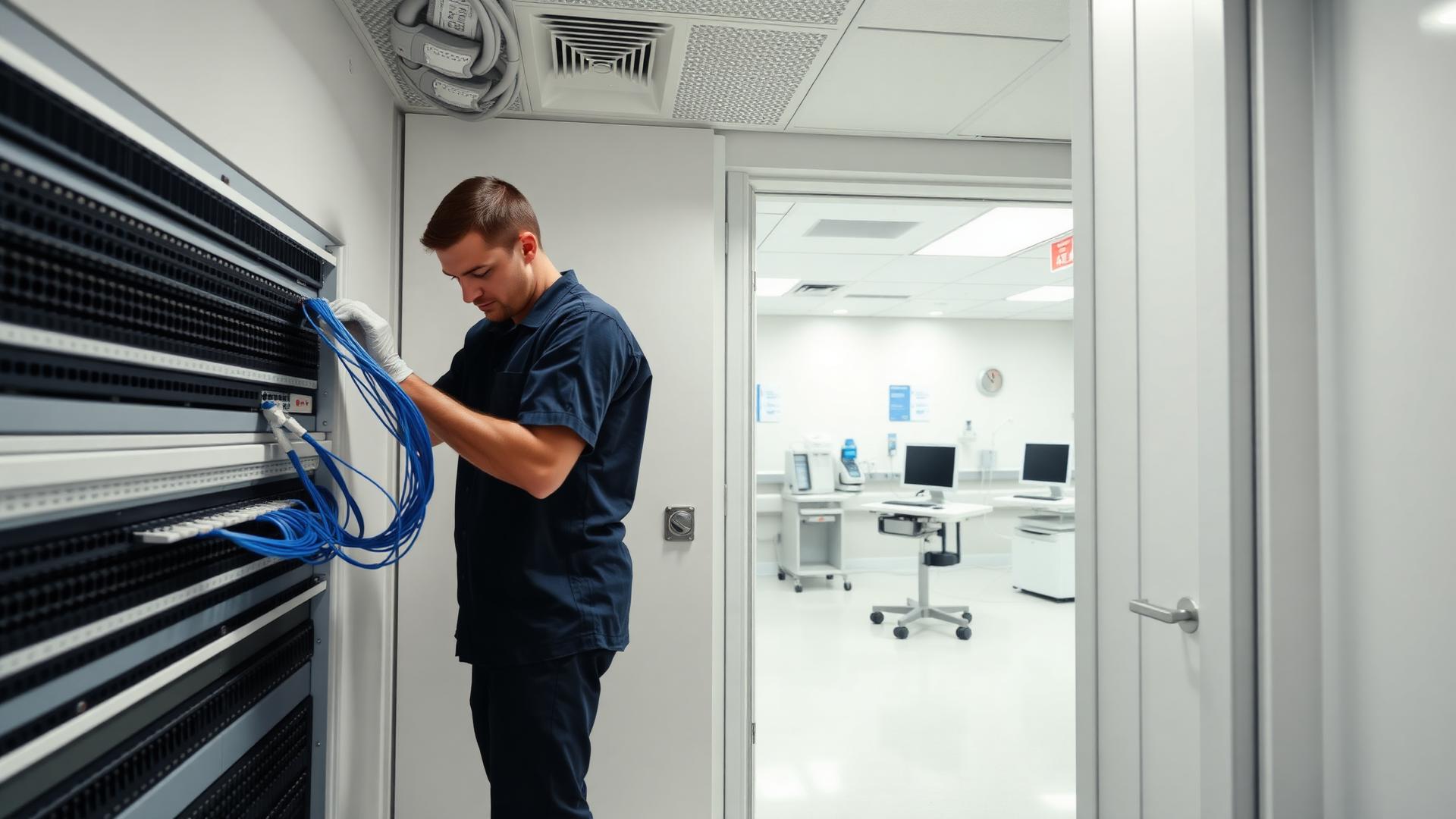
Hospital cabling is a life-safety infrastructure. It carries nurse-call, patient monitoring, imaging, EHR traffic, and the security systems that keep controlled substances locked up. Every project decision has to consider infection control, uptime, and regulatory posture in addition to the usual cabling standards.
- Cat6A is baseline; healthcare-grade jackets are common in patient areas.
- Redundant pathways and diverse fiber routes are required, not optional.
- Cable pathways coordinate with medical gas, imaging, and RF-shielded rooms.
- Every drop is documented for Joint Commission and HIPAA auditability.
Executive summary
Healthcare structured cabling meets or exceeds TIA-1179 (healthcare facilities) with Cat6A horizontal and diverse fiber backbones. Design coordinates with clinical, mechanical, imaging, and IT stakeholders early; installation phases around occupied units; and documentation supports downstream audits. The premium over standard commercial cabling is 15–25% and it is not optional in an accredited facility.
What makes healthcare different
A hospital cannot go dark. Cable pathway work in an occupied unit requires infection control barriers (ICRA), coordination with nursing supervisors, and often after-hours or partial-unit shutdowns. Every hour of the schedule is negotiated with patient care, not just facilities.
Standards and design
- TIA-1179 governs telecommunications infrastructure in healthcare.
- Every patient room typically gets 6–10 drops (nurse call, TV, phone, monitor, EHR, PoE lighting).
- Diverse pathway between MDF and IDFs; single-pathway failures are unacceptable.
- MRI and imaging rooms require RF-shielded penetrations and waveguide entries.
- Copper and fiber pathways coordinate with medical gas and vacuum lines.
Common mistakes
- Treating a clinic like an office — skipping diverse pathways or under-scoping drops per room.
- Missing manufacturer requirements for imaging equipment (fiber-only in MRI faraday cages).
- No labeling to trace clinical devices back to VLAN and firewall policy.
- Coordinating with IT but not with clinical engineering — biomed devices have their own network requirements.
Best practices
- Pre-construction meeting with facilities, IT, clinical engineering, infection control, and nursing supervision.
- Fire-stopping and firestop-tested penetrations documented per NFPA 70/101.
- Every drop labeled with room number, jack ID, patch panel ID, and VLAN assignment.
- As-builts delivered in a format that supports the facility's CMMS.
- Warranty registration through a manufacturer with healthcare-grade cable options.
Typical drop count per space
| Space | Typical drop count |
|---|---|
| Patient room (med/surg) | 6–10 |
| ICU room | 10–14 |
| OR | 16–24 |
| Nurse station | 12–20 |
| Imaging suite (CT/MRI) | 4–8 + fiber to control |
| Pharmacy | 8–12 |
When to call a professional
Every healthcare project should use a low-voltage contractor with recent healthcare experience, ICRA-trained technicians, and current OSHPD/HCAI documentation in California. Generalist crews without healthcare experience cause schedule and infection-control problems that dwarf any labor savings.