
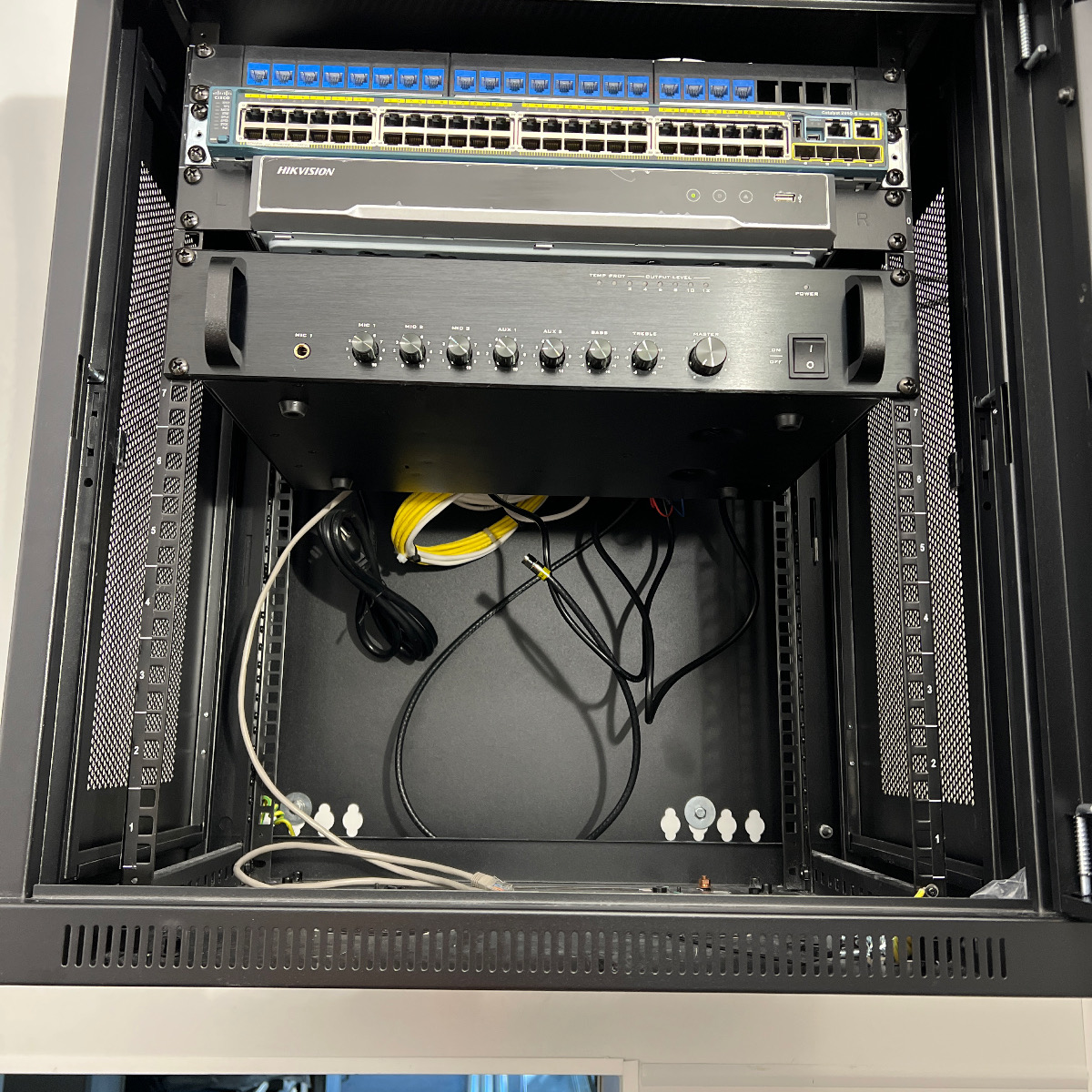
Network security architecture usually starts one layer too high. Firewalls, segmentation, and identity are essential, but the physical layer is where a locked cabinet, a labeled jack, and a bonded ground actually prevent the most common breaches — an unauthorized device plugged into an unlocked drop. Physical-layer security is unglamorous and non-negotiable.
- Every telecom room and MDF should have card-access and video coverage.
- Unused ports at the outlet and the switch should be shut, not just unpatched.
- 802.1X on wired ports; MAB with allow-list on legacy devices.
- Cable pathways above locked ceilings are still accessible from other spaces — plan for that.
Executive summary
A defensible network security posture treats the cable plant as a controlled asset. Card-access on all telecom spaces, per-port 802.1X on the switch, disabled unused ports, and monitored physical alarms on cabinets and telecom rooms make the difference between an infrastructure that can be audited and one that cannot.
The physical layer nobody thinks about
Auditors ask for firewall configs and identity policy; they rarely ask who has the key to the MDF. Every credible incident-response engagement we have seen included at least one entry point that a physical-layer control would have prevented — a live jack in a public area, an unlocked cabinet, or an abandoned demarc room.
Controls to implement
- Card-access on every MDF, IDF, and any cabinet containing switches or network equipment.
- Video coverage of MDF/IDF entry with 30-day retention minimum.
- 802.1X authentication on wired ports; MAB with allow-list where 802.1X is not supported.
- Sticky MAC or port security with 1 MAC per port for legacy devices.
- Shutdown of unused switch ports and outlet jacks.
Common mistakes
- Access-control on the MDF door but not on the drop ceiling above it.
- Guest Wi-Fi on the same VLAN as building automation.
- Legacy 'jack the phone into the conference room' pattern — every unused outlet is a threat.
- No monitoring on the environmental sensors — a door propped open in the MDF should alert.
Best practices
- Physical security controls parity between MDF and every IDF.
- 802.1X for all wired ports; documented exceptions with quarterly review.
- Disable unused ports at the switch and at the wall.
- Environmental monitoring reporting to the SIEM, not just the facility helpdesk.
- Annual physical-security audit alongside the annual network audit.
Cabinet and closet baseline
- Card-access with unique credential per person
- Camera with view of the doorway
- Cabinet lock separate from room lock
- Environmental sensor (temp/door)
- TGB with bonded rack and equipment
When to call a professional
Any organization subject to HIPAA, PCI, SOC 2, or CMMC benefits from a physical-layer security assessment alongside its annual audit. A licensed low-voltage contractor familiar with access control and structured cabling can bring the two disciplines to the same table.