
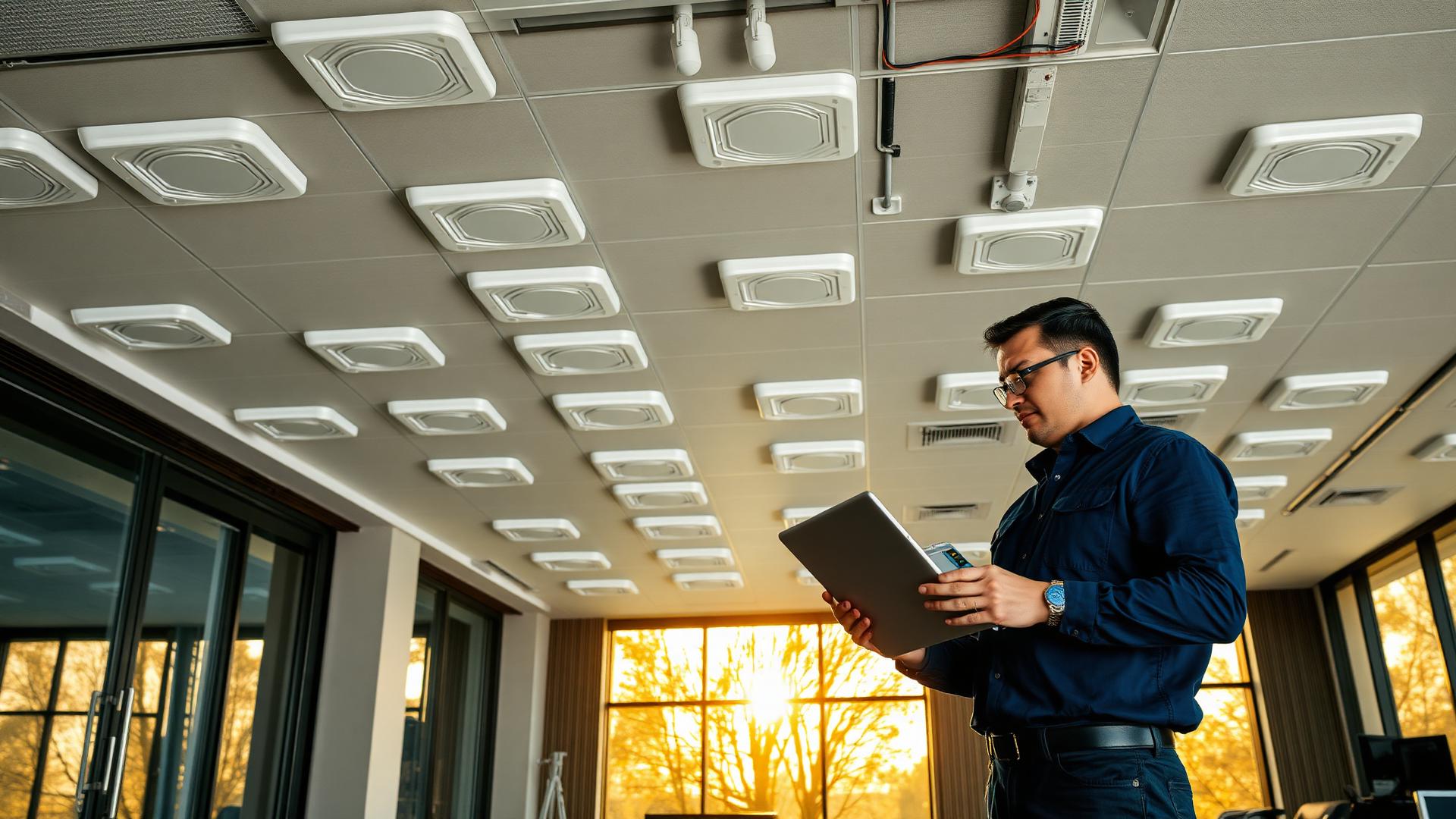
A Distributed Antenna System is what makes a phone work inside a hospital, a stadium, a data center basement, or the interior offices of a modern LEED-glazed high-rise. It rebroadcasts licensed carrier signal — and increasingly public-safety radio — through a network of small antennas fed by a common signal source. In California, and in most of the country, DAS has moved from a tenant amenity to a code-enforced life-safety requirement at plan check.
- DAS extends carrier cellular (and public-safety radio) inside buildings where outdoor signal doesn't reach — hospitals, high-rises, warehouses, basements, LEED buildings with low-e glazing.
- Active DAS uses fiber to remote radio units; passive DAS uses coax and splitters — active scales further, passive is cheaper for small buildings.
- Public-safety DAS (ERRCS/BDA) is now required at building plan check in most California AHJs for structures over ~50,000 sq ft.
- Carrier DAS requires signed carrier approval before broadcast — Verizon, AT&T and T-Mobile each have their own process and none are fast.
- DAS cabling is coax or hybrid fiber-coax and must be pulled separate from data cabling; combining the trades on one contractor saves 15–25% on labor.
Executive summary
Any new commercial building over ~50,000 sq ft in California should have DAS in the design conversation before framing. Public-safety DAS is code-required and enforced at final inspection — retrofit after CO adds 40–80% to the cost. Carrier DAS is a tenant amenity in offices, a revenue lever in retail, and a coverage necessity in hospitals, stadiums, and high-rises. Both share the same in-building distribution and can be designed as one system with two head-ends, which is the cost-efficient path.
The business problem
Modern commercial buildings block cellular signal by design. Low-emissivity glazing, insulated concrete, metal decking, and continuous foil vapor barriers all attenuate the frequencies carriers use. A 250,000 sq ft office tower that meets Title 24 energy code will measure below -110 dBm on most interior floors — unusable for voice, marginal for text.
At the same time, the AHJ (fire marshal) now requires public-safety radio coverage on 90–99% of the building's floor area, tested with a handheld radio walking every corner. Fail the test and the certificate of occupancy is held. This has moved DAS from 'nice to have' to 'design it in or don't get the CO.'
The tenant experience layer sits on top. A law firm signing a 15-year lease will ask about cellular coverage. A hospital cannot dispatch a code team without carrier voice reaching every room. A stadium loses concessions revenue every time 40,000 phones can't process a payment. DAS solves all of it — but only if the design happens before the walls close.
Technical explanation
A DAS has three parts: a signal source (donor antenna, small cell, or off-air BDA), a head-end that conditions and distributes the signal, and antennas throughout the building. The distribution medium is what separates the two main architectures.
| Attribute | Passive DAS | Active DAS | Hybrid DAS |
|---|---|---|---|
| Distribution medium | Coax + splitters/taps | Fiber to remote radio units, coax to antennas | Fiber backbone, coax at zone |
| Typical building size | Under 100,000 sq ft | 100,000 sq ft to multi-million | 50,000–500,000 sq ft |
| Carrier count | 1–3 carriers | 3+ carriers, expandable | 3+ carriers |
| Public-safety support | Yes (BDA/ERRCS) | Yes (dedicated head-end) | Yes |
| Cost per sq ft | $0.50–$1.50 | $1.50–$3.50 | $1.00–$2.50 |
| Design flexibility | Fixed topology | Software-defined zones | Zone-flexible |
Public-safety DAS (also called ERRCS — Emergency Responder Radio Coverage System, or BDA — Bidirectional Amplifier) is a specialized DAS on the licensed public-safety spectrum used by fire, police, and EMS. It's mandated by IFC 510 and NFPA 1221, adopted by most California AHJs. The equipment is separate from the carrier DAS head-end but shares the same distribution cabling and antennas in a well-designed system.
Common mistakes we see in the field
- Treating public-safety DAS as an afterthought at TCO — the coax cable, antennas and battery-backed BDA all need to be roughed in before drywall closes.
- Designing carrier DAS without carrier approval already in progress. Verizon and AT&T both routinely take 90–180 days to sign off; starting the paperwork after construction is over means an empty system for months.
- Undersizing the BDA battery backup. Code (NFPA 1221) requires 12 or 24 hours of standby depending on jurisdiction; retrofit battery cabinets are 3× the cost of installing them at rough-in.
- Combining DAS coax with data cabling in the same tray without proper separation. RF coupling into Cat6 shows up as intermittent link errors that are hard to diagnose.
- Skipping the FCC-required post-install commissioning walk test. Without a signed test report the AHJ won't sign off on the CO.
- Buying an off-the-shelf small-cell 'signal booster' and calling it a DAS. Consumer boosters are not code-compliant for public safety and will not satisfy any AHJ inspection.
Best practices
- Engage a DAS designer at DD (design development), not CD (construction documents). Placement of the head-end, riser cabling, and antennas needs to be in the drawings.
- Do a pre-construction RF survey to establish baseline signal levels — this is the document that proves the DAS is necessary and sizes the system.
- Design public-safety and carrier DAS as one distribution plant with two head-ends. The pathway is 60–70% of the cost; sharing it is the biggest single savings.
- Coordinate carrier applications early. Each carrier has its own Neutral Host or dedicated head-end process. Start month one.
- Locate the head-end near the main telecom room with dedicated power, UPS, HVAC and grounding. It's not a closet install.
- Commission with a walk test. Every zone, every floor, on a service monitor and a public-safety handheld. Deliver the report to the AHJ before final.
Real-world considerations
Cost. A passive DAS in a 60,000 sq ft office might install for $60,000–$90,000. An active DAS in a 500,000 sq ft hospital can be $1.2M–$2.5M all-in. Public-safety DAS alone in a 100,000 sq ft building typically runs $80,000–$140,000. Rough budgeting rule: $1.00–$2.50 per sq ft for a full carrier + public-safety active DAS in a mid-market commercial building.
Ownership models. In enterprise buildings the owner buys and operates the DAS. In some deployments a Neutral Host provider funds and operates the system in exchange for carrier revenue share. In venues (stadiums, airports), the carriers themselves often pay for and operate the DAS. Which model applies changes the entire budgeting conversation.
Small cells and 5G. Small-cell CBRS deployments overlap with traditional DAS and are now viable for coverage in mid-size buildings without the full carrier approval process. 5G on mid-band and mmWave has changed DAS design — mmWave doesn't penetrate walls, so any 5G-mmWave building strategy is DAS by definition.
Public-safety code adoption. California adopted the IFC 510 requirements in the 2019 fire code. Every AHJ interprets slightly differently — Los Angeles, San Francisco, San Jose, and Sacramento all have their own supplemental requirements. Always check with the local fire marshal at DD.
Recommended solution profiles
| Building type | Recommended DAS | Est. cost per sq ft |
|---|---|---|
| Class-A office, 200,000 sq ft | Active carrier DAS + public-safety BDA | $1.50–$2.50 |
| Hospital, 500,000 sq ft | Active carrier DAS + public-safety, redundant head-end | $2.00–$3.50 |
| Warehouse / distribution, 400,000 sq ft | Public-safety BDA + carrier picocells at office | $0.60–$1.20 |
| Retail center / mall | Neutral-host active DAS | Carrier-funded |
| Stadium / arena | Carrier-funded active DAS + Wi-Fi 6E overlay | Carrier-funded |
| Data center | Public-safety BDA only | $0.40–$0.80 |
When to call a professional
Any commercial building over ~50,000 sq ft should have a DAS design conversation at DD. Public-safety DAS in California requires design-build coordination with the AHJ, licensed low-voltage installation (C-7 or C-10 with the appropriate endorsements), FCC-signed commissioning, and battery-backed head-end power. Carrier DAS additionally requires carrier approval before broadcast. This is not a scope any generic electrician or IT reseller can execute — the design, approvals, and commissioning all sit on the DAS integrator, and the AHJ inspection is where under-scoped systems get caught.