
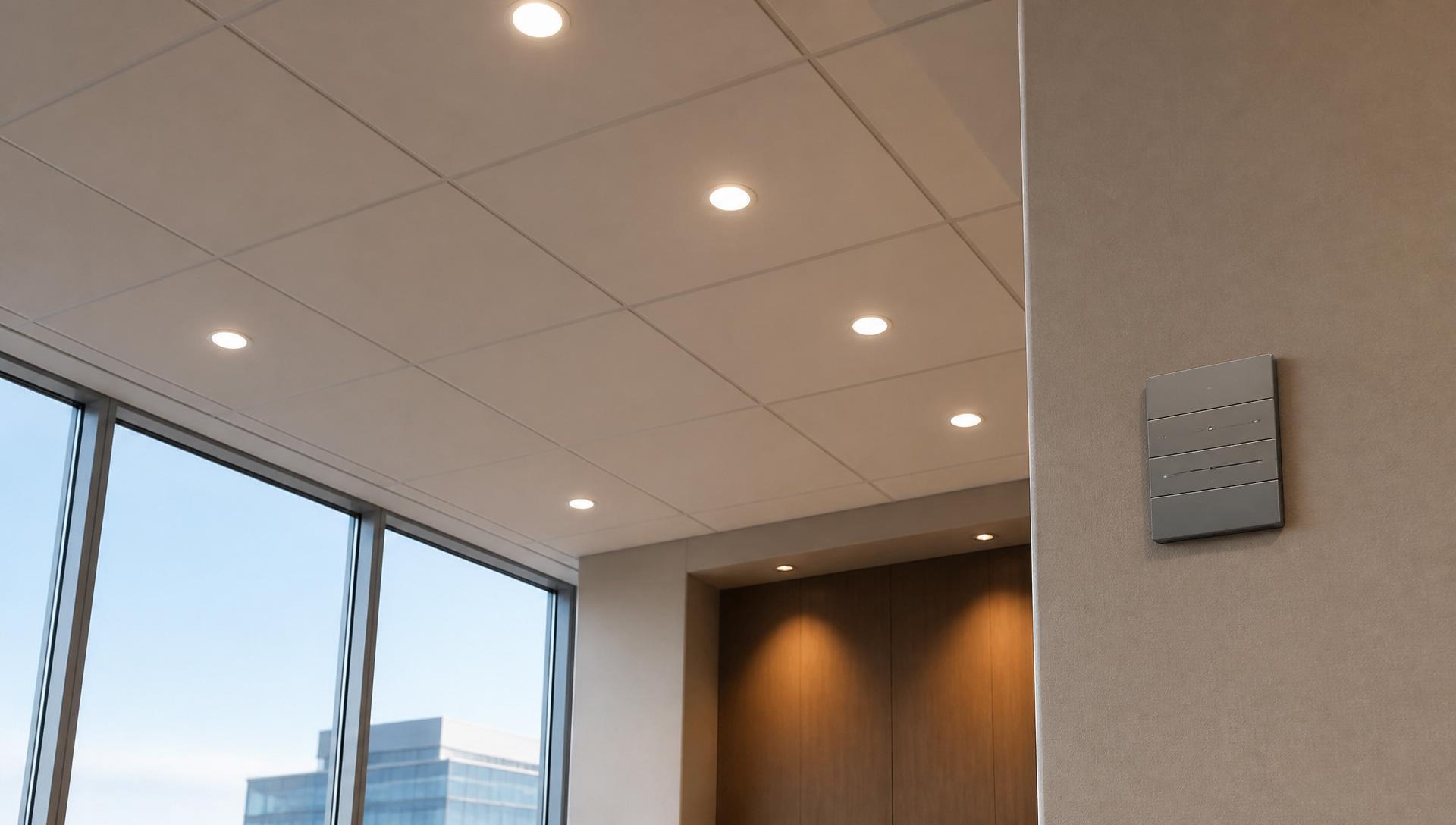
Low-voltage cabling used to serve five discrete systems — data, voice, video, security, and controls — on five discrete networks. Convergence is turning those into one physical infrastructure with logical separation. The buildings we cable in 2026 look more alike than the buildings we cabled in 2016, and less alike than the buildings we will cable in 2030.
- PoE is the delivery mechanism for lighting, sensors, and access points.
- Cat6A is the baseline cable because PoE++ heat and Wi-Fi 6E throughput both need it.
- One physical infrastructure, many logical networks; convergence lives at the switch.
- Documentation and monitoring are what make converged systems maintainable.
Executive summary
Smart buildings are cabled as one physical infrastructure — Cat6A horizontal, OS2 or OM4 backbone — with logical separation at the switch (VLANs, SDN, or per-tenant switches). PoE++ powers lighting, cameras, access points, and increasingly sensors and controls. The buyer benefit is fewer separate contractors, a single documentation set, and a single warranty. The buyer risk is that a poorly-designed convergent system loses everything at once when it fails.
Why convergence, why now
Every new low-voltage system ships with an Ethernet port and PoE compatibility. Running a separate lighting network, a separate access-control network, and a separate HVAC controls network is expensive to install, expensive to maintain, and expensive to modify. Converging on structured cabling reduces material, labor, and long-term operating cost.
What converges
- Lighting — PoE luminaires and drivers now common in Class-A office.
- Access control — IP door controllers with PoE readers.
- HVAC controls — BACnet/IP replacing MS/TP in new construction.
- Digital signage — PoE HDBaseT extenders.
- Sensors — occupancy, environmental, and safety.
Common mistakes
- Under-sizing PoE budget at the switch — 40-port switch with 380 W total is inadequate for a modern floor.
- Missing UPS on the switch that powers lighting — a network outage becomes a lights-out event.
- Treating each subsystem as an isolated project — cabling is duplicated, pathways clash.
- No VLAN or firewall discipline — every device is on the same broadcast domain.
Best practices
- Master low-voltage design coordinated with electrical and IT from schematic design.
- One structured cabling system serving all low-voltage subsystems.
- Per-subsystem VLAN with firewall segmentation.
- PoE budget sized to full deployment plus 25% growth.
- UPS-backed switches for any system that includes life-safety functions.
Reference converged design
| Subsystem | PoE class | Notes |
|---|---|---|
| Wi-Fi APs | Class 6 (60 W) | Wi-Fi 6E/7 |
| IP cameras | Class 4–5 | PTZ higher |
| Access control | Class 3 | Doors, readers, REX |
| PoE lighting | Class 3–5 | Per luminaire |
| Sensors | Class 0–1 | Occupancy, air quality |
When to call a professional
Every new tenant improvement or ground-up commercial building should have a low-voltage master plan produced by a licensed contractor working with the electrical engineer and IT stakeholder. Retrofits benefit from the same conversation before change orders start flowing.
- What Are Low Voltage Systems? — Start with the fundamentals: what low voltage covers, the codes that apply, and California C-7 licensing.