
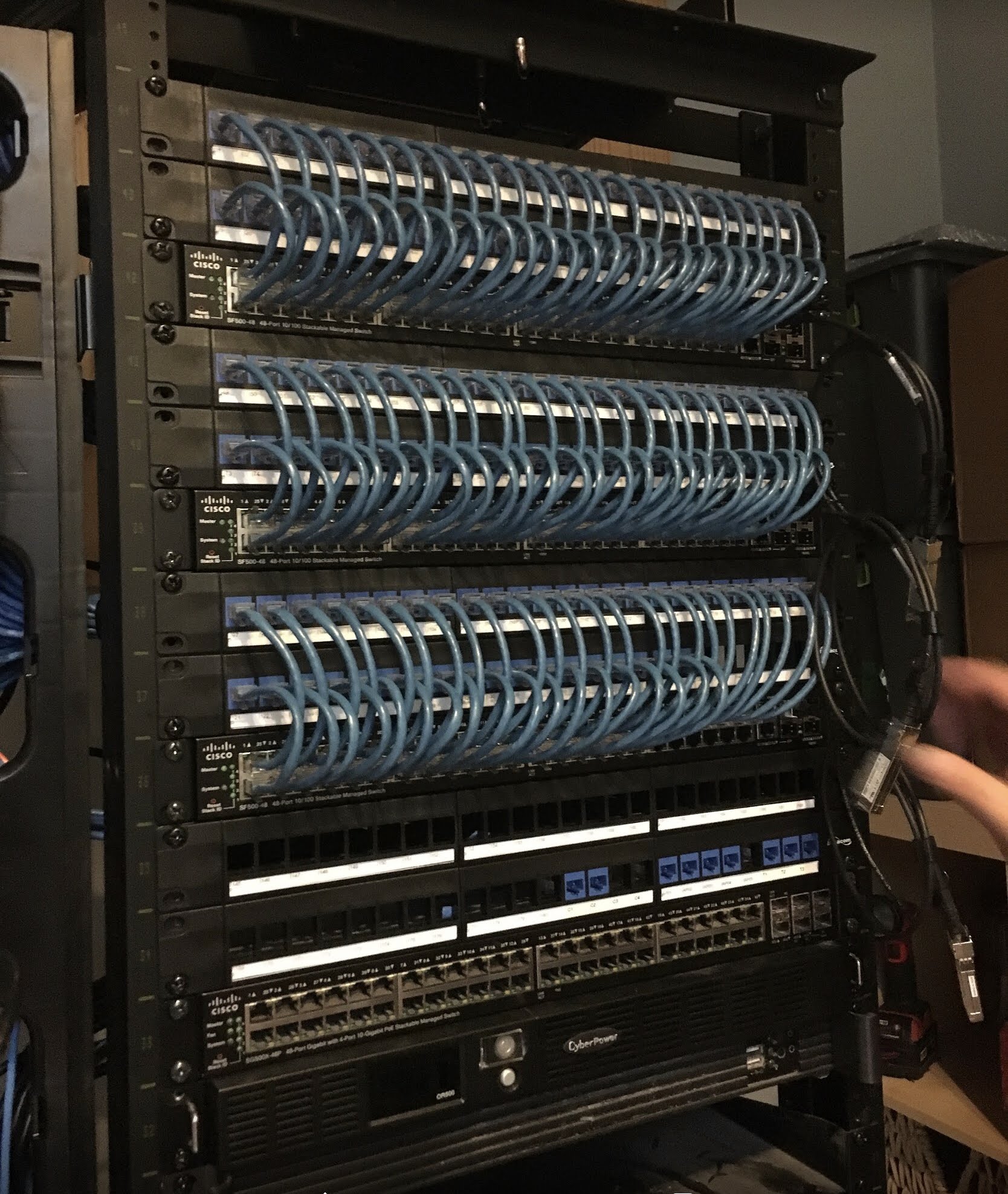
PoE budgets are where switch selection meets electrical planning. A switch with 48 PoE++ ports and a 740 W budget cannot fully power 48 60 W devices. The math is straightforward; the failures happen when nobody does the math.
- Add up worst-case per-port draw; compare against the switch's budget.
- Reserve 25% headroom for growth and transient loads.
- PoE++ (Type 4) is 90 W per port maximum; not every switch supports it.
- UPS runtime scales with PoE load — 60 W per port drains batteries fast.
Executive summary
A well-planned PoE budget documents the per-port class demand, sums it against the switch capacity, and adds a growth margin. Switch stacking, budget-pooling, and UPS sizing all fall out of that math. Skipping it is how buildings end up with switches that quietly disable ports under load.
The switch that runs out of power
Ports go up and stay up until the day a new access point is added and an unrelated port drops. The switch is honoring its budget. The fix — a bigger power supply, a second switch, or a smaller AP — should have been designed at spec time.
PoE classes
| Standard | Type | Max power per port | Common devices |
|---|---|---|---|
| 802.3af | 1 | 15.4 W | IP phones, older APs |
| 802.3at (PoE+) | 2 | 30 W | APs, PTZ cameras |
| 802.3bt | 3 | 60 W | Wi-Fi 6E APs, PoE lighting |
| 802.3bt | 4 | 90 W | Wi-Fi 7 APs, kiosks, TVs |
Common mistakes
- Switch budget matches total port count × class max — no headroom.
- UPS sized for switch idle draw, not PoE load.
- Single power supply on a switch that needs redundant PSUs for PoE.
- Cat6 to a 60 W device on a long run — heat approaches derating.
Best practices
- Build a per-port class inventory and sum against the switch budget.
- Reserve 25% headroom for growth and transients.
- Redundant PSUs on switches that back life-safety devices.
- UPS runtime sized to PoE load, not switch idle.
Sample budget
A 48-port switch dedicated to 32 Wi-Fi 6E APs (60 W each) needs 32 × 60 = 1,920 W of PoE budget plus 25% headroom = 2,400 W. Most 48-port switches ship with 740 W to 1,440 W. Two 24-port PoE++ switches, or a switch with dual power supplies and full-budget PoE, is the correct answer.
When to call a professional
Any deployment with PoE lighting, high-density Wi-Fi 6E/7, or life-safety devices should have a PoE budget worksheet reviewed by the low-voltage contractor and the electrical engineer. The switch spec follows the worksheet, not the other way around.
- What Are Low Voltage Systems? — Where PoE fits inside the wider low-voltage stack — cabling, Wi-Fi, cameras, access control and AV.