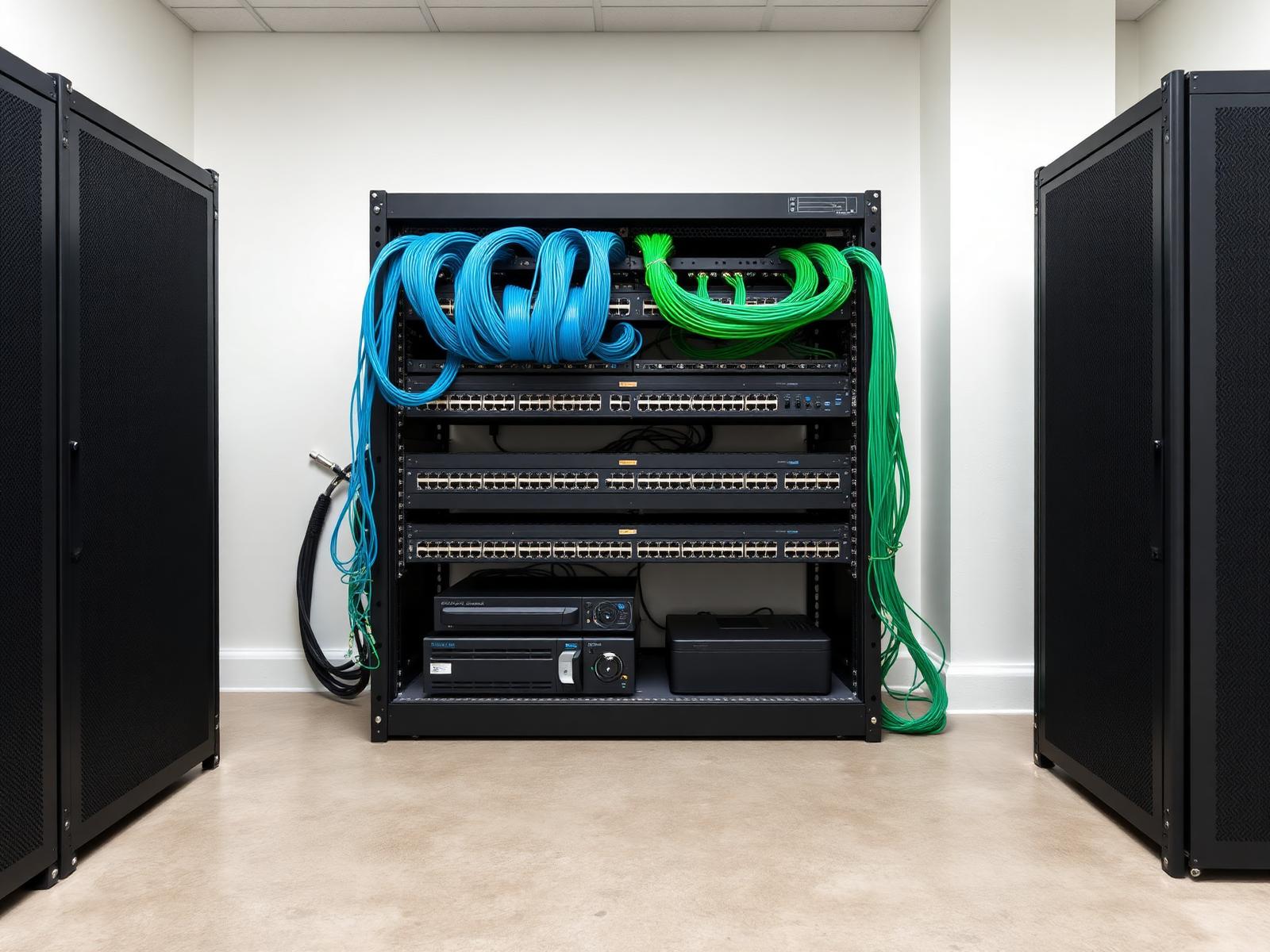
Unmanaged cable infrastructure can severely impede network performance, complicate troubleshooting, and pose significant operational challenges for IT departments and facilities managers. Access Cabling specializes in comprehensive cable cleanup services, transforming chaotic, legacy, or undocumented cable plants into meticulously organized, high-performing, and easily maintainable systems. Our approach goes beyond simple tidying; we re-engineer your physical layer, adhering to BICSI, TIA/EIA, and NEC standards to deliver a future-ready infrastructure. This service is critical for organizations experiencing network bottlenecks, frequent downtime due to cabling issues, or those preparing for significant system upgrades. Our 28 years of nationwide experience provide an unparalleled understanding of diverse environments, ensuring that every cable cleanup project is executed with precision, minimal disruption, and maximum long-term benefit.
Defining Cable Cleanup: Scope and Standards Adherence
Cable cleanup, within the realm of Moves, Adds, and Changes (MAC) services, meticulously addresses the physical layer infrastructure to rectify issues stemming from poor installation practices, accumulated modifications, or inadequate documentation over time. This includes identifying and removing abandoned cable, consolidating pathways, re-routing existing active cables, and ensuring proper slack management. Our process strictly adheres to industry benchmarks such as TIA/EIA-568-D for commercial building telecommunications cabling, TIA/EIA-569-C for telecommunications pathways and spaces, and TIA/EIA-606-C for administration standard for telecommunications infrastructure. The National Electrical Code (NEC), specifically Article 800 for Communications Circuits and Article 770 for Optical Fiber Cables, also governs our approach to firestopping, plenum ratings, and safe practices. For fiber optic systems, we additionally refer to TIA/EIA-568.3-D requirements for fiber optic cabling, ensuring bend radius compliance and proper connectorization. This foundational commitment to standards ensures not just aesthetic improvement, but a robust and compliant physical layer that supports current and future network demands.
Initial Assessment and Engineering for Optimization
Every effective cable cleanup project begins with a thorough site survey and a detailed engineering assessment. Access Cabling's certified RCDDs (Registered Communications Distribution Designers) conduct an exhaustive analysis of the existing cable plant, identifying pathways, active and abandoned cabling, undocumented connections, and potential points of failure. This involves mapping existing data drops, assessing patch panel utilization, and evaluating the condition of existing support structures like cable trays, J-hooks, and conduits. We utilize advanced cable analyzers, such as the Fluke DSX-8000 Versiv Cable Analyzer, to identify poorly performing links that might be masked by the overall chaos. Based on this assessment, a detailed cleanup plan is engineered, specifying re-routing strategies, new pathway designs if necessary, consolidation points, and a comprehensive labeling scheme compliant with TIA/EIA-606-C. This design phase prioritizes minimizing downtime during execution while optimizing for pathway capacity, airflow, and future scalability.
Material Selection for Durability and Performance
The longevity and performance of a re-organized cable plant heavily depend on the quality of materials used. For cable cleanup projects, we specify and integrate components from industry-leading manufacturers such as Panduit, CommScope, Leviton, Belden, and Corning. This includes appropriate cable management hardware – such as vertical and horizontal cable managers (e.g., Panduit NetRunner, CommScope SYSTIMAX Z-MAX), hook-and-loop fasteners (avoiding damaging plastic zip ties), and D-rings. When replacing or extending existing runs, we use copper cabling like Belden 10GX or CommScope SYSTIMAX GigaSPEED X10D for Category 6A applications, or Corning Altos fiber optic cables for high-bandwidth backbones. New patch cords, if required, conform to the same category ratings as the installed horizontal cabling. Patch panels, often a major point of disarray, are replaced or augmented with high-density, clearly labeled solutions (e.g., Leviton eXtreme, Panduit Opti-Jack). Material selection is not merely about brand recognition; it's about matching component specifications to the network's performance requirements and environmental conditions, ensuring consistent throughput and reducing signal degradation.
Structured Installation, Routing, and Slack Management
The execution phase of a cable cleanup is where meticulous planning translates into tangible organization. Our technicians, trained to BICSI standards, meticulously remove abandoned cable in compliance with NEC Article 800.2(A)(3), which mandates the removal of accessible abandoned communications cables. Active cables are carefully re-routed using appropriate bend radius controls as per TIA/EIA-568-D, especially critical for fiber optic cables which have minimum bend radius requirements to prevent signal loss from micro-bending. Proper slack management is implemented in telecommunications rooms (TRs) and equipment rooms (ERs) using dedicated slack loops or horizontal cable managers to prevent snags and facilitate future MACs. All cable bundles are dressed and secured using hook-and-loop fasteners, never plastic zip ties, to prevent cinching and potential long-term damage to conductor pairs or optical fibers. Pathways are optimized to ensure proper segregation of copper and fiber, and compliance with EMI/RFI guidelines is maintained to minimize interference. The emphasis is on creating clean, straight cable runs that are easy to trace, identify, and service, significantly reducing future troubleshooting time.
Comprehensive Testing and Archival Certification
Upon completion of the physical cleanup and re-organization, every active cable link undergoes rigorous testing and certification. For copper cabling, this involves comprehensive testing for parameters such as wire map, length, propagation delay, delay skew, NEXT (Near-End Crosstalk), FEXT (Far-End Crosstalk), insertion loss, and return loss using industry-standard certifiers like the Fluke DSX-8000. These tests verify performance against TIA/EIA-568-D Category 5e, 6, 6A, or above specifications. For fiber optic cabling, we perform Tier 1 testing (power loss/attenuation and length) using an Optical Loss Test Set (OLTS) and Tier 2 testing (OTDR trace analysis) to identify splices, connectors, and potential defects, compliant with TIA-568.3-D and ISO/IEC 11801 standards. Each certified link receives a unique ID, and all test results are compiled into a comprehensive report, frequently provided in both digital and printed formats. This certification report serves as an invaluable baseline for future network diagnostics and validates the integrity and performance of the newly organized infrastructure, providing crucial documentation for the client's asset management.
Addressing Common Use Cases and Operational Benefits
Cable cleanup services are particularly beneficial in several common scenarios. Organizations experiencing frequent network outages or intermittent connectivity issues often find the root cause in an unmanaged cable plant, which diagnostics become nearly impossible in. Data center refreshes or migrations, where consolidating and optimizing existing infrastructure is key to maximizing rack space and improving cooling efficiency, are prime candidates. Post-acquisition integrations, where disparate network infrastructures need to be harmonized and standardized, also heavily rely on effective cable management. Furthermore, any office relocation or significant departmental reconfigurations present an opportunity to implement a clean, well-managed cable plant from the outset. The operational benefits are substantial: reduced mean time to repair (MTTR) for network issues, improved airflow and cooling efficiency in server rooms, extended lifespan of active equipment due to better thermal management, clearer pathways for future expansion, and a significantly enhanced aesthetic that reflects professionalism and attention to detail within the IT space.
Ensuring Compliance, Safety, and Long-Term Maintainability
Beyond performance, a professional cable cleanup rigorously addresses compliance and safety mandates. Adherence to NEC mandates for communications cabling, including proper firestopping in penetrations through fire-rated walls and floors, and correctly rated cables (e.g., plenum-rated CMP cable in air plenums), is paramount to fire safety. Our technicians are trained in identifying and mitigating potential safety hazards such as overloaded cable trays, improperly secured cables creating tripping hazards, or exposed conductive parts. From a long-term maintainability perspective, our structured approach ensures every cable is clearly labeled at both ends as per TIA/EIA-606-C, simplifying future Moves, Adds, and Changes. We implement logical labeling schemes (e.g., TR1-A-1-F1 for Telecom Room 1, Rack A, Panel 1, Port F1) that are easily understood and consistent across the entire infrastructure. This dramatically reduces the time and effort required for future maintenance, making the physical layer a predictable, manageable asset rather than a constant source of operational overhead.
Access Cabling's Distinctive Project Management and Delivery
What distinguishes Access Cabling in cable cleanup projects is our comprehensive project management and unwavering commitment to client communication. Unlike vendors who simply tidy up visible cables, we deliver a fully engineered and documented solution. Our dedicated project managers act as a single point of contact, coordinating all aspects from initial assessment to final certification and documentation handover. We meticulously plan and phase the cleanup work to minimize disruption to your ongoing operations, often performing work during off-hours or weekends if required. Our technicians are not only BICSI-certified but also undergo continuous training in the latest cabling standards and manufacturer best practices. We provide detailed, ‘as-built’ documentation including floor plans showing cable runs, patch panel layouts, and comprehensive test results, which become critical assets for your facilities and IT teams. This holistic approach ensures that your cable cleanup is not just a temporary fix, but a strategic investment in a resilient, high-performance, and easily manageable network infrastructure.
Advanced Remediation of Legacy Infrastructure Challenges
Cable cleanup initiatives frequently encounter deeply entrenched legacy infrastructure, characterized by undocumented, non-standardized cabling dating back decades. This presents significant challenges beyond simple untangling. Our approach includes identifying and isolating active circuits from abandoned copper and fiber optic runs, a process that often requires specialized tone generators with inductive clamps for copper pairs and optical time domain reflectometers (OTDRs) with visual fault locators (VFLs) for fiber. We prioritize maintaining service continuity during this discovery phase, often implementing temporary bypasses or establishing a 'cold cut' window with meticulous pre-planning and stakeholder communication. Pitfalls include misidentifying active circuits, leading to service interruptions, or failing to account for environmental factors like asbestos-containing materials (ACMs) in older conduit systems, which necessitate strict adherence to OSHA 29 CFR 1926.1101 and engagement of certified abatement specialists. Our remediation strategies extend to upgrading or replacing outdated cable support systems – including deteriorating ladder racks, sagging J-hooks, and overloaded cable trays – to comply with BICSI TDMM guidelines and prevent future sag, crimping, or exceeding fill ratios. This proactive overhaul ensures the cleaned infrastructure is not only organized but also structurally sound for future growth and maintenance. We also address common failure modes observed in legacy systems, such as connector degradation due to repeated movement or environmental exposure, and signal attenuation exacerbated by excessive bend radii or improper splices, implementing best practices for repair or replacement based on TIA/EIA-568 standards for commercial building cabling.
Beyond physical restoration, our remediation encompasses logical documentation reconstruction. Many legacy environments lack accurate blueprints or patching schedules. We employ a multi-faceted approach, combining physical tracing with analysis of switch port mappings and network device configurations to reverse-engineer logical connectivity. This critical step ensures that after the cleanup, the rehabilitated infrastructure is fully mappable and manageable, providing a foundation for subsequent network upgrades or migrations. This often involves the creation of new cable schedules, rack elevation diagrams, and updated floor plans using CAD or equivalent tools, linking physical infrastructure directly to logical network assets. The complexity of these remediations necessitates a deep understanding of historical cabling practices, current industry standards, and forward-looking network designs, enabling Access Cabling to transform chaotic legacy systems into high-performance, maintainable assets.
Strategic Phasing and Live Environment Cutover Protocols
Executing a cable cleanup in a live operational environment demands a meticulously planned, phased migration and cutover strategy to minimize disruption. Access Cabling develops granular cutover plans that include risk assessments, back-out procedures, and dedicated communication protocols for each phase. Our process typically begins with detailed physical and logical inventory verification, cross-referenced with existing documentation (if any) and current network configurations. For active cables to be reorganized or rerouted, we implement a 'trace and verify' standard, utilizing cable identifiers, port mapping, and live traffic monitoring tools to confirm circuit integrity before any physical manipulation. Critical elements of our cutover protocols include establishing defined maintenance windows, often during off-peak hours, and ensuring the availability of redundant paths or temporary loopbacks for mission-critical services. The selection of tools for these live cutovers is paramount; for instance, fiber optic re-patching often involves fusion splicers for permanent, low-loss connections or high-density MPO/MTP systems for quick reconfigurations, always considering minimal insertion loss and return loss specifications (e.g., TIA/EIA-568.3-D). Copper cutovers similarly leverage pre-terminated assemblies or rapid termination tools to expedite connections while adhering to TIA Category 6A or higher performance metrics. Pitfalls include inadequate preparation, leading to extended downtime, or misidentification of active circuits, resulting in unexpected service outages. Our strategy incorporates a 'dry run' for complex cutovers, simulating steps end-to-end to identify potential bottlenecks or errors before live execution.
Furthermore, our strategic phasing considers the long-term technology roadmap of the client. Cable cleanup is not merely about aesthetics; it's an opportunity to future-proof the physical layer. This involves assessing current and anticipated bandwidth requirements, power over Ethernet (PoE) demands, and the potential adoption of new technologies such as Wi-Fi 6E, 5G in-building solutions, or advanced data center interconnects. For example, consolidating cable runs might involve upgrading existing Category 5e to Category 6A or fiber where future 10 Gigabit Ethernet (GbE) or 40/100 GbE is anticipated. We evaluate the total cost of ownership (TCO) implications of these upgrades, balancing initial investment with projected operational savings and extended infrastructure lifespan. Our planning includes detailed coordination with other trades (e.g., HVAC for pathway cooling, electrical for rack power, security for access control) to ensure all interdependencies are managed. Each phase concludes with functional verification testing and a post-implementation review, ensuring all services are restored and performing optimally, documented in detail for ongoing operational support. This rigorous approach minimizes operational impact and maximizes the strategic value derived from the infrastructure cleanup.
Integrating Physical Security and Environmental Controls
A comprehensive cable cleanup extends beyond mere organization, strategically incorporating physical security and environmental control considerations for enhanced infrastructure resilience. Unsecured or disorganized cabling presents significant vulnerabilities, ranging from accidental disconnections to intentional tampering or unauthorized data access. Our methodology includes implementing structured cabling pathways that improve physical security by limiting unauthorized access points. This involves utilizing secure, lockable server cabinets and racks (e.g., compliant with IEC 60529 IP ratings), reinforced cable trays with solid bottoms, and conduit systems that prevent easy cable interception or damage. For sensitive environments, we specify pathways that accommodate tamper-evident cable ties, seals, or even fiber optic monitoring systems that detect intrusions. Furthermore, our design considerations account for electromagnetic interference (EMI) and radio frequency interference (RFI) shielding, particularly for copper cabling in proximity to high-power electrical systems or wireless transmitters, often achieved through proper grounding, bonding, and shielded twisted pair (STP) cables, adhering to TIA/EIA-606-B for administration and labeling where security zones are defined.
The environmental impact of cabling infrastructure, both during installation and throughout its lifecycle, is another critical integration point. Excess, tangled cabling impedes airflow within racks and pathways, leading to hot spots and increased energy consumption for cooling. Our cleanup process actively optimizes cable routing to maximize airflow (e.g., front-to-back or side-to-side cooling designs), utilizing specialized cable management accessories like vertical and horizontal cable managers with airflow-friendly designs. We also factor in power density requirements, ensuring separation of power and data cables to prevent interference and improve safety (e.g., adhering to NEC Article 800 standards). Sustainable practices are embedded in our approach, including the responsible disposal of removed legacy cabling, prioritizing recycling programs for copper and aluminum, and minimizing waste generation. This contributes to reduced carbon footprint and operational costs for the client. We conduct thermal mapping and airflow analysis post-cleanup to quantify improvements in cooling efficiency and identify any remaining thermal anomalies, ensuring the cleaned environment is not only orderly but also optimally conditioned for equipment longevity and energy efficiency, supporting long-term maintainability and reduced TCO.
Code Compliance and Strategic Permitting Navigation
Navigating the complex landscape of local, state, and national codes, along with diligent permitting processes, is a non-negotiable aspect of any major cable cleanup project. Access Cabling maintains deep expertise in interpreting and adhering to relevant standards, which extend far beyond basic TIA/EIA requirements. Our project planning meticulously incorporates the National Electrical Code (NEC) – particularly Articles 770 (Optical Fiber Cables and Raceways), 800 (Communication Circuits), and 820 (Community Antenna Television and Radio Distribution Systems) – to ensure all cabling installations meet stringent safety and performance criteria. This includes proper cable ratings (e.g., plenum, riser, general-purpose) based on building classifications, grounding and bonding requirements for racks and pathways, firestopping measures for penetrations through fire-rated walls and floors using UL-certified materials and methods, and clear separation of low-voltage communication cabling from high-voltage power lines to prevent induction and maintain safety clearances specified in NEC 300.3(C) and 800.133(A)(1)(c). Failure to comply can result in project delays, significant rework, fines, and even safety hazards, underlining the criticality of proactive code adherence.
The permitting process itself often requires working with Authority Having Jurisdiction (AHJ) agencies early in the project lifecycle. This typically involves submitting detailed engineering drawings, scope of work documents, cable schedules, and firestopping plans for review and approval. Access Cabling's project managers are adept at liaising with municipal building departments, fire marshals, and other regulatory bodies, ensuring all required permits (e.g., low-voltage, electrical, fire alarm) are secured before physical work commences. We understand that local interpretations of codes can vary, and our team is experienced in addressing specific jurisdiction amendments or supplemental regulations. For instance, adherence to specific earthquake bracing requirements (e.g., OSHPD in California) or hurricane-resistant mounting in coastal regions may be paramount. Our comprehensive documentation deliverables include 'as-built' drawings that reflect the final, code-compliant installation, crucial for subsequent inspections and for demonstrating compliance throughout the building's lifecycle. This proactive and meticulous approach to code compliance and permitting navigation guarantees not only a safe and functional cabling infrastructure but also mitigates legal and operational risks for our clients, ensuring a smooth project execution free from regulatory impediments.