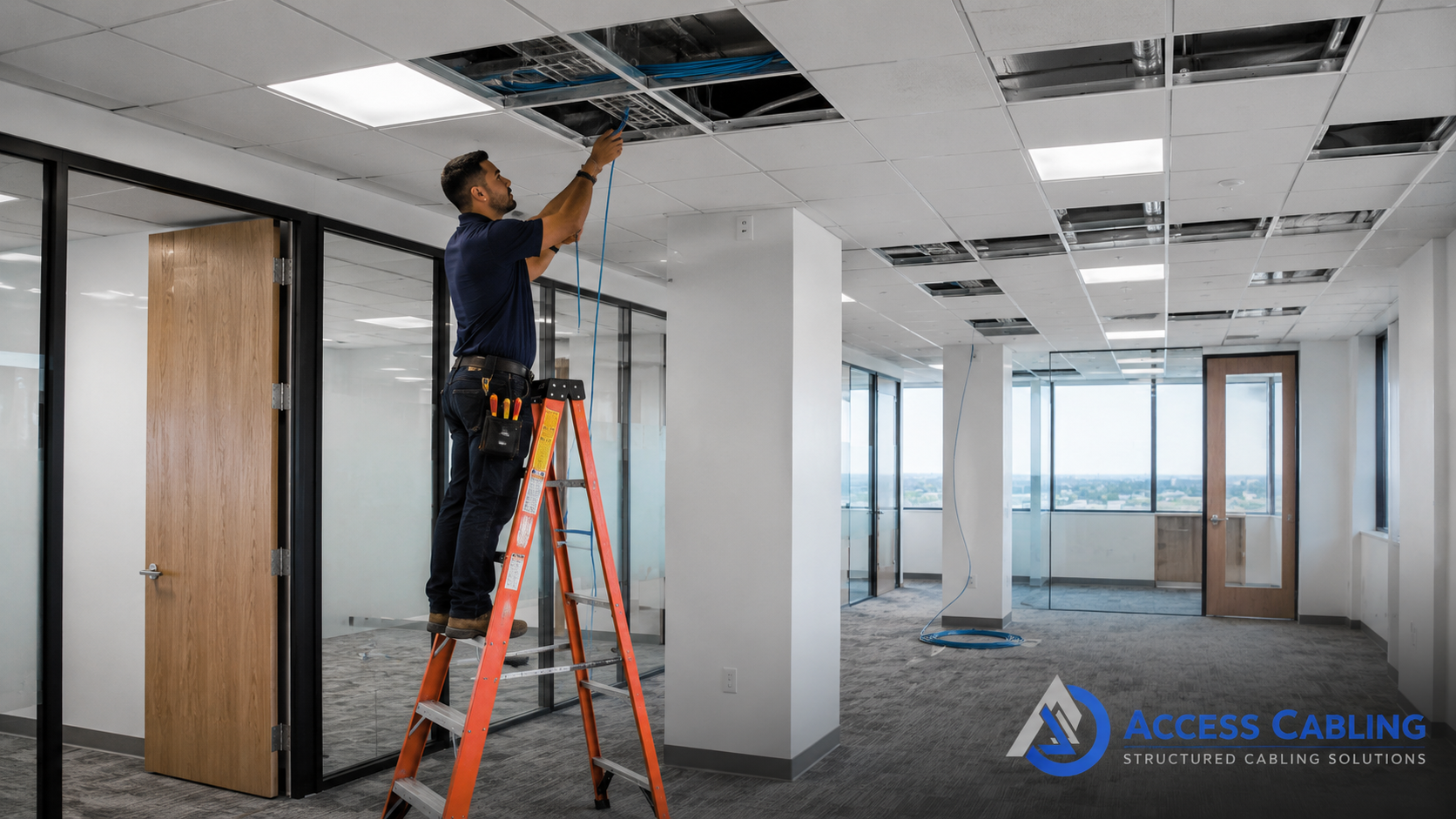
The dynamic nature of modern enterprise necessitates a robust, adaptable network infrastructure. As businesses expand, reconfigure spaces, or adopt new technologies, the underlying low-voltage cabling plant must evolve synchronously. Moves, Adds, and Changes (MACs) are not merely reactive tasks but strategic adjustments crucial for maintaining network performance, reliability, and security. Access Cabling provides comprehensive, structured cabling MAC services designed to meticulously integrate new drops, relocate existing workstations, or upgrade infrastructure components without disruption to ongoing operations. Our approach emphasizes minimal downtime, adherence to industry standards, and a deep understanding of facility and network architecture, ensuring that each modification seamlessly extends the life and efficiency of your low-voltage investment. We deploy certified technicians equipped with manufacturer-specific training and diagnostic tools, translating our 28+ years of experience into precise, future-proof MAC implementations for organizations across diverse sectors.
Defining Moves, Adds, and Changes in Structured Cabling
Moves, Adds, and Changes (MACs) within structured cabling refer to the systematic process of relocating, installing, or modifying network infrastructure to support evolving business requirements. A 'Move' typically involves the physical relocation of an existing network drop or workstation from one point to another within a facility, requiring careful disconnection, rerouting, and reconnection of horizontal cabling, and sometimes cross-connects or patch panel adjustments in the telecommunications room (TR). An 'Add' entails the installation of new cabling infrastructure, including horizontal cabling, outlets, and corresponding TR terminations, to support new workstations, devices, or expanded zones. A 'Change' encompasses modifications to existing infrastructure, such as upgrading cable types (e.g., Cat5e to Cat6A), replacing faulty components like patch cords or keystone jacks, or reconfiguring patch panel assignments to optimize port utilization or accommodate new networking hardware. Each MAC operation is executed with adherence to TIA/EIA 568 series standards, ensuring compliance with established bending radii, termination practices (T568A/B), and pathway fill capacities, thereby preserving the integrity and performance of the entire physical layer.
Strategic Planning and Efficient Execution for MACs
Effective management of Moves, Adds, and Changes relies heavily on meticulous planning and precise execution to minimize operational impact. Our process begins with a detailed site survey and consultation to understand the scope of work, existing infrastructure, and specific client requirements, including preferred timelines and any access restrictions. For moves, this involves identifying the source and destination points, verifying pathway availability, and assessing existing cable and connectivity types. For adds, a comprehensive design phase considers optimal drop locations, pathway routing (e.g., above ceiling, under floor, within walls), and capacity planning for telecommunications rooms. Changes demand a thorough impact assessment, ensuring upgrades or reconfigurations integrate seamlessly with existing active equipment and network services. We utilize detailed floor plans, existing cabling documentation (if available), and sometimes advanced tools like Fluke CableAnalyzers for pre-assessment, allowing us to anticipate challenges and precisely coordinate material staging, technician scheduling, and communication protocols to ensure MACs are completed on schedule, within budget, and with minimal disruption to end-user productivity. Our strategic approach ensures that even minor modifications contribute to the long-term maintainability and scalability of the network.
Component Selection and Standards for MAC Integrations
The longevity and performance of any MAC depend significantly on the quality and compatibility of the components used. Access Cabling strictly adheres to manufacturer guidelines and TIA/EIA standards for all installed and replaced components. This includes selecting appropriate cable types such as Category 6A, 7A, or fiber optic cables (OS2, OM3, OM4, OM5) based on current and future bandwidth requirements, and ensuring all horizontal cabling meets NEC requirements for fire resistance (e.g., Plenum, Riser). We utilize reputable brands like Panduit, CommScope, Leviton, and Corning for outlets, patch panels, patch cords, and fiber optic transceivers, ensuring interoperability and guaranteed performance. For instance, when adding new drops, we ensure keystone jacks and patch panels are rated for the specified cable category and are correctly terminated using the T568B or T568A standard to maintain polarity and minimize crosstalk. Our procurement process prioritizes components that offer system warranties from leading manufacturers, providing our clients with peace of mind regarding the reliability and compliance of their expanded or modified infrastructure. This commitment extends to ensuring that all components are suitable for the environment and meet any specific contractual requirements.
Installation Methodologies and Best Practices for MACs
Our installation methodology for Moves, Adds, and Changes is governed by BICSI ITS IMM standards and industry best practices, ensuring robust and compliant infrastructure. When adding new cable runs, technicians meticulously route cables through designated pathways, observing proper bend radii, avoiding pressure points, and ensuring separation from EMI sources like power lines, as specified in TIA-569-C. For moves, existing cable integrity is verified before and after relocation, often involving re-termination at both the work area outlet and the telecommunications room, ensuring clean and proper dressing of cables within racks and cabinets to maintain airflow and ease of future management. Changes, particularly upgrades, involve careful de-installation of old components and precise installation of new ones, always maintaining network continuity wherever feasible. We employ specific tools for each task, from Panduit termination tools for modular jacks to fiber optic fusion splicers for precision fiber connections. All work areas are kept organized, and disruptions are scheduled during off-peak hours whenever possible to minimize impact on client operations. Post-installation, all newly installed or modified cabling is dressed, labeled clearly according to TIA-606-C standards, and thoroughly documented, providing a precise record for ongoing management.
Comprehensive Testing, Certification, and Documentation
Upon completion of any Move, Add, or Change, Access Cabling performs comprehensive testing and certification to guarantee adherence to TIA/EIA performance standards. For copper cabling, this involves using Fluke Networks DSX Series CableAnalyzers to test for critical parameters such as wire map, length, propagation delay, insertion loss (attenuation), return loss, and near-end crosstalk (NEXT) and far-end crosstalk (FEXT) for all pairs. For fiber optic installations, testing includes OTDR (Optical Time Domain Reflectometer) measurements and end-to-end loss testing with light sources and power meters, verifying insertion loss and basic continuity for multimode (Tier 1) and single-mode (Tier 2) fiber. All test results are compiled into detailed certification reports, providing verifiable proof of compliance and performance. Beyond testing, robust documentation is paramount for effective MAC management. We provide updated floor plans indicating new or moved drops, detailed labeling schemes in accordance with TIA-606-C, and revision-controlled as-built documentation for all infrastructure changes. This meticulous approach ensures traceability, simplifies future troubleshooting, and provides a clear audit trail for the physical layer, crucial for IT directors and facilities managers.
Optimizing Network Agility with Ongoing MAC Services
While individual Moves, Adds, and Changes address specific requirements, a programmatic approach to ongoing MAC services through a service agreement significantly optimizes network agility and reduces administrative overhead. Instead of reacting to discrete requests, a pre-negotiated service level agreement (SLA) establishes agreed-upon response times, pricing structures, and a streamlined process for submitting and executing MAC requests. This proactive framework allows businesses to budget predictable costs for their evolving infrastructure needs and ensures priority scheduling for critical changes. Common use cases include rapid reconfigurations for office re-stacks or departmental moves, fast deployment of new network drops for new hires, and seamless integration of specialized equipment requiring dedicated network connectivity (e.g., surveillance cameras, access control systems, VoIP phones). Such agreements provide dedicated resources and a consistent point of contact, ensuring that every modification, whether minor or extensive, is handled with the same level of expertise and adherence to your organizational standards, accelerating your ability to adapt to market shifts and technological advancements with a reliable, high-performance network.
Ensuring Compliance and Safety in MAC Operations
Compliance with relevant codes and safety regulations is non-negotiable for all Moves, Adds, and Changes. Access Cabling strictly adheres to the National Electrical Code (NEC) article 800 for communications circuits, ensuring proper cable types are used (e.g., CMP for plenum spaces, CMR for riser applications) and installed safely to mitigate fire hazards. All installations comply with local building codes, including pathway fill capacities and firestopping requirements to maintain compartmentalization. Our technicians are OSHA 10/30 certified and trained in safe work practices, including proper ladder usage, fall protection, and Lockout/Tagout procedures when working near active electrical systems. During MAC operations, especially in occupied spaces, we implement strict safety protocols such as clear work zone demarcation, proper tool handling, and debris management to prevent accidents and maintain a safe environment for both our crew and client personnel. This diligent approach not only protects personnel and property but also ensures that all modifications meet regulatory scrutiny, providing clients with a compliant, insurable, and safe infrastructure, reflecting our CSLB 992009 licensing and commitment to industry best practices.
Differentiating Access Cabling's MAC Service Offerings
Access Cabling differentiates its MAC services through a comprehensive blend of extensive experience, certified expertise, and a client-centric operational framework. Unlike commodity providers, our 28+ years in the low-voltage industry provide unparalleled insight into diverse facility environments and network architectures, enabling us to anticipate challenges and implement optimal solutions for even the most complex MACs. Our team comprises BICSI-certified RCDDs and technicians trained on leading manufacturer platforms (e.g., Panduit ONE, CommScope SYSTIMAX), ensuring that every installation, move, or change is executed with the highest degree of technical proficiency. We prioritize transparent communication, providing detailed proposals and regular updates throughout the project lifecycle. Furthermore, our commitment to using only certified, high-quality components from industry leaders translates into robust, warrantied installations that minimize future service calls. Our ability to scale resources for multi-site rollouts or large-scale reconfigurations nationwide, coupled with our meticulous documentation and dedicated project management, positions Access Cabling as a trusted partner for businesses requiring dependable, future-ready network infrastructure MAC services.
Advanced Project Management for Complex MAC Deployments
Successful Moves, Adds, and Changes (MACs) are critically dependent on rigorous project management, particularly in dynamic enterprise environments where minimal disruption is paramount. Our methodology extends beyond typical IT project frameworks, integrating PRINCE2 principles with Agile adaptability to specifically address the transient nature of MAC projects within a live operational infrastructure. This involves detailed scope definition at the micro-level of every port and cable run, comprehensive risk assessment considering both immediate operational impact and long-term network integrity, and precise resource allocation leveraging certified BICSI RCDDs and OSP designers. For instance, a departmental relocation involving hundreds of workstations requires granular planning: identifying existing cable pathways, assessing conduit fill ratios (e.g., adherence to TIA-569-D pathway and spaces standards), pre-cabling strategies for 'hot cutovers,' and scheduling all activities during maintenance windows to avoid peak business hours. We utilize specialized project management software, such as Microsoft Project integrated with CAD/GIS systems, to track every fiber strand, copper pair, and termination point. This ensures real-time visibility into project status, facilitates immediate identification of potential bottlenecks – like unforeseen structural impediments or conflicting installations by other trades – and allows for rapid re-prioritization of tasks. Our daily stand-up meetings involve not only our cabling technicians but also representatives from IT infrastructure, facilities management, and affected business units, fostering a collaborative environment critical for mitigating inter-departmental friction and ensuring all stakeholders are aligned on project objectives and potential contingencies, such as a fiber optic splice requiring an unscheduled outage.
One of the most frequent pitfalls in complex MAC projects is inadequate coordination with Mechanical, Electrical, and Plumbing (MEP) trades, often leading to clashes in pathway usage, power availability, or cooling requirements for new hardware. Our project managers proactively engage with MEP engineers during the planning phase, utilizing Building Information Modeling (BIM) software to identify and resolve potential conflicts in a virtual environment before they manifest physically. This foresight prevents costly rework and delays. For example, when adding a new server rack requiring increased power density and cooling, we coordinate the installation of dedicated circuits (e.g., NEMA 5-20R or C13/C19 receptacles) and ensure CRAC unit capacity enhancements or hot/cold aisle containment modifications are concurrently executed. Furthermore, cutover strategies are meticulously planned, often involving phased migrations or 'flash cuts' during off-peak hours. Testing protocols, including OTDR traces for fiber and Fluke DSX-8000 certification for copper, are integrated directly into the cutover schedule to validate performance immediately post-change. We also manage vendor coordination for equipment provisioning, ensuring that network hardware (switches, patch panels, SFPs) arrives precisely when needed, preventing staging delays and optimizing the overall deployment timeline, thereby minimizing total cost of ownership by reducing costly downtime and accelerating time-to-service for new infrastructure.
Sustainability and Lifecycle Management in Cabling MACs
Integrating sustainability principles into Moves, Adds, and Changes (MACs) is no longer a peripheral concern but a core aspect of responsible infrastructure management, directly impacting lifecycle costs and corporate environmental responsibility. Our approach to sustainable MACs focuses on material selection, waste reduction, and energy efficiency throughout the cabling lifecycle. We prioritize the reuse of existing infrastructure components whenever technically feasible and compliant with current performance standards (e.g., re-terminating existing Category 6A cable runs if they meet bandwidth requirements and physical integrity checks, rather than entire re-cabling). When new materials are required, we specify products from manufacturers committed to environmental stewardship, such as cables with low-smoke zero-halogen (LSZH) jackets to reduce toxic emissions in case of fire, or those made with recycled content. We also assess the embodied energy and carbon footprint of new cabling products, promoting solutions like thinner diameter Category 6A cables that reduce plastic consumption and optimize pathway space, thereby delaying the need for additional conduit installation.
Waste management during MACs is meticulously controlled to minimize landfill contributions. All discarded cabling, connectors, and packaging materials are categorized and routed to certified recycling facilities. For example, copper cabling is separated for metal reclamation, and plastic components are sent for polymer recycling. Our technicians are trained in efficient cable removal techniques that prevent contamination of recycling streams. Beyond material aspects, we evaluate the long-term energy consumption implications of new cabling deployments. By optimizing cable pathways and ensuring proper bend radius (e.g., TIA/EIA-568-C compliance) and slack management, we reduce signal loss, which in turn minimizes the energy required by active network equipment to transmit data over those links. Furthermore, our documentation includes a 'depreciation and disposition schedule' for all newly installed and modified assets, facilitating future end-of-life planning and ensuring adherence to e-waste regulations, such as WEEE directives. By considering the entire lifecycle – from procurement through installation, operation, and eventual decommissioning – Access Cabling provides MAC services that are both technically sound and environmentally conscientious, contributing to a reduced total cost of ownership (TCO) and enhanced brand reputation for our clients.
Security Integration and Compliance for Network Modifications
Every Move, Add, or Change (MAC) involving network infrastructure creates a potential vulnerability if not managed with an explicit focus on security and regulatory compliance. Our MAC processes are inherently designed to integrate cybersecurity best practices and adhere to industry-specific regulations such as HIPAA, PCI DSS, GLBA, and GDPR. Before any physical modification, a comprehensive security impact assessment is conducted, evaluating how proposed changes to physical media, active equipment location, or network topology might affect data confidentiality, integrity, and availability. For instance, relocating critical servers necessitates assessing the security posture of the new rack space, including physical access controls (e.g., biometric readers, robust cabinet locks compliant with EN 12209), CCTV surveillance, and environmental monitoring systems. Cabling pathways are physically secured to prevent unauthorized access and tampering, utilizing locked patch panels and conduit systems where sensitive data traverses.
During the actual MAC execution, strict chain-of-custody protocols are enforced for all network devices and cabling. Only authorized, background-checked personnel with appropriate security clearances are permitted to perform work within secure areas. Any existing security devices, such as access control readers, IP cameras, or intrusion detection sensors, are carefully decommissioned and reinstalled or recalibrated at the new location, ensuring no lapses in perimeter protection. Post-installation, a rigorous security validation phase is conducted. This includes not only performance testing (e.g., certifying new fiber optic links) but also a re-verification of network segmentation, firewall rules, and port security configurations on affected active equipment (e.g., Cisco's Port Security feature or IEEE 802.1X authentication on switch ports). For regulated industries, this validation includes specific audit procedures to confirm compliance with physical security controls mandated by, for example, PCI DSS requirement 9 ('Restrict physical access to cardholder data'). Detailed documentation of all changes, including physical access logs, equipment serial numbers, and configuration modifications, forms an immutable audit trail, critical for forensic analysis and regulatory reporting. Our methodology ensures that each MAC not only improves network functionality but also strengthens its overall security posture, mitigating risks associated with physical access breaches and maintaining continuous regulatory compliance.
Migration and Cutover Strategies for Zero-Downtime MACs
Executing Moves, Adds, and Changes with minimal to zero downtime is a critical undertaking in high-availability environments, demanding sophisticated migration and cutover strategies. Our approach leverages a combination of redundant infrastructure, phased deployment, and 'hot cutover' techniques to ensure continuous operation. For network moves, this often involves pre-cabling the destination location with new network runs (e.g., deploying redundant Category 6A drops or OS2 fiber runs) while the existing infrastructure remains active. This allows for a parallel operation where new hardware is installed and configured at the new site, tested, and validated against baseline network performance metrics (e.g., latency, jitter, packet loss) before the actual transition. The 'hot cutover' itself is meticulously orchestrated as a sequence of events, often executed during planned maintenance windows outside of peak business hours, minimizing impact on end-users.
Key to this strategy is the use of intelligent patch panels and automated infrastructure management (AIM) systems, such as RiT's PatchView or CommScope's imVision, which provide real-time visibility into port utilization and enable rapid identification of active connections. This helps in precisely identifying which cables need to be moved and at what time. For server or rack migrations, we often employ virtualization technologies to migrate workloads seamlessly to new hardware or locations, transparently to the application layer. Physical equipment is then powered down, moved, and reconnected, often leveraging pre-labeled and color-coded cabling for expedited re-termination. Redundant power feeds (e.g., A+B circuits) and secondary network paths are verified to ensure that if one connection fails during the cutover, traffic can seamlessly failover to another. Comprehensive post-cutover validation, including end-to-end connectivity tests, application performance monitoring, and user acceptance testing (UAT), is mandatory. This includes verifying DHCP assignments, DNS resolution, and access to critical business applications. Detailed rollback plans are always prepared as a contingency, outlining the steps to revert to the previous configuration should unforeseen issues arise. By planning for every eventuality, from cable labeling consistency with TIA-606-C standards to the logistical choreography of equipment relocation, we execute MACs that uphold the highest standards of network availability and operational continuity, providing predictable outcomes and minimizing business disruption.