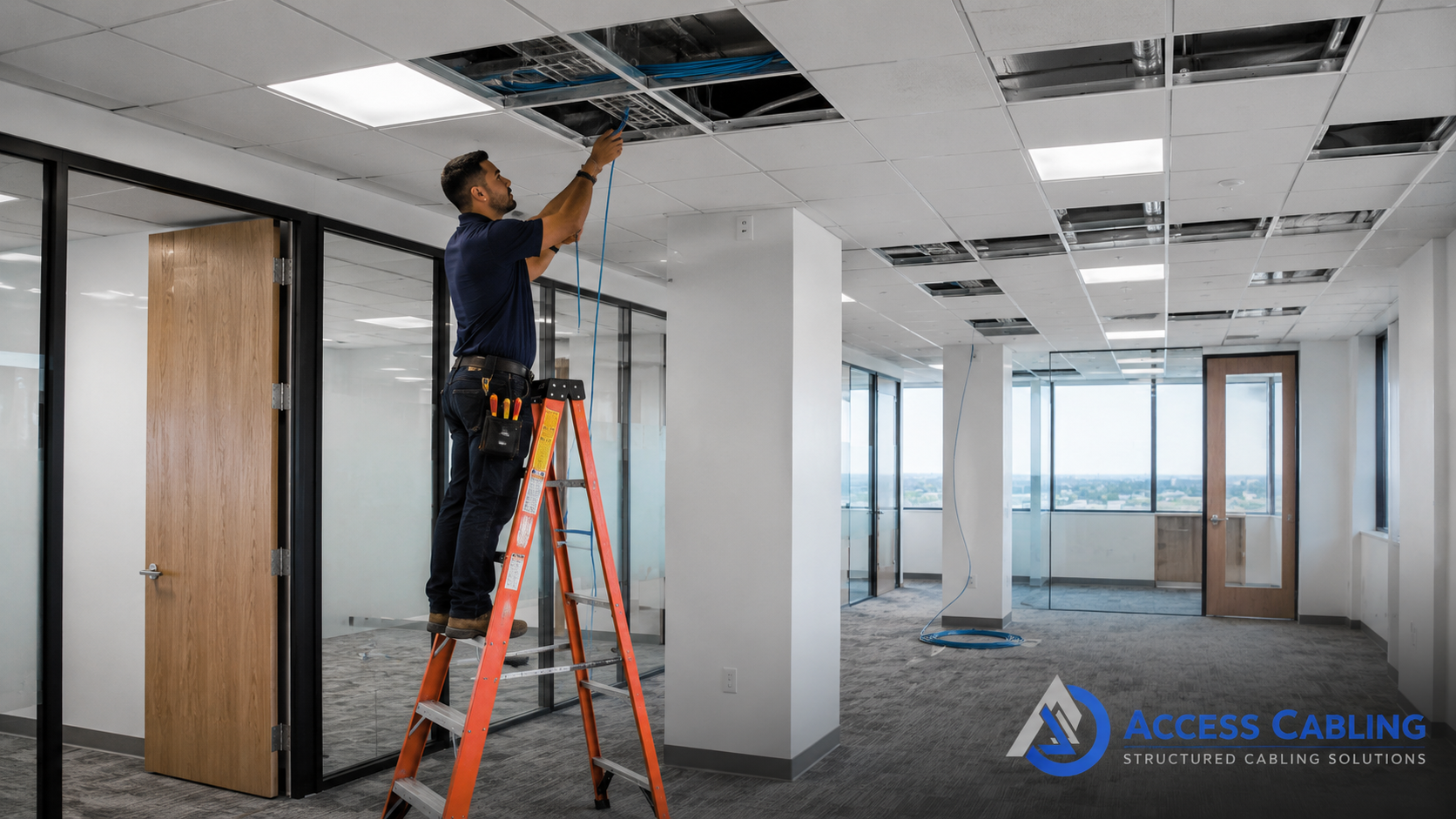
Optimizing network infrastructure is a continuous process, not a one-time deployment. For IT Directors, Facilities Managers, and General Contractors overseeing dynamic commercial environments, the perpetual demand for network Moves, Adds, and Changes (MACs) presents significant operational challenges. These can range from reconfiguring existing workstation drops to integrating new departments or expanding wireless access points. Access Cabling specializes in mitigating these disruptions, providing structured cabling MAC services that maintain network integrity, performance, and future scalability. Our approach is grounded in rigorous adherence to TIA/EIA standards, precise documentation, and the strategic utilization of top-tier materials. We deliver efficient, minimally disruptive MACs, ensuring your network continues to support evolving business requirements without compromising reliability or introducing technical debt. This proactive, professional management of your cabling infrastructure is critical for sustained operational efficiency, making Access Cabling an indispensable partner in maintaining your physical layer.
Defining Network MAC Services and Operational Standards
Network Moves, Adds, and Changes (MACs) encompass any modification to an existing structured cabling system subsequent to its initial deployment. A 'Move' typically involves relocating an existing network device, requiring the extension or re-termination of cabling. An 'Add' introduces new network drops, pathways, or equipment, while a 'Change' modifies existing components, such as upgrading patch panels or consolidating fiber runs. These services are fundamental to supporting organizational growth, technology upgrades, and physical space reconfigurations. Our methodology for executing MACs rigidly adheres to TIA/EIA-568-D series standards, specifically TIA-568-D.1 for premises cabling and TIA-569-C for telecommunications pathways and spaces. We also integrate BICSI TDM guidelines for structured cabling system design and installation. This commitment ensures that every MAC not only resolves an immediate need but also maintains the system’s original performance specifications, category compliance (e.g., Cat6A, OS2 fiber), and future expansion capabilities, thereby preventing the accumulation of technical debt common in poorly managed networks. All work is also performed in compliance with NEC low-voltage wiring regulations, ensuring electrical and fire safety.
Precision Design and Engineering for Seamless Integration
Every MAC, regardless of its apparent simplicity, necessitates a detailed design and engineering approach to avoid unintended network performance degradation. Our process begins with a comprehensive site assessment, leveraging existing as-built documentation (if available) and performing pre-installation Fluke DSX-8000 CableAnalyzer scans to understand the current cabling plant's health. For moves, we re-evaluate pathway capacity (e.g., cable trays, conduit fill rates per TIA-569-C) to ensure new routes do not violate bend radius or segregation requirements for different cable types. Adds involve meticulous planning for new cable runs, often requiring engineering calculations for power over Ethernet (PoE) demands specific to IEEE 802.3bt, ensuring adequate conductor gauge and heat dissipation in cable bundles. Changes, such as patch panel upgrades, are designed to minimize downtime by pre-staging components and planning cutovers during off-peak hours. We specify components from manufacturers like Panduit, CommScope, Leviton, and Belden, ensuring compatibility with existing infrastructure and adherence to original system design principles. This proactive engineering mitigates common MAC pitfalls like exceeding channel length limits, introducing crosstalk, or creating future congestion points, guaranteeing that each modification contributes to a robust and high-performing network.
Strategic Material Selection and Component Compatibility
The longevity and performance of any network modification are directly tied to the quality and compatibility of the materials used. For copper deployments, we adhere strictly to the original cabling category classification, utilizing Cat6, Cat6A, or Cat8 cable from trusted manufacturers like Belden or CommScope, ensuring impedance matching and minimal signal loss. Connectors, such as keystone jacks and patch panels, are selected for their performance rating and compatibility with existing infrastructure, often standardizing on brands like Panduit's TX6A or Leviton's Atlas-X1 lines to maintain channel performance. For fiber optic MACs, we specify appropriate fiber types (e.g., OS2 single-mode, OM4 multimode) and connectors (e.g., LC, SC, MPO) from Corning, ensuring insertion loss budgets are met and light bleed is minimized. All components, including patch cords, cable management systems, and raceways, are chosen not only for their immediate function but also for their contribution to overall system resilience and ease of future maintenance. This meticulous material selection prevents hybrid cable plants with disparate performance characteristics, which can lead to unpredictable network behavior and difficult troubleshooting post-MAC.
Minimally Disruptive Installation and Integration Procedures
Executing MAC installations with minimal disruption to ongoing business operations is paramount. Our field technicians are trained in best practices for live environment work, including dust control, noise reduction, and adherence to client-specific safety protocols. For cable additions, pathways are carefully identified and utilized, often requiring precise coring or conduit extensions while meticulously managing firestopping requirements in accordance with local building codes and UL listings. Cable pulling techniques are employed to prevent kinking, over-tensioning (exceeding manufacturer-specified pull force), or exceeding bend radius limits, which can permanently damage cable performance. Termination practices for all copper and fiber optic drops are performed by certified technicians using manufacturer-specific tools, such as Panduit's QuickNet or Corning's UniCam systems, ensuring consistent, high-quality connections. For critical changes, such as core switch upgrades or fiber backbone re-routes, we collaborate closely with internal IT teams to schedule work during maintenance windows, implement roll-back strategies, and communicate extensively throughout the process. This rigorous approach minimizes downtime and ensures a smooth transition to the modified infrastructure.
Rigorous Testing, Certification, and Detailed Documentation
Every network move, add, or change is followed by comprehensive testing and certification to guarantee adherence to TIA/EIA standards and manufacturer specifications. For copper cabling, we perform Level 2G/IIIe field testing using Fluke DSX-8000 CableAnalyzers, measuring critical parameters such as wire map, length, propagation delay, delay skew, NEXT, FEXT, return loss, and insertion loss for the specified category (e.g., Cat6A channel or permanent link). Fiber optic MACs undergo Tier 1 (power meter and light source) and, where specified, Tier 2 (OTDR) testing to measure end-to-end attenuation, polarity, and identify any macrobends or splices. All test results are compiled into detailed certification reports, providing auditable proof of performance. Post-installation, as-built documentation is meticulously updated to reflect the new cabling routes, termination points, and port assignments. This includes updated floor plans, pathway schematics, and patch panel records, which are crucial for future troubleshooting, maintenance, and further MACs, preventing the 'spaghetti' undocumented cabling phenomenon that plagues many organizations and drives up operational costs.
Versatile Use Cases for Commercial Network Adaptability
The need for network MAC services spans a multitude of commercial scenarios, reflecting the dynamic nature of modern business. Common use cases include office reconfigurations, where workstation densities change or departments relocate, requiring re-routing of existing drops or installation of new ones. Tenant improvements within multi-story buildings frequently necessitate extending building backbone fiber to new floor tenants or establishing dedicated IDF/MDF spaces. Technology refresh cycles often introduce new devices like 10GbE network access points, requiring Cat6A runs, or high-density IP cameras, demanding PoE++ capable cabling. Data center expansions or consolidations involve intricate fiber patching, new power distribution units requiring precise cable management, and structured cabling for new server racks. Furthermore, the growing adoption of IoT devices and building automation systems necessitates additional network drops in non-traditional locations, such as environmental sensors or access control points. Each of these scenarios underscores the critical role of professional MAC services in maintaining a flexible, high-performing, and standards-compliant network infrastructure.
Compliance, Safety, and Long-Term Infrastructure Integrity
Beyond performance, every network MAC service must adhere to a stringent framework of compliance and safety. Access Cabling operates under CSLB 992009, a testament to our commitment to regulatory compliance and professional standards. All installations strictly follow the National Electrical Code (NEC) for low-voltage wiring, particularly Articles 770 (Optical Fiber Cables), 800 (Communications Circuits), and 725 (Class 1, Class 2, and Class 3 Remote-Control, Signaling, and Power-Limited Circuits), ensuring fire safety and proper grounding. Firestopping is implemented for all penetrations through fire-rated walls and floors, utilizing UL-approved materials and methods to maintain compartmentation integrity. Occupational Safety and Health Administration (OSHA) regulations are rigorously followed during all on-site work, including ladder safety, confined space entry protocols, and personal protective equipment (PPE) usage, protecting both our personnel and client employees. By embedding compliance and safety into every MAC operation, we not only deliver a functional network modification but also ensure the long-term integrity, legal adherence, and safe operation of your entire physical layer infrastructure, mitigating liability and ensuring business continuity.
Access Cabling's Differentiated Approach to MACs
Access Cabling differentiates its Network Moves, Adds, and Changes service through a combination of structured methodology, unparalleled expertise, and a commitment to transparent communication. Unlike general contractors who subcontract low-voltage work, we are a licensed C-10/C-7 contractor, ensuring direct control over project quality, timelines, and compliance. Our 28+ years of experience provide a deep institutional knowledge of diverse network architectures and building types, enabling us to anticipate challenges and implement optimal solutions for even the most complex MACs. We assign dedicated project managers who serve as single points of contact, streamlining communication and accountability. Our investment in advanced testing and certification equipment, such as the Fluke DSX-8000, ensures that every MAC is not just completed, but rigorously verified to meet or exceed industry standards. Furthermore, our focus on comprehensive as-built documentation and intelligent cable management during MAC operations significantly reduces future maintenance costs and simplifies network troubleshooting for your internal IT teams. This holistic, proactive approach positions Access Cabling as a trusted partner for managing your evolving network infrastructure.
Advanced Migration and Cutover Strategies for Zero Downtime
Executing network MACs often necessitates a meticulously planned migration and cutover strategy to ensure business continuity and minimize operational disruption. Access Cabling employs a multi-tiered approach, beginning with a comprehensive pre-migration impact analysis that assesses upstream/downstream system dependencies, existing traffic patterns, and potential single points of failure. We leverage sophisticated network simulation tools, such as GNS3 or EVE-NG, to model proposed changes and validate configurations in a sandbox environment before touching live production. Staging environments are utilized for pre-configuring hardware (routers, switches, firewalls, and access points from vendors like Cisco, Juniper, Aruba, or Fortinet) with their final configurations, firmware updates, and license activations, reducing on-site installation time and error potential. For critical infrastructure, parallel run strategies are often implemented, establishing new network paths alongside existing ones, allowing traffic redirection incrementally or via BGP communities/OSPF areas for layer 3 changes, or VLAN migration for layer 2, enabling immediate rollback if unforeseen issues arise without full service interruption. Our technical teams are proficient in scripting automation (e.g., Python with Netmiko or Ansible) for bulk configuration deployments across multiple devices, further reducing manual error and accelerating the cutover process. Post-cutover, a defined monitoring window and rollback plan are standard, utilizing real-time network performance monitoring (e.g., SolarWinds, PRTG, or Dynatrace) to validate service health and immediately address any deviations from baseline performance metrics, effectively safeguarding against prolonged outages during critical transition phases.
Integrated Project Management and Stakeholder Coordination
Successful network MAC projects, particularly those involving significant infrastructure alterations, demand highly integrated project management and rigorous stakeholder coordination. Access Cabling utilizes Prince2 and Agile methodologies, tailored to IT infrastructure deployments, ensuring iterative planning, risk mitigation, and adaptive execution. Our project managers establish a clear communication matrix at project inception, detailing roles, responsibilities, and reporting structures for all internal teams (cabling specialists, network engineers, security analysts) and external stakeholders, including facility management, HVAC, electrical, and data center operations teams. Regular cadences, such as daily stand-ups and weekly progress reports, are maintained, leveraging collaborative platforms like Microsoft Teams or Asana to track tasks, share documentation, and anticipate potential inter-dependencies or conflicts. Specific attention is paid to coordinating with Mechanical, Electrical, and Plumbing (MEP) trades for power delivery, cooling, and conduit pathways, ensuring that physical infrastructure can adequately support new network equipment and cabling density, adhering to NEC (National Electrical Code) and BICSI (Building Industry Consulting Service International) standards. Change management protocols are strictly enforced for any scope modifications, requiring formal approval processes to prevent 'scope creep' and ensure all changes are duly documented and assessed for their impact on budget, timeline, and technical feasibility. This holistic approach minimizes project delays, optimizes resource allocation, and fosters an environment of transparency and accountability across all project facets.
Operational Security and Compliance Adherence in MACs
Implementing network MACs requires an unwavering commitment to maintaining and enhancing existing security postures and regulatory compliance. Every modification, addition, or change to the network infrastructure introduces potential vectors for compromise if not handled with stringent security protocols. Access Cabling employs a 'security-by-design' principle, ensuring that all proposed changes undergo a thorough security impact assessment, evaluating potential vulnerabilities introduced by new hardware, software, or configuration alterations. This includes validating that new devices adhere to established organizational security policies, such as specific hardening guides (e.g., CIS Benchmarks), access control lists (ACLs), multi-factor authentication (MFA) requirements, and network segmentation rules. For additions, proper asset inventory management and integration into Configuration Management Databases (CMDBs) are critical, ensuring clear ownership, patch management schedules, and lifecycle tracking, especially important for compliance frameworks like NIST, ISO 27001, HIPAA, or PCI DSS. During configuration, privileged access management (PAM) tools and role-based access control (RBAC) are utilized to limit technician permissions to only what is necessary, minimizing the risk of unauthorized or accidental changes. Post-implementation, automated vulnerability scanning and penetration testing tools (e.g., Nessus, Qualys, or Rapid7) are deployed to verify that the new topology or devices do not present exploitable weaknesses. Furthermore, all changes are meticulously documented, including network diagrams (physical and logical, using tools like Visio or OmniGraffle), configuration baselines, firewall rule modifications, and audit logs, providing an immutable record for compliance audits and forensic analysis, thereby upholding the integrity and security of the client's information assets.
Lifecycle Management and Total Cost of Ownership Optimization
Effective network MAC services extend beyond immediate implementation to encompass comprehensive lifecycle management, directly influencing the Total Cost of Ownership (TCO) of the network infrastructure. Access Cabling integrates TCO considerations into every phase of a MAC project, starting with technology roadmap alignment. This involves evaluating new equipment and cabling solutions not just on initial purchase price, but on their projected operational expenses (OpEx), including power consumption, cooling requirements, maintenance contracts, software licensing, and ease of management. We prioritize scalable solutions that can accommodate future growth with minimal additional investment, supporting longer refresh cycles and reducing future MAC complexity. For instance, when adding new pathways, we consider deploying higher-density fiber optics (e.g., OM4 or OS2) or future-proof Category 6A/7A copper, even if current demand doesn't fully necessitate it, anticipating 10GbE or 25GbE requirements and delaying the need for costly future re-cabling projects. Depreciation schedules, end-of-life (EOL) considerations for existing hardware, and the transition cost to new technologies are all factored into our recommendations. We assist clients in developing robust asset disposal plans for replaced equipment, ensuring compliance with environmental regulations and data destruction policies, often partnering with certified e-waste recyclers. By analyzing mean time between failures (MTBF) for proposed components and leveraging predictive analytics from network monitoring data, we help clients make informed decisions that optimize financial outlays over the operational lifespan of their network, rather than focusing solely on short-term implementation costs. This proactive approach minimizes unforeseen expenses, extends infrastructure utility, and aligns network investments with long-term business objectives.