
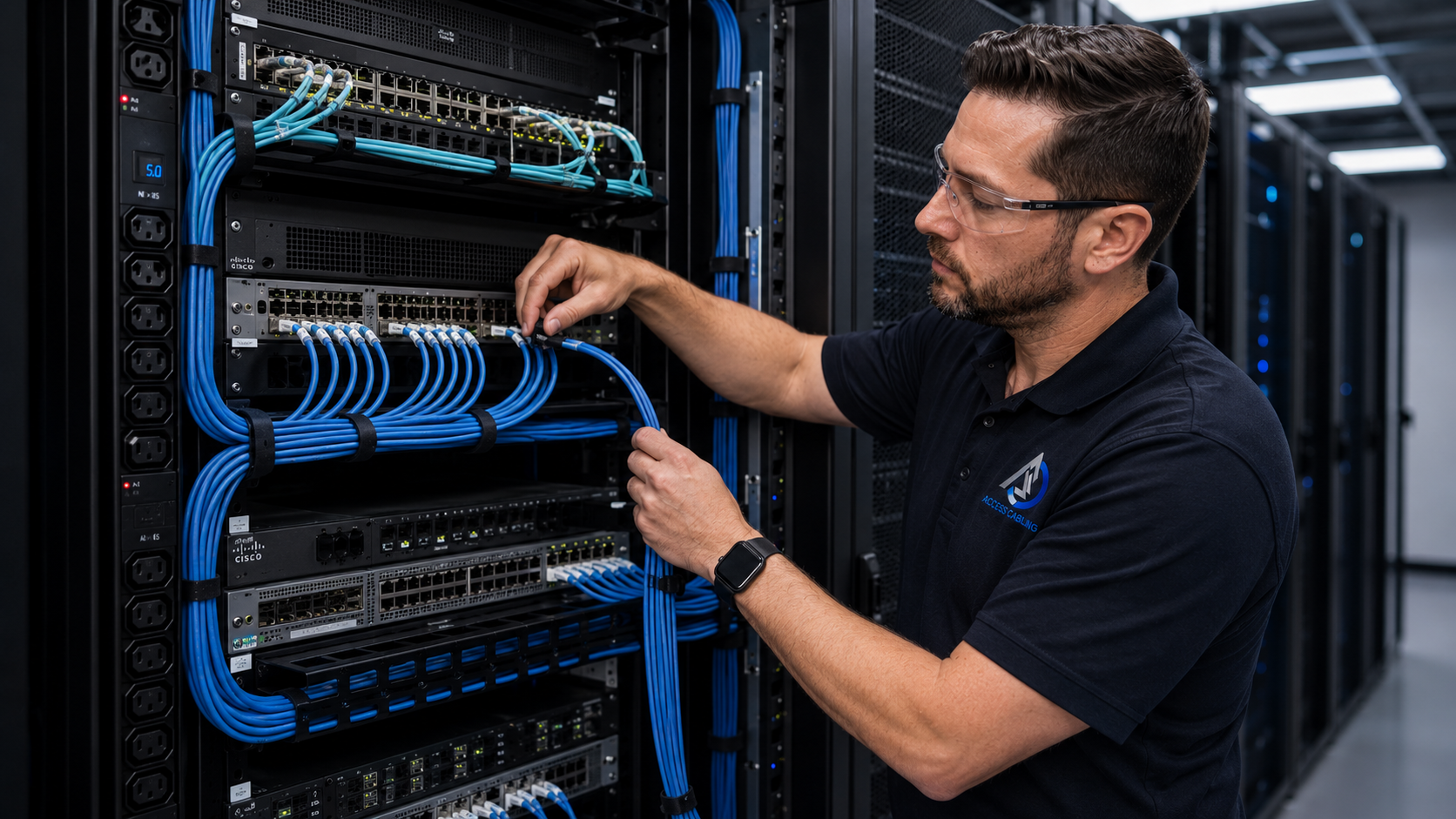
AI workloads are dense. The GPUs, the DPUs, the storage they feed on, and the switches that connect them consume power, generate heat, and demand fiber counts that a conventional server room was never sized for. Building an AI-ready cable plant is less about buying different cable and more about doubling the strand counts, sizing pathways for growth, and coordinating with mechanical from day one.
- Rack density has moved from 8 kW to 40+ kW for AI workloads.
- Fiber counts per GPU node have doubled or tripled.
- MTP-24 pre-terminated trunks are the practical standard.
- Power and cooling constrain long before fiber does.
Executive summary
AI-ready cabling is Cat6A for management, MTP-24 OM4 for compute-to-network, OS2 for WAN and long backbones, and a pathway system sized for 2× the initial strand count. The specification is straightforward; the coordination with mechanical and electrical is where projects succeed or fail.
Why AI breaks old rules
A rack of eight GPU servers with 8×400G optics each needs 64 optical paths in and out. Multiply by a training pod and the backbone strand count exceeds what conventional server-room fiber design produced. Adding fiber later is 10× more expensive than adding it at build.
Design principles
- MTP-24 pre-terminated OM4 trunks in the backbone.
- Base-8 or base-12 channel structure aligned with 400G/800G optics.
- OS2 for any link that will exceed OM4 reach or wavelength count.
- Copper reserved for BMC/IPMI/management, sized for future PoE.
Common mistakes
- Sizing fiber to today's optic count.
- Using OM3 in a new build; OM4 is only marginally more expensive.
- Field-terminating instead of pre-terminated MTP; slower and less consistent.
- Ignoring pathway growth — trays fill before the first refresh.
Best practices
- Design in 25 kW modular pods with matching fiber capacity.
- Coordinate cabling with rear-door heat exchanger footprints.
- Instrument at DCIM level from day one.
- Document strand assignments in the cable schedule with room for expansion.
Reference AI pod
| Component | Spec |
|---|---|
| Racks | 8 × 48U 750 mm × 1200 mm 2500 lb |
| Power | Dual 60A 415V 3-phase per rack |
| Cooling | Rear-door heat exchangers + row CDU |
| Fiber | 192 strands OM4 in MTP-24 trunks |
| Copper | Cat6A for IPMI + management |
When to call a professional
Any AI infrastructure deployment should involve a licensed low-voltage contractor working with mechanical and electrical engineers from concept. The failure modes are thermal and topological and only appear under load — plan them out, don't retrofit them out.