
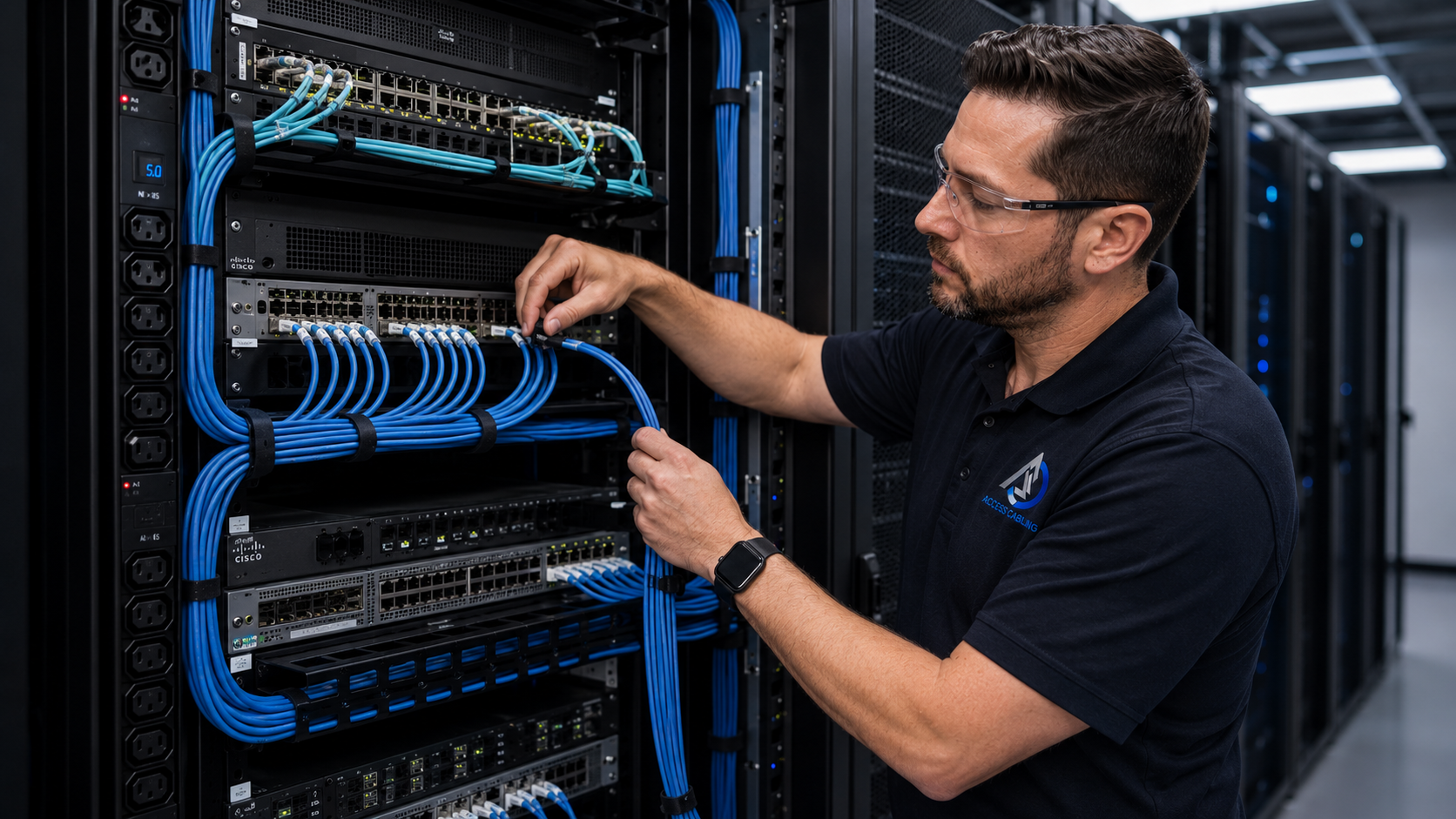
Data center design changed more between 2022 and 2026 than in the previous decade. GPU density, direct-to-chip liquid cooling, and 400/800 Gb/s optics have collapsed old rules of thumb about kilowatts per rack and cabling headroom. The core disciplines have not changed — they just apply to larger numbers.
- GPU racks are 30–120 kW; conventional CRAC air is insufficient above 20 kW.
- Structured cabling still applies — but pre-terminated MTP is standard, not optional.
- Fiber counts have doubled per compute node; plan pathway accordingly.
- Power and cooling capacity ceilings arrive before rack space does.
Executive summary
Modern data center design starts with the power and cooling envelope, not the floor plan. High-density AI workloads require rack-level liquid cooling, redundant power feeds sized for compute plus cooling, and a fiber infrastructure that assumes 400 Gb/s uplinks are the near-term ceiling. Structured cabling principles from TIA-942 remain the baseline; the specifications inside them have escalated.
The density problem
A rack of general-purpose 1U servers used to draw 5–8 kW. A rack of GPU servers can draw 40–120 kW. The cooling architectures, PDU configurations, and floor loading built for the first are inadequate for the second. Retrofitting is expensive and disruptive.
What has changed
Cooling
- Air cooling is practical to about 20 kW per rack with hot-aisle containment.
- Rear-door heat exchangers extend to about 40 kW per rack.
- Direct-to-chip liquid cooling covers 40–120 kW per rack; requires CDU and manifolds.
- Immersion cooling is emerging for extreme density but is not yet common in commercial builds.
Power
- Dual 60A 415V three-phase whips per rack are becoming baseline for GPU racks.
- A/B feed with separate UPS strings is standard; single-feed racks are legacy.
- Power monitoring at the outlet level is required for capacity planning and stranded-capacity recovery.
Cabling
- MTP-12 / MTP-24 pre-terminated trunks; field-terminated fiber is exceptional.
- 100G, 400G, and 800G optics drive strand counts up 2–4× per node.
- Copper is reserved for management, IPMI, and low-speed control.
Common mistakes
- Sizing cooling to compute nameplate without adding CDU pump load.
- Using OM3 in a new build — OM4 is only marginally more expensive and buys 4× the 40G distance.
- Skimping on strand count in the backbone; adding fiber later is far more expensive than adding it at build.
- Ignoring floor loading — GPU racks routinely exceed 2,500 lb loaded.
Best practices
- Design in 25 kW modular pods; expand pod-by-pod rather than rack-by-rack.
- Deploy structured cabling zones with distribution frames — not point-to-point spaghetti.
- Instrument everything: temperature per rack top/middle/bottom, humidity per aisle, power per outlet.
- Document at DCIM level from day one; retrofit is 10× the effort.
Reference build for a mid-scale AI room
| Element | Spec |
|---|---|
| Racks | 8 × 48U 750 mm wide, 1200 mm deep, 2500 lb rated |
| Power | Dual 60A 415V 3-phase per rack, A/B PDUs |
| Cooling | Rear-door heat exchangers + row-level CDU |
| Fiber | MTP-24 OM4 pre-terminated trunks, 96 strands to core |
| Copper | Cat6A for IPMI and management |
| Monitoring | Per-rack env, per-outlet power, leak detection |
When to call a professional
Any deployment above 20 kW per rack should involve a mechanical engineer and a licensed low-voltage contractor from the concept phase. The failure modes at high density are thermal and topological, not electrical, and they only appear under load.