
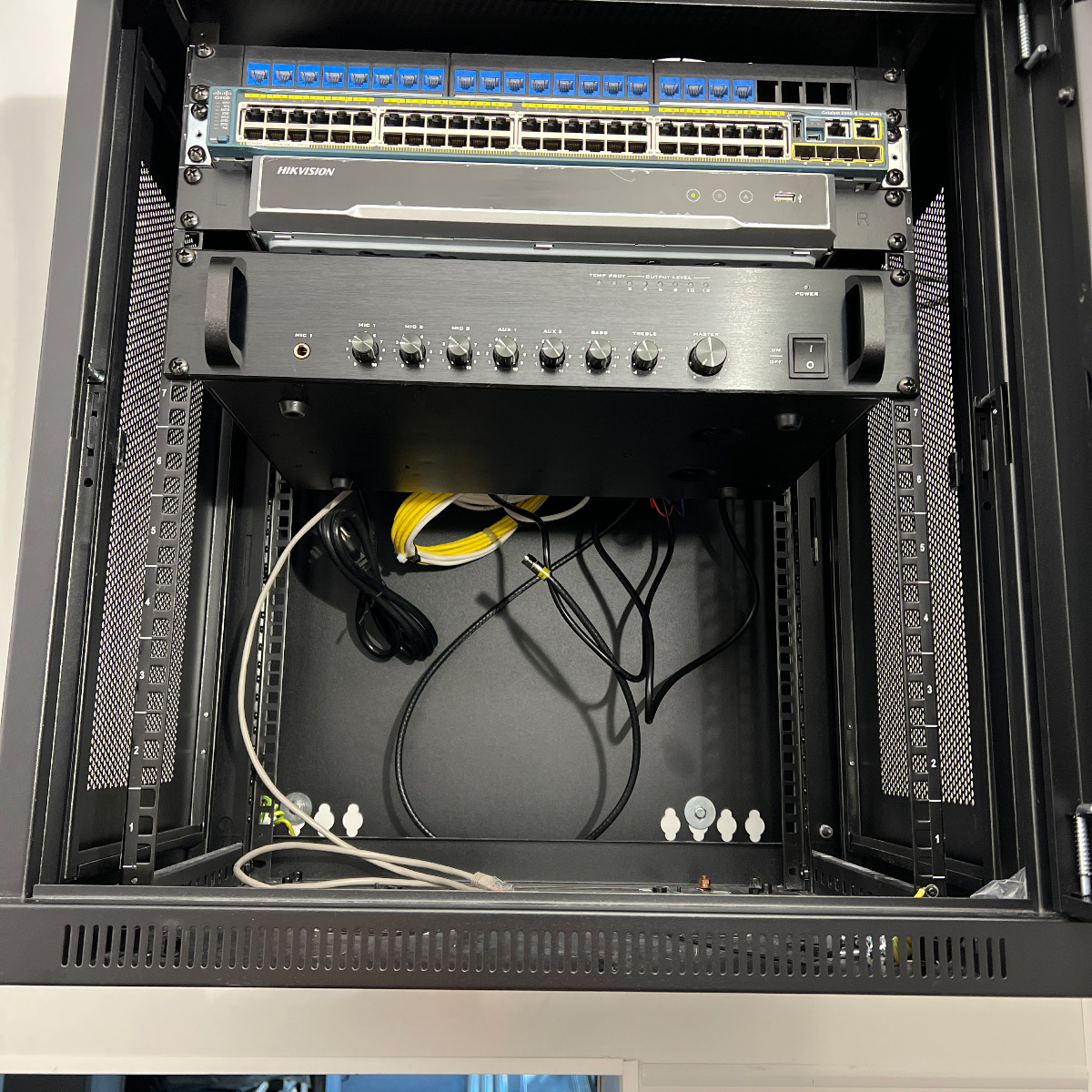
Restaurant IDF rack with segmented CAMERAS, POS and DATA patch panels, two Cisco Catalyst PoE switches and OS2 fiber handoff installed by Access Cabling
Featured Restaurant Project

Restaurant IDF Rack —POS, Cameras & Data

A PCI-aware restaurant IDF with segmented CAMERAS · POS · DATA patch fields, dual Cisco Catalyst PoE switches and an OS2 single-mode fiber handoff — engineered to be Toast-ready on day one and serviceable for the life of the store.

Restaurant IDF rack with CAMERAS, POS and DATA patch panels, Cisco Catalyst PoE switches and OS2 fiber patch panel
Completed restaurant IDF — segmented patch fields (CAMERAS · POS · DATA), two Cisco Catalyst 24-port PoE switches cross-connected with short blue Cat6 patch cords, and a duplex OS2 single-mode fiber handoff.
Client
California Restaurant Operator
System
IDF · POS · Cameras · Data
POS Platform
Toast-Ready
Status
Completed
Project Overview

A restaurant IDF built the way restaurants actually operate.

Access Cabling designed and installed a restaurant IDF rack that separates the three networks a modern restaurant actually runs — POS, cameras, and back-office data — onto their own labeled patch fields and dedicated PoE switches. The result is an IDF an IT vendor can walk into on day one and understand, and an operator can extend without a redesign.

Every design decision was made against the two things that break restaurant networks in year two: PCI scope creep (POS traffic sharing a switch with guest WiFi or IoT), and PoE budget starvation (cameras and access points competing for the same power). This rack solves both up front.

The build is repeatable. Same rack elevation, same panel labels, same VLAN plan — deployable at the next location, and the twenty after that, with identical results.

Project Objectives

What the IDF was built to deliver.

  • Deliver a restaurant IDF the operator can service without a call-out
  • Physically segment POS, cameras and data on separate patch fields
  • Support PCI DSS scope reduction
  • Stand up dual PoE switches sized for Toast + KDS + PoE cameras
  • Provide a documented OS2 fiber handoff to the MPOE / ISP
  • Label every drop to TIA-606 for future MACs
  • Leave spare U-space and pathway capacity for growth
Rack Elevation

How the rack is laid out — top to bottom.

The order isn't cosmetic. Cameras sit above their own switch, POS sits above its own switch, and horizontal managers separate every active device from every patch field — so airflow, cord lengths and future MACs all stay clean.

UDeviceDetail
1UCAMERAS Patch Panel24-port Cat6 — all PoE cameras
1UHorizontal Cable ManagerFinger-duct
1UCisco Catalyst 24-port PoE SwitchCamera VLAN · PoE+ budget for PTZ
1UHorizontal Cable ManagerFinger-duct
1UPOS Patch Panel24-port Cat6 — Toast terminals, KDS, kitchen printers
1UHorizontal Cable ManagerFinger-duct
1UCisco Catalyst 24-port PoE SwitchPOS + Data VLANs · PCI-segmented
1UHorizontal Cable ManagerFinger-duct
2UDATA Patch Panel + OS2 FiberBack-office, WiFi APs, IoT + OS2 fiber handoff
1UBlank / Spare — reserved for next-round addsGrowth capacity
Design Approach

PCI-aware, Toast-ready, serviceable for years.

  • Rack elevation planned before the first cable pull
  • Function-based patch panel labels (CAMERAS · POS · DATA)
  • PCI-aware VLAN plan mapped to physical panels
  • PoE budget calculated for cameras + APs + handhelds
  • Short uniform patch cord kits, color-coded
  • Finger-duct horizontal managers between every device
  • OS2 single-mode fiber to the MPOE for ISP handoff
  • Consistent labeling scheme on both ends of every drop
  • As-built drawings and Fluke DSX certification reports delivered
Installation Highlights

What sets this restaurant IDF apart.

PCI-AWARE POS PATCH FIELD

Dedicated POS patch panel — physically and logically separated from guest, back-office and camera traffic — supporting the operator's PCI DSS scope-reduction strategy.

DEDICATED CAMERA PANEL

A separate CAMERAS patch field feeds every PoE camera on its own VLAN, so surveillance retention is never blocked by kitchen printer chatter or Toast handheld traffic.

TWO CISCO CATALYST POE SWITCHES

Stacked Cisco Catalyst 24-port PoE switches — one dedicated to cameras and one to POS/data — cross-connected with short, uniform blue patch cords for fast, obvious tracing.

SEGMENTED DATA PATCH FIELD

The DATA panel carries back-office, WiFi APs and IoT drops — labeled and grouped so future MACs land in the right VLAN without a redesign.

OS2 SINGLE-MODE FIBER HANDOFF

Duplex OS2 fiber patch panel with LC connectors provides a clean ISP / primary-backup handoff and a documented single-mode path to the MPOE.

HORIZONTAL CABLE MANAGEMENT

Finger-duct horizontal managers between every active device and patch field keep the airflow path clear and the port faces fully readable.

TOAST / KDS READY

Static IPs and DHCP reservations are pre-planned for every Toast terminal, KDS screen, kitchen printer and handheld charger — the operator's POS vendor plugs in and goes.

SERVICEABLE FOR THE LIFE OF THE STORE

Every drop labeled at both ends, spare U-space above and below active gear, and pathway capacity for the next round of cameras, APs or KDS screens.

Results

What the operator got.

100%
Fluke DSX certified drops
0
Missed services during cutover
3
Segmented VLANs — POS · Cameras · Data
48h
Toast implementation plug-and-play
25 yr
Manufacturer warranty
Repeatable
Multi-site rollout ready
Why Restaurant IDF Design Matters

A restaurant network is a life-support system — not just plumbing.

When the POS drops, the line stops. When cameras drop, insurance and loss-prevention are exposed. When KDS drops, tickets go on paper and covers slow to a crawl. A properly designed IDF prevents all three from ever competing for the same wire.

PCI SCOPE REDUCTION

Physical + logical separation keeps POS out of the guest and IoT VLANs — smaller PCI scope, cleaner audits.

PROTECTED POE BUDGET

Dedicated switches keep cameras from starving APs, and APs from starving KDS. Every device stays powered under peak load.

FASTER TROUBLESHOOTING

Function-labeled patch panels and consistent cord kits mean a night-shift IT vendor can trace a problem in minutes, not hours.

MULTI-SITE REPEATABILITY

Standardized rack elevation and VLAN plan deploy identically at every location — from store 2 to store 200.

Licensed C-10 Electrical Licensed C-7 Low-Voltage CSLB 992009
Services Provided

Delivered on this project.

Related Services

Explore adjacent capabilities.

FAQ

Restaurant IDF rack — common questions

WHY ARE POS, CAMERAS AND DATA ON SEPARATE PATCH PANELS?+

Physical separation makes VLAN segmentation obvious and enforceable. In a restaurant this matters for two reasons: PCI DSS scope reduction (the POS network stays isolated from guest, IoT and camera traffic), and troubleshooting speed (an IT vendor can see at a glance which panel a problem belongs to). It also protects camera recording bandwidth from KDS printer bursts and Toast handheld chatter.

WHY DEDICATE A CISCO SWITCH TO CAMERAS?+

PoE cameras — especially PTZ and higher-resolution units — consume real power and bandwidth. Putting them on their own PoE switch guarantees the PoE budget is available, keeps recording steady during peak service, and prevents a single misbehaving device from starving POS or KDS.

DOES THIS RACK SUPPORT TOAST POS?+

Yes. The POS patch panel and dedicated Cisco Catalyst switch are configured for Toast's cabling spec — hardwired Cat6 to every terminal, KDS screen and kitchen printer, PoE for KDS where used, and a PCI-aware VLAN. Static IPs and DHCP reservations are pre-planned so Toast implementation shows up, plugs in, and goes live.

WHY SINGLE-MODE (OS2) FIBER INSTEAD OF COPPER FROM THE MPOE?+

OS2 fiber gives you a clean, distance-tolerant, EMI-immune handoff from the ISP demarc to the IDF. It future-proofs the site for higher bandwidth and multiple carriers (primary + backup), and it separates the low-voltage build from whatever the ISP's contractor drops in the MPOE closet.

HOW MUCH DOWNTIME DID THIS BUILDOUT REQUIRE?+

Zero — for the operator. The rack was staged and dressed off-hours, cutover happened between close and open, and Access Cabling stayed on-site through the first breakfast prep. That's the standard cutover playbook for every restaurant rack we build.

WHAT LABELING STANDARD IS USED?+

TIA-606-C. Every drop is labeled at both ends (room-jack-port), every patch panel port is labeled, and the as-built drawing and Fluke test report reference the same IDs. The operator's IT vendor can walk in on day one and trace anything.

CAN THIS RACK GROW WITH THE RESTAURANT?+

Yes. There's reserved U-space, spare ports on every patch panel, and pathway capacity above the rack for the next round of cameras, APs, KDS screens or a second location's aggregated backhaul. Growth is an addition — not a redesign.

IS THIS BUILD REPEATABLE ACROSS MULTIPLE LOCATIONS?+

That's the point. The same rack elevation, patch panel labels, VLAN plan, switch config and PoE budget can be deployed at every site in a chain — so location 2, location 20 and location 200 all look and behave identically. See our 300-location restaurant chain case study for the multi-site version.

Restaurant Cabling · California & Nationwide

Opening A New Restaurant? Get An IDF That's Toast-Ready From Day One.

Access Cabling builds restaurant IDFs, POS networks, KDS drops, PoE camera cabling and OS2 fiber handoffs for California operators — single-unit concepts through multi-site chains. PCI-aware, Toast-ready, and repeatable across every location.

28+ Years ExperienceLicensed C-10 & C-7 ContractorCSLB: 992009Serving California & Nationwide
Call Local Office(650) 212-1544