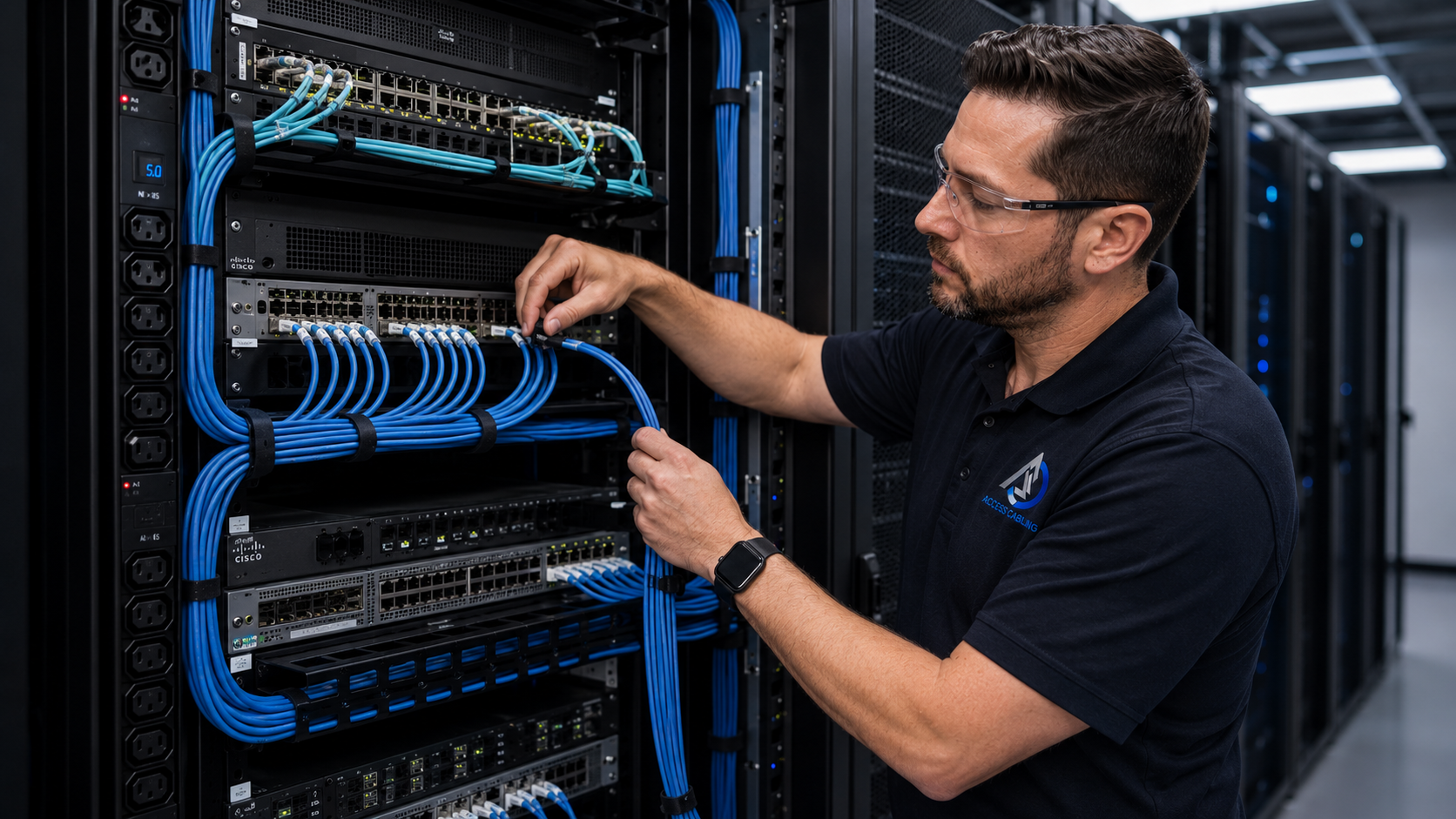
Developing and maintaining robust data center infrastructure mandates a specialized understanding of physical layer technologies, environmental controls, and performance demands beyond standard enterprise networking. Access Cabling provides comprehensive, vendor-agnostic data center infrastructure services, from greenfield design and build-out to brownfield upgrades and optimization. Our C-10/C-7 licensing (CSLB 992009) and 28 years of nationwide experience enable us to deliver turnkey solutions for critical environments, integrating structured cabling, power distribution, cabinet systems, and containment. We partner with IT Directors, Facilities Managers, and General Contractors to engineer data center solutions that ensure uptime, scalability, and long-term operational efficiency, adhering strictly to TIA-942-B and BICSI 002-202X standards. Our approach prioritizes future-proofing and energy efficiency through meticulous planning and precision execution.
Comprehensive Data Center Infrastructure Solutions & Standards
Data center infrastructure encompasses the entire physical layer that supports computational and storage assets, including structured cabling, power distribution, rack and cabinet systems, and hot/cold aisle containment. Access Cabling designs and deploys these interdependent systems to create resilient, high-performance environments. We adhere rigorously to industry standards such as TIA-942-B, which defines the telecommunications infrastructure for data centers, and BICSI 002-202X, covering best practices for data center design and implementation. Our solutions integrate active and passive components from leading manufacturers like Panduit, CommScope, and Corning, ensuring interoperability and long-term reliability. This foundational layer is critical for achieving desired uptime thresholds and supporting evolving IT loads.
Strategic Design and Engineering for Data Center Efficiency
Effective data center design goes beyond simply connecting devices; it involves strategic planning for scalability, energy efficiency, and operational agility. Our engineering process initiates with a thorough site assessment and requirements analysis, considering factors such as power density, cooling strategies, growth projections, and disaster recovery objectives. We leverage computational fluid dynamics (CFD) analysis for advanced thermal management planning and produce detailed schematics, elevations, and bill of materials. The design phase integrates physical security, environmental monitoring, and intelligent infrastructure management (DCIM) considerations from the outset. This holistic approach ensures that the initial deployment supports immediate needs while providing a clear pathway for future expansion without disruptive overhauls, optimizing total cost of ownership (TCO) and mitigating costly post-deployment modifications.
Advanced Structured Cabling for High-Density Environments
Structured cabling forms the backbone of any data center, demanding precision installation and optimal performance in high-density environments. We specialize in deploying high-performance copper (e.g., Category 6A, Category 8) and fiber optic cabling systems (e.g., OM3, OM4, OM5, OS2) from manufacturers like Belden and Corning. Our expertise extends to multi-fiber push-on (MPO/MTP) solutions for high-density fiber patching and pre-terminated trunk cables, significantly reducing installation time and improving termination quality. Cable management is paramount in data centers; we implement overhead raceways, underfloor and overhead conduits, vertical cable managers, and zero-U or horizontal cable organizers to maintain bend radius, airflow, and accessibility, conforming to TIA-569-C pathways and spaces standards. This prevents performance degradation and simplifies future adds, moves, and changes consistent with BICSI 'Information Technology Systems Installation Methods Manual' guidelines.
Rack, Cabinet, and Power Infrastructure Deployment
The physical housing and power delivery within a data center are critical for equipment protection, thermal management, and power efficiency. We deploy industry-standard 19-inch racks and cabinets from vendors such as Chatsworth Products (CPI) and Rittal, optimizing for airflow, security, and seismic bracing where required. Our power infrastructure services include the installation of primary and secondary busway systems, rack power distribution units (PDUs), and remote power panels (RPPs). Emphasis is placed on proper grounding and bonding per NEC Article 250 and TIA-607-C. We also implement hot/cold aisle containment solutions, including blanking panels, aisle containment systems (chimneys, flexible walls), and raised floor systems to manage airflow, increase cooling efficiency, and reduce operational costs. This precise integration of physical infrastructure supports high-density compute and storage while maintaining optimal operating conditions.
Rigorous Installation and Post-Installation Verification
Our installation process for data center infrastructure adheres to strict methodologies to ensure quality and compliance. Every cable run, connectivity point, and system component is installed according to manufacturer specifications and relevant TIA/BICSI standards. Our technicians are factory-trained and hold industry accreditations. Post-installation, we perform comprehensive verification to confirm adherence to design specifications and operational readiness. This includes detailed visual inspections, as-built documentation, and labeling that meets TIA-606-C standards. The objective is to provide a fully commissioned infrastructure that is thoroughly documented, easy to maintain, and ready for immediate equipment deployment, minimizing deployment risks and accelerating time-to-service. Our commitment to meticulous execution ensures that the physical layer is a reliable foundation, not a bottleneck, for critical data center operations.
Advanced Testing, Certification, and Documentation
Thorough testing and certification are non-negotiable for critical data center infrastructure. We utilize advanced testing equipment, such as Fluke Networks DSX-8000 CableAnalyzers, to perform comprehensive Tier 1 (basic link) and Tier 2 (OTDR) certification for fiber optic cabling, and full TIA/ISO Level IIIe or Level 2G copper certification. Each test report provides detailed performance parameters, including insertion loss, return loss, NEXT, PSNEXT, ELFEXT, PSELFEXT, propagation delay, and skew, comparing results against TIA-568-D limits. Our deliverables include complete electronic documentation packages comprising 'as-built' drawings, comprehensive test results, warranty information, and port mapping. This detailed documentation is crucial for troubleshooting, capacity planning, and future upgrades, providing a verifiable record of performance and compliance for warranty purposes.
Resilience and Security in Data Center Infrastructure
A resilient and secure data center infrastructure is paramount for business continuity. Our designs integrate redundancy at multiple levels, from power paths (A/B feeds) to network connectivity, minimizing single points of failure. We implement robust physical security measures, including secured racks, access control systems for data center environments, and environmental monitoring for temperature, humidity, and leak detection. Disaster recovery and business continuity planning are inherent in our infrastructure solutions, ensuring rapid recovery capabilities. Furthermore, all installations are performed in strict accordance with local and national electrical codes (NEC) and relevant fire safety standards, safeguarding both personnel and critical assets. This comprehensive approach establishes a secure and highly available operating environment capable of withstanding various physical threats and operational disruptions.
Access Cabling's Unmatched Expertise in Critical Environments
Access Cabling distinguishes itself through an unwavering commitment to engineering excellence and specialized expertise in critical data center environments. Our team comprises BICSI-certified RCDDs and technicians who possess deep knowledge of complex data center ecosystems, not just individual components. We offer unbiased, manufacturer-agnostic recommendations, focusing solely on solutions that best meet your specific performance, budget, and scalability requirements. Unlike general contractors, our core competency is low-voltage infrastructure, allowing us to deliver superior quality and precision. Our CSLB 992009 license and extensive national project history underscore our capability to execute complex data center projects on time and within budget, ensuring that your mission-critical infrastructure is built with the highest standards of reliability and future-proofing.
Optimizing Data Center Cooling and Environmental Controls
Effective thermal management is paramount for data center longevity and operational efficiency, directly impacting equipment reliability and energy consumption. Our approach to data center cooling extends beyond simple CRAC/CRAH unit deployment, delving into computational fluid dynamics (CFD) analysis to identify and mitigate hot spots, ensuring uniform temperature distribution across the server floor. We design and implement solutions integrating hot/cold aisle containment, underfloor or overhead plenum considerations, and intelligent airflow management systems utilizing blanking panels and brush seals to prevent air recirculation. Our expertise encompasses various cooling methodologies, from traditional air-side economizers and chilled water systems to direct-to-chip liquid cooling and adiabatic cooling solutions, evaluated based on climate, facility footprint, and power density requirements. We integrate environmental monitoring systems (EMS) with granular sensor placement (temperature, humidity, pressure, leak detection) for real-time data, enabling proactive response to deviations and optimizing PUE. This includes integration with Building Management Systems (BMS) for centralized control and automated responses, such as dynamic fan speed adjustments or humidifier activation. Special consideration is given to ASHRAE thermal guidelines (e.g., A1-A4 classes), ensuring equipment operates within specified environmental envelopes while balancing energy efficiency and hardware warranty requirements. Common pitfalls in cooling design, such as inadequate static pressure management in raised floor systems or mismatched cooling capacity to IT load, are meticulously addressed through iterative design and simulation, ensuring a robust and scalable thermal infrastructure from day one. Our project management methodology includes close coordination with mechanical, electrical, and plumbing (MEP) trades to synchronize HVAC, power distribution, and fire suppression systems, ensuring seamless integration and adherence to local building codes and NFPA standards.
Robust Power Distribution and Uninterruptible Power Supply (UPS) Systems
The backbone of any resilient data center is its power infrastructure, demanding meticulous design and implementation to ensure continuous operation and protect critical IT assets. Our solutions encompass end-to-end power distribution, starting from diverse utility feeds and redundant A/B bus configurations, through medium voltage (MV) and low voltage (LV) switchgear, down to intelligent Power Distribution Units (PDUs) at the rack level. We specify and integrate high-efficiency Uninterruptible Power Supply (UPS) systems, including modular, three-phase, and distributed rotary UPS architectures, selecting appropriate topologies such as double conversion online, line-interactive, or standby based on the required reliability and energy efficiency profiles. Battery energy storage systems (BESS), whether VRLA, Li-Ion, or emerging flywheel technologies, are sized for defined autonomy periods, with stringent attention to charge/discharge cycles, thermal management, and regular testing protocols (e.g., battery impedance testing) to prevent unexpected failures. Generator sets (diesel, natural gas, bio-fuel) are redundantly configured (e.g., N+1, 2N), with automated transfer switches (ATS) rigorously tested under full load conditions. We deploy branch circuit monitoring (BCM) and intelligent rack PDUs with outlet-level metering (PDU-level accuracy typically +/-1%), enabling precise power consumption monitoring, capacity planning, and proactive load balancing. Each component of the electrical infrastructure adheres to NEC (National Electrical Code) Article 645, addressing safe installation practices for Information Technology Equipment, and local AHJ (Authority Having Jurisdiction) requirements. Lifecycle management practices are integrated into our power designs, accounting for future IT load growth, decommissioning strategies, and the potential for migrating to higher voltage rack configurations (e.g., 400V PDU input) to reduce current and improve cable management within high-density racks. We also emphasize the importance of selective coordination studies to ensure that overcurrent protective devices clear faults effectively and minimize disruption to upstream circuits.
Advanced Monitoring, Management, and Automation Platforms
Modern data centers require sophisticated orchestration to maintain peak performance, resource efficiency, and proactive problem resolution. Our infrastructure solutions incorporate Data Center Infrastructure Management (DCIM) platforms that provide a unified, holistic view of the entire physical layer. This integration spans power, cooling, environmental sensors, asset inventory (CMDB), and connectivity mapping, offering real-time visibility into operational parameters. We deploy DCIM solutions that monitor key metrics such as PUE (Power Usage Effectiveness), WUE (Water Usage Effectiveness), and CUE (Carbon Usage Effectiveness), enabling granular reporting and trend analysis for sustainability initiatives. The platform facilitates capacity planning by tracking available power, rack space, cooling capacity, and network ports, preventing oversubscription and optimizing resource utilization. Automation capabilities are central to our implementations, including automated workflow triggers for environmentals, power events, and device status changes. Example automations involve dynamic fan speed adjustments in CRAC units based on server inlet temperature, or automated ticketing system integration upon exceeding predefined thresholds for power draw or humidity. Our expertise extends to integrating DCIM with IT Service Management (ITSM) platforms (e.g., ServiceNow, Jira) and network management systems (NMS) to correlate infrastructure events with application performance and network health, providing a comprehensive understanding of the impact of physical layer events on digital services. This includes API integrations for data exchange and command execution, facilitating northbound and southbound communication. The selection of DCIM platforms, such as Schneider Electric EcoStruxure IT, Vertiv Environet, or Nlyte, is driven by the client's existing ecosystem, scalability requirements, and desired level of feature granularity, focusing on platforms that offer robust security protocols (e.g., role-based access control, encryption) and a clear roadmap for future enhancements, including AI/ML integration for predictive analytics and anomaly detection. These platforms are crucial for incident response, root cause analysis, and demonstrating compliance with various regulatory frameworks through auditable data logs.
Lifecycle Management, Decommissioning, and Sustainable Practices
A truly robust data center strategy considers the entire lifecycle of its infrastructure, from initial design through eventual decommissioning and asset disposition. We provide comprehensive lifecycle management services that extend the operational life of existing infrastructure while planning for future growth and technology refreshes. This includes proactive maintenance scheduling, preventative measures based on vendor recommendations and observed operational data, and end-of-life (EOL) planning for all critical components (UPS batteries, generators, CRAC units, network hardware). Our decommissioning services are executed with meticulous precision to minimize disruption to remaining active infrastructure, ensuring data security through certified data destruction methods (e.g., degaussing, shredding, wiping to NIST 800-88 Revision 1 guidelines) for retired IT assets. This process adheres strictly to environmental regulations for e-waste disposal, partnering with certified recyclers (e.g., R2, e-Stewards certified) to ensure responsible and sustainable material recovery. We integrate sustainability best practices throughout the data center's lifecycle, from selecting energy-efficient hardware and infrastructure components (e.g., high-efficiency transformers, EC motors in CRAC units) during the design phase to implementing resource-saving operational practices like liquid cooling for higher density racks and leveraging renewable energy sources where feasible. Our consultations include analyzing metrics such as Water Usage Effectiveness (WUE) and Carbon Usage Effectiveness (CUE) to identify opportunities for reducing the environmental footprint. Furthermore, our project documentation includes detailed asset registries that facilitate accurate financial depreciation, warranty management, and streamlined asset disposal, ensuring compliance with corporate governance and environmental stewardship goals. We also advise on strategies for repurposing existing infrastructure elements where possible, reducing waste and contributing to a circular economy model within the data center environment.