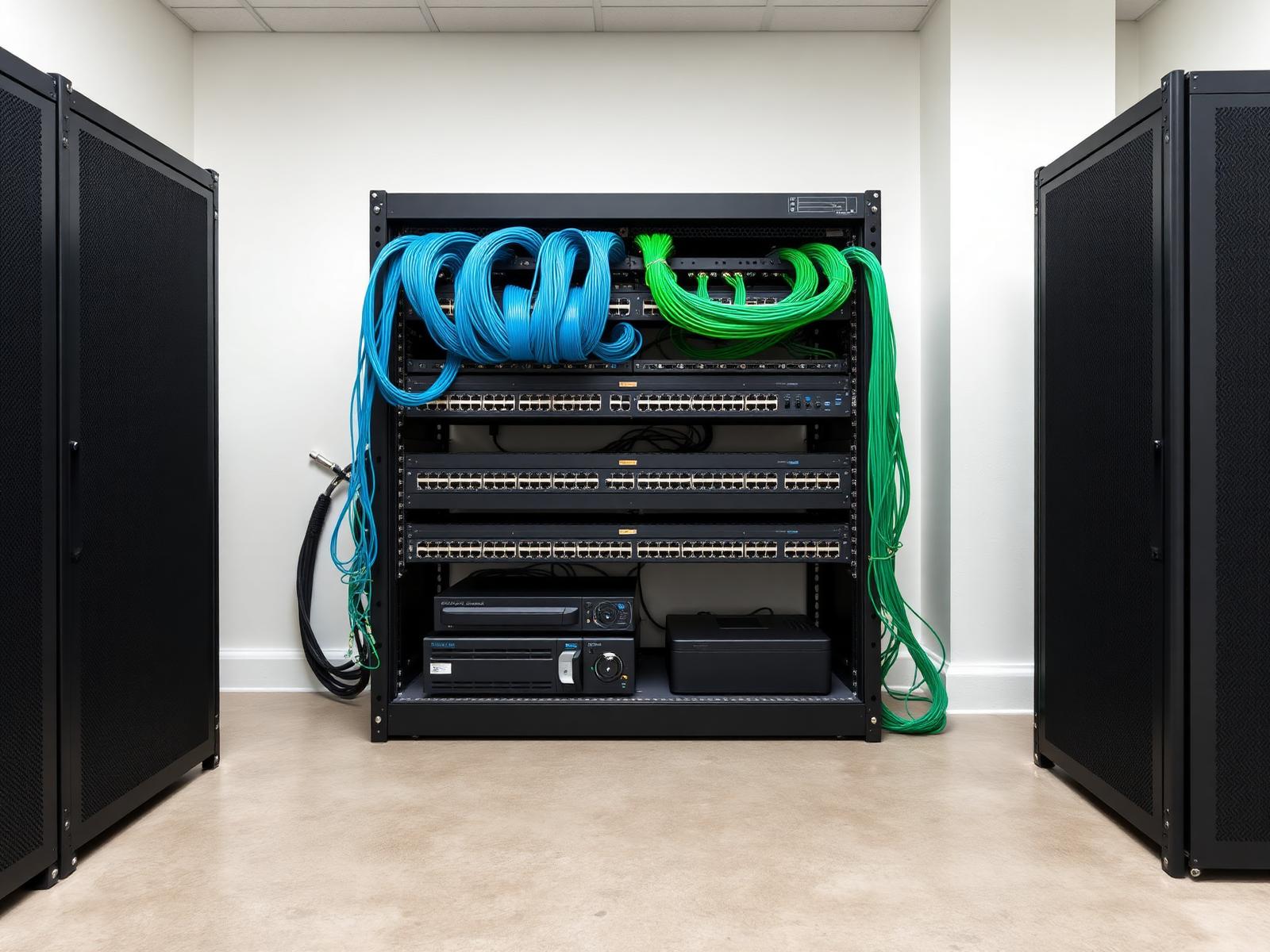
Optimizing network distribution within multi-story or expansive facilities demands meticulously engineered Intermediate Distribution Frames (IDFs). An IDF serves as a crucial aggregation and distribution point for network cabling, extending the reach of your Main Distribution Frame (MDF) to end-user devices or other network segments on specific floors or building zones. For IT Directors, Facilities Managers, and General Contractors overseeing complex building infrastructure, robust IDF installation is paramount for network performance, scalability, and long-term maintainability. Access Cabling specializes in the design, construction, and certification of high-performance IDF build-outs. Our approach integrates TIA-568, TIA-942, and BICSI best practices with extensive experience in data center environments, ensuring each IDF is dimensioned for current demands while accommodating future technology evolution. We implement structured cabling solutions that minimize signal loss, optimize cooling, and facilitate streamlined troubleshooting, delivering resilient network distribution platforms tailored to your operational imperatives and physical constraints.
Foundational Principles of IDF Design and Placement
The strategic placement and robust design of an Intermediate Distribution Frame are critical for minimizing cable runs, optimizing signal integrity, and simplifying network management across a facility. Per TIA-568.C.0 and TIA-569-C, IDFs act as horizontal cross-connects, serving a specific floor or designated area from the backbone cabling originating at the Main Distribution Frame (MDF) or Entrance Facility (EF). Proper IDF placement considers maximum horizontal cable lengths (typically 90 meters for twisted-pair, excluding patch cords), cable bend radius requirements, and proximity to the largest concentration of end-user devices. Our design process initiates with a thorough site survey and requirements analysis, mapping out device density, power availability, and environmental factors like vibration and temperature excursions. We assess structural load-bearing capabilities for cabinet and rack installations, ensuring compliance with local building codes. This foundational approach prevents common issues such as exceeding maximum cable lengths, creating bottlenecks, or incurring excessive construction costs due to inefficient space utilization, guaranteeing optimal network performance and simplified maintenance for the entire lifecycle of the installation.
Structured Cabling Architectures within the IDF
Within an IDF, the structured cabling architecture must support a diverse array of applications, from enterprise Ethernet to specialized control systems, while adhering to TIA-568 standards for Category 6A, Category 8, or fiber optic deployments. Our implementations typically feature cross-connect or interconnect architectures, carefully chosen based on network topology, port density, and management preferences. A cross-connect utilizes patch cords to connect active equipment ports to horizontal cabling via redundant patch panels, offering maximum flexibility for MACs (Moves, Adds, Changes). An interconnect, conversely, directly connects active equipment to horizontal cabling, often preferred in environments with fewer anticipated changes. We specify high-performance components from manufacturers like Panduit, CommScope, and Leviton, utilizing shielded (F/UTP or S/FTP) or unshielded (U/UTP) copper cabling as dictated by EMI/RFI environments and bandwidth requirements. For fiber optic backbone connections, we deploy multi-fiber push-on (MPO/MTP) or standard LC/SC connectors, selecting single-mode or multimode fiber (OM3, OM4, OM5) based on distance and data rate specifications, such as 10GbE, 40GbE, or 100GbE, ensuring compliance with IEEE 802.3 Ethernet standards.
Environmental Controls and Physical Security for IDFs
Protecting network infrastructure within an IDF necessitates robust environmental controls and stringent physical security measures. As critical network points, IDFs are susceptible to performance degradation from heat, humidity, dust, and unauthorized access. Following TIA-942-B and BICSI 002 guidelines for data center and telecommunications spaces, we integrate solutions for temperature and humidity management, often recommending dedicated CRAC (Computer Room Air Conditioner) or in-row cooling units for larger IDFs, or ensuring adequate passive airflow and exhaust for smaller closets. Power distribution is engineered for redundancy and surge protection, using UL-listed PDUs (Power Distribution Units) from vendors like APC or Eaton. Physical security includes access control systems – biometric, card reader, or key lock – fire suppression systems (e.g., pre-action sprinkler systems or clean agent systems like FM-200 or Novec 1230), and environmental monitoring sensors for temperature, humidity, and water ingress. These measures are not merely additive but are designed holistically to prevent outages, protect sensitive equipment, and maintain compliance with regulatory requirements such as HIPAA or PCI DSS by controlling access to critical network assets.
Power Distribution and Grounding for IDF Compliance
Proper power distribution, grounding, and bonding are non-negotiable within an IDF, serving as the bedrock for system reliability and personnel safety. All electrical work strictly adheres to the National Electrical Code (NEC) NFPA 70, local electrical codes, and BICSI TDMM guidelines. We design dedicated circuits for active network equipment, servers, and cooling systems, ensuring adequate amperage and voltage stability. Redundant power feeds (e.g., A+B circuits) are often implemented for mission-critical IDFs, supported by uninterruptible power supplies (UPS) from manufacturers like Eaton or Schneider Electric to provide a seamless power transition during utility outages. The grounding and bonding infrastructure follows TIA-607-C, establishing a comprehensive telecommunications grounding busbar (TGB) or bonding infrastructure for all metallic components, racks, and cabinets. This mitigates electromagnetic interference (EMI), prevents ground loops, and provides a safe path for fault currents, protecting both equipment and personnel from electrical hazards while ensuring optimal network performance by maintaining signal integrity across the entire cabling plant.
Advanced Testing, Certification, and Documentation Protocols
Post-installation, Access Cabling employs rigorous testing and certification protocols to validate the performance and compliance of every IDF build-out. For copper cabling, we use Fluke Networks DSX-8000 CableAnalyzers to perform Level 2G or Level IIIe field certification to TIA-568.C.2 and ISO/IEC 11801 standards, testing parameters such as Near-End Crosstalk (NEXT), Far-End Crosstalk (FEXT), Return Loss, Insertion Loss, and length. Fiber optic cabling is tested according to TIA-568.C.3 using Optical Loss Test Sets (OLTS) and Optical Time Domain Reflectometers (OTDRs), verifying insertion loss, optical return loss, and splice/connector attenuation. All test results are compiled into comprehensive documentation packages, detailing pass/fail grades, link IDs, and equipment used. This documentation, alongside as-built drawings, labeling schemas adhering to TIA-606-C and ISO/IEC 14763-2, and component warranties, provides an invaluable resource for future MACs, troubleshooting, and auditing. This meticulous approach guarantees that the installed infrastructure meets or exceeds specified performance criteria, ensuring long-term reliability and compliance with industry benchmarks.
Futureproofing and Scalability: Access Cabling's Differentiator
In a rapidly evolving technological landscape, building an IDF that can scale with future demands is paramount. Access Cabling's expertise goes beyond current standards; we design IDFs with inherent futureproofing capabilities. This includes deploying higher-category cabling (e.g., Category 6A or Category 8) even if current applications only require Category 5e, providing headroom for 10GbE, 25GbE, or even 40GbE over copper. For fiber backbones, we often provision additional dark fibers or deploy higher-strand count cables to accommodate future expansion without invasive re-cabling. Our cabinet and rack solutions are selected for their modularity and capacity, allowing for easy expansion of patch panels, active equipment, and cable management without sacrificing airflow or accessibility. We plan for adequate cooling and power infrastructure that can be incrementally scaled. This forward-looking strategic planning, coupled with our 28+ years of experience and C-10/C-7 licensing, differentiates Access Cabling by delivering not just a functional IDF, but a resilient, adaptable, and easily scalable network distribution point that safeguards your investment and supports your organization's growth for decades to come, minimizing total cost of ownership.
Optimizing IDF Rack and Cabinet Density for Performance
The strategic selection and configuration of racks and cabinets within an Intermediate Distribution Frame (IDF) directly dictate present and future network performance and manageability. Access Cabling prioritizes high-density rack units (RUs) with robust weight capacities, such as APC NetShelter SX or Panduit PIM series, to accommodate current active equipment while providing ample vertical and horizontal pathway for future expansion. Critical considerations include total rack units available (e.g., typically 42U or 48U for standalone, or custom configurations for wall-mount IDFs), the internal depth for various server and switch form factors (e.g., 1000mm to 1200mm to support deep blade servers or large modular switches like Cisco Nexus 9000 series), and ventilation designs (perforated front and rear doors with >70% open area for efficient airflow, conforming to ASHRAE thermal guidelines). Adequate cable management, both vertically (e.g., Panduit WMPV45E, CPI T-Series) and horizontally (e.g., Panduit WMP1E, Great Lakes Cable Mgmt 1000-series finger ducts), is integrated to prevent cable strain, maintain bend radius compliance (e.g., minimum of 4x cable diameter for Cat6A), and simplify MACs (Moves, Adds, Changes). We assess the specific heat loads generated by anticipated hardware to ensure the rack’s thermal envelope is not breached, often recommending hot aisle/cold aisle containment when multiple racks are deployed within a larger IDF environment, or specifying self-contained cooling racks for high-density edge deployments. This meticulous planning prevents thermal throttling, simplifies maintenance, and extends the lifespan of active components, directly impacting network uptime and operational longevity. Failure to adequately plan density often leads to premature capacity exhaustion, cable spaghetti, and costly retrofits, underscoring the importance of our detailed design phase that leverages CAD drawings and 3D modeling for spatial optimization.
Interfacing IDF Infrastructure with Building Management Systems (BMS)
Seamless integration of IDF infrastructure with the overarching Building Management System (BMS) is paramount for holistic facility oversight, proactive maintenance, and energy efficiency. Access Cabling designs IDF installations with comprehensive sensor integration for critical environmental parameters, including temperature (e.g., utilizing calibrated thermistors and RTDs at intake/exhaust points), humidity (e.g., calibrated hygrometers), and access control (magnetic contacts on doors, motion sensors, CCTV integration for forensics). We facilitate the deployment of SNMP-enabled intelligent Power Distribution Units (PDUs) (e.g., Eaton, APC, Raritan offerings) that report granular power consumption, voltage, current, and outlet status directly to the BMS. Furthermore, our designs incorporate environmental monitoring units (EMUs) that aggregate data from various sensors and translate it into standardized protocols such as Modbus TCP/IP, BACnet/IP, or SNMP Traps, allowing the BMS platform (e.g., Johnson Controls Metasys, Siemens Desigo CC, Schneider Electric StruxureWare) to monitor, log, and trigger alarms based on predefined thresholds. This integration enables centralized control over cooling units (CRAC/CRAH units), fire suppression systems (e.g., FM-200, Novec 1230), and physical access controls from a single pane of glass. The advantages extend to predictive analytics, where trending data from the IDF allows for identification of potential equipment failures or cooling inefficiencies before they escalate into service outages. Our project scope always includes explicit coordination with building engineers and facilities management teams to ensure protocol compatibility, IP address assignment, and the successful commissioning of all BMS interfaces, validating data flow and alarm triggering mechanics through rigorous testing protocols. This level of interoperability provides significant operational benefits, enhancing resilience and reducing MTTD (Mean Time To Detect) and MTTR (Mean Time To Resolve) incidents, crucial metrics for any robust data center operation.
Compliance and Lifecycle Management: Beyond Installation
IDF installations are not static deployments; they demand rigorous adherence to compliance standards and a comprehensive lifecycle management strategy to ensure sustained performance and regulatory alignment. Access Cabling ensures every IDF installation conforms to industry standards such as TIA-942-B for data center infrastructure, BICSI TDMM for telecommunications distribution methods, and relevant local building codes (e.g., NFPA 70 National Electrical Code, local fire department regulations). This includes specifying plenum-rated cabling (CMP) in air-handling spaces, adhering to grounding and bonding requirements per TIA-607-D, and ensuring clear labeling standards (TTR, ANSI/TIA-606-C) for all passive and active components. Beyond initial compliance, we provide detailed documentation packages, including as-built drawings (e.g., AutoCAD, Visio), attenuation and NEXT test results (Fluke DSX-8000), power consumption reports, and detailed equipment inventories with serial numbers and warranty information. This documentation is critical for ongoing auditing, asset management, and facilitating future upgrades or troubleshooting. Our lifecycle management recommendations encompass scheduled preventive maintenance (e.g., cleaning, cable pathway inspections, power system checks), capacity planning for network growth projections (e.g., typically a 5-year and 10-year growth model), and end-of-life strategies for hardware and cabling. We emphasize the importance of regular audits against the initial design specifications and evolving industry best practices to identify potential vulnerabilities or obsolescence. Access Cabling also consults on strategies for decommissioning old equipment responsibly, adhering to WEEE or local e-waste regulations. This holistic approach ensures that the IDF not only meets stringent initial certification requirements but remains a compliant, efficient, and adaptable component of the overall network infrastructure throughout its operational lifespan, minimizing TCO (Total Cost of Ownership) and maximizing ROI (Return on Investment) for our clients. Neglecting this lifecycle planning often results in technical debt, security vulnerabilities, and non-compliance fines.
Project Management and Multi-Vendor Coordination for Complex IDFs
The successful deployment of a complex Intermediate Distribution Frame (IDF) necessitates a meticulously planned and executed project management methodology, particularly when coordinating multiple vendors and trades. Access Cabling employs certified Project Management Professionals (PMPs) who utilize industry-standard frameworks such as PRINCE2 or PMBOK to oversee every phase, from detailed statement of work (SOW) development to final handover. Our project plans incorporate critical path analysis, resource leveling, and risk management strategies to mitigate potential delays and budget overruns. A key aspect is the seamless coordination with other trades: electrical contractors for dedicated power circuits (e.g., 20A 120V NEMA 5-20R or 30A 208V L6-30R for high-density environments, adhering to NEC Article 645), HVAC technicians for precision cooling and humidity control (e.g., specifying Sensaphone 1800 for remote monitoring capabilities), general contractors for structural considerations, and security integrators for physical access controls (biometric, keycard systems integrated with the BMS). We establish clear lines of communication through regular progress meetings, consolidated reporting, and a single point of contact for all IDF-related activities. This prevents scope creep and ensures all interdependent tasks are synchronized, such as ensuring sufficient conduit pathways (e.g., RGS or EMT, sized according to NEC Chapter 3) are installed prior to cable pulls, or ensuring proper grounding busbars (GBB) are in place before active equipment mounting. Furthermore, our project managers are adept at handling change orders efficiently, assessing their impact on schedule and budget, and communicating adjustments proactively. We leverage collaborative tools like Microsoft Project or Asana for task tracking, Gantt chart generation, and documentation sharing, ensuring all stakeholders have real-time visibility into project status. This disciplined approach to project management and multi-vendor coordination is essential for delivering complex IDF installations on time, within budget, and to the exacting technical specifications required by enterprise clients, ultimately minimizing disruption to ongoing operations during the deployment phase and ensuring a smooth transition to operational status.