
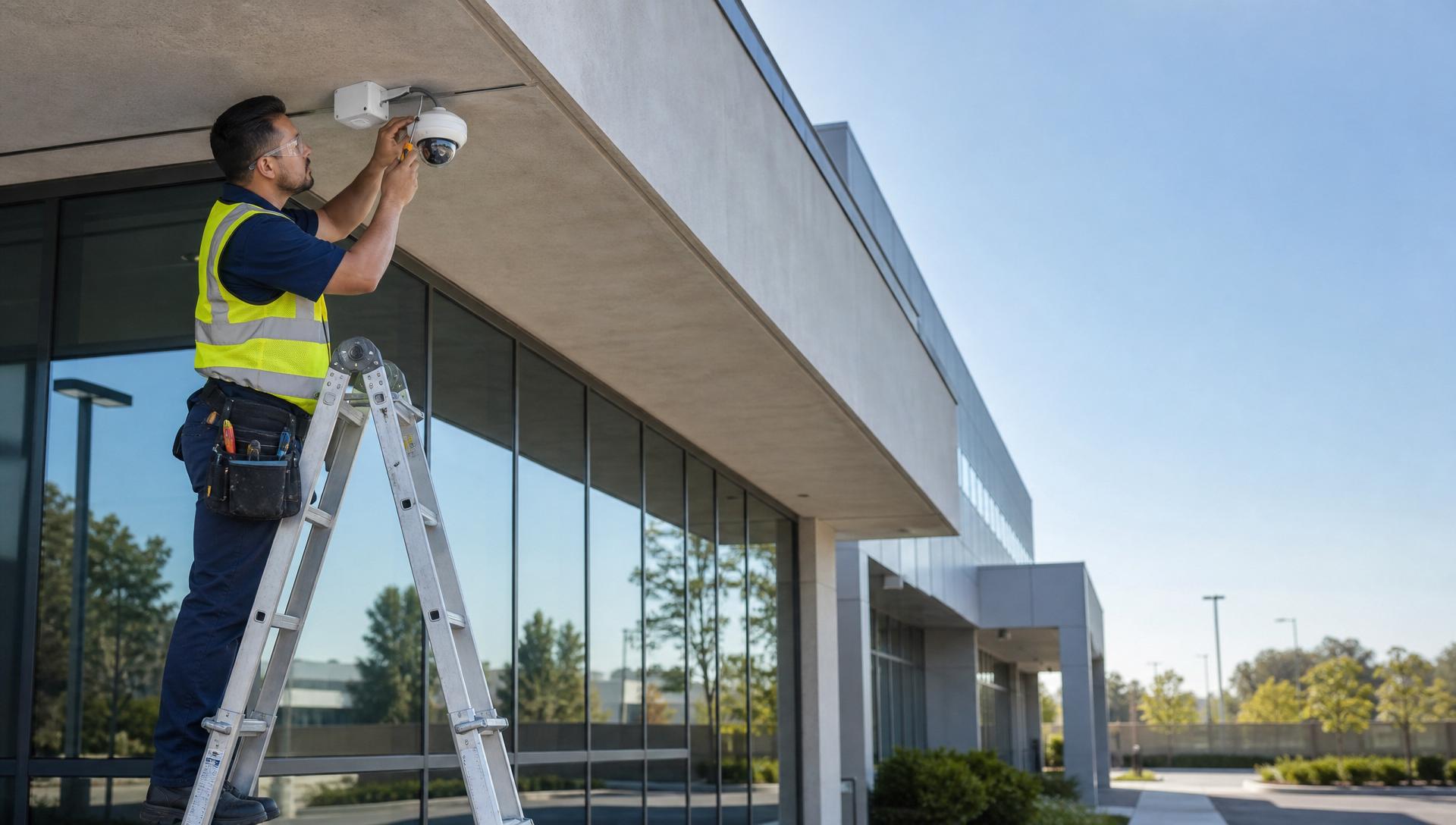
Commercial CCTV pricing is one of the most opaque line items in a building budget. A retailer gets a $12,000 quote for 8 cameras from one integrator and a $34,000 quote for the same 8 cameras from the next. Neither is dishonest — they're pricing different systems, different cameras, and different pathways. Understanding what actually drives the cost lets a facilities or IT lead compare bids on the same footing and avoid the two-year regret of an under-scoped system.
- Most commercial IP camera installs land at $850–$2,400 per camera fully installed — hardware, cabling, mounting, NVR share, config and testing included.
- Enterprise cameras (PTZ, LPR, thermal, 8K multi-sensor) run $2,500–$6,000 per camera; retail budget cameras run $400–$700 but rarely survive commercial duty.
- NVR storage is the single biggest hidden cost — 30 days of 4K on 32 cameras is 60–100 TB of RAID, a $6,000–$12,000 line item on its own.
- Cat6 is fine for most IP cameras under 90 m; upgrade to Cat6A for PTZ, LPR, and any camera in high-EMI environments.
- Pathway and building type swing labor 30–60% — open plenum ceilings are cheapest, hard-lid retrofits with fire-rated walls the most expensive.
Executive summary
For budgeting purposes in 2026, plan on $1,200–$1,800 per camera fully installed for a mid-market commercial system with a 30-day 4K NVR, PoE cabling, professional mounting, VMS licensing and commissioning. Multiply by camera count for the hardware/labor line, add $6,000–$12,000 for storage on any deployment over 16 cameras, and add 10–15% for VMS licensing and annual maintenance. Anything materially cheaper is trading storage retention, camera quality, or professional installation for the discount.
The business problem
A commercial security system has three buyers: facilities pays for the install, IT pays for the storage and network capacity, and operations pays for the ongoing monitoring. When any of the three isn't consulted at scope, the system gets under-designed on that dimension and the gap surfaces six months later — usually as 'why don't we have footage of what happened last night?'
The purchase decision isn't just camera brand. It's how many cameras, at what resolution, retained for how many days, viewed by whom, tied into what access-control or alarm platform, and mounted where. Each of those choices moves the total cost by thousands. The published sticker price on the camera is 15–25% of the true installed cost.
Technical explanation
A commercial IP CCTV system has five cost buckets. Understanding all five is how buyers compare quotes.
| Cost bucket | Typical share of total | What drives it |
|---|---|---|
| Cameras & mounting | 25–35% | Resolution, sensor size, PTZ vs fixed, indoor vs outdoor rated |
| Cabling & pathway | 20–30% | Ceiling type, run length, fire-rated wall penetrations, after-hours access |
| NVR / storage | 15–25% | Retention days × camera count × resolution × frame rate |
| Network & PoE | 8–15% | PoE switches, UPS backup, VLAN and firewall config |
| Software & commissioning | 8–15% | VMS licensing, integration to access control, training, day-1 tuning |
A 16-camera 4K system with 30-day retention typically costs $24,000–$34,000 all-in. A 32-camera version of the same system is $42,000–$62,000 — sub-linear because the NVR, VMS licensing, and PoE switching don't double even though the camera count does.
Common mistakes we see in the field
- Buying a $400 camera to save money — then the ceiling has to open again at year three because the sensor can't identify a face across a lobby.
- Sizing NVR storage for 'what we need today' instead of the compliance window (7, 30, 90 days) the insurance carrier or regulator actually expects.
- Running cameras on the same VLAN as production data. A commercial CCTV design isolates cameras on their own VLAN with a dedicated PoE switch stack, firewalled from the corporate network.
- Skipping UPS backup on the NVR. The one hour after a power event is exactly when video is needed most.
- Choosing a proprietary VMS locked to a single camera brand. When the OEM discontinues a model, the entire system becomes a refresh instead of a replacement of one camera.
- Ignoring low-light performance in the spec. Most commercial incidents happen after hours; a 4K sensor with poor low-light rating produces less usable evidence than a 1080p sensor with a large aperture and IR.
Best practices
- Do a walk-through with the security integrator, the IT team, and operations together — the three buyers must agree on camera placement and retention before hardware is ordered.
- Standardize on ONVIF-compliant cameras. Mixing brands is fine when the VMS speaks a common protocol; locking to one brand rarely saves money.
- Design storage to the retention requirement, not to a stock NVR SKU. 30-day is a common floor; 60-day is common for banking, cannabis, and multi-tenant retail.
- Cable with Cat6A on any run over 60 m and on all PTZ / LPR positions. Cat6 is acceptable on short fixed-camera runs.
- Put every camera and the NVR on UPS backup with at least 30 minutes of runtime.
- Certify every camera drop with a Fluke DSX report before mounting the camera. Diagnosing a bad drop after the camera is on a 20-ft ceiling costs the same as pulling the cable twice.
Real-world considerations
Building type is the largest cost multiplier. An open-plenum warehouse or Class-A office with existing cable tray is the cheap case. Hard-lid retail with fire-rated walls, occupied tenant spaces, or historic buildings with plaster ceilings can double the labor line without adding any cameras.
Regulatory retention. California cannabis dispensaries require 90-day retention at minimum resolution thresholds. Federally-insured banks target 90–180 days. Restaurants for insurance often target 30–45 days. The storage line item is directly downstream of whichever number applies.
Cyber-security posture. Commercial cameras are now a common IoT attack vector. A defensible design places all cameras on an isolated VLAN, firewalled outbound to only the NVR and cloud services, with default credentials replaced and firmware update policy documented. Insurance carriers increasingly require this in writing.
Access-control integration. When cameras and door readers share a VMS, a badge event can auto-cue the nearest camera. This is table stakes on new commercial builds; retrofit integration is usually possible but adds 8–12% to the total.
Recommended solution profiles
| Project | Camera count | Est. installed cost | What's included |
|---|---|---|---|
| Small retail / QSR | 8 cameras | $10,000–$16,000 | 1080p fixed, 30-day NVR, PoE switch, basic VMS |
| Mid-market office | 16 cameras | $24,000–$34,000 | 4K fixed + 2 PTZ, 30-day NVR, PoE+ stack, enterprise VMS |
| Multi-site retail chain | 8 per site × 20 sites | $180,000–$260,000 | Cloud VMS, centralized 60-day retention, alerting |
| Warehouse / distribution | 32 cameras | $52,000–$78,000 | 4K fixed + LPR at docks, 60-day NVR, Cat6A |
| Hospital / medical campus | 64+ cameras | $140,000–$220,000 | Enterprise VMS, 90-day retention, redundant NVR |
| Cannabis dispensary (CA) | 24 cameras | $36,000–$52,000 | 4K, 90-day retention, tamper alarms, per-code coverage |
When to call a professional
Any commercial CCTV project over 8 cameras, any project with regulatory retention requirements, any integration into an existing access-control or alarm platform, and any camera position requiring lift work or fire-rated wall penetrations should be scoped by a licensed C-7 low-voltage contractor. The camera is the 25% of the project the buyer sees; the pathway, storage, network isolation, and commissioning are the 75% that determines whether the system produces usable evidence when it matters.