
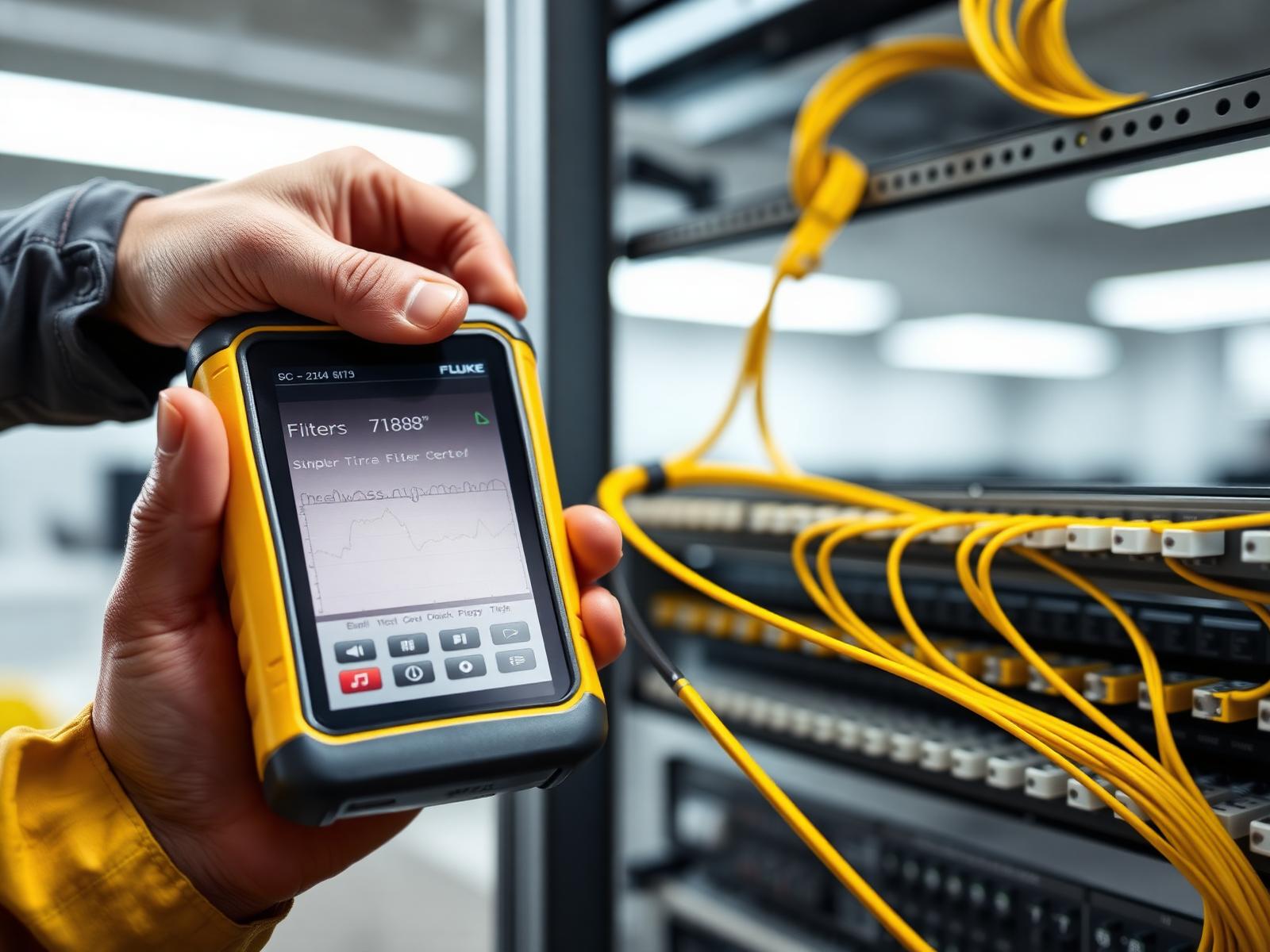
Single-mode versus multimode fiber is the decision that quietly sets a building's ceiling for the next 20 years. Multimode dominates data-center rows and building risers because the transceivers are cheap; single-mode wins every campus, every OSP run, and every link that will ever need 100G at real distance. Getting the choice right the first time is the difference between a switch refresh and a pathway retrofit.
- Single-mode (OS2) uses a 9-µm core with a laser; multimode (OM3/OM4/OM5) uses a 50-µm core with a VCSEL — physically incompatible on the same link.
- OS2 is the default for any run over ~400 m, all outside-plant, all building-to-building, and any link that might see 100G or 400G in its life.
- OM4 is the practical default for in-building backbones and data-center rows in 2026; OM3 is legacy on new work.
- OM5 (wideband) supports SWDM so a single duplex pair can carry 40G/100G — worth the ~10% premium on long-life backbones.
- Yellow single-mode and aqua/lime multimode patch cords are TIA-598 requirements, not decoration — mixing them is the #1 cause of intermittent fiber links.
Executive summary
For new commercial construction and any greenfield backbone, install single-mode (OS2) between buildings, on OSP runs, and on any link that could plausibly need 40G or 100G at distance — the fiber is cheap, only the transceivers are expensive, and swapping optics is a routine refresh. Use OM4 (or OM5 for long-life core links) inside a building where distances are under 400 m and transceiver cost matters. The mixed plant — OS2 for the backbone risers plus OM4 in data-center rows — is the default modern design.
The business problem
A CFO asks why the fiber vendor is quoting single-mode when the last building used multimode. An IT director asks whether to keep 10G optics or jump to 40G. A facilities lead asks whether the existing OM3 will carry the next server refresh. All three are asking the same question: does the glass in the ground support what the business needs for the next 15–20 years, or is a rip-and-replace already inevitable?
Fiber itself lasts. Modern OS2 and OM4 glass installed to spec in 2010 is still passing acceptance tests in 2026. What ages out is the electronics on the ends. Getting the fiber type right decouples the cable plant from the switch refresh cycle — get it wrong and the network team is trapped between the pathway that exists and the bandwidth the business is asking for.
Technical explanation
Single-mode fiber has a tiny 9-µm glass core. Light travels down a single narrow path — a laser is required to launch it, and the light stays coherent for kilometers. That's why single-mode dominates telecom and any long-distance link.
Multimode fiber has a 50-µm core (62.5-µm on legacy OM1). Light travels down many paths simultaneously — a VCSEL can launch it, transceivers are cheap, and the physics of multiple modes means the signal spreads out with distance. That's fine for 300–550 m; beyond that, single-mode wins.
| Attribute | OM3 | OM4 | OM5 | OS2 (single-mode) |
|---|---|---|---|---|
| Core diameter | 50 µm | 50 µm | 50 µm | 9 µm |
| Jacket color | Aqua | Aqua/Erika violet | Lime green | Yellow |
| 10G distance | 300 m | 400 m | 400 m | 10 km+ |
| 40G distance | 100 m | 150 m | 150 m | 10 km+ |
| 100G distance | 70 m (SR4) | 100 m (SR4) | 100 m (SR4) / 150 m (SR1.2) | 10 km+ |
| 400G distance | 70 m (SR8) | 100 m (SR8) | 100 m (SR8) | 10 km+ |
| Transceiver cost (per side, 10G) | $40–$120 | $40–$120 | $60–$150 | $150–$400 |
| Typical use | Legacy in-building | Data-center rows, risers | Long-life backbones, SWDM | Backbones, OSP, campus, buildings |
Common mistakes we see in the field
- Installing OM3 on a new build to save $200 across a 24-strand riser — then discovering at year six that the 40G upgrade needs 150 m and OM3 only reaches 100 m.
- Mixing single-mode and multimode patch cords in the same panel with no color discipline — the LC connectors mate perfectly and the link comes up, but throws bit errors under load.
- Field-terminating single-mode with mechanical splices in a permanent link. OS2 tolerates almost no loss budget; every mechanical splice adds 0.3–0.5 dB and eats the margin.
- Choosing multimode for a building-to-building run because 'it's only 250 m' — then losing the link to lightning-induced ground-loop currents that a single-mode plant with no metallic path would have shrugged off.
- Skipping OTDR testing on single-mode acceptance. OLTS alone confirms end-to-end loss; only an OTDR shows where the losses are, which is the difference between commissioning and future troubleshooting.
Best practices
- Backbone risers: OM4 minimum, 24-strand minimum, 30% spare strands for growth.
- Between buildings and any OSP: OS2, 12-strand minimum, in innerduct with pull rope left in place.
- Data-center rows: OM4 pre-terminated MTP trunks; single-mode reserved for cross-connect to carrier gear.
- Long-life core links intended to see 100G+: OM5 or OS2 — the premium is trivial next to the 15-year opportunity cost of re-pulling.
- Color discipline: OS2 yellow jackets and yellow patch cords, OM4 aqua, OM5 lime. Label every port with the fiber type in the port designator, not just on the panel.
- Certify to TIA-568: Tier 1 OLTS on every strand, Tier 2 OTDR on all single-mode and any multimode over 200 m. Archive .flw / .sor files with the as-builts.
Real-world considerations
Transceiver economics dominate. On a 12-strand link, the fiber cable itself is a $600–$1,800 material line item. The transceivers are $80–$1,600 per side. A data-center row with 200 links picks multimode because the transceiver savings compound. A campus with 8 building-to-building links picks single-mode because the transceiver premium is small next to the distance and future-proofing gained.
Lightning and ground loops. Any run between buildings on separate power services should be single-mode with no metallic elements — dielectric OSP fiber. Copper between buildings, or any fiber cable with a metallic strength member or armor, becomes a lightning path that will destroy switch ports on both ends the first time a nearby strike induces a ground-loop transient.
Future proofing has an expiration date. Betting on OM3 today assumes the network never exceeds 10G at 300 m or 40G at 100 m. Every switch generation since 2020 has pushed those numbers up; the industry is on 400G in the core and 800G in the roadmap. OS2 supports every one of those speeds at distances OM3 cannot touch.
Recommended solution profiles
| Deployment | Fiber type | Strand count | Notes |
|---|---|---|---|
| Class-A office, single floor | OM4 to zone, Cat6A to desk | 12 strands per zone | Standard TI design. |
| Multi-floor building riser | OM4 for in-building, OS2 for carrier entrance | 24 OM4 + 12 OS2 riser | Split panels; separate jackets. |
| Campus (multiple buildings) | OS2 dielectric OSP | 24 strands min per building | Innerduct, pull rope, OTDR both directions. |
| Data-center row | OM4 MTP trunks | 24–96 fibers per trunk | Pre-terminated; base-8 or base-12. |
| Long-life core (10-yr horizon) | OM5 in-building, OS2 backbone | 24+ each | SWDM support on OM5, 400G ready. |
| Hospital / imaging | OS2 to modality suites | 12 strands minimum | No metallic paths near MRI. |
When to call a professional
Any project involving single-mode fiber, any OSP run, any building-to-building link, any splicing, and any acceptance test intended to register a manufacturer warranty should be handled by a fiber-certified low-voltage contractor with an OLTS and OTDR on truck. The economics are simple: the fiber pathway is a 20-year investment, and the OTDR trace generated at commissioning is the document that lets a technician find a fault at year twelve in fifteen minutes instead of two days.