Commercial fiber optic installation across California and nationwide — single-mode and multimode backbones, riser and plenum runs, campus and outside-plant, MDF/IDF interconnects, and data-center cross-connects. Access Cabling designs the topology, pulls and terminates the cable, fusion-splices where required, and delivers Tier 1 and Tier 2 Fluke/EXFO OTDR certification with a bound test report. Licensed C-10/C-7 (CSLB #992009), 28+ years, BICSI-trained crews.
When you actually need fiber (vs. copper)
Fiber is the right call for runs beyond 100m, any building-to-building or floor-to-floor backbone, 10/25/40/100G uplinks between switches, storage/HPC/AI fabrics, and environments with electrical noise, lightning exposure, or ground-loop risk. For workstation drops inside 100m, copper still wins on cost. Most commercial buildings end up with fiber backbones between MDF and each IDF, and copper (CAT6/6A) horizontal to the outlet — the classic hierarchical star topology called out in TIA-568.
Single-mode vs. multimode: pick once, live with it 20 years
OS2 single-mode (9µm core, yellow jacket) is the default for new commercial and campus backbones — it supports 10G to 100km, 100G to 40km, and every future speed roadmap without recabling. OM4 or OM5 multimode (50µm core, aqua or lime jacket) is cost-effective for short data-center reaches (10G to 400m, 40/100G to 150m) using less-expensive VCSEL optics. When budget allows we pull both to give IT a choice per link. OM1 (orange) and OM3 in legacy plants are supported but not specified new.
Cable construction we specify
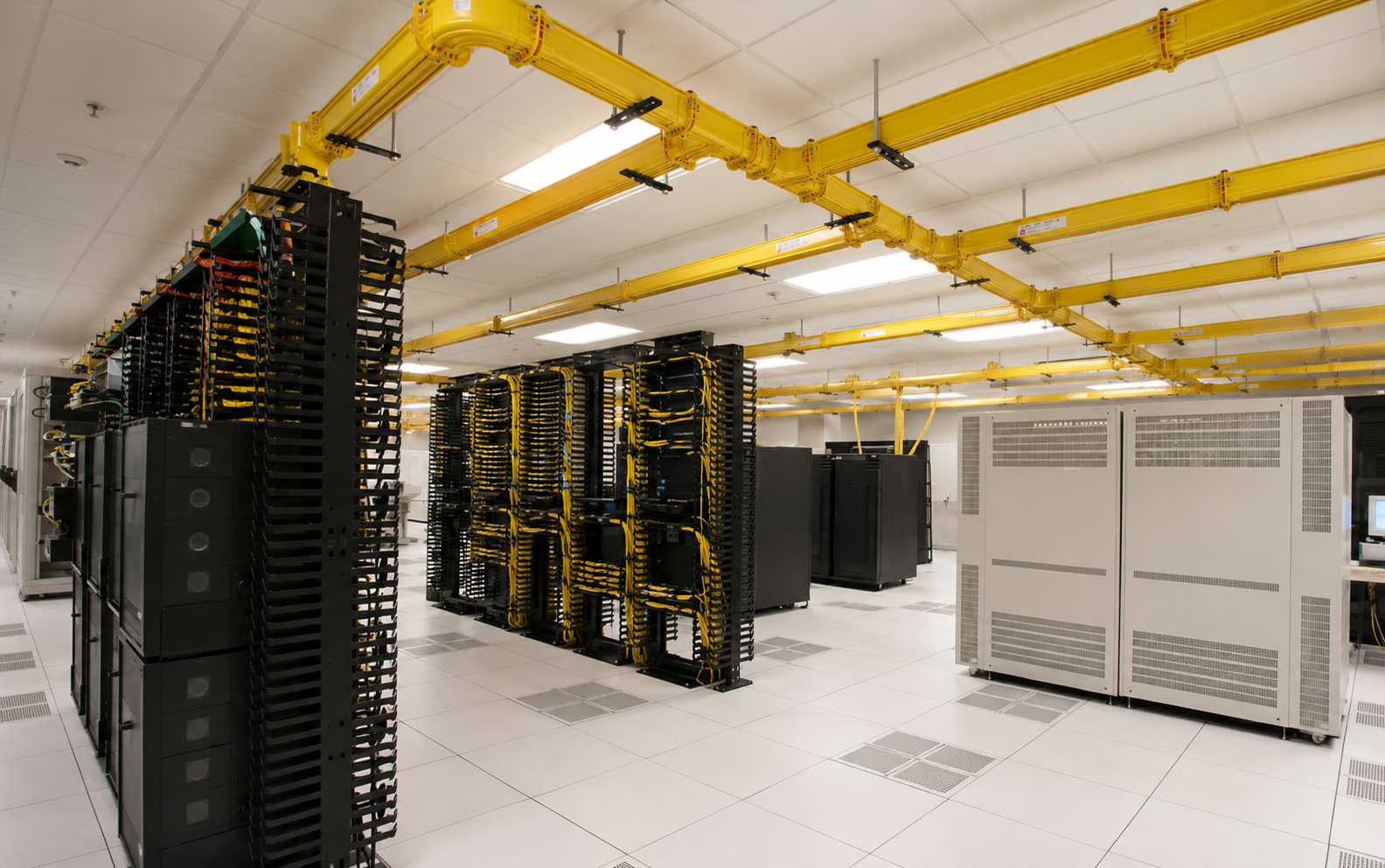
Indoor riser (OFNR) or plenum (OFNP) tight-buffered distribution cable for inside-plant, indoor/outdoor loose-tube gel-filled or dry-block for building-to-building, armored for direct-bury or rodent-prone routes, and ADSS or figure-8 for aerial spans. Standard fiber counts: 12 or 24 for IDF backbones, 48-144 for MDF/campus backbones, 288+ for data-center rows. All cable is Corning, OFS, Prysmian, or Belden with matching connectors and panels.
Termination: fusion splice vs. field-polish vs. pre-term
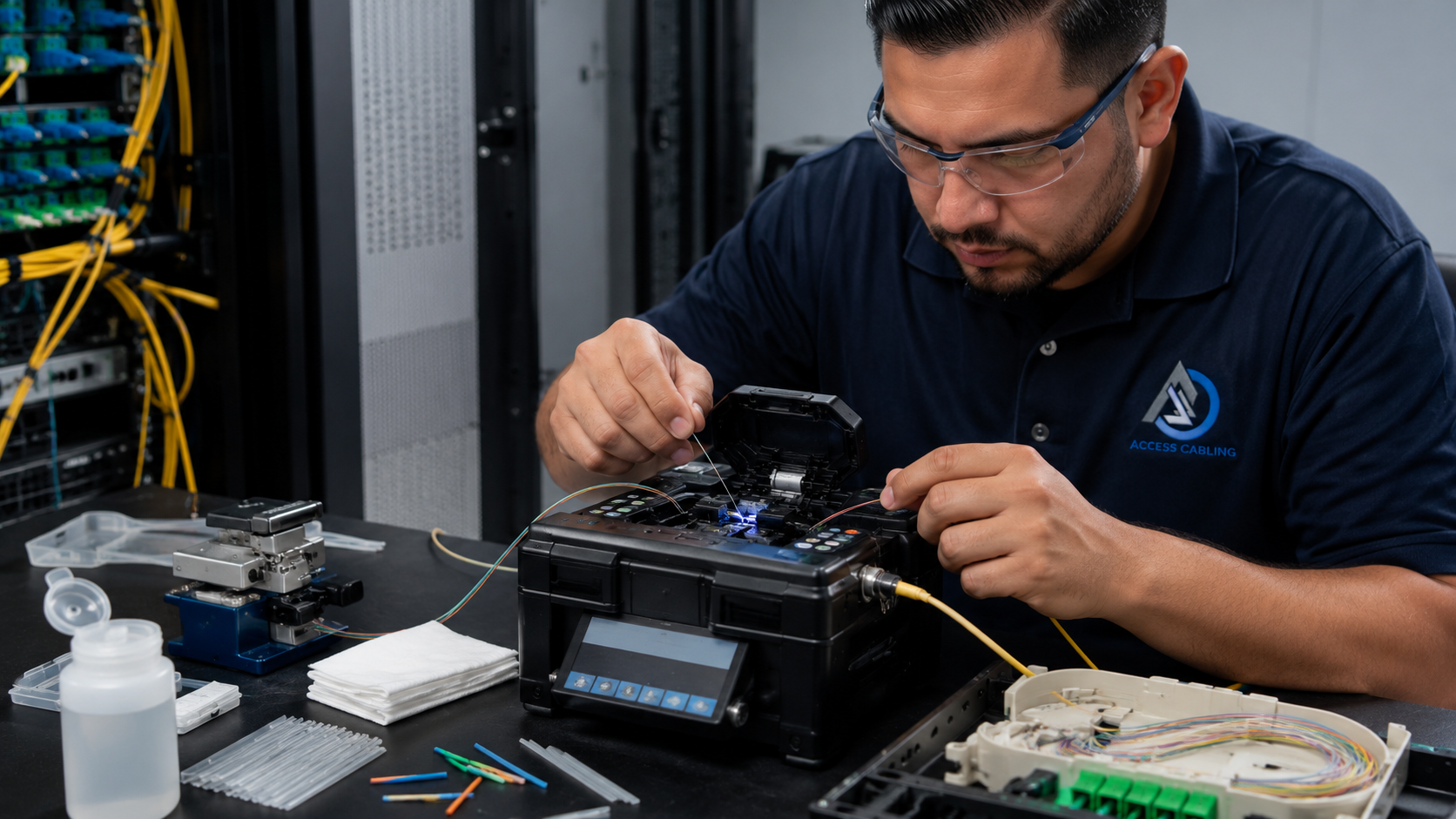
For any single-mode span or any run that will be certified with an OTDR, we fusion-splice pigtails onto the field cable — this yields sub-0.1 dB splice loss and factory-quality connector geometry. For short multimode runs we sometimes use mechanical (Unicam-style) or fusion-splice-on connectors. For data-center rows and MDF core we prefer factory pre-terminated MTP/MPO trunks — faster deployment, guaranteed loss budget, no field polish variability. Every termination is LC, SC, or MTP with green (APC single-mode) or blue (UPC) boots as spec'd.
Testing: Tier 1 loss + Tier 2 OTDR trace
Every fiber link is tested with Fluke CertiFiber Pro or EXFO for Tier 1 insertion loss (dual-wavelength: 850/1300 for MM, 1310/1550 for SM) against the calculated loss budget, plus Tier 2 OTDR bidirectional trace showing every splice, connector, and event along the fiber. You receive .flw and .sor files plus a bound PDF report with pass/fail per link, loss headroom, and event map. Failed links are re-spliced or repulled at no cost. Certified installs qualify for 25-year Corning, CommScope, or Panduit system warranties.
Outside plant, aerial, and underground work
For campus and building-to-building runs we design pathway (conduit, innerduct, direct-bury, or aerial), pull permits, coordinate with utility locates (USA 811), and install to Corning/OFS OSP standards with proper slack loops, splice enclosures (Corning FOSC or 3M), pedestal or handhole terminations, and cable-in-conduit records. Aerial spans use Kevlar messenger or ADSS with proper sag/tension calcs. Every OSP run is documented with GPS points at pull-boxes and splice cases.
Documentation and warranty
Closeout package: as-built pathway drawings, fiber schematic showing every strand and splice, patch-panel port assignments, OTDR traces and loss reports, connector inspection photos (per IEC 61300-3-35), materials list, warranty registration, and firestop records. Delivered as a single PDF plus native OTDR files. Workmanship warranty is one year; manufacturer system warranty is 25 years when installed with certified end-to-end Corning or CommScope components.
Fiber optic cable installation cost: what commercial projects budget in 2026
Commercial fiber optic cable installation cost breaks into four line items: cable and pathway materials, terminations, fusion splicing, and Tier 1/Tier 2 certification. For a straightforward inside-plant backbone — 12 to 24 strands, MDF to a single IDF one floor apart, accessible pathway — budget roughly $6-$15 per foot installed and certified, plus $75-$150 per fusion splice and $150-$300 per LC/SC terminated pigtail. A typical 24-strand riser between two IDFs at 200 feet, fully spliced, terminated, and OTDR-tested, lands in the $6,000-$12,000 range all-in.
Outside-plant fiber installation cost varies far more because pathway drives the number: direct-burial in soft dirt with existing conduit adds $10-$25 per foot; directional bore under a road or parking lot adds $30-$75 per foot; aerial on existing pole plant with permitted attachments adds $8-$20 per foot. A 500-foot campus link between two buildings — trench, conduit, 12-strand OS2 armored cable, splice cases at both ends, and full certification — typically runs $18,000-$35,000 depending on ground conditions and permit scope. Data-center MTP/MPO pre-terminated trunks are quoted per assembly ($400-$1,200 each depending on length and fiber count) plus mobilization; they usually beat field termination on total cost above 24 strands.
The biggest cost lever on any fiber optic installation is single-mode vs. multimode and the strand count you pull. Pulling 48 strands instead of 12 adds maybe 15% to the material cost and almost nothing to labor — but re-pulling in year seven when you need more capacity costs 100% of the original job. For most commercial projects we recommend installing 4x the strands you need today, all OS2 single-mode, and terminating only what is needed at cutover. Every quote we send is fixed, line-itemized, and delivered within 48 hours of a site walk — no per-foot guessing.