Developing and maintaining robust network infrastructure for multi-building environments, such as corporate headquarters, educational institutions, or research parks, presents a unique set of challenges far exceeding those of single-facility deployments. These sprawling ecosystems demand seamless connectivity, high bandwidth, and unparalleled reliability across diverse environmental conditions and varying distance requirements. Access Cabling specializes in the design, installation, and optimization of enterprise-grade Campus Networks, providing the critical fiber optic and copper backbones that unify disparate structures into a single, high-performance data transport system. Our approach prioritizes future scalability, fault tolerance, and adherence to stringent industry standards like TIA/EIA and BICSI, ensuring your multi-site operations benefit from a resilient and high-capacity network foundation engineered for longevity and peak performance. We leverage over two decades of low-voltage contracting expertise to deliver integrated solutions that solve complex inter-building connectivity demands.
Comprehensive Campus Network Design & Engineering
Effective Campus Network deployment begins with a meticulous design and engineering phase, essential for establishing a high-performance, scalable, and resilient inter-building infrastructure. Unlike single-facility setups, campus environments require careful consideration of Open-System Interconnection (OSI) layer 1 and 2 topography across widely dispersed sites. Our process involves detailed site surveys, existing infrastructure analysis, and collaboration with IT and facilities teams to define current and future bandwidth requirements. We engineer backbone pathways that align with TIA-568 series standards, particularly TIA-568.C.0 and TIA-568.C.3 for fiber optic cabling, ensuring proper fiber counts, cable types (typically OS2 single-mode for distances exceeding 300 meters, or OM3/OM4 multimode for shorter links), and splice tray configurations. This phase also includes the strategic placement of Main Distribution Areas (MDAs) and Intermediate Distribution Areas (IDAs) within each building, optimizing cross-connect and inter-building cabling runs while minimizing signal degradation over extended distances. Our designs account for potential environmental factors, including soil conditions, water tables, and climate, which directly impact the choice of outside plant (OSP) cabling and pathway protection methods.
Outside Plant (OSP) Fiber Optic Backbone Implementation
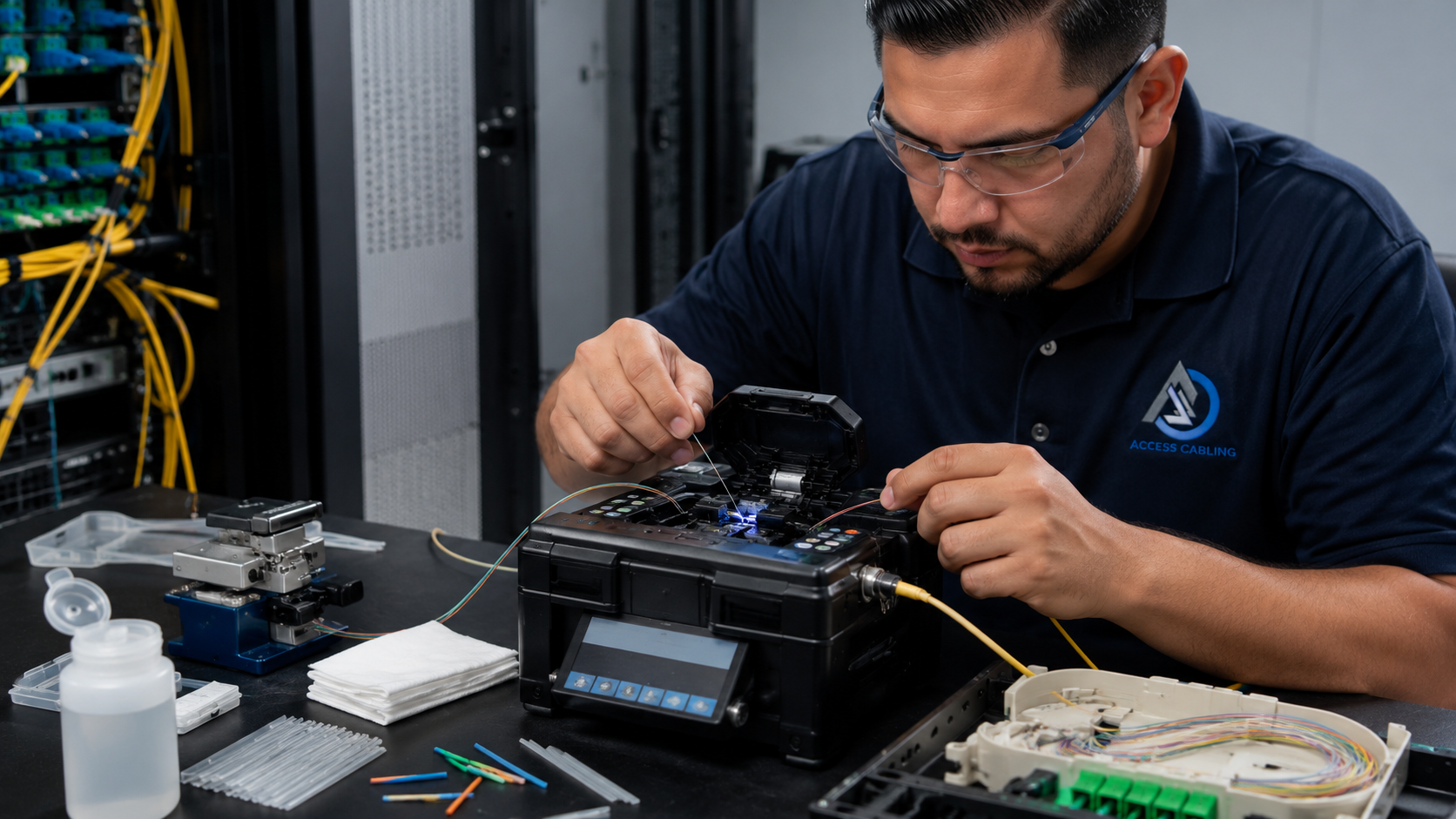
The backbone of any robust Campus Network is its Outside Plant (OSP) fiber optic cabling, providing high-capacity, low-latency connectivity between buildings. Our expertise encompasses all aspects of OSP deployment, from pathway creation to termination. We adhere strictly to BICSI OSP standards and NEC Article 770 for optical fiber cables, particularly concerning proper grounding and bonding. Pathway options include direct burial in trenched conduits (e.g., Schedule 40 or 80 PVC, HDPE), aerial installations using figure-8 self-supporting or lashed cable, or placement in existing underground duct banks. Each method is selected based on site-specific soil conditions, span lengths, environmental exposure, and future expandability. We utilize purpose-built OSP cables with UV-resistant jackets, gel-filled or dry water-blocking elements, and often steel armor for rodent protection. Fiber splicing, whether fusion or mechanical, is performed by certified technicians to ensure minimal insertion loss (typically <0.1 dB per fusion splice for single-mode fiber) and optimal return loss, critical for high-speed protocols. Termination is typically done within weather-rated OSP enclosures or inside building entrance facilities, transitioning to premise-rated fiber within the building to comply with fire codes and provide accessible points for future expansion or troubleshooting.
Building Entrance Facilities and Inter-Building Copper Integration
The Building Entrance Facility (BEF) serves as the critical demarcation point where the OSP backbone transitions to the indoor cabling infrastructure. Proper design and execution of the BEF are paramount for network resilience and compliance. Here, OSP cables are terminated in weather-resistant enclosures, and often, OSP fiber is spliced to premise-rated fiber (e.g., OFNR or OFNP) to meet NEC fire safety requirements. Our technicians meticulously manage this transition, ensuring proper grounding and bonding for metallic components, as stipulated by NEC Article 250. While fiber optic cabling typically handles the primary inter-building data backbone, often copper cabling (e.g., Cat6A for 10 Gigabit Ethernet) is required for specific applications, such as VoIP systems, low-speed data, or powering remote devices via Power over Ethernet (PoE) in adjacent buildings. For these instances, we deploy OSP-rated shielded copper cables within dedicated pathways, connecting through suitable protection units at the BEF to guard against lightning and transient voltage surges, ensuring the integrity and safety of the entire network segment.
Scalability, Resiliency, and Redundant Pathway Design
Designing Campus Networks with built-in scalability and resiliency is not an optional add-on; it's a fundamental requirement. We employ redundant pathway strategies, such as developing diverse OSP routes for critical fiber backbones, to mitigate single points of failure. This involves laying parallel fiber runs in physically separate conduits or trenches that do not share common manholes or duct banks, ensuring that a single event (e.g., accidental excavation) does not disrupt connectivity to an entire building or campus segment. Our designs often incorporate multiple fiber strands beyond immediate needs, providing dark fiber capacity for future expansion without costly re-trenching or re-cabling. Furthermore, we implement network topologies that support rapid failover mechanisms, such as redundant fiber links to core switches, aligning with TIA-942 Telecommunications Infrastructure Standard for Data Centers considerations for high availability. These foresightful design elements ensure that as your campus evolves and bandwidth demands increase, the underlying infrastructure can gracefully accommodate new requirements with minimal disruption and maximum uptime.
Precision Testing, Certification, and Documentation
Rigorous testing and comprehensive documentation are cornerstones of a professionally deployed Campus Network. Upon completion of installation, every fiber strand and copper pair is meticulously tested to TIA/EIA standards using industry-leading equipment such as Fluke DSX-8000 for copper certification and Fluke OptiFiber Pro for fiber optic Tier 1 (OTDR) and Tier 2 (OLTS) testing. For fiber, we measure insertion loss, return loss, and validate length, ensuring compliance with specified attenuation budgets. For copper, parameters like Near-End Crosstalk (NEXT), Far-End Crosstalk (FEXT), PSNEXT, ACR-F, and return loss are certified against manufacturer and TIA performance parameters. Individual test results are compiled into detailed certification reports, providing verifiable proof of performance. Beyond testing, accurate documentation is provided, including 'as-built' drawings, fiber matrix tables, splice diagrams, pathway maps, and component labeling schemes (e.g., TIA-606-C compliant). This exhaustive documentation package serves as an invaluable asset for future troubleshooting, MACs (Moves, Adds, Changes), and long-term network management, enabling efficient maintenance and ensuring accountability.
Adherence to Industry Standards and Regulatory Compliance
Compliance with relevant industry standards and local regulations is non-negotiable for enterprise-grade Campus Networks. Access Cabling operates under strict adherence to TIA/EIA standards (e.g., TIA-568 for cabling, TIA-942 for data center aspects, TIA-758 for OSP), BICSI Telecommunications Distribution Methods Manual (TDMM) guidelines, and the National Electrical Code (NEC) as adopted by local jurisdictions (e.g., in California). These standards dictate everything from cable types and bend radius to grounding, bonding, firestopping, and pathway protections. Our CSLB C-10/C-7 licensing (992009) reflects our comprehensive understanding and application of these codes. For example, firestopping materials and methods (e.g., employing UL-listed firestop collars or sealants at penetration points) are precisely implemented to maintain the fire rating of walls and floors, an NEC requirement crucial in multi-building environments. This commitment to regulatory compliance minimizes risk, enhances safety, and ensures that your campus infrastructure meets all required jurisdictional mandates, avoiding costly penalties and potential operational shutdowns.
Access Cabling's Differentiated Project Execution
Access Cabling sets itself apart in Campus Network deployments through an unwavering commitment to quality, an integrated project management approach, and deep technical expertise. Our 28+ years of experience provide a granular understanding of the unique challenges associated with multi-building interconnectivity, from complex right-of-way negotiations for OSP routes to navigating diverse building code requirements. We are not simply installers; we are end-to-end solution providers, from initial consultation and design to final commissioning and ongoing support. Leveraging partnerships with leading manufacturers like CommScope, Panduit, Leviton, Belden, and Corning, we specify and install only commercial-grade, warranted components engineered for longevity and performance. Our project managers ensure transparent communication, adherence to timelines, and meticulous budget control, integrating seamlessly with general contractors, facilities teams, and IT departments. This holistic, quality-driven approach minimizes disruptions, maximizes network uptime, and delivers a robust campus infrastructure that truly embodies the term 'enterprise-grade' connectivity.
Advanced Wireless Infrastructure for Seamless Campus Connectivity
Deploying a robust wireless infrastructure across a multi-building campus environment demands meticulous planning beyond simple access point (AP) placement. Access Cabling specializes in designing and implementing high-density Wi-Fi networks leveraging Wi-Fi 6E (802.11ax) and emerging Wi-Fi 7 (802.11be) standards to support bandwidth-intensive applications, IoT proliferation, and real-time communication protocols. Our approach begins with comprehensive site surveys utilizing specialized tools such as Ekahau Pro to perform active, passive, and spectrum analysis across all relevant frequency bands (2.4 GHz, 5 GHz, 6 GHz). This data informs precise AP placement, channel planning, power level optimization, and antenna selection (e.g., directional vs. omnidirectional) to mitigate co-channel interference, optimize signal-to-noise ratio (SNR), and ensure ubiquitous coverage with minimal dead zones. We consider diverse client device types, expected user densities per area (e.g., lecture halls vs. administrative offices), and critical application requirements like voice over IP (VoIP) and video streaming to guarantee Quality of Service (QoS). Furthermore, we integrate wireless security best practices, including WPA3 encryption, RADIUS-based authentication (802.1X), and network segmentation through Virtual Local Area Networks (VLANs) to isolate traffic and protect sensitive data across the wireless medium. Our deployments often involve integrating Power over Ethernet (PoE) solutions (e.g., PoE++, 802.3bt) to centrally power APs, minimizing electrical infrastructure requirements at each device location and simplifying management. The robust wireless backbone is seamlessly integrated with the wired network segments, ensuring consistent policy enforcement and streamlined network administration.
The real-world complexities extend to aesthetic integration and environmental factors. For historical buildings or architecturally significant structures, APs may need to be discreetly mounted or camouflaged without compromising RF performance. Outdoor wireless deployments, for courtyards or common areas, necessitate industrial-grade, weather-resistant APs (IP67-rated) and careful consideration of backhaul options, often leveraging point-to-point wireless bridges or dedicated fiber links. Spectrum management is an ongoing challenge, especially in dense urban environments or on large campuses with multiple RF-generating entities. Our engineers continuously monitor for rogue APs and potential sources of interference, such as microwave ovens or unlicensed wireless devices, to maintain optimal network hygiene. We also design for future capacity, anticipating the continued growth of wireless-only devices and bandwidth demand, ensuring the chosen AP models and controller infrastructure can scale effectively through software upgrades and modular expansions rather than complete rip-and-replace scenarios. This foresight minimizes total cost of ownership (TCO) and extends the lifecycle of the wireless investment.
Structured Cabling Design for Future-Proof Campus Evolution
The foundational element of any resilient campus network is a properly designed and installed structured cabling system. Access Cabling designs and implements Category 6A and Category 8 copper cabling systems, alongside single-mode (OS2) and multi-mode (OM3/OM4/OM5) fiber optic cabling, specifically engineered to support current 10 GbE, 25 GbE, 40 GbE, and future 100 GbE+ Ethernet standards across the campus. Our designs rigorously follow TIA/EIA-568 series standards for commercial building cabling and TIA-758 for customer-owned outside plant. This translates into meticulously planned horizontal cabling runs, minimizing cable length to avoid attenuation issues, and strategic placement of telecommunications rooms (TRs) or intermediate distribution frames (IDFs) to reduce maximum channel lengths. We specify high-performance components including shielded or unshielded twisted pair (UTP/FTP/STP) cables, patch panels, outlets, and connectivity hardware that meet or exceed industry specifications from reputable manufacturers like CommScope, Panduit, and Siemens. Emphasis is placed on cable management within TRs, including proper dressing, slack management, and comprehensive labeling (e.g., TIA/EIA 606-C compliant) to facilitate moves, adds, and changes (MACs) and simplify troubleshooting.
Beyond just raw performance, we address critical aspects like power distribution and surge protection within TRs, collaborating closely with electrical engineers for dedicated circuits and proper grounding. Environmental control within these spaces—temperature and humidity management—is paramount to ensure the longevity and reliability of active network equipment. Our designs account for diverse campus building types, from modern multi-story facilities to older structures with inherent infrastructure limitations. This often involves creative routing solutions, conduit sizing calculations to prevent overfills, and firestopping measures that adhere to building codes (e.g., ASTM E814/UL 1479) to maintain fire ratings of floor slabs and wall penetrations. We consider cable tray systems, J-hooks, and other support structures to prevent cable sagging, kinking, and strain, which can degrade performance over time. A core principle is designing for redundancy and alternate pathways, particularly for critical data backbone links between buildings, ensuring network continuity even in the event of a localized failure. This proactive approach to physical infrastructure forms the bedrock upon which all other network services depend, directly impacting network uptime, security, and the campus's operational efficiency for decades.
Integrated Network Security and Physical Infrastructure Hardening
Campus networks, by their very nature, present a complex attack surface due to their open access points (academic, research, administrative, and public guest networks), diverse user base, and distributed physical infrastructure. Access Cabling integrates network security considerations directly into the physical infrastructure design from conception. This begins with hardening telecommunications rooms (TRs) and main distribution frames (MDFs) through controlled access mechanisms, such as robust locking mechanisms, access control card readers, and even video surveillance systems. We advocate for and implement network segmentation strategies at the physical layer, such as deploying separate cabling plants or dedicated VLANs for sensitive research networks, administrative systems (e.g., HR, finance), building management systems (BMS), and guest Wi-Fi. This limits the blast radius of a breach and prevents lateral movement across critical infrastructure. We also consider the physical security of 'edge' devices, particularly outdoor APs or security cameras, ensuring they are mounted securely and cabling pathways are protected from tampering or vandalism.
Our security-conscious design extends to the selection and deployment of network switching and routing hardware, emphasizing devices that support advanced security features like port security (limiting devices per port), 802.1X for user/device authentication, MAC address filtering, and Dynamic ARP Inspection (DAI) to prevent spoofing. We often collaborate with IT security teams to ensure the physical infrastructure supports their logical security policies, such as the placement of intrusion detection/prevention systems (IDS/IPS) or network access control (NAC) appliances. Special attention is paid to dark fiber deployments: while offering superior security against eavesdropping compared to copper, proper physical termination, patching, and stringent access controls at each end point are still critical to prevent unauthorized access or taps. We document all security-relevant physical infrastructure elements, including locked enclosures, surveillance camera fields of view, and access control system integration points, to provide a holistic overview for campus security and IT operations teams. The aim is to create a multi-layered security posture where physical hardening complements and reinforces logical cybersecurity defenses.
Strategic Network Migration and Cutover Planning for Zero Downtime
Migrating or upgrading active campus network infrastructure presents significant challenges, particularly the imperative to maintain continuous operation for critical academic, research, and administrative functions. Access Cabling's approach to network migration and cutover is meticulously planned to achieve near-zero downtime. This begins with a comprehensive audit of the existing infrastructure, identifying dependencies, legacy systems, and critical applications. Our project managers develop a granular, phased migration plan that segments the campus into manageable deployment zones, allowing for sequential upgrades rather than a disruptive full-campus cutover. This often involves establishing a 'parallel run' scenario where new infrastructure is installed, tested, and provisioned alongside the existing network before any traffic is transitioned.
Detailed cutover schedules are developed in close coordination with campus IT stakeholders, typically leveraging off-peak hours (e.g., weekends, academic breaks) to minimize user impact. Each phase includes a rollback plan, ensuring that if unforeseen issues arise, the network can revert to its previous stable state quickly. Key activities during cutover include pre-validation of all new fiber and copper links using Tier 1 and Tier 2 testers (e.g., Fluke Networks Versiv DSX-8000 for copper, OptiFiber Pro for fiber), ensuring all performance parameters meet or exceed specified standards (e.g., TIA-568.3-E for fiber attenuation, TIA-568.2-D for copper NEXT/PSNEXT). We collaborate with network engineers for IP address planning, VLAN assignments, routing protocol convergence, and firewall rule updates to ensure seamless Layer 2/3 transitions. Our team conducts extensive post-cutover verification, including application-level testing, user acceptance testing (UAT) in conjunction with campus staff, and continuous network monitoring to identify and resolve any latent issues promptly. Comprehensive documentation, including updated as-built drawings, termination schedules, and configuration guides, is delivered immediately post-migration, ensuring operational continuity for campus staff. This rigorous planning and execution methodology drastically reduces risks associated with network upgrades, safeguarding critical educational and operational services.