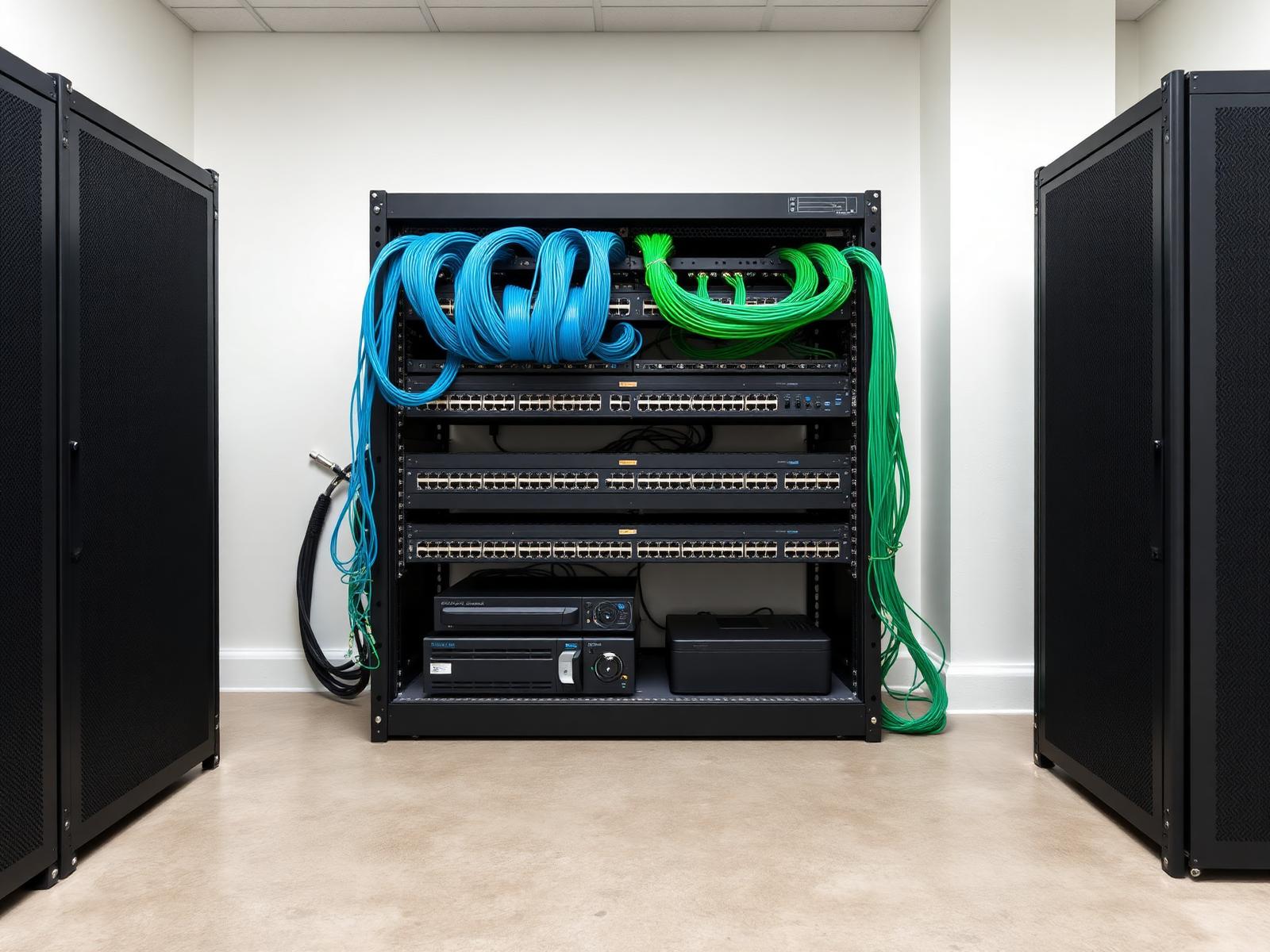
Enterprise-level distributed operations necessitate a robust and uniform network infrastructure. When your organization requires consistent, high-performance structured cabling deployments across multiple geographically dispersed locations, a nationwide cabling rollout becomes a critical strategic initiative. Access Cabling specializes in the planning, project management, and execution of these complex multi-site infrastructure projects across all 50 states. Our deep understanding of local codes, logistical challenges, and the criticality of standardized deployment protocols distinguishes our service. We provide a single point of contact for unified procurement, standardized installation methodologies, and predictable outcomes, directly mitigating the inherent risks and inefficiencies often associated with managing numerous local contractors. This approach ensures your distributed enterprise benefits from a cohesive, scalable, and fully compliant network foundation, irrespective of location.
Defining Enterprise-Grade Nationwide Rollout Services
Nationwide cabling rollouts, in Access Cabling's context, encompass the systematic deployment of structured cabling and low-voltage systems across a client's entire national footprint. This service is engineered for enterprises expanding, consolidating, or upgrading their physical infrastructure across dozens, hundreds, or even thousands of locations simultaneously. Our methodology centers on establishing a 'gold standard' for installation – a meticulously defined set of procedures, material specifications, and quality benchmarks applied uniformly across every site. This standardization is crucial for future network scalability, ease of maintenance, and troubleshooting. We adhere rigorously to TIA/EIA standards, such as TIA-568 (Commercial Building Telecommunications Cabling Standard), TIA-569 (Telecommunications Pathways and Spaces), and TIA-606 (Administration Standard for Telecommunications Infrastructure). Beyond mere physical deployment, our service integrates comprehensive project management, logistical coordination, and detailed site-specific assessments, ensuring each installation consistently meets performance criteria, safety regulations, and the client's operational objectives. This unified approach minimizes variability and maximizes long-term network reliability for geographically disparate assets.
Strategic Design and Engineering for Multi-Site Uniformity
The core of a successful nationwide rollout lies in its foundational design and engineering. Access Cabling develops a master design blueprint that dictates every aspect of the structured cabling system, from cable types (e.g., Cat6A, OS2 fiber, OM4 fiber) and connectivity hardware (e.g., Panduit Opti-Jack, CommScope TeraSPEED panels) to pathway design and equipment room layouts. This includes specifying BICSI best practices for cable management, grounding, bonding, and firestopping. Our engineering team conducts thorough site surveys, often leveraging remote assessment tools and standardized templates, to identify site-specific variables while ensuring adherence to the overall design. Each site's unique architectural elements, existing infrastructure, and environmental conditions are mapped against the master specification. This process often involves detailed CAD drawings (AutoCAD Electrical, Revit) and Bills of Materials (BOMs) that are standardized across all locations, accounting for environmental factors like plenum vs. non-plenum rated cable requirements based on building codes, and considerations for extreme temperatures or humidity in specific regions. This meticulous planning phase prevents costly deviations and ensures inter-site compatibility and performance predictability across the entire enterprise network.
Procurement and Logistics: Standardized Material Deployment
Effective management of procurement and logistics is paramount for ensuring material consistency and timely delivery across a nationwide rollout. We establish centralized procurement channels for all network infrastructure components, typically partnering with industry leaders such as Panduit, CommScope, Leviton, Belden, and Corning. This strategy guarantees that every location receives identical, high-quality, manufacturer-warrantied products, eliminating the risk of performance variances due to non-standard or inferior components. Our logistics team orchestrates the staging, shipping, and scheduled delivery of materials to hundreds or thousands of job sites, often coordinating with general contractors, facilities managers, and client-designated personnel. This involves detailed inventory management, just-in-time delivery strategies to minimize on-site storage requirements, and robust tracking systems to monitor material flow from warehouse to installation. Compliance with NEC Article 800 for communications circuits and Article 770 for optical fiber cables, particularly concerning fire ratings (e.g., CMP, CMR), is integrated into the material selection and procurement process to ensure all components meet local and federal safety standards regardless of geographic location. This end-to-end control over the supply chain directly contributes to project efficiency and material authenticity.
Installation Methodologies and Quality Assurance across States
Deploying consistent installation quality across 50 states requires a rigorously defined methodology and robust quality assurance protocols. Access Cabling utilizes a comprehensive Project Management Office (PMO) approach, deploying a national network of licensed and certified low-voltage technicians, all operating under unified directives. Our field technicians are trained on standardized cabling practices, equipment configurations, and safety procedures developed by our internal engineering team, often exceeding baseline BICSI installation methods. Each project includes a detailed Statement of Work (SOW) and installation guideline that all field teams must follow, covering aspects from cable routing and termination best practices to labeling conventions (e.g., TIA/EIA-606-B). Supervisory oversight is continuous, leveraging remote monitoring tools, site photos, and regular progress reports. For critical phases, regional project managers conduct on-site audits to verify adherence to design specifications and quality parameters. This multi-layered approach ensures that whether an installation is in California or New York, it meets the exact same high standards for workmanship, performance, and future scalability.
Rigorous Testing and Certification for Nationwide Performance
Post-installation, comprehensive testing and certification are non-negotiable for every single cable run and fiber optic link across all sites. Access Cabling utilizes industry-standard certification testers, predominantly Fluke DSX CableAnalyzers for copper infrastructure and Fluke CertiFiber Pro for fiber optics, ensuring objective and verifiable performance metrics. All testing procedures strictly adhere to TIA-568-C.2/D.2 (for copper) and TIA-568-C.3/D.3 (for fiber) standards, confirming parameters such as insertion loss, return loss, near-end crosstalk (NEXT), power sum NEXT (PSNEXT), attenuation-to-crosstalk ratio (ACR-F, ACR-N), and propagation delay. For fiber, this includes measuring attenuation, length, and polarity. Each certified cable run receives a unique ID, and all test results are compiled into a comprehensive digital report package – often thousands of individual test reports. This central repository of certified performance data provides the client with an indisputable record of compliance and a baseline for future network troubleshooting, validating the integrity of their nationwide physical layer infrastructure and ensuring full eligibility for manufacturer warranty coverage (typically 20-25 years).
Ensuring Compliance, Safety, and Comprehensive Documentation
Compliance with all applicable codes, safety regulations, and client-specific requirements is embedded into every phase of a nationwide rollout. This includes strict adherence to the National Electrical Code (NEC) as adopted by local jurisdictions, particularly regarding cabling pathways, firestopping materials (e.g., 3M, Hilti), and grounding/bonding practices. Our teams are trained in OSHA safety protocols, utilizing appropriate PPE and safe work practices, especially when working in conjunction with other trades on active construction sites. Moreover, we ensure compliance with building fire codes and specific industry regulations pertinent to the client's sector (e.g., healthcare, finance). Upon project completion, a full documentation package is provided, which typically includes as-built drawings, detailed cable plant maps, equipment rack elevations, fiber fusion splice diagrams, and the full corpus of certification test results. This comprehensive documentation is critical for ongoing MAC (Moves, Adds, Changes) work, future upgrades, and simplifies facilities management, providing a clear, accurate, and actionable record of the deployed infrastructure for every location.
The Access Cabling Nationwide Rollout Advantage
Access Cabling's distinct advantage in nationwide rollouts stems from our integrated, end-to-end capabilities and unwavering commitment to standardization. Unlike managing multiple independent contractors, which often leads to inconsistent quality, varied pricing, and logistical nightmares, we offer a single, accountable entity. Our 28+ years of experience as a C-10/C-7 low-voltage contractor, coupled with our national project management infrastructure and a network of qualified technicians, enables us to execute projects of immense scale and complexity. We leverage established relationships with leading manufacturers for consistent material supply and warranty support. Our proactive communication, transparent reporting, and dedicated project management structure provide clients with clear visibility and control over all sites. This consolidated approach not only streamlines the deployment process but significantly reduces total cost of ownership by eliminating redundancies, ensuring uniform performance, and extending the lifespan of the critical cabling infrastructure across your entire enterprise.
Advanced Project Management and Collaborative Integration
Successful nationwide rollouts hinge on an advanced project management framework that transcends standard PMP methodologies, integrating deeply with client-specific enterprise resource planning (ERP) systems and operational technology (OT) platforms. Our approach utilizes a hybrid agile-waterfall model, leveraging agile sprints for rapid deployment phases and waterfall for meticulous long-lead item procurement and site preparation. Dedicated program managers, each holding PMP and PgMP certifications, are assigned to oversee multiple interdependent projects, ensuring alignment with overarching strategic objectives. This includes rigorous risk mitigation protocols, such as pre-emptive site surveys to identify unique geotechnical or structural challenges, and the development of contingency plans for material shortages or unforeseen permitting delays. Furthermore, our collaboration extends to critical Mechanical, Electrical, and Plumbing (MEP) trades, often initiating integration meetings during the design phase to coordinate conduit pathways, power requirements (e.g., dedicated circuits for network closets, UPS sizing for PoP locations), and HVAC considerations for heat dissipation in comms rooms. We utilize Building Information Modeling (BIM) tools like Autodesk Revit and Navisworks to create federated models, allowing for clash detection and optimized space utilization before physical construction begins. This proactive engagement minimizes on-site rework, reduces change orders, and accelerates deployment schedules, directly impacting Time-to-Value (TTV) for our enterprise clients. Our PMO employs a centralized dashboard accessible to key stakeholders, providing real-time progress updates, budgetary adherence, and critical path analysis, fostering transparency and accountability across all 50 states.
Robust Cybersecurity Posture and Physical Security Implementation
Deploying technology across numerous disparate locations inherently amplifies the attack surface, necessitating a robust cybersecurity posture integrated from the earliest design stages. Our nationwide rollout services embed security-by-design principles into every layer, from infrastructure cabling to active network device configuration. This includes the implementation of segregated network zones (e.g., VLANs for IoT, corporate, and guest networks), adherence to NIST Cybersecurity Framework guidelines, and often, compliance with industry-specific regulations such as PCI DSS for retail environments or HIPAA for healthcare facilities. Physical security at each site is paramount; this encompasses specifying UL 2050 listed alarm systems, access control solutions utilizing multifactor authentication (MFA) – often biometric readers or smart card integration – for telecom rooms, and the installation of discreet yet comprehensive CCTV surveillance systems to monitor infrastructure access points. We meticulously document and implement hardening guides for all active components, disabling unnecessary ports and services, configuring strong password policies, and ensuring regular firmware updates are part of the maintenance schedule. Encryption protocols, such as AES-256 for data-at-rest and TLS 1.3 for data-in-transit, are mandated for critical data paths. Furthermore, our deployment teams are trained in social engineering awareness, recognizing the human element as a common vulnerability. Post-installation, we recommend and can integrate vulnerability scanning and penetration testing services to validate the security posture across the entire deployed infrastructure, ensuring that each new node in the network chain adheres to the highest enterprise security standards, mitigating both internal and external threats effectively.
Future-Proofing and Technology Lifecycle Management
The rapid pace of technological evolution demands that nationwide rollouts are not merely present-day solutions but also foundational platforms for future growth and innovation. Our approach includes a comprehensive technology roadmap exercise, projecting infrastructure requirements 3-5 years out. This involves specifying cabling media (e.g., Category 6A or higher for 10 Gigabit Ethernet, OS2 fiber for 100 Gigabit Ethernet and beyond) that exceeds current immediate needs but accommodates anticipated bandwidth demands from emerging applications such as augmented reality (AR), artificial intelligence (AI) at the edge, and ultra-high-definition video streaming. We design structured cabling systems with modularity and scalability in mind, often incorporating pre-terminated fiber optic assemblies and high-density copper patching solutions that facilitate easier upgrades and reduce future operational expenditures (OpEx). Furthermore, our methodology considers the total cost of ownership (TCO), advocating for infrastructure components with proven longevity, energy efficiency, and simplified maintenance profiles. This includes selecting PoE++ (Power over Ethernet Plus Plus) capable switches and cabling to support an increasing array of IoT devices without requiring additional localized power infrastructure. We develop detailed lifecycle management plans, outlining refresh cycles for active network gear and passive infrastructure components, integrating with the client’s asset management systems. This forward-looking perspective minimizes the likelihood of premature obsolescence and ensures that the initial capital expenditure (CapEx) in nationwide infrastructure delivers sustained value, supporting the enterprise's long-term digital transformation objectives and providing a resilient backbone for next-generation applications. Our recommendations are supported by industry standards such as TIA-942 for datacenter design and BICSI best practices.
Migration Strategy, Cutover Planning, and Business Continuity
Executing a large-scale nationwide rollout, particularly when it involves upgrading or replacing existing infrastructure, necessitates an meticulously detailed migration strategy and cutover plan to minimize downtime and prevent business disruption. Our methodology involves developing granular, site-specific cutover schedules that account for local operational hours, peak business periods, and dependencies on external services or client personnel availability. This frequently includes 'dark fiber' or overlay network deployments, where new infrastructure is installed and tested completely in parallel with the existing system before a planned, phased cutover. For mission-critical sites, we implement 'hot cut' strategies with redundant systems in place, ensuring continuous service during the transition. A critical component is the development of comprehensive rollback procedures; in the event of unforeseen issues during cutover, we have clearly defined steps to revert to the previous operational state, minimizing potential data loss or extended outages. Pre-cutover activities include thorough data integrity checks, network configuration validation, and simulated traffic testing to ensure adequate bandwidth and latency pre-performance. During the cutover window, dedicated support teams, often augmenting internal client IT staff, are on standby, equipped with pre-staged diagnostic tools and direct lines of communication to our Network Operations Center (NOC). Post-cutover, a stabilization period is monitored intensively, with key performance indicators (KPIs) tracked to confirm full operational functionality and identify any latent issues. Our business continuity planning extends to geographic redundancy considerations for core network services and critical 'meet-me' points, ensuring that distributed failures do not cascade into systemic outages. This methodical approach to migration and cutover is paramount for enterprise clients where even minutes of unplanned downtime can translate into significant financial losses and reputational damage across multiple locations.