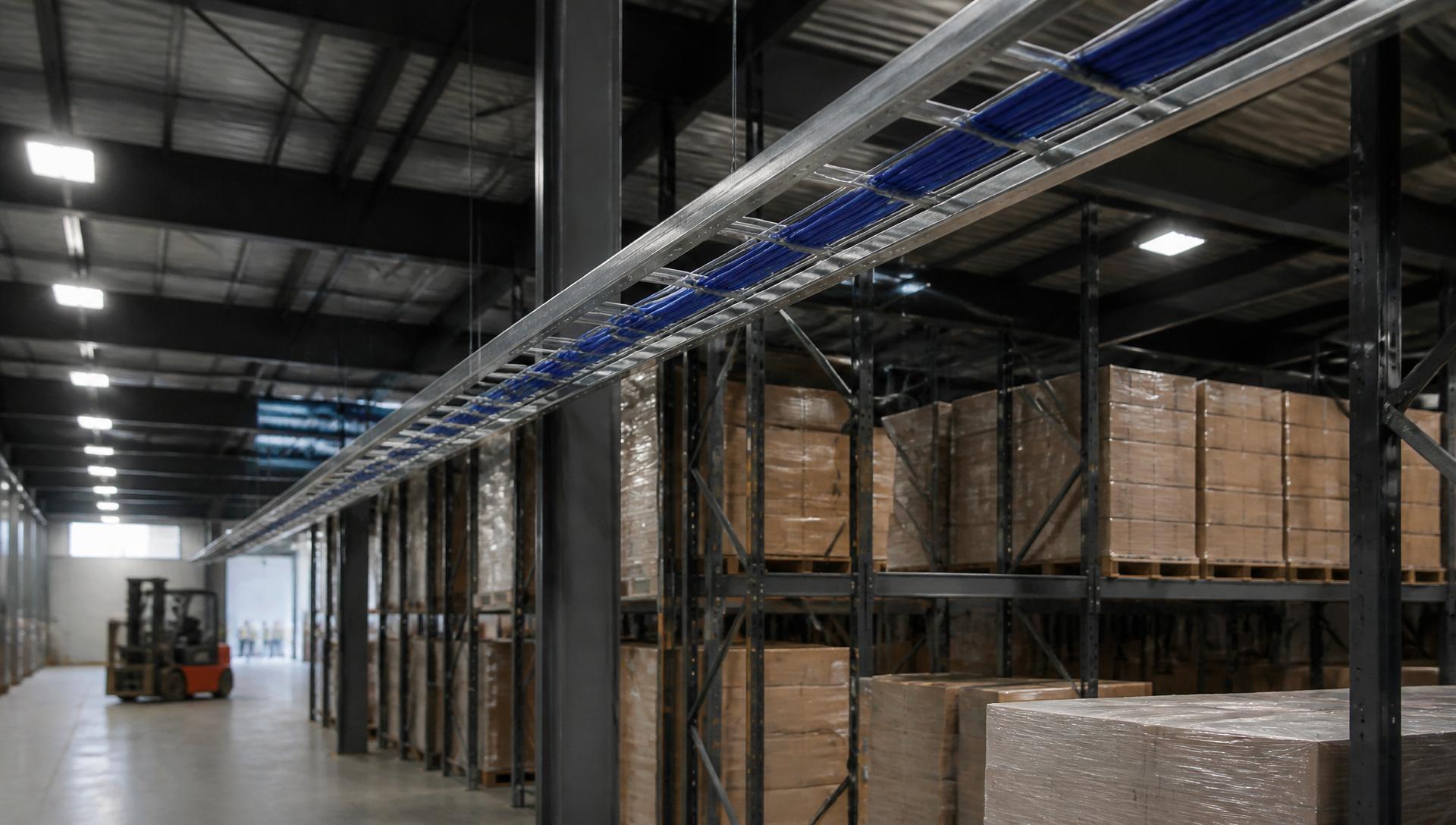
Optimizing the logistical backbone of a modern distribution center requires a robust, scalable, and resilient cabling infrastructure. From automated storage and retrieval systems (AS/RS) and robotic material handlers to high-density Wi-Fi networks supporting handheld scanners and real-time inventory management (WMS), the data highway within a distribution center is its circulatory system. Access Cabling specializes in designing, installing, and certifying advanced distribution center cabling solutions that ensure peak operational efficiency, minimize downtime, and support future technological advancements. Our C-10/C-7 licensing and 28+ years of expertise enable us to deliver architecturally sound, standards-compliant networks tailored to the unique demands of high-throughput logistics environments, ensuring seamless data flow for mission-critical operations across California and nationally.
Foundational Design Principles for DC Cabling Infrastructure
Effective distribution center cabling goes beyond simply running wires; it necessitates a comprehensive understanding of the facility's operational workflow, current and forecasted data demands, and the physical environment. Access Cabling's design methodology adheres strictly to TIA-568 series standards for commercial building telecommunications cabling, specifically addressing TIA-942-B for Data Center Infrastructure, which provides guidance pertinent to the high-density, mission-critical nature of DC networks. We factor in electromagnetic interference (EMI) sources prevalent in industrial settings, such as heavy machinery, motors, and high-voltage power lines, often recommending shielded twisted pair (STP) solutions like Belden 2000 Series or CommScope SYSTIMAX Category 6A F/UTP to mitigate crosstalk and external noise, ensuring reliable data transmission for automated systems and IP-based security. Pathway design is critical, utilizing BICSI TDMM guidelines to specify conduit fill ratios, wire basket routing, and properly rated cable trays (e.g., NEMA VE 1) to accommodate present demands and future expansion while protecting against physical damage and environmental stressors.
High-Performance Cabling for Automated Systems and Robotics
The integration of automated guided vehicles (AGVs), autonomous mobile robots (AMRs), and AS/RS requires a low-latency, high-bandwidth network backbone. For fixed robotic cells and automated conveyors, Category 6A unshielded twisted pair (UTP) or shielded types are commonly deployed, supporting 10 Gigabit Ethernet (10GbE) over copper up to 100 meters, using products from manufacturers like Panduit TX6A™ 10GbE UTP or Leviton Atlas-X1™ Category 6A. Fiber optic cabling, particularly OM4 or single-mode OS2, is essential for backbone links, long-distance runs to remote racking units, and inter-building connectivity. Corning OptiComm® or CommScope LazrSPEED® fibers are selected for their performance and durability, often terminated with LC or MPO connectors to facilitate streamlined deployment and maintenance within a structured cabling paradigm outlined by TIA-568.3-D. Our engineering considers robotic duty cycles, power-over-Ethernet (PoE) requirements for vision systems and sensors (e.g., PoE++ 802.3bt), and the need for hardened industrial Ethernet components (e.g., IP67-rated connectors) in challenging environments where dust, vibration, and temperature fluctuations are common.
Wireless Network Infrastructure for Mobile Logistics Operations
Efficient distribution centers rely heavily on pervasive, high-performance Wi-Fi to enable handheld scanners, tablets, voice-picking systems, and mobile terminals. Designing wireless infrastructure involves a detailed RF site survey using tools like Ekahau Pro or NetAlly AirMagnet to map signal propagation, identify potential interference, and optimize access point (AP) placement for maximum coverage and throughput. Access Cabling designs dedicated Category 6A or fiber optic runs to each wireless access point, ensuring sufficient power via PoE+ or PoE++ and backbone capacity for high-density client loads. We specify manufacturer-preferred cabling configurations for major enterprise Wi-Fi vendors such as Cisco Meraki, Aruba, and Ruckus, aligning with their best practices for ceiling, wall, or pole-mounted APs. Our structured cabling approach for wireless incorporates plenum-rated cables (e.g., LSZH versions) in HVAC air handling spaces, ensuring compliance with local fire codes and NEC Article 770/800 regarding installation in plenums and risers. This meticulous planning prevents dead zones, packet loss, and ensures instantaneous data capture for WMS synchronization.
Robust Material Selection and Installation for Industrial Durability
The physical demands of a distribution center necessitate industrial-grade cabling and connectivity solutions. We exclusively utilize commercial-grade components from leading manufacturers like Panduit, CommScope, Belden, Leviton, and Corning. This includes ruggedized patch panels, industrial-rated conduits, and impact-resistant faceplates. For structured runs, we specify plenum or riser-rated cables based on the pathway environment, adhering strictly to NEC Article 770 (Optical Fiber Cables) and Article 800 (Communications Circuits) for fire safety. Our installation teams employ precise termination techniques, such as TIA-568-C.2 compliant punch-down methods for copper and fusion splicing for fiber, ensuring optimal signal integrity and minimal insertion loss. All horizontal and backbone cabling is properly dressed, labeled per TIA-606-C administration standards, and secured using appropriate cable management hardware—including J-hooks, cable ties (compliant with TIA-569-D), and ladder rack systems—to maintain bend radius, prevent damage, and facilitate future MACs (Moves, Adds, Changes). This meticulous approach guarantees a resilient infrastructure capable of withstanding constant activity and environmental stress.
Rigorous Testing, Certification, and Documentation Protocols
Upon completion of every distribution center cabling installation, Access Cabling performs comprehensive testing and certification to guarantee performance and compliance. For copper cabling, we use industry-standard Fluke DSX-8000 CableAnalyzers to test against TIA-568-C.2 Category 6A permanent link and channel specifications, including Return Loss, Near-End Crosstalk (NEXT), Power Sum NEXT (PSNEXT), Alien Crosstalk (ANEXT), and Insertion Loss. For fiber optic cabling, we perform Tier 1 testing (power meter and light source) and Tier 2 testing (OTDR) using Fluke OptiFiber Pro or equivalent, conforming to TIA-568.3-D and ISO/IEC 14763-3 standards for attenuation, length, and optical return loss. Every certified link receives a detailed test report, providing objective evidence of compliance and bandwidth capacity. In addition to testing, we provide comprehensive documentation, including as-built drawings, labeling schemes (per TIA-606-C), and a component-level warranty from manufacturers, ensuring long-term maintainability and simplifying troubleshooting for facilities management and IT staff. This meticulous process ensures the installed infrastructure meets or exceeds performance requirements for all connected systems.
Ensuring Scalability and Future-Proofing for DC Expansion
Distribution centers are dynamic environments, frequently undergoing expansion, reconfiguration, and technology upgrades. Access Cabling's design methodology incorporates scalability as a core principle. We design modular cabling pathways, such as oversized conduits and expandable cable tray systems, to easily accommodate increased cable counts and technology refreshes without costly infrastructure overhauls. Our designs include spare fiber strands, pre-installed empty conduits, and strategically placed telecommunications rooms (TRs) or telecommunications enclosures (TEs) to support future growth. We employ a zone cabling approach where appropriate within large open areas, using Multi-User Telecommunications Outlets Assemblies (MUTOA) or Consolidation Points (CPs) to minimize cable runs to individual work areas and provide flexibility for reconfiguring workstations, AS/RS cells, or shipping lanes. By adhering to TIA-569-D for Telecommunications Pathways and Spaces, we ensure that the installed infrastructure can readily adapt to new robotics, increased Wi-Fi density, or next-generation WMS requirements, protecting the client's investment and minimizing disruption during growth cycles.
Compliance, Safety, and Project Management for Industrial Settings
Navigating the complexities of project execution within an operational distribution center demands strict adherence to safety protocols and regulatory compliance. Access Cabling’s field teams are experienced in working in active industrial environments, implementing rigorous safety measures, and coordinating closely with facility management to minimize operational disruption. All installations comply with local building codes, fire regulations, and NEC (National Electrical Code) articles relevant to low-voltage cabling, especially concerning grounding, bonding, and firestopping. We specify and install fire-rated wall sleeves and sealants to maintain fire barriers as per local egress and fire safety requirements. Our project management methodology includes detailed planning, scheduling, and regular communication, ensuring that all work is completed on time, within budget, and to the highest quality standards. From pre-project risk assessments to post-installation walkthroughs, our focus is on delivering a safe, compliant, and high-performance cabling solution that supports the long-term strategic objectives of the distribution center operation.
Optimizing Network Latency and Bandwidth for Real-time Inventory Systems
In a modern distribution center, the efficiency of inventory management directly correlates with the responsiveness and throughput of its underlying network infrastructure. Real-time inventory systems, leveraging RFID, IoT sensors, and high-speed barcode scanners, demand ultra-low latency and substantial bandwidth to prevent bottlenecks in data acquisition and processing. Our approach begins with a comprehensive analysis of data flow patterns, prioritizing critical pathways for autonomous guided vehicles (AGVs), automated storage and retrieval systems (AS/RS), and conveyor control systems. We deploy high-density fiber optic cabling, specifically multimode OM4 or OM5 for intra-building linkages up to 300 meters, and single-mode OS2 for inter-building connections or backbone infrastructure exceeding these distances, ensuring minimal signal degradation and optimal propagation delay. For copper segments, Category 6A shielded twisted pair (S/FTP) is standard to mitigate electromagnetic interference (EMI) prevalent in industrial environments and support 10 Gigabit Ethernet (10GbE) to the edge devices, particularly for high-transaction workstations and vision systems. Strategic placement of industrial-grade network switches, often incorporating Power over Ethernet Plus Plus (PoE++) for powering edge devices like IP cameras and wireless access points without additional electrical drops, is crucial. These switches are selected for their non-blocking architecture and advanced Quality of Service (QoS) capabilities to ensure priority for mission-critical traffic, preventing jitter and packet loss that could disrupt automated processes or delay inventory updates. We also consider the physical constraints of cabling routes, avoiding pathways adjacent to high-voltage power lines or heavy machinery with significant motor noise, and using armored fiber or conduit for protection in high-traffic areas, thereby preserving signal integrity and network uptime. The selection of robust connectors, such as industrial MPO/MTP for fiber and robust RJ45 for copper, ensures reliable physical layer performance even under repeated handling and vibrations.
Seamless Integration with Building Management Systems and Security Protocols
The modern distribution center operates as a complex ecosystem where IT infrastructure must seamlessly integrate with operational technology (OT). Our cabling solutions are designed to facilitate this convergence, enabling unified monitoring and control of facility-wide systems, including HVAC, lighting controls, fire suppression, and physical access security. This integration hinges on a robust and segmented network architecture that supports various industrial protocols while maintaining stringent security postures. We often implement a converged IP network, utilizing virtual local area networks (VLANs) to logically separate OT traffic (e.g., Modbus/TCP, BACnet/IP) from IT traffic, thereby enhancing security and reducing broadcast domains. For environmental and safety sensors, our cabling infrastructure incorporates specialized low-voltage wiring that can coexist with data cabling, conforming to relevant industry standards like NFPA 70 (National Electrical Code) for separation and grounding. Physical security, paramount in distribution centers, is addressed by integrating IP-based surveillance (CCTV), access control systems (ACS), and intrusion detection systems (IDS) directly into the network. This typically involves deploying Category 6A or fiber optic cabling to connect high-resolution IP cameras and card readers, often leveraging PoE+ or PoE++ to streamline installation and reduce power infrastructure complexity. Our designs prioritize physical security of the network itself, with secure cabinets, lockable patch panels, and clearly labeled pathways to prevent unauthorized access or tampering. We also consider the long-term maintenance implications, ensuring that cabling pathways and termination points are accessible for routine inspections and troubleshooting without disrupting critical operations. The goal is to create a 'smart' distribution center where facility managers have real-time visibility and control over all critical systems through a single, secure, and resilient network backbone, supported by meticulously installed and documented cabling.
Strategic Pathway and Space Management for Optimal Rack and Cabinet Density
Efficient utilization of rack and cabinet space is paramount in distribution center data rooms and communication closets, where floor space comes at a premium. Our designs prioritize strategic pathway and space management to accommodate both current demands and future expansion while maintaining optimal airflow and ease of access. This involves a granular analysis of equipment footprints, power distribution units (PDUs), and anticipated growth in active network gear, servers, and storage. We implement structured cabling systems that leverage high-density patch panels, often 1U or 2U with up to 48 ports for copper and 72-144 fibers for fiber optic, to maximize port density within limited rack units. Vertical and horizontal cable managers are meticulously planned and installed to ensure proper bend radius for fiber optic cables (typically 10-15x cable diameter to prevent micro-bends and signal loss) and to prevent cable stress on copper pairs, which could degrade performance. Overhead cable trays and basket-style pathways are specified for primary distribution, providing ample capacity for growth and facilitating expedient adds, moves, and changes. Beneath raised floors, if applicable, we utilize designated pathways to separate power and data cabling, adhering to stringent electrical codes and best practices to minimize electromagnetic interference and ensure safety. For fiber optic deployments, pre-terminated MPO/MTP trunk cables are frequently utilized not only to expedite installation but also to significantly reduce the physical volume of cabling within pathways and racks, leading to a cleaner and more manageable environment. The meticulous planning extends to power cabling, ensuring sufficient dedicated circuits per rack and strategic placement of PDUs to avoid cable obstruction and facilitate proper airflow for cooling, which is critical for equipment longevity and performance. Our aim is to create a highly organized, easily identifiable, and scalable cabling infrastructure within the confines of a compact and high-performance data environment.
Disaster Recovery and Redundancy Planning for Mission-Critical Operations
The continuous operation of a distribution center is critically dependent on its network infrastructure, making robust disaster recovery and redundancy planning an indispensable component of our cabling design. A disruption, even a brief one, can lead to significant financial losses and operational backlogs. Our strategy begins with identifying single points of failure within the network topology, extending from the main entrance facility to individual network drops. Physical redundancy is achieved through diverse routing of backbone fiber optic cables, where two or more distinct pathways are established to key communication closets or data rooms. This ensures that a localized incident, such as a cut cable or equipment failure in one pathway, does not cripple the entire network. We frequently implement dual-homed connectivity for critical servers and active network equipment, employing two separate network interface cards (NICs) connected to independent switches, which are in turn connected to diverse backbone routes. Power redundancy for network equipment is also critical; this involves deploying uninterruptible power supplies (UPS) at the cabinet level and often incorporating automatic transfer switches (ATS) to seamlessly transition to generator power during extended outages. For wireless infrastructure, deploying redundant wireless access points with overlapping coverage ensures continued connectivity for mobile devices even if one AP fails. Our documentation includes detailed 'as-built' schematics that clearly map primary and secondary routes, fiber strand utilization, and equipment locations, drastically reducing recovery time objectives (RTO) in the event of an outage. We also specify industrial-grade components designed to withstand harsh environmental conditions, minimizing the likelihood of component failure. Beyond physical infrastructure, contingency planning extends to having readily available spare parts and a well-defined incident response protocol. By embedding redundancy at every critical layer – physical pathways, active equipment, and power – we fortify the distribution center's network against unforeseen disruptions, ensuring maximum uptime for its mission-critical logistics operations.